



Air conditioning marketing: how to get more HVAC leads
Effective air conditioning marketing means getting your business in front of homeowners and facilities managers at exactly the right moment: when the system fails, when summer heat arrives, or when a building manager is planning next year's maintenance budget. The core elements are simple. Local search visibility, a converting website, and consistent follow-up turn one-time customers into a predictable revenue stream.
Done right, the seasonal feast-or-famine cycle gives way to a pipeline that grows year over year.
Most HVAC companies that plateau on revenue are not short on technical skill. They are short on a system. A digital presence that cannot capture demand independently keeps growth tethered to referrals and favorable seasons, rather than to owned channels you control.
How to market an air conditioning business?
Market your air conditioning business by combining local SEO, Google Ads, and email marketing to reach customers at every stage of the buying process. Some are typing "emergency AC repair" on a sweltering afternoon. Others are comparing contractors weeks before they plan to replace a unit. Each stage demands a different tactic, but the same foundation: a business that is easy to find, easy to trust, and easy to contact.
Before spending on ads or content, understand what your customers actually face:
- High upfront costs for new systems create sticker shock that delays purchasing decisions by weeks or months.
- Uncertainty about contractor reliability pushes homeowners to study reviews before making any call.
- Limited knowledge about service timing leads to emergency repairs that cost more and stress the customer relationship.
- Energy efficiency concerns make equipment ratings a real purchasing driver for a growing share of buyers.
- Difficulty finding honest pricing drives comparison behavior across multiple contractors before anyone gets called.
Address these concerns in your air conditioning marketing materials, and you close the trust gap before the first phone call. Your marketing message in every channel should answer three questions clearly: why trust us, why call now, and why not keep searching. A business that answers all three, through reviews, specific offers, and a low-friction booking process, converts far more of its traffic than one that simply lists its services.
What are the best air conditioning marketing strategies?
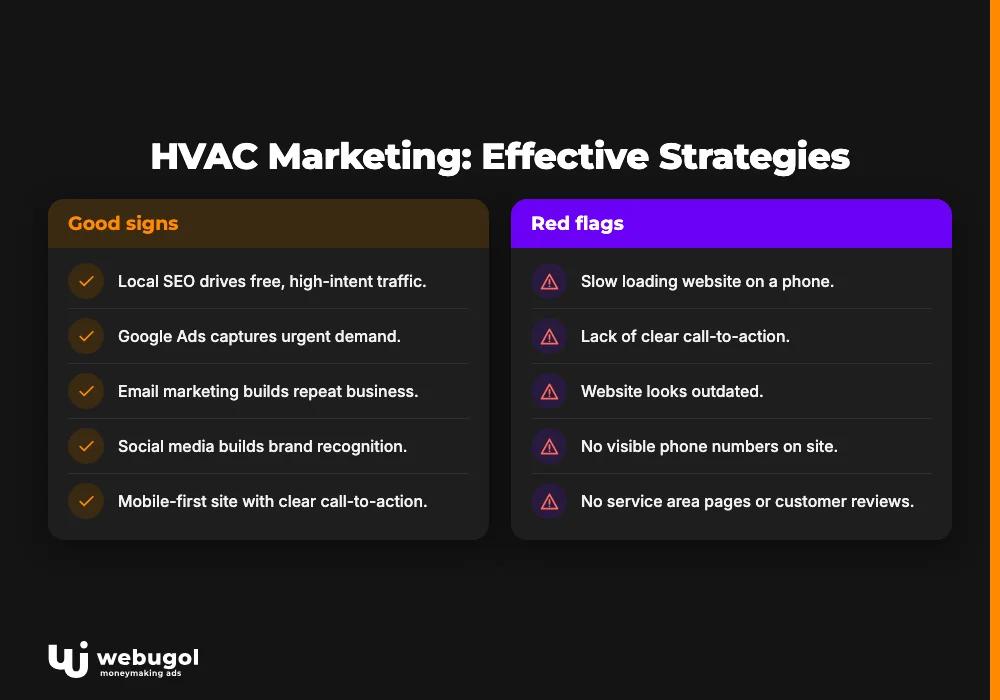
The most effective air conditioning marketing strategies are local SEO, Google Ads, email campaigns, and social media, working together as a system rather than independently. No single tactic keeps a schedule full through every season. The businesses with steady revenue through shoulder months and packed trucks during peak weeks treat HVAC marketing strategy as infrastructure, not campaign-by-campaign spending.
Here is how each channel contributes to overall HVAC lead generation:
- Local SEO and Google Business Profile drive free, high-intent traffic from customers already searching for a service.
- Google Ads and Local Services Ads capture urgent demand before competitors do.
- HVAC email marketing turns one-time service calls into repeat business and referrals.
- Social media builds brand recognition and social proof with homeowners in your service area.
- Retargeting campaigns recover the majority of visitors who leave your site without booking.
- Content marketing (blog posts, FAQs, guides) earns organic rankings for research-phase queries and positions your company as the local expert.
These channels reinforce each other. Paid ads drive traffic to your website, which captures email signups, which feed retention campaigns, which reduce your dependence on expensive paid traffic in future seasons.
Your website: the foundation every channel depends on
Every HVAC digital marketing channel eventually sends a prospect to your website. If that site loads slowly on a phone, lacks a clear call-to-action, or looks outdated compared to competitors, the marketing spend that drove the visit is wasted. A mobile-first site with visible phone numbers, service area pages, and customer reviews is the floor the entire strategy stands on.
Practical improvements that move the needle for air conditioning marketing conversions:
- A site that responds quickly on mobile and loads within the user's attention window (many HVAC customers search from their phones while dealing with an active problem).
- A primary CTA ("Request a quote" or "Book a service") visible without scrolling on every key page.
- Dedicated service pages for installation, repair, maintenance, and indoor air quality, each with locally targeted content.
- Customer testimonials and review counts displayed near booking prompts.
- Clear service area coverage so both search engines and visitors know exactly where you operate.
The goal is a site that works as a 24/7 sales function, converting visitors and capturing leads when your team is out on jobs. Without a converting website, any air conditioning marketing investment leaks leads at every stage.
HVAC local SEO: get found by nearby customers
HVAC local SEO determines whether your business appears when someone nearby searches "air conditioning repair" or "HVAC company near me." Google Business Profile is the highest-leverage local asset: a fully optimized profile with current hours, service categories, photos, and consistent responses to customer reviews outperforms competitors who ignore it.
Local search rankings depend on proximity, relevance, and trust signals, so consistency in how your name, address, and phone number appear across directories matters more than most owners expect.
A practical HVAC local SEO checklist:
- Claim and fully complete your Google Business Profile, including service areas and Q&A sections.
- Keep your NAP (name, address, phone number) identical across Google, Yelp, Angi, HomeAdvisor, and industry directories.
- Use locally-targeted keywords in title tags, meta descriptions, and H1 headings, for example "air conditioning repair in [City]."
- Ask every satisfied customer for a Google review while still on-site or immediately after completing the job.
- Publish service-area landing pages for each major city or zip code you cover.
- Build citations from local chambers of commerce, neighborhood associations, and community sites.
Consistent NAP data, strong review volume, and service-specific landing pages compound over time. Local SEO builds more slowly than paid ads, but the leads it produces cost far less per booked job once it reaches full momentum.
Content marketing that builds authority before the sale
Homeowners making a decision about replacing a central air system do research first. Blog posts and FAQ pages that answer questions like "how long does an AC unit last" or "signs my HVAC system needs replacing" pull in that research traffic organically. The business that answers these questions owns the relationship before a competitor has even been considered.
Real case studies and customer testimonials work the same way in a different form. When a prospect reads how you resolved a persistent cooling problem for a homeowner like them, the authority gap closes. Content here is proof: it makes your ads and reviews more believable because there is substance behind them.
How to get more leads for an HVAC company?
The fastest path to more HVAC leads combines Google Ads for immediate visibility with Local Services Ads for high-trust discovery and email campaigns for repeat business from your existing customer base. Each has a different time horizon: paid ads produce results in days, local SEO builds over months, and email compounds quietly across years.
Google Ads and local service ads
The paid component of air conditioning marketing is where most companies see the fastest results. Google Ads campaigns built around high-intent searches ("emergency AC repair," "HVAC tune-up near me") put your company in front of customers at the moment they are ready to call. Call-only ad formats work especially well for HVAC lead generation because a customer with a broken AC unit wants to dial, not browse a landing page.
Google Local Services Ads (LSAs) operate differently from standard pay-per-click. You pay per lead rather than per click, and the "Google Guaranteed" badge addresses contractor reliability concerns at the moment of search. For companies structuring paid search for HVAC companies, LSAs and call-only campaigns often run in tandem during peak summer months when urgency is highest.
Track cost per acquisition rather than click-through rate. Know what you pay for each booked job. That number tells you which campaigns to scale and which to cut before they drain your budget.
HVAC email marketing: turn one-time calls into repeat business
Email marketing is the most cost-effective way to generate repeat revenue from customers who already know and trust you. Build a list from every service call, then send consistent, useful communication that keeps your company top-of-mind between visits.
The most effective email campaigns for home service providers follow these patterns:
- Maintenance reminders: a spring message about A/C tune-ups and a fall message about furnace inspections generate a predictable surge of inbound calls each season.
- Personalized follow-ups based on service history: if a customer had a repair two years ago, a targeted message about system age and replacement options is relevant, not spam.
- Seasonal promotions: time-limited offers on specific services create urgency without sounding desperate.
- Educational tips: short messages about filter replacement schedules, thermostat settings, and when to call a technician build trust and reduce hesitation between visits.
- Post-job thank-you messages with review requests: a simple note asking for a review and offering a referral incentive generates two compounding results at once.
Generic mass emails underperform segmented campaigns tied to service history, equipment type, or geography. That gap is where most HVAC companies leave retention revenue on the table.
Retargeting: recover visitors who didn't book
Most visitors who land on your site do not convert on the first visit. That is normal for any service business. Retargeting campaigns show relevant ads to those visitors across other sites and social platforms, keeping your business visible until they are ready to book.
The most effective retargeting creative leads with a specific offer (a maintenance check at a fixed price, for example) rather than a generic brand reminder. A concrete reason to click back outperforms brand exposure alone.

What social media platforms work best for HVAC companies?
Facebook is the most effective social platform for HVAC companies targeting homeowners, followed by Instagram for visual job content and LinkedIn for reaching commercial clients. Not every platform deserves equal investment. Spreading effort thin produces weak results everywhere.
Facebook allows for hyper-local geographic targeting and is the best platform for neighborhood-level promotional campaigns, before-and-after job photos, and seasonal offers to your existing audience. Facebook business pages also support customer review collection, adding to your overall trust signal profile.
Instagram works well for before-and-after installation photos, short videos of your team on the job, and time-lapse content showing a full installation day. This content signals quality and professionalism to homeowners who have never seen inside a mechanical room or attic space.
LinkedIn is worth attention if your revenue mix includes commercial contracts. Property managers, facilities directors, and commercial real estate operators use LinkedIn professionally. A consistent presence that speaks to multi-unit efficiency upgrades and long-term maintenance agreements positions your company differently than a residential-only competitor.
The honest limitation: social media is a brand-building and trust channel for HVAC companies, not typically a direct-response lead machine. Use HVAC social media tips to build presence and credibility, then let paid search and LSAs close the leads. Together, the effect is greater than either channel alone.
HVAC advertising ideas for social media that actually perform:
- Short video testimonials from satisfied customers filmed immediately after a job.
- Behind-the-scenes content showing your team's training process, truck organization, or quality-check routine.
- Seasonal content tied to real weather events in your service area.
- Local community involvement posts (sponsoring youth sports, supporting neighborhood events).
- Q&A sessions answering common AC problems homeowners can diagnose themselves.

How much should an HVAC company spend on marketing?
Allocate the most to paid search and LSAs, which deliver immediate, measurable results, and a steady portion to SEO and email marketing, which compound over time. The exact amount depends on market competition and growth targets. The right allocation matters more than the total spend.
A practical breakdown by function:
- Paid search and LSAs get the largest share, since they produce the fastest and most attributable results.
- SEO and content receive a consistent portion to build organic rankings that lower cost per lead over time.
- Email marketing and CRM automation receive a smaller allocation but deliver the highest return on existing customer relationships.
- Social media and retargeting receive the remaining portion for brand building and visitor recovery.
Businesses that plateau on referrals often find the problem is not budget size but allocation. All spending in one channel (typically a single ad campaign with no retention system) produces results that stop when the campaign stops. A system that builds owned traffic through SEO and email while using paid ads for peak demand sustains growth without depending on any single platform.
Your air conditioning marketing budget should match spend to customer intent and time horizon, not to what is easiest to track. The allocation principles here are nearly identical to those for plumbing and other home service businesses: seasonal demand, trust-sensitive customers, and the same need to balance immediate lead generation with long-term brand equity.
Build a marketing system that keeps your trucks running
Scattered campaigns will fill gaps but won't build a business. HVAC companies that consistently dominate their local market treat air conditioning marketing as a connected system: search visibility feeds the site, the site converts to calls, email retains customers, and paid ads close the gap during peak season.
Webugol builds and grows websites for home services companies, combining development with a full-funnel marketing system so your site captures demand instead of leaking it. If you have no clear picture of cost per booked job, Webugol's growth programs for home services can close that gap.
FAQ
How to market an air conditioning business?
Start with a fast, mobile-optimized website and a fully completed Google Business Profile. Add Google Ads for immediate lead flow and an email system to retain existing customers. Local SEO compounds over time and reduces cost per lead as rankings improve.
What are the best HVAC marketing strategies?
The core of any air conditioning marketing strategy combines local SEO, Google Ads and Local Services Ads, targeted email campaigns, and social media for brand recognition. Each channel addresses a different stage of the customer journey, from first-search discovery to post-service retention.
How to get more leads for an HVAC company?
Google Local Services Ads produce leads quickly because the "Google Guaranteed" badge addresses contractor reliability concerns at the point of search. Pair LSAs with an email system that follows up after every service call, and add retargeting campaigns to recover visitors who leave your site without booking.
How much should an HVAC company spend on marketing?
Allocate the most to paid search and LSAs for immediate results, and maintain steady investment in SEO and email marketing for long-term owned channels. The right allocation matters more than the total budget; a balanced system outperforms a single over-funded channel.
What social media platforms work best for HVAC companies?
Facebook is the most effective platform for reaching homeowners with local promotions and trust-building content. Instagram works well for visual job documentation. LinkedIn is worth the investment only if your company pursues commercial contracts.

