



Health and wellness marketing strategies to retain clients
The most effective health and wellness marketing strategies combine authority-building content, deliberate channel selection, and retention programs that run without constant manual effort. Done right, they move clients from first contact to long-term loyalty. The backend is usually where growth stalls. Most wellness operators have some acquisition system in place, but fewer have a retention program designed to outlast a new client's initial enthusiasm.
The same structural gap appears at every stage. A solo wellness coach struggling to fill a calendar and a telehealth operator with five-figure monthly ad spend face the same core issue: leads entering a funnel that was never designed end-to-end. What keeps a small studio from growing is the same structural weakness that caps an established clinic at its current plateau.
What are the most effective health and wellness marketing strategies?
Five approaches consistently move revenue: organic search, paid media, educational content, influencer partnerships, and lifecycle email and SMS.
None works in isolation. Organic search drives discovery over time. Paid media compresses the timeline to first booking. Content builds authority that lowers conversion friction before any sales conversation starts. Influencers extend reach into audiences that have not yet found your brand. Email and SMS protect clients you already paid to acquire.
The right combination depends on your stage, budget, and compliance constraints.
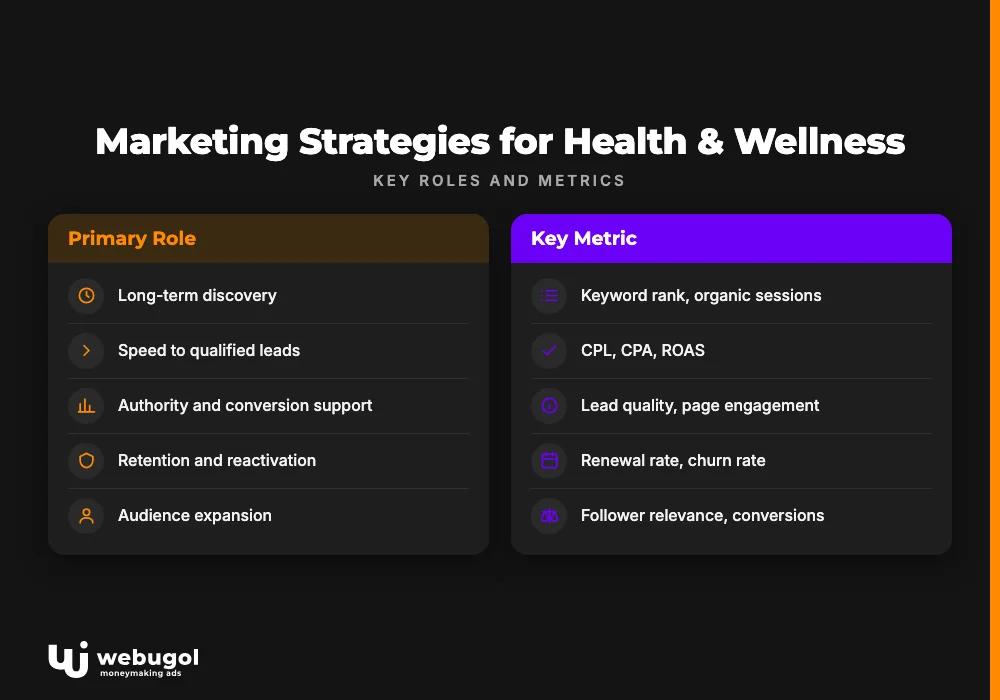
| Strategy | Primary role | Key metric |
|---|---|---|
| Organic search | Long-term discovery | Keyword rank, organic sessions |
| Paid search and social | Speed to qualified leads | CPL, CPA, ROAS |
| Educational content | Authority and conversion support | Lead quality, page engagement |
| Email and SMS | Retention and reactivation | Renewal rate, churn rate |
| Influencer partnerships | Audience expansion | Follower relevance, conversions |
Early-stage brands benefit most from pairing paid search with health and wellness seo, running them in parallel to generate faster learning. At scale, the highest-leverage shift is usually into retention, not more acquisition.
Which digital channels work best for health and wellness brands?
The honest answer: the channel that fits your audience and your compliance setup. Wellness marketing is tighter than most. Google and Meta restrict health condition targeting, require consent-mode implementation, and limit retargeting on specific medical topics. Their platform policies are more restrictive than those in general e-commerce, which affects channel allocation before it affects creative. Selection cannot happen independently of compliance review.
Patterns do hold across fitness marketing channels. Visual platforms like Instagram and TikTok outperform text-heavy formats for fitness and lifestyle brands that can demonstrate client transformation. Search channels capture higher-intent users already looking for a specific solution. For clinic and telehealth operators, healthcare social media marketing produces better compliance outcomes when built around education rather than promotional claims.
Running five channels at half-effort generates noisier data and harder-to-diagnose funnel drop-offs than running three channels with clean tracking. Diversifying across channels is a risk management move, not a growth strategy by itself.
Paid search and organic working together
SEO and paid search reinforce each other when coordinated. PPC data shows which queries convert at acceptable CPAs, giving your SEO effort validated targets rather than keyword guesses. Strong organic rankings improve Quality Score on the same terms, reducing per-click costs. Paid search provides speed. For a new location launch or a seasonal program, it delivers volume before organic rankings are established. The mistake is treating paid as a permanent substitute for organic growth rather than a faster lane to the same destination.
How does content marketing build trust in the wellness industry?
Directly. Consumers choosing health and wellness services make personal, sometimes vulnerable decisions. They need evidence of expertise before they book. A well-structured healthcare content strategy provides that evidence at the moment of research, before anyone picks up the phone.
Effective wellness content follows a consistent pattern:
- Answer the exact question being searched. A post titled "10 ways to improve gut health" earns rankings and converts because it matches search intent precisely. Generic wellness content neither ranks reliably nor builds trust.
- Show outcomes, rather than services. Case studies, before-and-after transformations, and testimonials with specific results give prospective clients a believable picture of what working with you produces.
- Layer in the evidence. Referencing the clinical or scientific basis, without inventing statistics, is more credible than asserting authority without it.
- Use visual formats alongside written content. Infographics and short-form video outperform long-form text on most social platforms for wellness topics. Use them as complements, not replacements.
Healthcare email marketing extends every content asset further. A single article sent to a segmented list at the right lifecycle moment converts far better than the same article waiting passively for search traffic.
The structural risk in wellness content is investing heavily in production while distribution remains under-resourced. Wellness brand building requires consistent, well-distributed content over time. Sporadic high-production pieces rarely move the needle.

What role do influencers play in health and wellness marketing?
Health influencer marketing works because trust transfers. An influencer who has built credibility with a specific audience extends that credibility to endorsed brands, faster than those brands can build it independently. The practical options:
- Long-term ambassadors. Sustained relationships outperform one-off sponsored posts. Audiences recognize returning ambassadors, and attribution to your brand strengthens over time.
- Authentic reviews. Video walkthroughs and testimonials reduce purchase friction by showing what working with you actually looks like.
- Affiliate programs. Unique referral links make performance measurable. Influencers who know their conversions are tracked tend to position offers more deliberately.
Follower count is a weak selection metric for wellness brands. Audience relevance, engagement rate, and alignment with the values your compliance approver can support matter more. A smaller influencer with highly engaged followers in the right health niche typically outperforms a lifestyle macro-influencer with a larger but less relevant audience.

How do wellness businesses retain long-term clients?
By measuring renewal first, then acting on what the data shows. Most wellness operators can report cost per new client. Few can report renewal rate, average client tenure, or the share of monthly revenue coming from returning versus new clients.
Fixing it starts with measurement. Without a renewal rate in your dashboard, you do not have a retention program. You have a hope.
Practical wellness client retention mechanics:
- Lifecycle email and SMS sequences. Automated flows triggered by appointment gaps, behavior signals, and renewal windows keep clients engaged without manual effort. These are not broadcast newsletters; they are personalized sequences based on what a client actually did.
- Community infrastructure. Forums, app-based groups, and in-person events make switching brands socially costly. The goal is connection, not content volume.
- Win-back campaigns. Dormant clients who already know your brand convert at a fraction of the cost of new acquisitions. A re-engagement sequence targeting lapsed clients is one of the highest-ROI moves in digital health marketing.
- Outcome documentation. Clients who can track their own progress are less likely to cancel during plateaus. Building measurement into the service creates retention leverage without requiring discounts.
The common miss: raising ad spend to compensate for churn rather than fixing the churn directly. Acquisition budget spent covering a retention leak is the most expensive channel waste in wellness marketing.
Build a system that holds
Health and wellness marketing strategies that produce predictable growth share one trait: they are designed as an integrated system, not a collection of loosely connected tactics. Acquisition, conversion, and retention run as connected stages, with shared measurement and clear handoffs between them.
If your current marketing looks like a list of activities without a clear line to revenue, Webugol builds the tracking-first acquisition system that makes that line visible. The healthcare growth system is a 90-day sprint for US health and wellness operators: strategy, funnel, tracking, and campaign execution as one integrated program. Book a strategy call.
FAQ
What are the most effective health and wellness marketing strategies?
The most effective combination is organic search paired with paid media for acquisition, educational content for trust-building, and email and SMS for retention. The right mix depends on your stage, compliance constraints, and what you can actually measure. Attribution clarity matters as much as channel selection.
How do wellness businesses retain long-term clients?
Retention starts with measuring it. Businesses that track renewal rate, client tenure, and the revenue split between new and returning clients have the data to act. Practical mechanics include lifecycle email sequences, community channels, and re-engagement campaigns for dormant clients.
Which digital channels work best for health and wellness brands?
Search channels capture high-intent users already looking for a specific solution. Visual platforms like Instagram and TikTok work for fitness and lifestyle brands that can demonstrate client transformation. Compliance constraints on health condition targeting and retargeting should shape channel selection before budget allocation.
How does content marketing build trust in the wellness industry?
Content builds trust by demonstrating expertise at the moment of research, before any sales conversation starts. Specific, outcome-focused content that answers the exact question being searched converts better than generic wellness content. Client case studies with concrete results are more persuasive than general authority claims without evidence.
What role do influencers play in health and wellness marketing?
Influencers transfer existing audience trust to brands faster than organic brand building allows. For wellness operators, long-term ambassador relationships and affiliate programs with tracked referral links produce more measurable results than one-off sponsored posts. Audience relevance and engagement rate are more reliable selection criteria than follower count.