



Aromatherapy marketing: proven strategies to boost sales
Aromatherapy marketing connects essential oil brands with buyers actively seeking natural wellness solutions. The strategies that work, brand clarity, search-optimized content, and retention-focused channels, are the same ones that separate growing wellness businesses from those stuck at a revenue plateau. The structural gaps that stall an essential oil brand at launch are identical to the gaps that prevent a scaling wellness business from pushing past its first growth ceiling: unclear positioning, disconnected channels, and no reliable measure of what is actually driving purchases.
The aromatherapy market: who buys and what they want
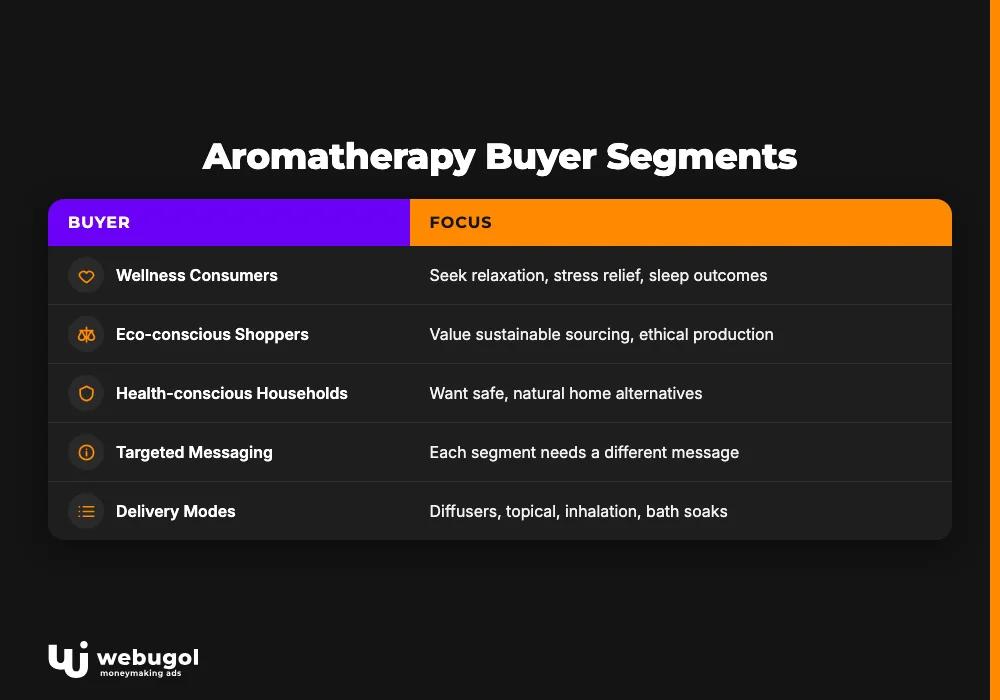
Consumer demand for aromatherapy products has grown steadily as buyers shift toward natural health and self-care routines. Industry forecasts point to continued expansion. Three distinct buyer groups drive this demand.
| Buyer segment | Primary motivation | What converts them |
|---|---|---|
| Wellness-focused consumers | Relaxation, stress relief, sleep | Outcome-led messaging, calming brand voice |
| Eco-conscious shoppers | Sustainable sourcing, ethical production | Certifications, origin stories, packaging claims |
| Health-conscious households | Safe, natural alternatives at home | Usage guides, educational content, trust signals |
Each segment needs a different message. Eco-conscious buyers want provenance. Wellness-focused buyers want outcomes. Health-conscious households want safety reassurance. Reaching all three with the same copy is how brands end up saying nothing memorable.
Aromatherapy products reach customers through diffusers, topical application, direct inhalation, and bath soaks. Each delivery mode attracts slightly different buyers and supports different product bundles and educational content.
What makes an aromatherapy brand stand out?
An aromatherapy brand stands out when it leads with a specific outcome the buyer already wants rather than listing ingredients or making broad wellness claims. Lavender for sleep, citrus for focus, sandalwood for tension relief: outcomes come before ingredients in every effective brand message.
Natural wellness branding that builds trust
Trust is the main purchase barrier in this category. Buyers cannot evaluate scent, purity, or sourcing before they buy. Your brand must substitute for that physical proof. Natural wellness branding elements that convert skeptical buyers:
- List the sourcing region and extraction method for each key ingredient directly on the product page.
- Publish third-party testing results or certifications to verify quality claims rather than asserting them.
- Provide usage guides that show how to apply each product and what to expect from consistent use.
- Keep visual language consistent across every channel, from packaging to email templates to social posts.
Generic claims like "100% natural" and "pure" are table stakes. The brand that specifies "cold-pressed Bulgarian lavender, independently tested" gives buyers something concrete to trust and repeat to others.
Brand storytelling that earns loyalty
Effective aromatherapy marketing in the brand storytelling layer puts the buyer at the center. What problem did they have before they found your product? What changed? Customer stories built around that before-and-after arc outperform founder-centric content because buyers evaluate products through the lens of someone like themselves.
Be specific about what you chose not to do: synthetic fragrance carriers you avoided, shortcuts you ruled out, why a formulation took longer than expected. That specificity builds credibility that broad quality claims cannot.
How to market an aromatherapy business?
Effective aromatherapy marketing runs on three layers: organic search visibility to attract qualified buyers, educational content that moves people from awareness to purchase, and direct channels that bring buyers back. No single channel sustains growth on its own.
Content marketing for aromatherapy sales growth
A content strategy built around health and wellness seo compounds over time in ways paid channels cannot. Blog posts that answer real buyer questions, how to use a diffuser for better sleep, which oils support focus, how to build a bath soak routine, attract organic traffic and build topical authority that takes time to replicate.
Video on product pages fills the gap text cannot. It shows scent delivery in action, demonstrates use context, and creates the sensory impression descriptions cannot replicate. Short product demonstrations consistently convert browsers at a higher rate than benefits copy alone.
Essential oil business tips for email
Email is one of the most cost-efficient aromatherapy marketing channels for essential oil brands that want to retain customers without depending entirely on paid acquisition. The first sale is expensive. The second is where margin lives. A structured email program covers:
- A welcome sequence that teaches the buyer how to get the most from their first purchase.
- Usage tips tied to seasonal goals, such as sleep routines in autumn or focus blends before busy periods.
- Replenishment triggers based on average consumption time for core SKUs.
- Loyalty mechanics that reward consistent buyers with early access or exclusive bundle pricing.
Healthcare email marketing covers the lifecycle and segmentation logic that applies directly to wellness brands building retention programs.
What social media platforms work best for aromatherapy brands?
Instagram and Pinterest deliver the most consistent aromatherapy marketing results for essential oil brands. Both are visual-first. Buyers on these platforms search actively for wellness product recommendations, which makes them a natural fit for brands in this category.
Instagram works for community building through short video, stories, and user-generated posts. Pinterest drives longer-tail discovery; an optimized pin on "essential oils for sleep" can generate consistent traffic for years without ongoing ad spend. TikTok has a growing wellness audience but converts better through creator partnerships than through a brand's own organic output.
For a full look at social strategy in health and wellness categories, healthcare social media marketing covers platform selection and content formats at channel depth.
Wellness product advertising on Meta extends reach through interest-based and behavioral targeting against buyers who have already engaged with similar products. Lookalike audiences built from a customer email list typically outperform cold interest targeting after a few thousand purchase events.
How to increase essential oil sales online?
The highest-leverage moves for essential oils promotion online are product page quality, search visibility, and repeat purchase mechanics. Each requires deliberate attention.
Product listings: Lead with the outcome, not the ingredient. "Supports restful sleep" precedes "contains lavender and cedarwood." Use the first product image to show the item in actual use rather than floating on a white background. Customer reviews that include specific use cases convert at a higher rate than star ratings alone.
Search visibility: Promote wellness products through optimized titles, descriptions, and category pages built around actual buyer search queries. Titles that include the buyer's desired result alongside the product name outperform feature-led titles consistently.
Repeat purchase mechanics: Subscription options, replenishment bundles, and loyalty points reduce churn. Essential oil buyers are habitual by nature. The product usage creates routines. Wellness brand strategy here should treat the first purchase as acquisition cost and the second as the beginning of margin.
Grow your aromatherapy brand with a system behind it
The aromatherapy marketing strategies that work at the brand-building stage break under scale when the systems holding them together are ad hoc: attribution that guesses, channels that do not connect, email programs that send without converting. Those gaps cost more as revenue grows.
Webugol builds acquisition and retention systems for wellness businesses that need to grow predictably. If your essential oil business is past early validation and ready to build the infrastructure behind the brand, the healthcare growth system is where that conversation starts. Book a strategy call.
FAQ
How to market an aromatherapy business?
Build your aromatherapy marketing around buyer outcomes rather than product features: name the specific problem each product solves and for which buyer segment. Combine search-optimized content with direct channels like email and social to capture and retain buyers across the full decision process.
What social media platforms work best for aromatherapy brands?
Instagram and Pinterest drive the most consistent results because both attract buyers in active discovery mode for wellness products. TikTok is worth testing for brands that can commit to consistent short-form video or creator partnerships.
How to attract customers to a wellness brand?
Lead with specific outcomes rather than ingredient lists or category claims. Transparency about sourcing, production choices, and third-party testing builds the trust that converts first-time browsers into buyers.
How to increase essential oil sales online?
Rewrite product listings to lead with the buyer's desired outcome, build search content that answers questions at each decision stage, and add replenishment mechanics like subscriptions or bundle pricing to lift repeat purchase rates.
What makes an aromatherapy brand stand out?
Specificity stands out in a category full of generic wellness claims. A brand that names its sourcing region, explains its production choices, and shows real customer results gives buyers something concrete to trust and share.

