



Ophthalmology marketing: a strategy guide for eye care practices
Ophthalmology marketing is the digital system that fills your schedule, lowers your cost per new patient, and makes your practice the default choice when someone nearby searches for an eye doctor. It runs on four channels: local SEO, paid search, social media, and content. When those channels share a tracking layer, you stop guessing which channel is worth its budget.
That gap between individual tactics and a connected acquisition system is not a beginner's problem. It is the same structural weakness that stalls established eye care groups at a revenue plateau after their first years of strong growth. Scattered touchpoints with no connected attribution produce unpredictable revenue at any scale.
How to market an ophthalmology practice?
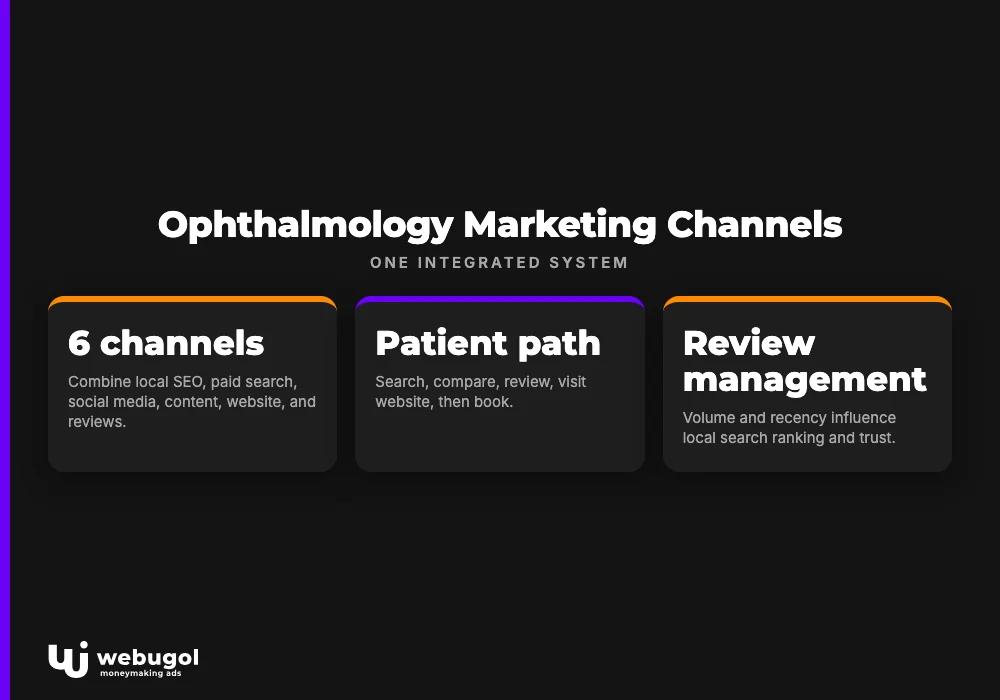
Market an ophthalmology practice by combining local SEO, paid search, social media, and content marketing through a system that connects each channel back to actual booked appointments. The patient's path is: search, compare, review, visit your website, book. Each step needs deliberate design.
The channels that move patients through that path most reliably are:
- Local SEO: capture nearby "eye doctor near me" and procedure-specific searches before a competitor does
- Google Ads for ophthalmologists: buy placement for high-intent queries like cataract surgery, dry eye treatment, or LASIK consultations while your organic presence grows
- Eye doctor online presence: build a fast, mobile-responsive website with clear service pages, provider bios, and frictionless online booking
- Social media for the eye clinic: build familiarity, convert referral traffic, and handle patient questions without delay
- Content marketing: answer the questions patients search for and build organic authority across eye-health topics over time
- Review management: generate a consistent flow of recent reviews, since volume and recency both influence local search ranking and trust at the decision point
Ophthalmology marketing that scales treats these channels as one system, not six separate projects. The practice running excellent Google Ads while ignoring email retention is spending to acquire patients it then fails to keep. The practice building content while running unchecked broad-match campaigns is growing organic authority at a loss. Each channel amplifies or undermines the others. The practices that scale fastest treat ophthalmology marketing as infrastructure, not a line item to toggle when schedules look thin.
No channel in this list works well alone. A patient who finds you through Google will typically check your reviews, visit your website, and scroll your social feed before deciding to book. If your tracking ends at the ad click, that entire path is invisible.
The most common ophthalmology marketing mistake is investing in channels before connecting them to downstream booking outcomes. That is a system design problem.
What digital marketing strategies work for eye clinics?
The eye clinic digital strategy that produces measurable patient growth has three core layers: strong local search visibility, a website that converts visitors into booked appointments, and paid campaigns targeted precisely enough to bring in patients who actually show up and pay.
Your website is the first real impression most patients form of your practice. It should load quickly on mobile, present your services clearly, introduce your team with professional bios, answer common questions in a FAQ section, and let patients book online. Friction at any of those points loses appointments you already paid to attract.
For search visibility, every page targeting a specific service or location needs geo-targeted keywords in titles, meta descriptions, and body text. Write naturally about ophthalmology care in your city and embed location-relevant terms where they read as genuine information rather than keyword insertion.
What is local SEO for eye doctors?
Local SEO for eye doctors is the practice of making your clinic appear in the Google Map Pack and local organic results when patients in your area search for eye care. It captures people who have already decided they need care and are comparing local providers. That makes it the highest-leverage channel for most ophthalmology practices.
The foundation is a complete, accurate Google Business Profile: correct address and phone number, up-to-date hours, your full service list, and recent photos of your facility and team. Consistent name, address, and phone information across every directory listing reinforces location authority with Google.
Listing your practice consistently across health-specific and general online directories alongside your Google Business Profile establishes the cross-platform consistency that search engines use to verify location legitimacy. Gaps or inconsistencies across those profiles subtract trust and can suppress your Map Pack visibility.
Patient reviews are both a local ranking signal and a conversion factor. Practices that actively ask satisfied patients to leave a review consistently outrank those that do not. The review volume gap between a practice managing this deliberately and one that is not tends to widen month over month.
For a thorough breakdown of how to structure your local search presence across directories and your Business Profile, the complete guide to building local patient visibility for eye care practices covers the technical and strategic layers in full.
Google Ads for ophthalmologists
Paid search puts your practice at the top of results for the specific procedures patients are searching for right now. Ophthalmology has natural keyword clusters: cataract surgery, LASIK consultations, dry eye treatment, and pediatric eye exams. Each carries different search intent and different cost-per-click economics.
The most common failure mode is running broad campaigns without tight geographic targeting, then blaming the channel when call quality is low. Health-related advertising on Google carries policy constraints. Claims about treatment outcomes, before-and-after framing, and references to certain medical conditions require review against Google's healthcare advertising policies before launch.
Campaigns that convert at a defensible cost per booking require discipline: strong negative keyword lists, tested ad copy, and landing pages that match the specific query rather than routing all traffic to the homepage. Paid search is one of the most direct levers in ophthalmology marketing when it is structured around procedure-specific intent rather than broad brand visibility.
How to get more patients as an ophthalmologist?
The most reliable path to more patients is being findable in local search, credible through reviews, and easy to book online. The tactics that move the needle most are local search visibility, a consistent flow of patient reviews, and a booking flow that removes every unnecessary step between finding your practice and scheduling an appointment.
Getting all of those right simultaneously is what separates a practice that grows predictably from one that fluctuates with ad spend. Effective ophthalmology marketing requires all three working in sequence: visibility that brings patients to the door, credibility that earns their trust, and a booking flow that converts both.
Social media eye clinic: an ophthalmology marketing channel for elective care
Social media works differently in ophthalmology than in many other healthcare verticals. A large share of eye care decisions are elective or semi-elective: LASIK, premium intraocular lenses, dry eye management, and specialty contact fittings. Patients research those procedures extensively before committing. It is not a vanity channel; it is where the selection process happens informally.
Content types that build trust on social platforms for eye clinics include educational posts about conditions like glaucoma or macular degeneration, patient success stories shared with appropriate consent, behind-the-scenes views of your facility and team, and plain-language explanations of procedures patients find intimidating.
Live Q&A sessions on Instagram or Facebook let prospective patients ask questions they might feel embarrassed raising in a clinical setting. A doctor answering directly builds more credibility than any promotional post.
Paid social through Meta campaigns works for ophthalmology when targeting is tight by geography and life stage. Retargeting visitors who viewed your LASIK or cataract pages but did not book is one of the more efficient uses of social ad spend. That setup requires HIPAA-compatible tracking and a compliant consent flow, a step many practices skip.
Understanding how patient decisions are shaped by social media content in healthcare is a useful foundation before you allocate social budget. The social media eye clinic mix that performs tends to be heavier on education and social proof than on direct promotional content, roughly the ratio at which trust builds without the feed starting to look like advertising.
Ophthalmology marketing through content and email
Content marketing for ophthalmology means publishing educational material that answers real patient questions: when to schedule a comprehensive exam, what to expect from cataract surgery, how to manage digital eye strain, or which symptoms need urgent attention. That content builds organic search authority, signals expertise to search engines, and keeps your practice visible between active patient visits.
Email is one of the most underused channels in eye care and tends to deliver strong return once it is set up properly. Annual exam recall reminders, post-procedure follow-up sequences, and reactivation campaigns for dormant patients all bring revenue back without additional acquisition cost.
The difference between a practice with no email program and one with a structured email approach for retaining and reactivating eye care patients tends to show up clearly in year-over-year retention numbers.

How much should an ophthalmology practice spend on marketing?
Most ophthalmology practices in competitive markets allocate budget across two layers: Google Ads for immediate, procedure-specific patient acquisition and SEO plus content for compounding organic growth. The specific split depends on how saturated your local market is and how mature your current organic presence is.
A common pattern is running Google Ads continuously for high-intent searches while building local SEO and content on a 6- to 12-month horizon. Paid search protects near-term appointment volume. Organic growth reduces dependence on ad spend over time. That balance shifts as organic channels mature and start generating reliable inbound volume, at which point paid budgets can move toward higher-margin procedure campaigns. Patient acquisition eye care practices achieve this balance fastest when paid and organic performance data are reported through the same attribution layer.
The budget question most practices struggle with is not the total amount. It is knowing what each channel is contributing. If your reporting shows clicks and impressions but not booked appointments by channel, you are funding channels based on belief rather than data. No budget adjustment solves that problem without fixing the tracking first.

Why ophthalmology marketing stalls without end-to-end measurement
Most ophthalmology practices have marketing data. Few have marketing clarity. The symptoms are recognizable: ad spend goes up and results do not follow; one month is strong, the next is flat, and nobody can explain what changed; the ad platform, website analytics, and practice management system all show different numbers for the same period.
The root cause is almost always the same. Tracking was configured at launch and was never audited after. It no longer reflects how patients actually move from first search to booked appointment.
Offline conversion events, calls, form submissions, and booked appointments never got connected to the ad platform data. The platform then optimizes toward the clicks it can see, not the patients who actually showed up.
A properly configured ophthalmology marketing stack connects your booking system to your ad accounts, routes call conversions back to the specific campaign and keyword that generated them, and answers one question cleanly: which channel drove which appointments at what cost. That is the minimum standard for defensible marketing decisions at any budget level.
A few diagnostic questions reveal the gap quickly. Does your Google Ads account receive conversion data from your booking system? Do call conversions feed back into your campaigns? Can you separate new patient appointments from follow-up visits in your attribution reports? A no on any of those means your campaigns are optimizing on partial information.
Fixing the tracking layer is what changes ophthalmology marketing from a cost center into a system with predictable output. It is the prerequisite for scaling anything else with confidence.
Ready to build a patient acquisition system that scales?
Webugol's healthcare growth program is built on exactly this model: tracking foundation first, then conversion-led campaigns, then scaling what the data proves. The Healthcare Growth System covers the full 90-day path from diagnostic audit to running campaigns to patient retention automation for US ophthalmology and eye care practices.
If your practice is hitting a growth plateau, spending on marketing without clarity on which channels drive revenue, or ready to build an acquisition system designed to scale, a strategy call is the right starting point. Book through the Healthcare Growth System page for a clear look at where your current patient acquisition path is leaking.
FAQ
What is ophthalmology marketing?
Ophthalmology marketing is the set of digital strategies used to attract new patients, retain existing ones, and build a practice's reputation in local search and social media. It includes local SEO, paid search, social media, content marketing, and email programs working together toward measurable patient acquisition goals.
How do eye clinics attract new patients through digital marketing?
The highest-leverage actions are claiming and optimizing your Google Business Profile, running Google Ads for cataract, LASIK, and dry eye keywords in your market, and actively collecting patient reviews after positive appointments. Each of those directly influences how many people find your practice and decide to book.
What is local SEO for eye doctors?
Local SEO for eye doctors is the process of making your practice appear in the Google Map Pack and local organic results when nearby patients search for eye care. It depends on a complete Google Business Profile, consistent directory listings, and an ongoing flow of patient reviews, all of which signal trust and location relevance to search engines.
How much should an ophthalmology practice spend on digital marketing?
There is no single correct number, but most practices in competitive markets allocate meaningful budget to both Google Ads for procedure-specific intent and ongoing SEO investment. Without end-to-end attribution from ad click to booked appointment, budget decisions are guesses regardless of how much is spent.
What digital marketing strategies work best for ophthalmology practices?
Local SEO combined with Google Ads for procedure-specific searches consistently produces the highest-intent patient traffic for eye clinics. Social media and content marketing support the decision process for elective procedures and build trust that makes paid campaigns more efficient over time.