



Healthcare local SEO: the complete guide for medical practices
Healthcare local SEO is the process of optimizing a medical practice's online presence so nearby patients find it first in search results. It combines Google Business Profile management, NAP consistency, and location-specific signals to connect providers with patients actively searching for care. Unlike broad SEO, the focus is geographic. Practices that get it right capture high-intent patients before competitors even appear on screen.
This guide covers what separates healthcare local SEO from general SEO tactics, why local visibility determines which clinics grow, and the specific strategies that move a practice into the local map pack.
What is local SEO for healthcare providers?
Local SEO for healthcare is a targeted optimization approach focused on geographic relevance rather than broad national rankings. General SEO reaches anyone searching a topic. Healthcare local SEO narrows that focus to patients within the clinic's actual service area.
Google's local ranking algorithm weighs three confirmed signals to determine which practices appear in the map pack:
| Ranking signal | What Google evaluates |
|---|---|
| Proximity | Distance between the searcher and the practice location |
| Relevance | How closely the profile and website match the search query |
| Prominence | Review volume, citation consistency, and backlink authority |
All three signals interact. A practice with strong reviews but an incomplete GMB profile for clinics will still rank below a competitor that addresses all three consistently. Healthcare online visibility depends on the full picture, not any single element.
Why does local SEO matter for healthcare businesses?
Medical practice SEO, when aimed locally, captures patients with the highest intent. Someone searching "urgent care near me" or "pediatrician [city name]" has already decided to seek care. They need a provider to find, not persuasion. Ranking for those queries means capturing demand that already exists.
Local map results sit above organic links on nearly every mobile healthcare search. A practice absent from the map pack is invisible to patients lost to geography. For clinic Google Maps ranking, that top position translates directly to calls, direction requests, and appointment bookings, actions that fill schedules.
Trust dynamics make local visibility especially consequential in healthcare. Patients are choosing who will manage their health, their records, and their most personal health decisions. Local search ranking factors like review recency, profile completeness, and photo quality act as credibility proxies before the first phone call. Patients assess a practice's trustworthiness through what they see in search results, before any direct contact occurs.
Two practices with identical credentials and similar locations will be evaluated through their Google profiles. The practice with a more complete profile, recent reviews, and genuine facility photos wins a disproportionate share of new patient inquiries. That advantage compounds over months and years as the stronger profile accumulates more reviews and engagement signals, pulling further ahead without additional effort.
How to optimize Google My Business for a medical practice?
Google My Business optimization is the most direct lever for improving local rankings. The GMB profile for clinics is the primary record Google uses to populate map results, knowledge panels, and voice search responses. A partially completed or unclaimed profile surrenders ranking potential to competitors who handle the basics.
Claim and verify the profile. An unclaimed listing can be edited by anyone, creating inaccurate information that damages both ranking and patient trust simultaneously.
Select categories with specificity. Category choice determines which patient searches trigger the profile. A dental practice should select "Pediatric Dentistry" or "Cosmetic Dentistry" if those reflect actual services, rather than defaulting to a generic "Dentist" label. A specialist clinic should align with "Orthopedics" or "Cardiology" — or with the specialty-specific category for TRT and testosterone practices — rather than the catch-all "Medical Clinic." Generic categories dilute relevance for the searches that generate appointments.
List services explicitly. Google uses the services section to match profiles against specific search queries. A practice listing "sports physicals," "telehealth visits," and "chronic disease management" as discrete services appears in results for each of those searches separately.
Add genuine photos of the facility. Stock images reduce trust; real photos of the waiting area, exam rooms, and clinical staff give prospective patients a sense of what to expect and reduce pre-visit anxiety. All images should be optimized for fast loading before upload to avoid performance penalties.
Update the profile consistently. New providers joining the practice, adjusted hours, and additional services should all appear in the profile promptly. Google rewards active profiles. An outdated profile suppresses rankings and misleads patients who rely on it for scheduling decisions.

What local SEO strategies work best for clinics?
Effective healthcare local SEO extends well beyond the Google Business Profile. The profile is the anchor, but durable local authority requires NAP consistency across the web, a systematic review management process, and an accurate presence in medical directories. Practices that treat these as separate tasks rather than a unified digital marketing strategy tend to underperform against competitors who manage all three together. The map pack rewards coherence: a profile that says one thing, directories that say another, and reviews that trickle in sporadically will not outrank a competitor who executes each element with discipline.
How to improve NAP consistency for medical practices?
NAP consistency means every platform listing the practice shows the exact same name, address, and phone number. This applies to the Google Business Profile, healthcare directories, social media pages, local landing pages, and the practice website.
Inconsistent NAP is one of the most common errors in local search. Two listings for the same practice, one reading "Riverside Medical Group" and another reading "Riverside Medical Group, LLC," represent two different entities to Google. Citation authority fragments between them, and both listings underperform as a result.
Multi-location practices or those that have recently moved face an amplified version of this problem. Each location needs its own consistent NAP across every platform. The audit process is direct: search the practice name and primary phone number to surface every listing that exists, document each variation, and correct them to match the official website exactly. Repeat this process quarterly and immediately after any contact information or address change.
Accurate NAP benefits patients directly, too. Wrong hours lead to patients arriving when the office is closed. Outdated phone numbers mean missed calls from people who are ready to book.
Managing patient reviews to strengthen local ranking
Review signals are a confirmed factor in local search ranking. Quantity, quality, and recency each influence map pack position. A practice with higher review volume and more recent submissions will typically outrank a competitor with a small set of older reviews, because volume and recency signal active, ongoing patient engagement more reliably than a sparse perfect score.
Request reviews consistently. A post-visit follow-up email is one practical approach: acknowledge the visit, express appreciation for choosing the practice, and include a direct link to the review page. Prompts can also appear in after-care instructions or on the appointment confirmation page of the practice website.
Responding to reviews matters as much as collecting them. Responding to positive feedback signals attentiveness. Addressing negative reviews professionally, without disclosing any patient information, demonstrates a commitment to improvement. A thoughtful response to criticism becomes evidence of accountability rather than a reputational liability.
Healthcare providers must handle review responses carefully under privacy regulations. Never confirm whether the reviewer was a patient or reference any health details in a public reply. Keep responses empathetic and general enough to protect patient confidentiality in every case.
Building local directory authority
Medical directory listings extend citation coverage beyond Google. Accurate entries in specialty-specific and geography-specific directories amplify NAP consistency signals and contribute to the prominence score that affects clinic Google Maps ranking.
A well-maintained citation footprint through local SEO directories for medical practices sends consistent verification signals to Google, reinforcing the legitimacy and local relevance of the practice. The broader and more consistent that footprint, the stronger the authority signal across the local search ecosystem.

Tracking healthcare local SEO performance
Optimization without measurement is guesswork. A defined tracking framework identifies which tactics are producing results, where rankings are stagnating, and where patients leave before converting to an appointment.
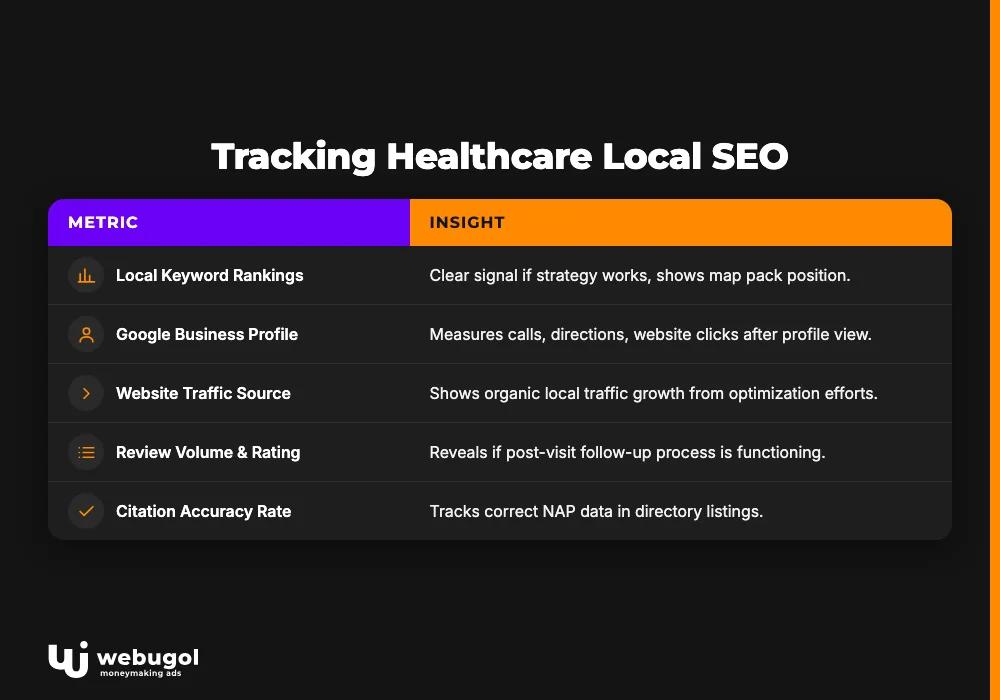
The core metrics for healthcare local SEO:
- Local keyword rankings show position in the map pack for the queries that drive appointments, such as "[specialty] [city]" and "[service] near me." Movement here is the clearest signal of whether the strategy is working at all.
- Google Business Profile actions measure what patients do after finding the profile: calls placed, direction requests, and website clicks. A drop in calls with stable profile views typically points to a conversion issue on the site rather than a ranking issue.
- Website traffic by source shows whether organic local traffic is growing as optimization efforts accumulate. Flat local traffic with stable rankings suggests content gaps or a weak conversion path on the site.
- Review volume and rating trend reveal whether the post-visit follow-up process is functioning. A sudden drop in new reviews usually means the solicitation workflow has broken down somewhere in the process.
- Citation accuracy rate tracks the percentage of directory listings with correct NAP data. Errors accumulate over time without active monitoring and require periodic correction to maintain consistency.
Review these metrics monthly. Quarterly trend analysis separates genuine momentum from short-term fluctuations, which in local search often reflect algorithm updates or seasonal shifts in search behavior rather than fundamental strategy problems.
When metrics decline, work backward through the framework. A drop in map pack position without a drop in profile views suggests a competitor has improved their prominence signals. A drop in profile actions without a position change suggests the profile itself needs updating. That diagnostic sequence prevents misallocating effort on tactics that are already working.
Healthcare local SEO compounds when the foundational elements are in place. Practices that rank consistently in competitive health and wellness markets share a pattern: complete and accurate profiles, reviews collected systematically, and clean NAP data across directories. None of this requires advanced technical expertise. Consistency is what separates the practices that rank from those that drift.
Understanding how organic search builds durable authority connects to a broader dynamic in health and wellness markets: organic search drives compounding growth for health and wellness businesses in ways that longevity clinic paid ads cannot replicate, because authority accumulates over time rather than resetting with each campaign budget cycle.
Improve your clinic's local search performance
Healthcare local SEO requires consistent execution across several connected elements: a fully optimized Google Business Profile, NAP data that matches on every platform, a process for generating and responding to patient reviews, and a tracking framework that shows what is actually working. Leaving any of these incomplete creates gaps that competitors will fill.
Webugol works with medical practices to build this foundation and maintain it over time. The healthcare growth system is structured specifically for healthcare providers, accounting for the regulatory environment, the trust dynamics of medical search, and the local ranking signals that move practices into the map pack and keep them there.
If your clinic is not appearing consistently in local map results for your core services, the gap is fixable. Start with a profile and NAP audit to identify where the current presence falls short. Contact Webugol to schedule a review.
FAQ
What is local SEO for healthcare providers?
Healthcare local SEO is the practice of optimizing a clinic's online presence to rank in geographic search results when nearby patients search for care. It involves Google Business Profile management, NAP consistency, and local citation building across medical directories. The goal is to appear in the map pack for high-intent local queries in the practice's service area.
How to optimize Google My Business for a medical practice?
Claim and verify the profile, fill every field accurately, and select the most specific relevant category for the practice type. Add genuine facility photos, list all services explicitly, and update the profile promptly when hours or offerings change. Responding to every review also signals an active, credible practice to Google's local ranking algorithm.
Why does local SEO matter for healthcare businesses?
Most patients begin their provider search online, and local map results are what they encounter first. A practice absent from those results loses patients to competitors before any direct contact happens. Healthcare online visibility also functions as a trust signal, since patients assess a practice's credibility through its digital presence before ever picking up the phone.
What local SEO strategies work best for clinics?
The highest-impact strategies are Google Business Profile optimization with precise category selection, NAP consistency across all directories, systematic patient review collection and response, and accurate listings in medical-specific directories. These address the core local search ranking factors Google uses to determine clinic Google Maps ranking.
How to improve NAP consistency for medical practices?
Audit all existing listings by searching the practice name and phone number to identify every platform where the practice appears. Correct every variation to match the name, address, and phone number exactly as shown on the official website. Repeat the audit quarterly and immediately after any contact information or location changes.