



Pain management marketing strategies that actually grow your practice
Pain management marketing is the system of digital strategies a pain clinic uses to attract qualified patients, convert them into booked appointments, and retain them over time. Done right, it covers search visibility, paid channels, website conversion, and the operational handoffs that turn inbound interest into recognized revenue. Skip any of those layers and the spend increases while the schedule gaps stay the same.
That dynamic runs at every stage of growth. The structural weaknesses that stall a new practice are the same ones that prevent an established clinic from scaling past its revenue plateau. This article covers both.
Why pain management marketing stalls before it scales
Most pain clinics have something in place: a Google Business Profile, a website, perhaps running Google Ads. The issue is not channel coverage. Each piece sits in a different silo, owned by a different vendor or staff member, and nobody owns the gap between them.
Leads arrive. Someone follows up, eventually. Some patients book. Most don't. The ad account reports a healthy click-through rate, the website reports traffic, and the schedule is still half-empty.
The bottleneck is rarely at the top of the funnel. Run this quick diagnostic before adding budget:
| Symptom | Where the problem actually is |
|---|---|
| High CPL, few bookings | Intake process or landing page, not ad targeting |
| Traffic up, calls flat | Website UX or missing click-to-call, not SEO |
| Bookings up, revenue flat | No-shows or case-mix, not patient volume |
| Ad spend up, revenue flat | Broken tracking; optimizing toward the wrong signal |
The pattern appears consistently across practices where budget grows and results don't follow.
How do I market a pain management practice?
Effective pain management marketing runs on three parallel tracks: visibility, conversion, and retention. Getting found online covers only the first. The second and third tracks are where most practices have the largest untapped revenue.
Visibility requires a fully optimized Google Business Profile, consistent NAP (name, address, phone) across local citations, and an SEO strategy targeting the conditions and procedures patients search for in your area.
Conversion depends on your intake path more than your ad creative. How fast does someone who fills out a form get a callback? What happens if they miss that call? A pain clinic's real website job is to remove every barrier between "I found you" and "I booked."
Retention is the revenue channel most practices leave unmonitored. Reactivating a previous patient costs a fraction of acquiring a new one. Without a systematic retention layer, you raise ad spend to cover a hole that marketing alone did not create.
What digital marketing strategies work for pain clinics?
Pain clinic digital marketing performs best when channels reinforce each other rather than run as parallel silos. The strategies below follow the patient acquisition path from first search to repeat visit.
Pain specialist SEO: organic visibility that compounds
SEO for a pain management practice operates on two layers. The first is local search, capturing patients who look for treatment nearby. The second is condition-specific content, reaching patients in the research phase who are deciding whether to seek a specialist at all.
Local SEO covers your Google Business Profile, local citations, and location-specific landing pages. Getting this right puts you in front of patients searching "pain management specialist near me" or "interventional pain doctor in [city]." For the technical requirements of this layer, see the complete guide to local search visibility for pain clinics.
Condition-specific content works over a longer horizon but builds durable authority. A page explaining what to expect from a nerve block procedure answers the exact question patients ask before they decide to call. That content works while the clinic is closed.
Google Ads for patient acquisition for doctors
Paid search is the fastest path to patients actively looking for a pain specialist. For patient acquisition for doctors, Google Ads gives keyword-level control: you can bid on "back pain specialist in [city]" and appear at the top of results within days of launching.
Compliance governs what you can do with those clicks. Standard Google Ads tracking can be misconfigured to log personally identifiable health information as event parameters, creating HIPAA exposure. Before scaling spend, audit whether your pixel configuration meets compliant conversion tracking standards. Remarketing to users based on medical conditions violates platform policy, so remarketing audiences must be built on engagement signals rather than diagnosis categories.
Social media for pain management: reaching patients before they search
Social media is not primarily a direct-response channel for pain management. Chronic pain patients often spend months deciding whether to seek specialist care, and social content influences that decision before they type a single search term.
Facebook and Instagram let you build reach within specific geographic areas and demographic bands without targeting based on health conditions. Educational content, provider introductions, and patient outcome stories with appropriate consents build familiarity that shortens the decision cycle. For how social content and paid social work together in healthcare, see building a social presence for pain management practices.
Content marketing and pain clinic online presence
Your blog and resource pages do two jobs simultaneously. They help the site rank for condition-specific terms that broad service pages miss, and they signal clinical competence to patients who have been dismissed by previous providers.
Chronic pain patients are a specific population. Many have had negative experiences with providers who minimized their symptoms. A practice that publishes clear, accurate explanations of diagnoses and treatment options distinguishes itself from a standard clinic website. That signal affects whether a first-time visitor becomes a caller.
Is SEO effective for pain management doctors?
Yes. SEO is among the most cost-effective long-term components of pain management marketing because chronic pain patients conduct extensive research before booking. A patient looking for a spine specialist typically reads several pages before calling, and if those pages belong to your practice, the advantage compounds.
The tradeoff is timeline. SEO results take three to six months to materialize and require consistent content production and technical site maintenance. For a practice that needs patient volume immediately, SEO works as a long-term investment alongside paid channels, not in place of them.
Once a page ranks for a high-intent local term, the cost per visitor approaches zero compared to maintaining a paid search campaign for the same phrase. That is the core argument for sustained SEO investment in pain specialist practices.

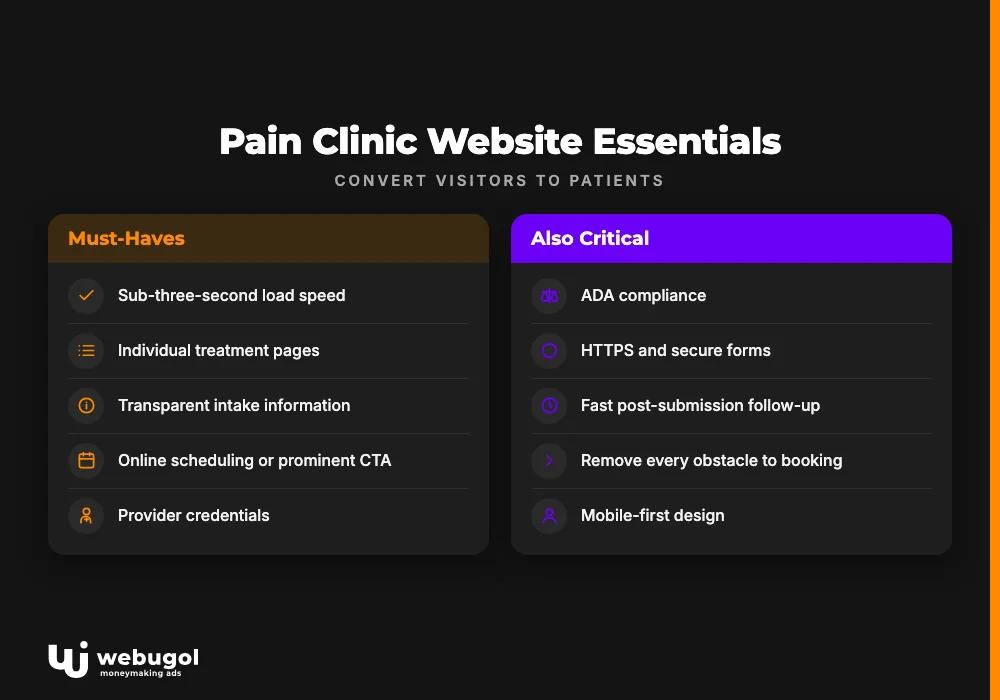
What should a pain management clinic website include?
A pain management website needs to remove every obstacle between a potential patient and a confirmed appointment. Description alone is not enough.
Non-negotiable elements:
- Sub-three-second load speed: most local searches originate on mobile, and slow pages lose patients before they read a word.
- Individual treatment pages: each major service or condition needs its own page with a clear explanation of what the treatment involves and what to expect.
- Transparent intake information: a first-time visitor should know within thirty seconds how to book, what insurance you accept, and roughly how long the wait is.
- Online scheduling or a prominent CTA: a phone number alone is not enough; offer a form or booking tool that works outside business hours.
- Provider credentials: board certifications, training, and experience are strong signals for patients selecting a pain specialist.
- ADA compliance: a legal requirement that also improves usability for patients with physical limitations.
- HTTPS and secure forms: required for any form that touches patient information.
The website's conversion job does not end at the contact form. What happens after submission, and how quickly, determines whether a visit becomes a booked appointment.
The gap between traffic and revenue: where pain clinic marketing actually loses patients
This is the section most pain management marketing coverage skips.
Strong SEO, active paid campaigns, and a well-designed website can coexist with a flat schedule. The leak is almost always in conversion operations: how fast you respond to new inquiries, how thoroughly you follow up on missed calls, and whether your intake process qualifies or loses patients before they ever meet a provider.
Speed-to-lead is measurable. The gap between responding to an inquiry within minutes versus within hours shows up directly in booking rates. A pain clinic that returns inquiry forms the next morning competes very differently than one that follows up within the hour. The ad accounts look the same. The schedules don't.
The diagnostic pattern we see in pain management practices: intake lives inside the clinical team's workflow, so marketing does not own it. Marketing reports on leads delivered. The intake team reports on appointments scheduled. Nobody has a figure for how many leads were delivered but never reached. That gap is invisible in most reporting setups. It costs more than underperforming ad creative.
This is a CRM and routing configuration problem as much as a marketing problem. If your stack includes HubSpot, GoHighLevel, or ActiveCampaign, lead routing and automatic follow-up sequences can close much of this gap without adding headcount. Whether you manage this in-house or with a healthcare marketing agency, the diagnostic step is the same: measure the full conversion path, not just the top of the funnel.

Medical practice lead generation: the retention channel most clinics ignore
Revenue from existing patients is the most underused lever in medical practice lead generation. For a pain management practice, returning patients represent follow-up treatments, complementary procedures, and referrals within a demographically aligned network.
The retention layer operates through automated appointment reminders, post-treatment check-ins, and reactivation sequences for patients who have not been seen in a defined window. This does not require a large marketing team. It requires consistent email and SMS configuration running in the background.
For practices that have an email system but no structured retention logic, automated email workflows for pain clinic patient retention covers what this looks like in a healthcare setting, including HIPAA-compliant list management.
The economics are straightforward. Acquiring a new patient through paid search in a competitive urban market can cost hundreds of dollars. Reactivating a former patient through an email sequence costs a fraction of that, with higher conversion rates because trust is already established.
How can pain specialists attract more patients online?
Pain specialists attract more patients online by building a system where every touchpoint, from first search to post-appointment follow-up, is connected and measured. The right tactic depends on your current bottleneck.
Low volume: the priority is visibility. Local SEO, Google Business Profile optimization, and paid search for high-intent terms form the starting layer.
Adequate volume but low booking rate: the priority is conversion. Website UX, landing page testing, and intake response speed produce faster gains than increasing ad spend.
Strong bookings but plateaued revenue: the priority is retention. Reactivation sequences, follow-up communications, and referral programs address this without raising acquisition costs.
Identifying the right layer produces faster results than adding budget across all channels. A practice tracking booked consultations, show rate, and revenue per new patient is building a sustainable pain management marketing approach. A practice tracking only impressions and sessions is not.
Ready to build a connected pain management marketing system?
If you are running paid ads, maintaining a pain clinic online presence, and publishing content but not seeing the revenue growth the spend should produce, the problem is usually structural. Each channel reports its own metrics, but nobody owns the revenue path from first click to recognized payment.
Webugol's Healthcare Growth System is a 90-day direct-to-patient sprint covering strategy and market research in month one, conversion assets and campaign launches in month two, and optimization and retention systems in month three. The program includes end-to-end tracking from ad click to revenue, weekly growth calls, and always-on optimization.
Valhalla Vitality, a telehealth provider, reduced CAC by 45% and grew monthly revenue by 287% with this approach. Ways2Well generated $2.1M in revenue over six months with a 38% reduction in CPA. These results came from fixing the full acquisition path, not just the ad account.
Book a strategy call to identify where your clinic's patient acquisition system is leaking.
FAQ
How do I market a pain management practice?
Start by auditing where your pipeline loses patients between the first contact and a booked appointment. Fix visibility with local SEO and paid search, then fix conversion by improving intake speed and your website's clarity. A retention layer for existing patients is the third track and usually the fastest return.
What digital marketing strategies work for pain clinics?
SEO, Google Ads, and a compliant social media presence form the core. What separates effective pain clinic digital marketing from ineffective is the conversion operations layer: how fast you follow up on inquiries, how your website guides visitors to book, and whether your reporting tracks the full path from ad click to confirmed appointment.
Is SEO effective for pain management doctors?
Yes, particularly for local searches and condition-specific research queries. Chronic pain patients research extensively before booking, which makes well-ranked content highly valuable. SEO builds over three to six months and compounds; it works alongside paid channels, not in place of them.
What should a pain management clinic website include?
Fast load speed, individual treatment pages, a clear intake path showing how to book and what insurance you accept, online scheduling or a strong CTA, provider credentials, ADA compliance, and HTTPS for all forms. Mobile performance is essential since most local searches originate on phones.
How can pain specialists attract more patients online?
Identify your bottleneck first: low visibility needs SEO and paid search, while low conversion needs website and intake improvements. Plateaued revenue despite strong bookings usually signals a retention gap. Fixing the right layer produces faster results than raising ad spend across all channels.

