



Orthodontist SEO: how to rank higher and get more patients
Orthodontist SEO is the practice of optimizing your digital presence so that patients in your area find your clinic when they search for braces, Invisalign, or orthodontic consultations. It combines local search signals, an authoritative website, and a verifiable online reputation into one system that delivers appointment requests without you paying for every click. When every layer connects, you stop competing on ad spend and start competing on trust.
That dynamic holds at every stage of practice growth. The same structural gaps that limit a single-location orthodontist's search visibility are the ones that hold a growing group at a plateau when it tries to open a second or third office. The fix is the same: build an acquisition system where every signal points to the right practice, in the right location, for the right patient.
What is SEO for orthodontists?
Orthodontic search engine optimization differs from broad SEO because almost every patient is local. They will drive to your office, so the implicit meaning of "best orthodontist" in any search is "near me." Local signals carry the most weight: your Google Business Profile, your NAP (name, address, phone) consistency across directories, and location-specific page content matter more than raw domain authority for most orthodontic searches.
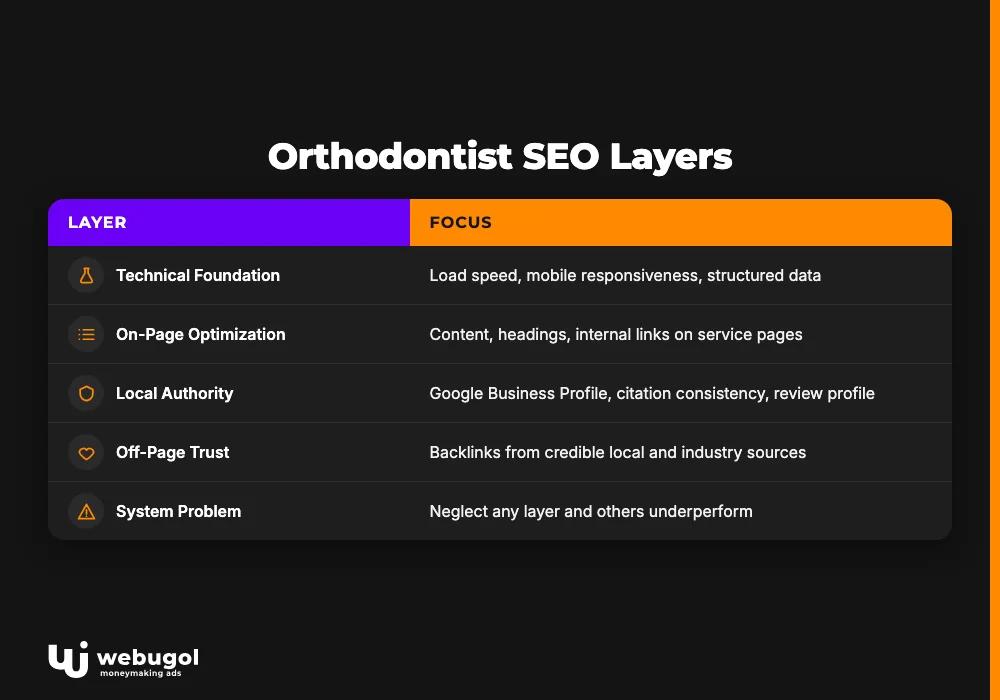
Orthodontist SEO covers four layers that work together. Technical foundation: load speed, mobile responsiveness, and structured data. On-page optimization: content, headings, and internal links on each service page. Local authority: Google Business Profile completeness, citation consistency, and review profile. Off-page trust: backlinks from credible local and industry sources.
Neglect any one layer and the others underperform. A well-optimized website with a neglected GBP loses to a competitor who has a mediocre website but a complete, active local profile. Orthodontist SEO is a whole-system problem, not a single-tactic fix.
What keywords should orthodontists target for local search?
The highest-value keywords pair a service term with a geographic modifier. That combination captures patients who have already decided to pursue treatment and are now selecting a provider.
| Keyword type | Example | Search intent |
|---|---|---|
| Core local | "orthodontist [city]" | High intent, provider selection |
| Service + location | "Invisalign [city]" | Treatment-specific, high conversion |
| Convenience | "orthodontist near me" | Highest conversion intent |
| Problem-aware | "how much do braces cost" | Research stage, top-of-funnel |
| Comparison | "braces vs Invisalign for adults" | Decision stage |
Long-tail questions like "how long does Invisalign take" and "do I need a referral for an orthodontist" drive modest volume individually but convert at higher rates because they signal a patient close to booking. These terms anchor your blog content, which strengthens your service pages through internal links and broadens your overall keyword footprint across dozens of related queries. Building a complete orthodontist SEO keyword strategy means covering all five rows of this table, not just the top two.
Does Google My Business help orthodontic practices rank higher?
Yes, decisively. Your Google My Business orthodontist listing is what appears in the local map pack when patients search "orthodontist near me," above the standard organic results. A complete, verified, and actively maintained profile is the fastest orthodontist SEO win available to most practices and the strongest ongoing local ranking signal they have.
The steps that actually move the needle for local SEO for orthodontists:
- Claim and verify your profile if you have not already done so.
- Complete every field: hours, services, payment options, and a business description that includes your city name and key treatment types.
- Add specific service entries for braces, Invisalign, retainers, and any specialty treatments you offer.
- Upload at least ten photos including the building exterior, treatment rooms, before-and-after results (with patient consent), and staff headshots.
- Publish a GBP post at least once a month. Announcements, seasonal content, and answered patient questions all signal an active, relevant profile.
- Keep your Google My Business orthodontist information consistent across every directory where your practice appears.
Reviews are the second half of the equation. Local SEO for orthodontic clinics depends on a consistent flow of genuine reviews, not a single push. Build a repeatable ask into your post-visit process. Respond to every review. Response rate and recency both factor into local ranking signals, and prospective patients read how you handle critical feedback as closely as they read the positive ones.
For a full picture of citations, directories, and profile strategy, the local search optimization guide for healthcare practices covers every step in detail.
On-page SEO for orthodontic websites
Rankings bring patients to your page. The page itself has to convert them. Orthodontic website SEO covers both sides: the signals that earn rankings and the structure that turns a visitor into a booked consultation.
On-page orthodontist SEO essentials
- Write a unique title tag for each page, leading with the service and location: "Invisalign in [City] | [Practice Name]."
- Keep meta descriptions to 140-150 characters and place the primary keyword near the beginning.
- Use one H1 per page that reflects exactly what that page covers. Avoid generic H1s like "Welcome to our practice."
- Write at least 400 words of original content on each service page. Thin pages signal low effort to both visitors and crawlers.
- Add local business schema markup so search engines can read your name, address, phone, hours, and service categories reliably.
- Include your practice name, address, and phone number as crawlable text, not only inside an image, on every page.
- Link service pages to relevant blog posts and from your homepage to distribute authority across the site.
Mobile responsiveness and page speed
Mobile optimization is not a secondary concern in orthodontist SEO. Most patients search for orthodontic care on a mobile device. A site that loads slowly or requires horizontal scrolling on a phone will rank lower and convert fewer visitors, regardless of how strong your other signals are.
Use a responsive design that adapts to any screen. Compress images before uploading. Remove unused plugins and scripts. Run pages through Google PageSpeed Insights regularly, and treat anything below a "good" score as a booking problem, not a technical inconvenience. Slow pages are a revenue leak.
How can orthodontists get more patients from Google?
Ranking is the first step. Getting those ranked pages to generate appointments is the second. Orthodontist SEO closes the gap between visibility and revenue through three reinforcing channels: content, social proof, and backlinks.
Content that earns rankings and patient trust
Blog content built around patient questions is one of the most reliable orthodontist SEO tactics available. Parents want to know what age to start Invisalign. Adults want to know if braces remain an option in their forties. Every patient wants to understand pricing and financing options before they call.
Each of those questions is a search query. Each answered thoroughly on your website is a ranking opportunity and a trust signal for the patient reading it. Local SEO for orthodontic clinics builds compounding returns this way: a library of patient-centered answers eventually drives organic traffic across dozens of queries, not just a handful of head terms.
Consistency matters. Search engines recognize websites that publish and update content regularly as more authoritative than those with long gaps between updates. Establish a publishing rhythm around seasonal topics, treatment explainers, and practice FAQs rather than bursts of activity followed by months of silence.
For a fuller picture of how content and authority compound over time, see the guide to organic search visibility for health and wellness businesses.
Social proof and reputation signals
Reviews are not just a local ranking factor. They are part of the content ecosystem that converts visitors into callers. A practice with a large number of recent Google reviews, before-and-after galleries, and patient testimonials carries more conversion weight than one with the same rankings but a sparse public profile.
Encourage satisfied patients to leave reviews on Google and other relevant directories. Share patient success stories and educational content through social media. These signals reinforce each other: strong reviews improve local rankings, more visibility brings more patients, and more patients generate more reviews.
Building backlinks that count
Quality backlinks from credible local and industry sources signal authority to Google. For orthodontic practices, natural link sources include healthcare directories, dental association listings, local business organizations, school partnerships, and community events you support.
These links carry more weight than generic directory submissions because they tie your practice to a real local context. Focus on earning links through genuine community involvement and clear published expertise, not through link schemes that Google identifies and discounts.
How long does SEO take for an orthodontic practice?
Expect initial movement in local pack rankings within two to three months when technical issues are resolved and your Google Business Profile is fully optimized. Sustainable organic rankings for competitive terms like "orthodontist [city]" typically require six to twelve months of consistent work.
The phasing looks like this in practice:
Weeks 1 to 6: Technical fixes, GBP completion, and citation cleanup. These changes index quickly and often produce early ranking movement for lower-competition local terms. This phase ends the bleed of patients going to competitors with more complete profiles.
Months 2 to 4: Service page content and blog posts start publishing. Review velocity increases. Local pack rankings stabilize. You begin capturing traffic from long-tail queries you were not ranking for at all.
Months 4 to 12: Domain authority grows as content ages and backlinks accumulate. High-competition head terms start to move. Organic becomes a meaningful channel instead of a rounding error.
What you stop losing during this window is the daily leak of patients who searched, found a competitor with a stronger profile, and booked there. Orthodontist SEO does not create demand. It captures the demand that already exists and routes it to your practice rather than the next result on the page.
Stop losing patients to practices with stronger search visibility
Webugol builds patient acquisition systems for healthcare practices that connect every layer: local search signals, website performance, content strategy, and reputation management tracked from patient search to booked appointment. That is the difference between a collection of scattered tactics and a system that produces predictable monthly bookings.
If your practice has strong clinical outcomes but a search presence that does not reflect them, Book a strategy call with the Healthcare Growth System and get a diagnosis of the specific gaps holding your orthodontist SEO back.
FAQ
What is SEO for orthodontists?
Orthodontist SEO is the process of optimizing your website, Google Business Profile, and online reputation so that patients searching for orthodontic care in your area find your practice first. It focuses on local search signals because orthodontic patients choose providers within driving distance. The goal is a consistent flow of high-intent appointment requests from organic search.
How can orthodontists get more patients from Google?
The core path is a fully optimized Google Business Profile, a fast and mobile-friendly website with well-structured service pages, and a consistent review-gathering process. Local SEO for orthodontists also depends on building citations across reputable directories and publishing blog content that answers the questions prospective patients search for before they book.
Does Google My Business help orthodontic practices rank higher?
Yes. A complete and actively maintained Google Business Profile is the strongest single factor for appearing in the local map pack, which captures the highest-intent "near me" searches. Photos, service listings, regular posts, and a strong review profile all contribute directly to local pack placement.
How long does SEO take for an orthodontic practice?
Initial improvements to local pack rankings often appear within two to three months when the GBP is optimized and technical issues are resolved. Competitive organic rankings for head terms like "orthodontist [city]" typically require six to twelve months of sustained work across content, backlinks, and on-page optimization.
What keywords should orthodontists target for local search?
The highest-value keywords combine a service term with a location, such as "orthodontist [city]" or "Invisalign [city]." The term "orthodontist near me" captures the highest-conversion intent. Supporting long-tail keywords built around patient questions such as "how long do braces take" and "cost of Invisalign" anchor the blog content strategy and attract research-stage patients.

