



Fitness email marketing: boost gym retention and revenue
Fitness email marketing is the practice of sending targeted, automated campaigns to current members, prospects, and lapsed clients to improve retention, fill class spots, and grow lifetime value per member. It consistently outperforms social media for direct member communication because you own the contact list and messages reach inboxes without algorithm interference. A well-structured gym email program automates new member onboarding, re-engages dormant members before they cancel, and keeps active clients booked between visits. The difference between studios that grow steadily and those that plateau often comes down to whether email is running in the background, doing that work consistently.
Whether you're a personal trainer managing your first client list of 50 or a studio owner at 400 members, the structural problem is the same: without automated retention touchpoints, every growth plateau eventually traces back to member drift you didn't see coming.
Why email outperforms other channels for fitness businesses
Gym owners managing full schedules tend to track visible metrics: social followers, Google reviews, walk-in traffic. What goes unmeasured is attrition that builds silently before a cancellation notice arrives. Members stop booking classes. They skip two weeks, then four. By the time they cancel, the relationship has been over for months.
Paid ads bring new leads. Email protects the members you already have.
That math matters at scale. If your studio has 400 active members (illustrative) and even a modest percentage go dormant over twelve months, re-engaging them through targeted fitness client retention emails is worth more than the same ad spend on cold acquisition. Email lets you act before the cancellation, not after.
This is why fitness email marketing consistently outperforms one-off promotional pushes: it operates across the full member lifecycle, not just the acquisition moment. For personal trainers building a client base, the same dynamic plays out at a smaller scale. Clients fall off routines, miss sessions, and drift unless someone keeps momentum alive. A personal trainer newsletter running on automation handles that follow-up without requiring manual outreach every week.
One more point before the tactics: gyms that build email and search together see compounding returns. Organic search brings in prospects who find you when searching locally; email converts and retains them once they join. If you're not building both channels in parallel, the acquisition side keeps working while the retention side leaks. Building long-term search visibility alongside email is covered in depth in our guide to search visibility for health and wellness businesses.
How do I build an email list for my fitness studio?
The direct answer: collect email at every touchpoint where members or prospects give you attention, offer something specific in return, and use a double opt-in to ensure your fitness studio email list stays clean and deliverable.
Building a quality fitness studio email list is the foundation of any fitness email marketing program. Here are the highest-yield tactics:
- Free trial or class pass form: New members who claim a trial session give their email willingly. Collect it on a short landing page, not just a paper waiver. Ask for email and nothing else to minimize friction.
- In-studio sign-up tablet or QR code: Place a simple opt-in at the front desk or locker room entry. A prompt like "Get our weekly workout tip" converts better than a generic newsletter offer.
- Social media lead ad: Facebook and Instagram lead ads pre-fill email from the user's profile. Use these to promote a specific offer (a free class, a nutrition guide, a challenge sign-up), not just your brand.
- Referral capture: When a current member refers a friend, collect the friend's email as part of the referral flow. The warm introduction raises open rates significantly on the first email.
- Fitness challenge sign-up: Running a 30-day challenge gives people a natural reason to give you their email, and it starts the relationship with high engagement from day one.
- Member portal login: If your booking software requires an email login, integrate that email into your marketing list with explicit permission during sign-up. Platforms like Mindbody, Glofox, and PushPress support this connection.
What to avoid: purchased lists, scraped directories, or contacts who signed a waiver without separately opting into marketing communications. Beyond the legal risk under CAN-SPAM, low-quality lists destroy your sender reputation and reduce deliverability for the contacts who actually want your emails.
Your fitness studio email list is an asset with measurable value. A clean list of 1,000 engaged members delivers more revenue than a bloated list of 5,000 mixed contacts, because deliverability and engagement rates compound in your favor over time.
What should a fitness newsletter include?
Fitness email marketing content that works follows one principle: deliver something members can use, not content that serves your promotional schedule. The quick answer is to mix member progress recognition, upcoming class and event highlights, one practical fitness or nutrition tip, and a single clear action you want them to take that week.
The breakdown by content type:
| Content type | Purpose | Suggested frequency |
|---|---|---|
| Upcoming classes and schedule changes | Drives bookings; reduces no-shows | Every send |
| Practical fitness or nutrition tip | Demonstrates expertise; earns consistent opens | Every send or weekly |
| Member spotlight or milestone | Builds community; reinforces belonging | Monthly |
| Promotion or offer | Revenue driver; must be earned by prior value | Max 1 in every 3 emails |
| Re-engagement prompt | Addresses dormancy before cancellation | Triggered by inactivity |
| Referral invitation | Low-cost member acquisition | Quarterly |
A newsletter that skews 80% promotional loses subscribers quickly. Fitness businesses that maintain high open rates over years consistently deliver content that members would miss if it stopped arriving.
Avoid padding your newsletter with generic motivational quotes. Members joined because they want results. Show them progress, teach them something useful, and make it easy to book their next session. One topic per email works better than trying to cover three things at once, because attention goes where there is a single clear reason to act.
How often should fitness businesses send marketing emails?
Fitness businesses should send marketing emails one to two times per week to active members, and more densely during onboarding for new sign-ups. Getting the fitness email marketing cadence right depends on your content quality, not an arbitrary schedule.
Here is how that breaks down by member lifecycle stage:
New member onboarding (days 1 to 30): Four to six emails over the first month is reasonable. Cover your facility, introduce the team, explain how to book, share what to expect in the first few sessions, and check in at day 7 and day 30. This sequence has the highest open rates of anything you will send, because new members are actively looking for information and are still forming habits.
Active members (ongoing): One email per week is the right floor. Two per week works if you have enough content to avoid repetition. Sending less than once a week causes members to forget they subscribed. More than three times a week risks fatigue unless the content is highly relevant to that specific segment.
Lapsed members (21 or more days inactive): A win-back sequence of two to three emails over ten to fourteen days is effective before you move them to a suppression list. Sending broadcast campaigns to dormant contacts depresses your open rate and harms deliverability for the whole list.
Before and after major campaigns: Events, challenges, and seasonal promotions warrant a denser schedule. Three to five emails around a Black Friday membership offer or a New Year challenge is expected behavior, not spam, as long as your baseline cadence stays reasonable.
Frequency fatigue shows up in unsubscribe rates above 0.3% per send. If you're seeing that number consistently, the problem is usually irrelevant content for the segment receiving it, not pure volume.
What email subject lines work best for gyms?
The fitness email marketing subject lines that drive opens share one trait: they signal something specific and relevant, not something vague and inspirational. Lead with the benefit, name the person or class when possible, and keep subject lines under 50 characters.
Subject line patterns that consistently work for gyms:
- Personalized name drop: "Alex, your 30-day streak starts tomorrow" outperforms "Start your fitness journey today" because it acknowledges the specific person. Most email platforms support merge tags for first name without additional configuration.
- Urgency tied to something real: "2 spots left in Saturday's HIIT class" works when scarcity is genuine. Manufactured urgency damages trust and trains members to ignore subject lines that use it.
- Number-led specifics: "5 ways to avoid plateau after month 3" gives the reader a reason to open before they decide the content is worth their time.
- Question that surfaces a real problem: "Still sore three days after leg day?" opens because the subject matches what a gym member actually experiences.
- Re-engagement directness: "We miss you at [Studio Name]" is simple, honest, and effective for lapsed member campaigns. Avoid clichés like "It's been a while" or "We haven't heard from you."
What to avoid: excessive emoji, all-caps language, overpromising copy like "TRANSFORM YOUR BODY IN 30 DAYS," or vague descriptions like "This week's update from us." These either trigger spam filters or fail to give the reader a reason to care.
A/B testing subject lines on a 20% segment before full send is worth building into your workflow. Even small subject line changes move open rates by several percentage points, which at a list of 2,000 members translates to meaningful differences in class bookings and member activity.

Automating fitness email marketing: core sequences for gyms
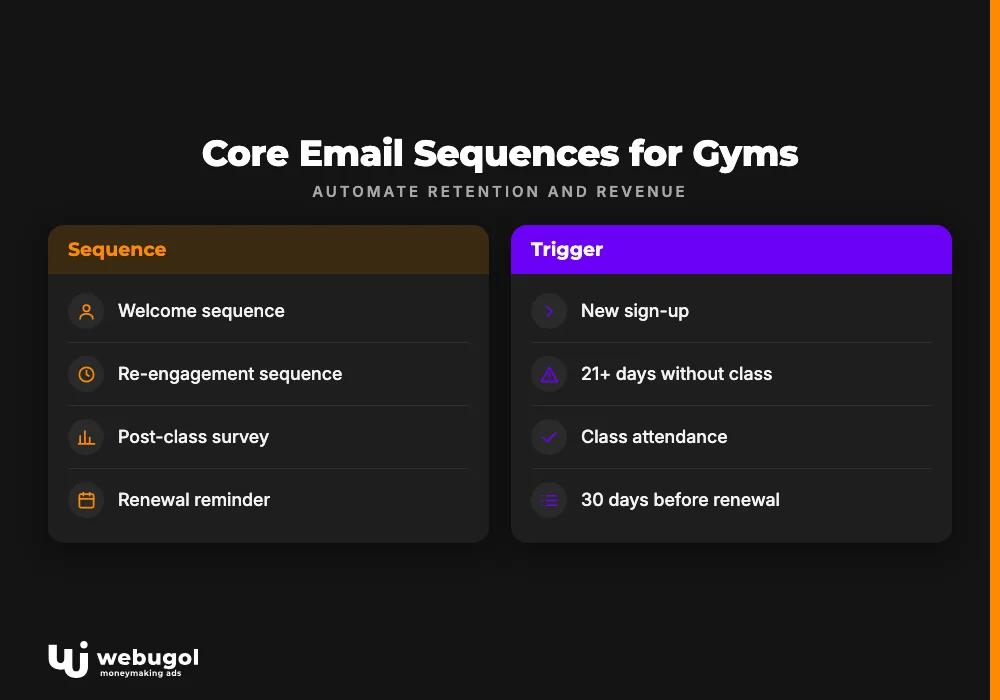
Email automation for gyms replaces the manual follow-up that most studios never get around to consistently. These are the core sequences worth building first, in order of retention impact:
Welcome sequence (trigger: new sign-up)
A workout email sequence for new members typically runs five emails over the first thirty days:
- Email 1 (day 0): Send confirmation and what to expect on day one; keep the content to practical logistics and a warm welcome.
- Email 2 (day 3): Share a quick wins checklist for the first week, with class recommendations based on stated goals.
- Email 3 (day 7): Check in with a brief note and an invitation to reply with questions; personal tone makes a difference here.
- Email 4 (day 14): Include social proof from a member who started where they are now, with a soft invite to a challenge or community group.
- Email 5 (day 30): Frame a progress milestone and acknowledge that they've made it through the hardest part of building a new habit.
Re-engagement sequence (trigger: 21 or more days without a class booking)
- Email 1: Acknowledge the gap and offer a low-barrier return like a complimentary class; keep the tone open and pressure-free.
- Email 2 (day 5): Share social proof from a member who had a similar gap and came back successfully.
- Email 3 (day 10): Offer a direct opt-out framed this way: "If we're not the right fit anymore, that's okay." This email recovers members precisely because it removes pressure and treats them as an adult making a choice.
Post-class survey (trigger: class attendance)
Send a single email within 24 hours: a 1-to-3 question survey about the experience. High response rates because the experience is recent. Positive responses convert into review requests.
Renewal reminder sequence (trigger: 30 days before membership expiry)
Send three emails: 30 days out (awareness), 14 days (offer if applicable), 3 days (final reminder). Most studios only send one of these, which means they miss two of the three highest-intent moments in the renewal window.
Gym membership email tips for automation come down to one principle: timing matters more than volume. The right email at the right moment in a member's lifecycle does more than any broadcast campaign. The member who just missed three classes and receives nothing is in a different situation than one who gets a check-in that makes returning easy.
How does email marketing improve gym member retention?
Fitness email marketing improves gym member retention by keeping the relationship active between physical visits, surfacing at-risk members before they cancel, and reinforcing the value a member gets from staying. The behavioral pattern is consistent in subscription businesses: members who stop attending for three to four consecutive weeks rarely return without some form of outreach.
Here is how fitness client retention emails do their work concretely:
They catch early disengagement. A member who skips two weeks and receives nothing from your studio has already started mentally canceling. A simple email that acknowledges the gap and lowers the barrier to return can interrupt that drift. The earlier the trigger fires, the higher the recovery rate.
They celebrate milestones automatically. A 90-day membership anniversary email, a first class booking anniversary, or a streak milestone message costs nothing to send once automated. These touchpoints create a sense of progress and belonging that makes cancellation feel like abandoning something, not just stopping a subscription.
They move members deeper into your offer. A member who attends group classes and receives an email about personal training after six weeks of consistent attendance is more likely to explore that upsell than a member who only sees it on a lobby poster. Gym membership email sequences move members through your offer at the right pace.
They give you a retention signal before it is too late. When a member stops opening your emails and stops booking classes in the same 7-day window, that co-occurrence is a stronger cancellation signal than either metric alone. Studios that integrate their email platform with booking data can build an early-warning system that flags at-risk members before a cancellation request arrives.
They reactivate before the gap becomes permanent. Most gym CRMs flag members as at-risk after 30 days of inactivity. The practical window to re-engage effectively is narrower: a re-engagement email triggered at three weeks of inactivity consistently outperforms one triggered at five weeks, because the habit gap is still recoverable.
The core argument is straightforward: email extends the average lifetime of a membership in a category where acquisition cost is high and switching costs are low.
The same retention logic applies across health verticals. If you work with a healthcare or medical wellness adjacent audience, the email lifecycle sequences for healthcare providers covers reactivation and onboarding in that specific audience context.
Segmentation: treating members as individuals, not a mass list
One consistent mistake in fitness email marketing is treating the entire list as a single audience. A new member in week one, an active member in year two, and a lapsed member who hasn't booked in three weeks are three people with very different needs. Sending them the same newsletter at the same frequency is not email marketing. It is email blasting.
Segmentation does not require sophisticated technology. Most email platforms support basic behavioral segmentation out of the box:
By activity: Separate members who booked in the last 14 days from those who have not booked in 21 or more days. These two segments should receive different subject lines, different content, and different offers. The active member needs enrichment and upsell opportunities. The inactive member needs a low-barrier reason to return.
By membership type: Group class members, personal training clients, and online-only members have different pain points. A personal trainer newsletter to PT clients can be more personal and goal-focused; a group class newsletter should lean into community and scheduling. Sending a "try personal training" upsell to current PT clients wastes the message and their attention.
By stated goal: If your intake form captures fitness goals (weight loss, strength, flexibility, general fitness), that data segments itself into content tracks that feel personalized without requiring manual work. A member training for their first 5K needs different content than a member focused on post-rehabilitation mobility.
By tenure: A three-month member and a three-year member need different content. The long-tenured member responds to loyalty recognition, advanced programming, and community leadership opportunities. The new member needs confidence, habit reinforcement, and social integration into the studio community.
The return on segmentation is a higher open rate and lower unsubscribe rate across all segments, which improves your sender reputation and ensures your emails actually reach inboxes over time. A healthy sender reputation is the unglamorous prerequisite for everything else in this list.

Measuring your fitness email marketing results
The standard metrics for gym email campaigns are open rate, click-through rate, and unsubscribe rate. Those are the right starting points, but they are not the full picture for a fitness business.
Open rate tells you how compelling your subject line is and how healthy your list is. A declining open rate is usually a list hygiene problem first, a content problem second.
Click-through rate measures whether the subject line and body content are aligned. If a high percentage open but few click, members opened expecting something the email did not deliver.
Unsubscribe rate is a warning metric. When it stays consistently above 0.3% per send, it usually signals frequency misfires or content that is significantly off-target for the segment receiving it.
But for a fitness business, the metric that matters most is behavioral: are members who receive your gym email campaigns booking more classes, renewing memberships, or purchasing additional services? That connection requires integrating your email platform with your booking software or CRM, which most mid-size studios have not done.
The setup is worth the effort. Even a simple report linking email opens to class bookings in the following 48 hours gives you a revenue-adjacent signal that justifies the investment in email, and shows you exactly which campaigns move members into the studio. Without this connection, you're optimizing for open rates in a vacuum.
Turn your email list into a retention system
Fitness businesses that run email as a background system rather than an occasional campaign consistently outperform those that blast and hope. The retention, referral, and renewal advantages compound over twelve to twenty-four months in ways paid acquisition cannot replicate.
Webugol's team builds email programs for growth-stage fitness and wellness businesses that want retention on autopilot, not managed manually. If your studio has a list sitting dormant or a welcome sequence that stops after one email, that is a growth gap we can close. Reach out for a consultation on what a systematic fitness email marketing program looks like for your specific studio size and member lifecycle.
FAQ
How often should fitness businesses send marketing emails?
One to two times per week is the right cadence for most active members. New member onboarding sequences can run more densely (four to six emails in the first thirty days) because engagement is highest then. Lapsed members should receive a focused re-engagement sequence of two to three emails before being moved to a suppression list.
What email subject lines work best for gyms?
Personalized, specific subject lines consistently outperform vague or inspirational ones. Use the member's name, reference a real class or milestone, or frame a problem they actually experience. Keep subject lines under 50 characters and A/B test on a 20% subset before full deployment.
How do I build an email list for my fitness studio?
Collect email at every high-attention touchpoint: trial class forms, in-studio opt-in tablets, referral capture, and social media lead ads. Always use double opt-in to protect deliverability. Never purchase lists or add contacts who only signed a waiver without explicit marketing consent.
What should a fitness newsletter include?
A strong fitness newsletter mixes upcoming class schedules, member milestone recognition, one practical fitness or nutrition tip, and a single clear call to action. Keep promotional content to no more than one in every three emails. Usefulness and consistency drive long-term open rates more than any design choice.
How does email marketing improve gym member retention?
Email surfaces at-risk members before they cancel by triggering re-engagement campaigns when activity drops. Automated milestone emails reinforce a sense of progress and belonging, and renewal reminder sequences reduce involuntary churn. These touchpoints extend average member lifetime in a business model where acquisition costs are high and switching friction is low.

