



Health and wellness SEO: how to build lasting search visibility
Health and wellness SEO is the practice of optimizing your website so people searching for health services, wellness products, or local practitioners find your business before competitors do. It targets users who are already looking for what you offer. That makes organic traffic far more conversion-ready than paid impressions. Applied consistently, it reduces ad spend dependence, compounds in authority, and builds a search presence that outlasts any single campaign.
Key benefits of health and wellness SEO for your brand
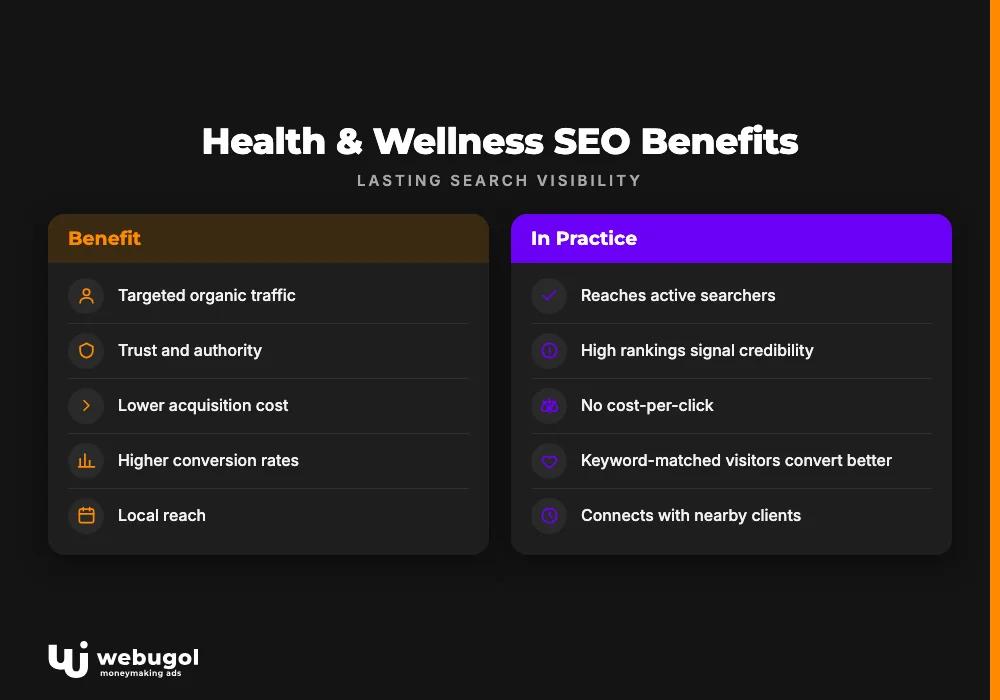
A structured SEO program delivers outcomes that broad advertising cannot match:
| Benefit | What it means in practice |
|---|---|
| Targeted organic traffic | Reaches users actively searching for your services, not passive browsers |
| Trust and authority | High rankings signal credibility to first-time visitors |
| Lower acquisition cost | No cost-per-click; traffic compounds with sustained effort |
| Higher conversion rates | Keyword-matched visitors convert better than paid traffic |
| Local reach | Local SEO for wellness connects you with nearby clients ready to book |
| Long-term compounding | Rankings built today keep delivering without recurring ad spend |
These benefits reinforce each other. A site that ranks for both broad informational queries and local service searches draws qualified traffic at every stage of the decision process.
What SEO strategies work best for health and wellness businesses?
The most effective health and wellness SEO strategies layer three areas: technical performance, keyword-targeted content, and trust signals. Neglect any one and the other two underperform.
Technical foundations first. Page speed, mobile responsiveness, and clean site architecture form the baseline. Google's mobile-first indexing means technical problems are assessed before content quality enters the ranking calculation, so fixing crawl errors and load times should always come first. Nothing else matters if your site cannot be indexed.
Keyword-targeted content. Wellness website optimization starts with matching each page to the exact phrases your audience types. Long-tail queries signal high intent. Pages built around specific, relevant service terms consistently outperform generic wellness content in organic search.
E-E-A-T signals. In the health space, Google applies Experience, Expertise, Authoritativeness, and Trustworthiness criteria more rigorously than in most other industries. Author bios, cited sources, and clinically accurate claims are not optional extras. They directly determine whether your pages surface for competitive queries, a reality central to any testosterone clinic SEO strategy.
For practices and clinics navigating search in licensed fields, building search authority for allied health practitioners covers the credentialing and citation signals specific to clinical settings.
What keywords should a health and wellness business target?
A practical keyword strategy for the wellness industry layers three tiers: broad category terms, service-specific mid-tail phrases, and local intent queries.
Broad phrases like "health and wellness seo" and "seo for wellness industry" build topical authority but compete with high-domain sites. Mid-tail phrases such as "online nutrition coaching seo" or "acupuncture content marketing" attract more qualified visitors at lower competition. Local intent queries, the backbone of local SEO for wellness, convert at the highest rates because the searcher has already decided to act and is choosing between nearby providers.
Map each tier to a specific page type: service pages target mid-tail phrases, blog content handles informational queries, and your Google Business Profile captures local intent. This structure prevents keyword cannibalization, where multiple pages compete for the same phrase and dilute each other's ranking potential.
How does local SEO help wellness businesses attract nearby clients?
Local SEO puts your wellness business in the Google local pack, that map-and-listings block above organic results, when someone searches "yoga studio in [city]" or "registered dietitian near me." That placement drives calls, direction requests, and bookings from users ready to act now.
Four factors drive local SEO for wellness:
- Google Business Profile. Claim your listing and complete every field: services, hours, photos, and the correct primary category. Incomplete profiles consistently rank below fully completed ones.
- NAP consistency. Your business name, address, and phone number must match exactly across your website, directories, and social profiles. Discrepancies create ambiguity for the local algorithm.
- Review signals. Volume and recency of reviews both influence local rankings. Respond to every review promptly and professionally, positive or critical.
- Localized content. Blog posts about local events, community health topics, or neighborhood partnerships build geographic relevance that directory listings alone cannot create.
Local optimization also builds word-of-mouth by surfacing client reviews when prospective clients search your name. Medical spa businesses face a specific set of local SEO challenges around service complexity and seasonal demand; the guide to on-page SEO and site structure for medical spas covers those in depth.
What are common SEO mistakes health and wellness businesses make?
The most common errors across wellness websites are neglecting mobile performance, skipping local SEO, keyword stuffing, thin content, and ignoring analytics. Most are preventable with a proper setup.
Neglecting mobile performance. Health-related searches skew heavily toward mobile. A slow or broken mobile experience loses those visitors before they read a single line. Google's mobile-first indexing means poor mobile scores also suppress desktop rankings.
Ignoring local SEO. Many practitioners optimize their homepage for broad national terms while leaving their Google Business Profile incomplete. This is a costly missed opportunity: local SEO for wellness drives higher-converting traffic than almost any other channel, because the searcher is already nearby and ready to book.
Keyword stuffing. Forcing your primary phrase into every sentence damages readability and can trigger search engine penalties. Health website seo tips from any credible source point to the same correction: write for your reader first, and let natural repetition build density.
Publishing thin content. A short page about a service you offer does not satisfy the search intent behind a query like "what does a functional medicine consultation include." Comprehensive, accurate pages that genuinely answer the question both rank and convert.
Skipping analytics. Without tracking traffic sources, bounce rates, and conversion paths, you cannot tell which content drives bookings from which wastes crawl budget. Google Analytics and Google Search Console together provide the signal needed to prioritize correctly.
How long does SEO take to show results for a wellness website?
SEO results build over months, not weeks. Wellness websites typically see initial organic traffic growth after several months of consistent execution, with results compounding more significantly after the first year as domain authority accumulates.
Competitive city markets take longer. Niche local queries can respond faster when your Google Business Profile is fully complete and your on-page signals are clean. SEO for wellness brands that publish content consistently, earn quality backlinks, and address technical issues systematically see the strongest long-term returns. The brands that stop after a few months rarely discover what sustained effort would have delivered.
Build a stronger health and wellness SEO strategy
Effective health and wellness SEO demands sustained effort across technical optimization, content strategy, and local visibility. Most in-house teams lack the bandwidth to run all three consistently while operating a practice or growing a brand.
As a full-service wellness SEO agency, Webugol combines SEO strategy with the technical depth to execute it, treating search visibility and site performance as one integrated system rather than separate workstreams. If you want to increase organic traffic, attract more local clients, and build a search presence that compounds over time, get in touch to discuss what a tailored wellness SEO plan looks like for your business.
FAQ
What SEO strategies work best for health and wellness businesses?
The most effective strategies combine keyword-targeted content, technical performance, and E-E-A-T trust signals such as author credentials and sourced claims. Local SEO is especially high-value for practices with physical locations, since it targets users who are ready to book. Consistency across all three areas over time produces the strongest long-term results.
How does local SEO help wellness businesses attract nearby clients?
Local SEO secures placement in Google's local pack, the map-and-listings block that appears above organic results for location-based searches. Optimizing your Google Business Profile, maintaining consistent NAP information, and earning recent reviews are the three highest-leverage actions. This traffic converts at higher rates than broad organic because the searcher is already nearby and looking for a local provider.
What are common SEO mistakes health and wellness businesses make?
The most repeated errors are neglecting mobile performance, leaving Google Business Profile incomplete, and publishing thin service pages. Keyword stuffing is also common: it reduces readability and risks penalties. Addressing these foundational issues typically produces faster ranking improvements than adding new content alone.
How long does SEO take to show results for a wellness website?
SEO results for wellness websites build over months, with meaningful organic growth appearing after several months of consistent execution. Niche local queries can respond faster with a fully optimized Google Business Profile. Results compound more significantly after the first year as domain authority builds.

