



SEO for Biotech Companies: Build Authority in Life Sciences
SEO for biotech companies turns specialized research expertise into search visibility that investors, procurement officers, and research partners can actually find. These decision-makers search Google before they ever contact you. A company that ranks for its core technology terms signals credibility before the first conversation begins.
This guide covers keyword targeting, site structure, page speed, link building, and performance tracking, with specific attention to where life sciences search diverges from general practice.
What makes SEO for biotech companies different?
Biotech SEO operates in a high-trust, low-volume keyword environment. The terms your buyers use, "CRISPR gene editing services," "GMP manufacturing for biologics," "Phase II clinical trial management", attract a fraction of consumer keyword traffic but carry far higher conversion value. Standard SEO optimizes for click volume. Effective life sciences digital marketing optimizes for signal-to-noise ratio: fewer visitors, more qualified ones.
Regulatory language shapes everything too. The terms acceptable in your industry are constrained by FDA guidance and partner compliance standards. Content must clear both Google's relevance threshold and your legal team's review. That dual requirement separates a biotech content strategy from a generic one.
What keywords should a biotech company target?
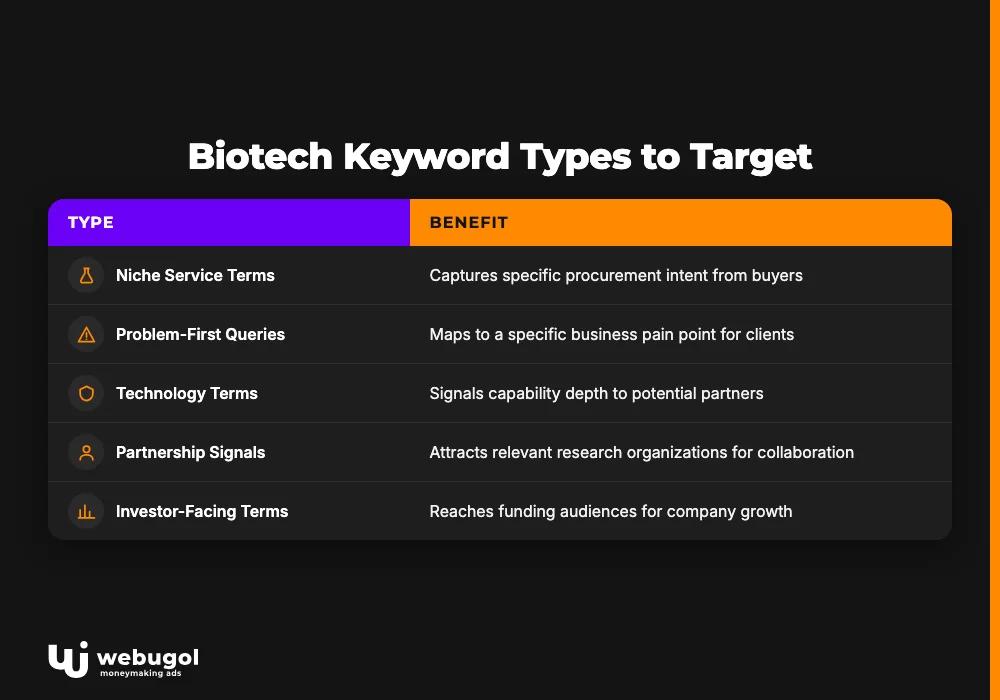
Biotech companies should target a layered mix: branded terms, niche service phrases, problem-first queries, and partnership-signal keywords.
| Keyword type | Example | Why it matters |
|---|---|---|
| Niche service terms | "contract protein expression services" | Captures procurement intent |
| Problem-first queries | "reduce time-to-IND submission" | Maps to a specific business pain |
| Technology terms | "AAV vector manufacturing cGMP" | Signals capability depth to partners |
| Partnership signals | "biotech CRO collaboration agreement" | Attracts research organizations |
| Investor-facing terms | "preclinical oncology pipeline" | Reaches funding audiences |
Use tools like Ahrefs or SEMrush to validate search volume and keyword competition. Focus on long-tail phrases with clear commercial or informational intent. Generic terms like "biotechnology" are too broad to convert at a useful rate.
Biotech startup marketing requires extra patience at the keyword stage. Early-stage companies have thin web authority. Starting with low-competition, high-specificity terms lets you build ranking momentum before competing on higher-volume phrases.
Website structure and on-page optimization
Biotech website optimization starts with architecture. Search engines need to crawl and index your content without friction. Buyers need to reach the right page within two or three clicks from the homepage.
Key structural elements:
- Primary navigation should label pages by function, not internal project names.
- URLs should be short, descriptive, and free of dynamic parameters.
- Every core service or research area needs its own dedicated page, not a section buried deep in a long "about" page.
- Internal links should connect related pages, your pipeline page should link to your manufacturing capabilities page and vice versa.
A structured site reduces bounce rates and helps Google identify your most important pages. The visibility problem a biotech startup faces is the same structural weakness that stalls growth for any SMB site on a plateau: a disorganized site obscures authority you already have. Getting site architecture right during development costs a fraction of what it takes to fix retroactively, which is why technical structure and development belong in the same conversation.
A structured site audit is the fastest way to see exactly where your current architecture is losing ranking potential.
Page speed and technical performance
Slow pages penalize rankings and drive qualified visitors away before they read a word. Google treats site speed as a ranking signal, and biotech audiences often work on enterprise networks where site responsiveness gets noticed.
Core improvements that move the needle:
- Image compression reduces file sizes without visual degradation, critical for sites with clinical imagery or research diagrams.
- Lazy loading defers off-screen images so the initial page renders faster.
- Browser caching stores static assets on repeat visits, cutting load times for returning partners and investors.
- Content Delivery Network (CDN) routes traffic to servers geographically close to each visitor.
- Code minification strips unnecessary whitespace from CSS and JavaScript files, reducing file transfer sizes.
How to build backlinks for a life sciences company?
Biotech link building works within the same trust constraints that govern the industry itself. A link from a low-quality directory does nothing. What works is earning editorial links from credible sources.
Effective approaches for life sciences companies:
- Research partnerships and co-publications: white papers and research co-authored with universities or institutes create natural, high-authority links that reflect genuine expertise.
- Industry directories and associations: listings in sector-specific databases like BioSpace carry real domain authority and qualified referral traffic.
- Contributed content: bylined articles in trade publications build both links and brand recognition among decision-makers.
- Conference and event mentions: speaking at or sponsoring industry events typically generates links from event sites and post-event coverage.
The pattern holds whether you are a 12-person startup or a 300-person contract research organization. Genuine expertise, published in the right channels, earns authority that manufactured link campaigns cannot replicate.
How does SEO help biotech companies attract investors?
Investors research founders and companies independently before every meeting. A biotech company with strong search visibility for its pipeline terms, technology platform, and leadership names establishes credibility before a pitch deck is shared. When a Series A investor searches for your specific approach and your company appears on page one, the first impression is already set.
Biotech content marketing is the primary vehicle. Publishing technically accurate content about your research area, key challenges, and your team's background builds documented authority that institutional partners can point to during due diligence. This is where pharmaceutical SEO strategy diverges most sharply from general B2B marketing: your audience reads for accuracy, not just relevance. A factual error in a published piece costs more credibility than the piece gained. Domain expert review before publication is not optional.
Tracking what your SEO delivers
SEO for biotech companies is not set-and-forget. Rankings shift as competitors publish, and search intent changes over time. Regular measurement keeps your strategy aligned with actual behavior.
Google Search Console shows which queries drive impressions and clicks. Google Analytics shows whether those visitors take the next step: submitting a contact form, downloading a whitepaper, or viewing your pipeline page. Key metrics to monitor monthly include organic traffic volume, keyword rankings, click-through rate from search, and conversion rate from organic visitors.
The pattern is consistent: companies that measure regularly adjust faster, and companies that adjust faster build compounding advantages over competitors who check in once a year.
The same structural weakness that stalls an established biotech firm stalls an early-stage founder even faster. A site that wasn't built to rank requires expensive rework later. That's the case for treating development and SEO as one project, not two.
Stop losing ground in life sciences search
The most competitive biotech companies treat search visibility with the same rigor they bring to their research. Rankings are not an accident. They are the output of consistent keyword work, clean site architecture, fast load times, and earned authority in the right publications.
Webugol is a digital marketing agency that builds websites designed to rank from day one, because development and SEO are planned together, not bolted on after launch. If your current presence does not reflect the quality of your research or pipeline, contact us to map out what it would take to change that.
FAQ
How does SEO help biotech companies attract investors?
Investors independently research companies online before any contact. Strong rankings for your pipeline and technology terms signal credibility and make the due diligence process work in your favor before you send a single document.
What keywords should a biotech company target?
Target niche service terms, problem-first queries, technology platform phrases, and partnership-signal keywords. Specific, long-tail terms convert at higher rates than broad industry terms and are more achievable for companies still building domain authority.
How long does it take for a biotech website to rank on Google?
Most sites see measurable ranking movement within three to six months of consistent SEO work, with more significant authority gains appearing around the twelve-month mark. Timeline depends on keyword competition, domain authority, and how consistently the site publishes and earns links.
What is the difference between biotech SEO and regular SEO?
Biotech SEO targets a small, highly qualified audience using specialized technical and regulatory language. It prioritizes search quality over volume, and content must satisfy both Google's relevance requirements and internal compliance review before publication.
How to build backlinks for a life sciences company?
Research co-publications, sector-specific directory listings, bylined articles in trade publications, and conference sponsorships are the most reliable sources of high-authority links. Editorial links from credible industry sources consistently outperform general directory submissions in both authority and qualified referral traffic.

