



What Is Involuntary Churn and Why Your Dashboard Can't See It
Involuntary churn is subscription cancellation caused by a payment failure rather than a deliberate choice to leave. The subscriber intends to stay; the exit happens because an expired card is never updated, a soft decline goes unretried, or a dunning sequence that should have fired never did. For owners and marketing leads of GLP-1 programs and healthcare membership practices, involuntary churn meaning is specific: revenue leaves before your dashboard records a complaint, and the billing system is the source. The fix is not a retention offer. It is payment infrastructure.
What is involuntary churn?
Involuntary churn happens when a subscription or membership ends because a charge fails, not because the subscriber decided to cancel. In GLP-1 continuity protocols, telehealth membership plans, and high-touch wellness subscriptions, this failure mode arrives without a complaint, a cancellation click, or a support ticket. The member stops receiving access. Nothing surfaces on a CRM active-subscriber report because the CRM never updated its records.
That silence is the operational problem. A renewal cohort approaching the three-month mark represents a concentration of payment risk: expiring cards, soft declines on post-holiday limited accounts, HSA resets at the start of a new policy year. If none of those events trigger dunning, exits happen and the dashboard reads them as ordinary attrition.
What's the difference between voluntary and involuntary churn?
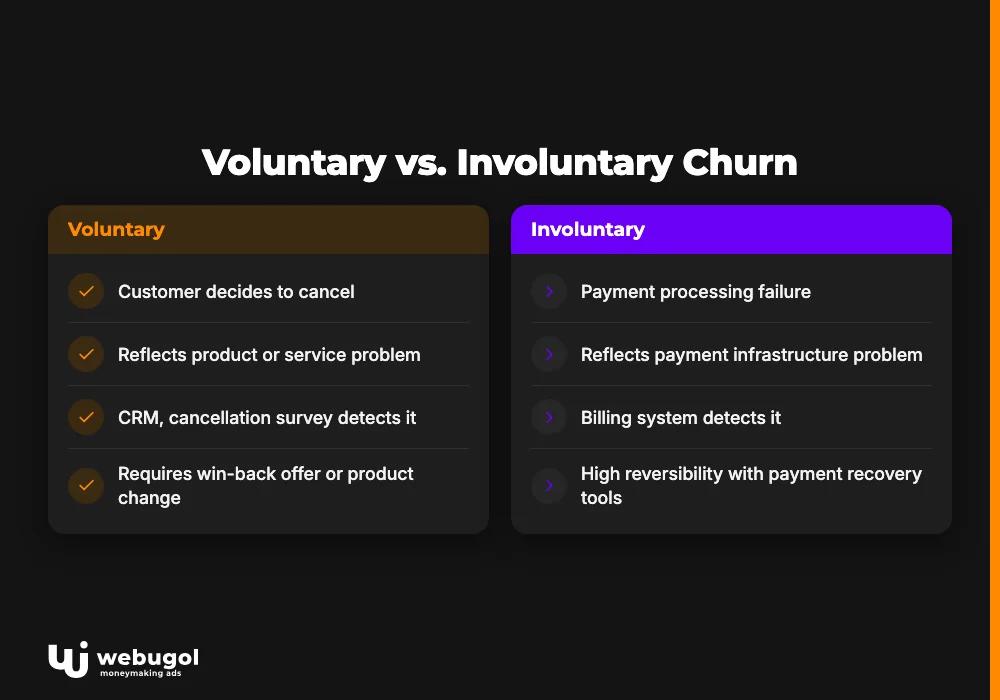
Voluntary churn is a deliberate choice to cancel. Involuntary churn vs voluntary churn represents a different failure category entirely: one reflects a product or service problem; the other reflects a payment infrastructure problem. The diagnosis and the fix share no overlap.
| Voluntary churn | Involuntary churn | Passive churn | |
|---|---|---|---|
| Cause | Customer decision to cancel | Payment processing failure | Gradual disengagement, payment never failed |
| Customer intent | Wants to leave | Wants to stay | Indifferent or drifting |
| Reversibility | Requires win-back offer or product change | High with payment recovery tools in place | Requires re-engagement campaign |
| Who detects it | CRM, cancellation survey | Billing system (CRM may not reflect it) | Product analytics, engagement scoring |
| Fix approach | Retention offer, product improvement | Retry logic, dunning, account updater | Re-engagement flow, pause option |
No competitor in the current top rankings publishes a three-way comparison of this kind. Conflating passive churn with the involuntary kind produces misdirected re-engagement campaigns sent to a population with a billing problem. The exits continue; the cause stays hidden.
Involuntary churn vs. passive churn: the important distinction
Passive churn is a disengaged subscriber whose payment never failed; the billing cycle renews while the person stopped engaging. Involuntary churn is an attempted charge that was declined. These two problems look nearly identical on a gross churn report but require entirely separate responses. Applying re-engagement tactics to a billing failure wastes budget and closes the recovery window during which payment updates are most likely.
What causes involuntary churn?
Failures cluster around three primary causes. Identifying which type dominates your decline distribution is the first diagnostic step, because the recovery action for each failure type is different and the tactics are not interchangeable.
Expired and reissued cards
Card networks reissue a significant share of cards each year for fraud prevention, product refreshes, and network migrations. When credentials change and the billing system is not notified, the next scheduled charge fails silently, with no alert sent to the subscriber and no update made to the CRM. This is the highest-volume cause of involuntary churn in subscription businesses because it strikes healthy customers who never chose to leave. The problem is a billing record, not a customer relationship.
Account updater programs exist specifically for this failure mode. Visa Account Updater and Mastercard Automatic Billing Updater push refreshed credentials to enrolled merchants before the charge cycle runs, stopping the failure before it occurs rather than recovering after the fact.
Soft declines, hard declines, and false declines
Treating all payment failures identically is how failure rates build across billing cycles without resolution.
- Hard decline: A permanent rejection caused by a stolen card, closed account, or an issuer fraud flag. This card will not process under any circumstances. Retrying a hard decline wastes processor attempts and can signal suspicious behavior to the issuer, compounding the problem.
- Soft decline: A temporary rejection caused by insufficient funds, a daily limit reached, or a transient issuer error. Soft declines respond to timed retry logic because the underlying card is valid and the condition typically clears within days.
- False decline: A legitimate charge blocked by the issuer's fraud filter. The customer is real, the card is valid, the funds are present. Most subscription operators treat false declines as a technical footnote. They are recoverable revenue from customers who never intended to leave.
The distribution of these three types in your decline data is the primary diagnostic input for any reduction strategy. Without that distribution, recovery investment lands on the wrong failure mode.
Charges not flagged as recurring
When an authorization omits the recurring transaction flag, issuers apply one-time fraud thresholds to the charge. Decline rates rise on otherwise healthy cards because the issuer reads the transaction as an unverified, one-time request rather than a known subscription renewal. This integration gap sits at the billing configuration layer. It rarely gets diagnosed because the failure shows as a standard decline code rather than a flag-related error.

What does involuntary churn actually cost you?
Lost subscription revenue is the visible figure. The cost extends deeper: into unit economics, the efficiency of acquisition spend, and the feedback loop that drives ad budgets higher to compensate for a billing problem that paid media cannot solve.
Wasted CAC inside the payback window
If a GLP-1 program member exits in months two or three on a 60-to-90-day payback window, the practice spent acquisition cost it will never recover. The math: CAC minus (monthly revenue times months retained) determines whether a member ever reached contribution before they left. A member who exits inside the payback window from an unrecovered payment failure is a structured loss. It repeats every billing cycle, for every member in that cohort whose payment credentials have lapsed.
Late-cycle attrition is a different economic category. A subscriber who exits at month ten has returned their acquisition cost multiple times over. For practices examining the revenue pressure of losing members before completing a first full renewal cycle, the relationship between payment recovery rate and acquisition ROI is direct and calculable against actual billing data.
NRR drag and what it forces you to spend on acquisition
Every incremental increase in payment failure rate suppresses net revenue retention. Lower NRR means the subscriber base grows more slowly, or contracts, and acquisition spend must increase to fill the gap. The ad account shows rising CPAs. The structural cause is in billing, not in the campaign.
For healthcare membership and telehealth operators at scale, this feedback loop is the hidden explanation behind acquisition pressure that does not respond to bid optimization or creative testing. Adding spend covers the gap temporarily; addressing the billing infrastructure removes the leak permanently. Practices that treat patient retention as a managed revenue system rather than assumed renewal address this from the lifecycle side; payment recovery addresses the same structural gap from the billing side. Both are required for NRR to stabilize.
The billing-CRM mismatch: when your stack disagrees
When billing marks a subscription as failed but the CRM still shows "active," dunning never triggers. Marketing continues treating the member as retained. Promotional messages go out for referrals and upsells while service access has already been suspended on the billing side.
The member receives an upsell offer from a program that has already removed their access. That sequence is not just a missed recovery opportunity; it damages the relationship precisely when trust determines whether a subscriber will act on a payment update request. For operations where CRM subscriber records drive downstream dunning and lifecycle messaging flows, synchronizing billing failure status with CRM active status is the prerequisite before any recovery tooling will function correctly. Without that sync, even a well-configured dunning sequence fires at the wrong population.

How do you diagnose involuntary churn before you fix it?
Start by pulling failed-payment events from the billing system and comparing them against the active-member count in the CRM. The gap between those two numbers is the volume of members exiting without a single dunning message sent. Every major competitor moves directly to tactics; none name this diagnostic step. Their recommendations land on an unmeasured problem, and the selection of which tactic to prioritize is uninformed.
Where to look first: billing logs vs. CRM active status
The audit runs in three steps:
- Export all failed-payment events from your billing system for the past 60 days, including the decline code for each event.
- Export all active subscriber records from the CRM for the same period.
- Cross-reference the two lists. Every record marked "active" in the CRM with a corresponding failed-payment event in billing is a member your dunning system never reached.
The delta between those two counts is the invisible exit volume. Practices that run this audit for the first time consistently find a gap larger than their reported churn rate suggests, because the CRM's "active" status was set at the time of enrollment and no automated process updated it to reflect billing outcomes.
Four questions to ask your payment processor
Before rebuilding retry logic or purchasing a dunning tool, get answers to these four questions from your processor:
- What is the distribution of decline codes in the past 90 days? A high concentration of hard declines calls for a different response than a high concentration of soft declines.
- What is the current false-decline rate? This is recoverable revenue most processors can segment from the rest of the decline volume on request.
- How is current retry logic configured, and does it distinguish by decline type? Uniform retry applied to all failure types is the most common structural gap.
- Are we enrolled in Visa Account Updater and Mastercard Automatic Billing Updater? Unenrolled merchants absorb expiry-driven failures that are fully preventable with an API integration.
These four questions surface where losses concentrate, which failure mode has the highest recovery yield, and which fix to prioritize before any tooling spend is committed.
If this audit reveals a gap between billing and CRM active records, Webugol structures the engagement around a retention-foundation audit in week one. See how the program works.

How to reduce involuntary churn: proven tactics
Reducing payment-driven subscription exits requires matching each fix to the specific failure type that drives it. These five tactics each address a distinct mechanism. None substitute for the others, and applying them in sequence after completing the diagnostic produces the highest combined recovery yield.
Smart retry logic matched to decline type
Applying uniform retry logic to all declined charges is the most common payment recovery error. Recovery behavior must be typed to the failure:
- Hard decline: Do not retry. Move to a cancellation or manual-review workflow immediately. Retrying a hard decline wastes processor fees and signals fraud to the issuer.
- Soft decline: Retry on days 3, 7, and 14. Update authorization parameters on each attempt to improve approval probability as the transient condition clears.
- False decline: Retry once, immediately, with revised descriptor flags that reduce the fraud-filter sensitivity for the issuer that originally blocked the charge.
Most published guidance on reducing payment-driven exits names retry logic as a tactic without providing timing specificity or sequencing by decline type. Stripe, Butter, and Solidgate all name retry as a solution; none give the timing by type. The recovery lift from typed retry versus blanket retry is measurable, and the processor can segment outcomes by decline category to confirm the improvement.
Account updater programs
Visa Account Updater and Mastercard Automatic Billing Updater push refreshed card credentials to enrolled merchants before the next billing cycle. Expiry-driven exits drop without any subscriber communication because the card on file updates before the charge fails.
Enrollment requires a qualifying merchant account and a billing platform that supports the updater API. Account updaters do not cover hard declines, closed accounts, or prepaid cards. For those failure types, the tactics below apply. For the expiry-driven failure mode, account updater enrollment is the most efficient path to prevent this failure at its most common source.
Proactive dunning: timing and channel sequence
Dunning that begins before a payment failure recovers more revenue than post-failure sequences alone because the subscriber acts before service interruption creates friction. A working pre-failure and post-failure dunning sequence:
- Day -7 (pre-failure): Card expiry notice via in-app notification, then SMS.
- Day 0 (failure): Immediate notification of the failed payment. In-app first, SMS second, email third.
- Day 3: Retry confirmation with a direct link to update payment information.
- Day 7: Final payment window with a reactivation link if access has been paused.
- Day 14: Access pause with a clear reactivation path.
Channel sequencing reflects response rates, not personal preference. In-app notifications outperform email for time-sensitive billing messages because inbox filtering delays action by hours or days. SMS delivers urgency. Email documents the sequence for subscribers who need it for their own records.
Expand payment method coverage
Adding ACH bank transfers, HSA/FSA-eligible cards, and digital wallets reduces single-card dependency in healthcare membership and GLP-1 programs. A member whose credit card expired may have a bank account or HSA available that the billing system never offered as a payment option.
HSA and FSA acceptance requires itemized billing for eligible services, a compliance requirement that shapes how payment options appear at checkout and in dunning communications. Getting this right removes a friction point for the subscriber demographic most likely to remain enrolled in a high-touch healthcare program long-term, because the option to pay through a benefits account aligns with how they already pay for care.
Subscriber-facing billing flexibility
Allowing members to pause billing, change their charge date, or self-update payment information in a portal removes friction that converts payment frustration into deliberate cancellations. When a dunning notification arrives and the subscriber has no clear path to update their card, the failed payment becomes a cancellation decision made by friction rather than intent.
This tactic addresses the boundary where voluntary and involuntary exits overlap. Dunning recovers failed payments from willing subscribers. Billing flexibility prevents the decision to abandon the update process and leave on purpose, which turns a recoverable billing event into a voluntary cancellation the CRM records as a deliberate exit.
How do you calculate involuntary churn rate?
Divide failed-payment cancellations in a period by total active subscriptions at the start of that period. The result is the proportion of the subscriber base lost specifically to payment failure, measured separately from deliberate cancellations and passive exits.
The involuntary churn rate formula
Involuntary churn rate = (subscriptions cancelled due to payment failure in period) / (active subscriptions at start of period)
As an illustrative example: a 1,000-member GLP-1 program with 35 failed payments in a month, 18 of which are not recovered, produces a rate of 1.8% for that month. The 17 recovered failures do not count as exits; they count as recovered revenue. Tracking both the failure rate and the recovery rate separately shows which parts of the payment stack are working and which are not.
What is a good involuntary churn rate for subscription businesses?
Benchmarks vary significantly by business type and the complexity of the payment environment:
- Low-touch digital subscriptions (streaming, SaaS, newsletters): below 0.5% per month is achievable with account updater enrollment and typed retry logic.
- Mid-touch SaaS and productivity tools: 0.5% to 1.0% per month is a realistic pre-optimization baseline before recovery infrastructure is in place.
- High-touch healthcare memberships and GLP-1 programs: 1.0% to 2.0% per month is an acceptable operating range; above 2.0% indicates a structural gap in payment recovery that retry timing alone will not close.
Solidgate's published FAQ asks this question but does not answer by business type. Healthcare and wellness membership programs carry higher baseline rates because the payment environment is more complex: HSA and FSA cards, employer benefit plan transitions, and policy-year resets create failure patterns that low-touch digital subscriptions do not face. Improving payment recovery in this vertical requires understanding those specific failure modes, not applying a streaming service benchmark.
Is Your Renewal Revenue Leaking Silently?
If billing and CRM disagree about who is active right now, renewal revenue is already leaving before any acquisition spend can replace it. The audit described in this article runs in an afternoon. What it surfaces in subscription practices with high-touch programs is consistently larger than the reported churn rate suggests, because the gap between billing failure and CRM active status has been accumulating without anyone's attention on it.
For practices that want to close this gap within a structured growth program, Webugol's Healthcare Growth System opens with a retention-foundation audit that maps the billing-to-CRM handoff and identifies the dominant failure modes in week one. Book a Strategy Call to see what the audit would find in your specific payment stack.
FAQ
What is involuntary churn?
Involuntary churn is the loss of subscribers caused by failed payments rather than a decision to cancel. Unlike voluntary exits, the customer still intends to stay; the departure is triggered by an expired card, a soft decline, or a dunning system that never fired.
What's the difference between voluntary and involuntary churn?
Voluntary churn is a deliberate cancellation; involuntary churn is an accidental exit caused by a payment failure the subscriber may not know occurred. The fix for each is different: voluntary churn requires product or offer changes, while this type requires payment recovery infrastructure and dunning sequences.
How do you calculate involuntary churn rate?
Divide the number of subscriptions cancelled due to payment failure in a given period by the total active subscriptions at the start of that period. A 1,000-member program that loses 18 members to unrecovered payment failures in a month has a churn rate of 1.8% for that period.
What is a good involuntary churn rate?
Low-touch digital subscriptions can reach below 0.5% per month with account updater enrollment and typed retry logic. High-touch healthcare memberships and GLP-1 programs typically run 1.0% to 2.0%; above 2.0% points to a structural gap in the payment recovery stack that retry optimization alone will not close.
Does the billing-CRM mismatch always cause dunning to fail silently?
When the billing system marks a subscription as failed but the CRM still shows "active," any dunning tool that reads CRM status will skip that member entirely. Correcting the status sync between billing and CRM is the prerequisite step; without it, even a well-configured dunning sequence sends nothing.

