



What Is Patient Churn Costing Your Clinic, and Who Owns It?
Patient churn is the rate at which acquired patients stop returning before their revenue compounds into profit. For a growth-stage clinic, it is not a patient-experience problem; it is the mechanism that forces ad spend to rise quarter after quarter while net revenue stalls. When churn is high enough to offset new acquisition volume, you are paying to run flat. Treating patient churn as a support ticket rather than a marketing metric is how acquisition budgets keep climbing while the board numbers stop moving.
What patient churn actually means for growth-stage clinics
Patient churn measures the share of your acquired patient base that does not return within a defined window. Unlike a software subscription, where cancellation is an explicit click, healthcare patient churn is mostly silent: the patient stops booking, stops responding to reminders, and eventually re-enters the market through a competitor's ad funnel.
The structural consequence is that a clinic adding new patients at a healthy pace can still report flat total revenue. The acquisition is real. The retention gap erodes it just as fast.
What is a normal patient churn rate for a telehealth clinic?
Telehealth subscription clinics face higher churn pressure than most clinic models because the renewal decision recurs explicitly each billing cycle. The patient actively chooses to continue rather than passively staying enrolled. High-ticket procedure practices see lower dropout rates in absolute terms, but each departure carries a larger sunk acquisition cost. Subscription wellness and direct primary care models sit between those two poles.
The warning threshold is not a specific number. It is the point at which your monthly patient churn volume approaches or equals your new-patient acquisition volume, meaning revenue growth is effectively flat despite rising ad spend.
| Clinic model | Churn pressure driver | Warning signal |
|---|---|---|
| Telehealth subscription | Monthly renewal decision is explicit | Dropout clusters around billing dates |
| Subscription wellness / DPC | Perceived value vs. continuity cost | Gradual disengagement before explicit cancel |
| Med spa | Seasonal and treatment-cycle timing | Long gap between first and second visit |
| High-ticket procedures | Outcome expectations vs. experience | No second procedure booked within 12 months |
| Weight loss / GLP-1 programs | Program milestone friction | Dropout in the early program milestone period |
Why churn is a marketing metric, not a support ticket
Most clinics route patient dropout to a support queue or a patient-experience coordinator who has no access to acquisition cost data and no budget to act on retention. The result is a function that cannot measure its own cost and cannot fund its own fix.
The reframe is structural. Every churned patient is a CAC already spent with no return leg on the investment. Your retention rate sets the floor on the new-patient ad spend required to hold flat revenue. Churn belongs in the marketing dashboard, reviewed alongside CPL and ROAS, not filed as a support ticket after the patient is already gone.
This is the kind of P&L misalignment that Webugol identifies when growth-stage owners bring in their revenue data: the problem rarely lives in the ad account, and almost always in a combination of untracked retention loss and attribution gaps that make the true cost invisible until a board conversation forces the question.
The CAC-churn trap: when ad spend fills a leaking bucket
When patient churn is high enough to erode new-patient revenue gains, the growth chart can look healthy for months because ad spend keeps rising to compensate. The trap closes gradually. Acquisition budgets grow quarter over quarter. Net revenue growth plateaus. The board asks why the numbers stopped moving, and the marketing team points to the campaign rather than the retention gap it was covering.
The diagnostic is a cohort-level comparison: compare new-patient revenue to total revenue across rolling 90-day cohorts. If total revenue growth consistently lags new-patient acquisition volume, the delta is being absorbed by retention loss. The gap between those two lines is the structural subsidy your ad budget is quietly paying every month.
This dynamic is also why how cohort-level churn compounds into LTV projections matters to any growth-stage owner: when churn is not subtracted from the acquisition cost baseline, projected returns on ad spend are materially overstated, and the scale decisions built on those projections carry hidden risk.

What are the most common causes of patient churn?
The three root causes of patient churn are offer mismatch at intake, operational dropout during the follow-up window, and provider-level loyalty without a practice-wide retention system behind it. Each cause has a distinct symptom and requires a distinct fix. A blanket "improve the patient experience" initiative will not address all three at the structural level.
| Root cause | Presenting symptom | Corrective tactic | Compliance flag |
|---|---|---|---|
| Offer / expectation mismatch | Dropout within first 30–60 days | Audit intake framing and milestone communication | Intake claims must match approved clinical language |
| Slow follow-up and no-shows | High no-show rate, silent dropouts after booking | Automate no-show recovery within 24–72 hours | Reminders must avoid PHI in subject lines |
| Provider dependency | Churn spikes when specific providers are unavailable | Build practice-level touchpoints independent of provider | Clinical relationship outreach requires separate consent |
Cause 1: offer or expectation mismatch at intake
Patients who enter a program expecting outcome X and experience process Y leave before the second visit regardless of clinical quality. This is not a satisfaction issue. It is an expectation gap created during acquisition, and it is the most common driver of early dropout in growth-stage clinics.
Five intake signals that predict first-90-day departure:
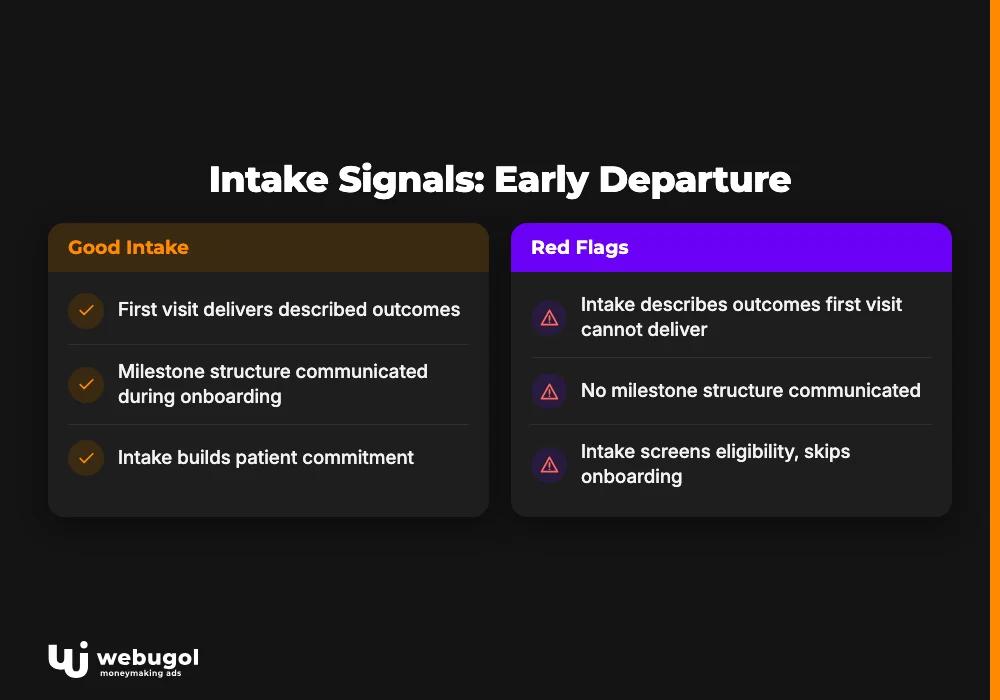
- Intake materials describe outcomes the first visit cannot deliver, creating a disappointment gap before treatment begins.
- No milestone structure is communicated during onboarding, leaving patients without a framework for measuring progress.
- Intake questions are designed to screen eligibility rather than build commitment, so the onboarding step gets skipped entirely.
- No first-week touchpoint follows the initial visit, leaving a silence window when patient motivation is highest.
- Price anchored the acquisition funnel, bringing patients who arrived for a promotional offer rather than a sustained program.
Mapping the patient journey from acquisition to reactivation often reveals that the expectation mismatch was introduced in the funnel long before the patient scheduled the first appointment.
Cause 2: slow follow-up, no-shows, and the silent dropout
The patient who books and never shows is not an acquisition failure. It is a follow-up failure in the 24-to-72-hour window post-booking, and it is one of the most recoverable forms of churn if automation catches it before the window closes.
A no-show recovery sequence must activate within the first 24 hours. Structure it as follows:
- Hours 2–4 post no-show: automated check-in via the patient's preferred channel, with a direct reschedule link.
- Hour 24: second touchpoint with softer framing, acknowledging the missed appointment without pressure.
- Days 3–5: provider-name-personalized outreach for patients with at least one prior visit on record.
- Days 7–10: re-engagement framing appropriate to the program model, within platform health-ad policy.
- Day 14: exit the active recovery track and transition to the lapsed-patient sequence.
Configure this in GoHighLevel or HubSpot using last-appointment-status as the trigger. Every day this automation does not exist, silent dropouts become permanent patient churn with no recovery attempt made.
Cause 3: provider dependency without a practice-level retention system
When patient loyalty lives inside a specific provider rather than inside the practice, a single schedule change or staff departure can trigger a churn wave. The practice does not know it is happening until appointment gaps appear in the data weeks later.
Six signs your retention is living inside individual providers rather than the practice:
- No automated rebooking prompt exists at checkout, so the front desk carries the entire rebooking function.
- Appointment gap data is reviewed at the provider level but not at the practice level.
- Post-visit follow-up is provider-driven rather than system-driven, so it stops when the provider is unavailable.
- Retention metrics are tracked per provider but not for the practice as a whole.
- A provider departure in the past 12 months caused a visible retention dip attributed to the individual rather than to a system gap.
- No practice-level welcome sequence exists for patients transferring between providers.

How to detect patient churn before it hits your revenue
CRM activity signals appear in the data weeks before they surface in revenue reports. That lag is your intervention window. A properly configured GoHighLevel or HubSpot instance can flag these seven conditions before the patient is gone:
- No appointment booked within the patient's standard return interval for their program type.
- Post-visit follow-up sequence opened but no reply logged within 72 hours.
- Appointment reminder ignored for two consecutive cycles.
- Renewal date approaching with no renewal confirmation in the pipeline.
- No referral activity from a patient who has referred at least once before.
- Provider-specific dropout pattern: multiple patients from one provider showing widening appointment gaps simultaneously.
- Billing lapse: a charge scheduled but not processed, indicating a payment method change or voluntary pause.
A coherent patient retention system connects these CRM signals to automated response sequences, so the intervention happens before the patient is lost rather than after the revenue report shows the dip.

Retention tactics that work for subscription and high-ticket clinics
Two tactics consistently outperform others for subscription and high-ticket practices: HIPAA-compliant win-back sequences for lapsed patients, and membership or package structures that embed retention directly into the billing cycle. Both require different execution depending on your clinic model.
Win-back sequences that stay HIPAA-compliant
Re-engaging lapsed patients via email or SMS is effective, but only with the right message structure. The HIPAA constraint is not primarily about whether you can send a message. It is about what the message contains and whether the channel exposes PHI in a non-compliant way, and this distinction is absent from every top-10 article currently ranking for patient churn.
Build your win-back sequence around these guardrails:
- Verify active consent before including any appointment history, diagnosis reference, or health condition in the message body or subject line.
- Use approved message categories: wellness check-ins and appointment availability prompts carry lower compliance risk than treatment-specific outreach.
- SMS messages must include opt-out language in every send and must respect the patient's stated channel preference.
- Email subject lines must contain no PHI: a patient name paired with a health service provider name may constitute PHI even without a diagnosis reference.
- Avoid outcome language in reactivation messages: "schedule your next visit" is lower risk than "resume your treatment plan."
- Run all win-back templates through a practice-level compliance review before launch, not just during initial setup.
For clinics in weight loss, GLP-1, or TRT verticals, these guardrails are not a detail. They are a requirement before any re-engagement sequence goes live.
Membership and package design to reduce voluntary churn
Prepaid memberships reduce voluntary patient churn by embedding scheduled touchpoints, milestone communications, and renewal triggers directly into the billing structure. The next visit is built into the product, not dependent on a separate rebooking decision after each appointment.
Design principles that reduce dropout in subscription wellness models:
- Communicate milestones at the early program points where dropout pressure is typically highest.
- Offer a pause option before a cancel option: a structured pause recovers far more revenue than a full churn event.
- Front-load perceived value in the first 30 days so the patient has tangible benefit before the first renewal decision.
- Set renewal notifications at 14 days and 3 days before the billing date, not just 24 hours before.
- Frame billing communications around the next milestone or outcome check-in rather than around the charge itself.
Who should own patient retention in your clinic?
Retention belongs to everyone and therefore to no one. That is the structural reality in most growth-stage clinics, and it is why churn lives in a support queue while ad spend keeps rising to cover the gap underneath.
The fix requires a single owner with access to both marketing performance data and CRM activity data. Without dual access, no one can connect a rising no-show rate to a specific acquisition cohort or identify whether a new campaign is generating mismatched patients at a higher rate than the previous one.
Here is where retention accountability typically fractures across the four functions that share partial ownership:
- Marketing owns the acquisition funnel and post-visit email sequences but usually lacks CRM access to appointment gap data.
- Operations owns no-show follow-up and front-desk rebooking but rarely reviews retention cohorts or connects them to acquisition cost.
- Clinical owns the provider-patient relationship but does not track practice-level retention patterns independently.
- Billing sees renewal lapses and payment failures earliest but rarely connects that data back to marketing attribution.
This fragmentation is also part of the broader in-house vs. agency accountability question: when retention is split across vendors and internal functions, the coordination cost itself can exceed the revenue impact of the gap, and no individual stakeholder is positioned to see it.
The Healthcare Growth System audit starts by mapping exactly who owns which data and quantifying what the current ownership gap costs in unrecovered revenue. That diagnostic is the right starting point before any retention intervention is funded.
Is your ad spend covering a retention problem?
If your ad budget has grown over the past two or three quarters while net revenue growth has plateaued, the gap is worth diagnosing before the next board conversation. The question is not whether you have a churn problem. It is whether acquisition spend has been masking one long enough that the true cost is invisible in your current dashboard.
A cohort revenue audit separates real acquisition gains from retention-loss coverage. It identifies the share of ad spend functioning as a structural subsidy rather than expansion capital, and targets the fix at the actual cause rather than the symptom. The Healthcare Growth System strategy call starts with that audit.
Schedule a cohort revenue review to see what the current structure is actually producing and where the revenue is going before it compounds.
FAQ
What is a normal patient churn rate for a telehealth clinic?
Telehealth subscription clinics face higher churn pressure than most clinic models because patients make an explicit monthly renewal decision rather than remaining enrolled by default. Rates vary significantly by offer design, billing cycle, and program length, so the more useful benchmark is whether your monthly churn volume is approaching your new-patient acquisition volume. When those two numbers converge, revenue growth stalls regardless of ad spend.
How do you calculate patient churn rate in a medical practice?
Divide the number of patients who did not return within your standard return interval by the total active patient count at the start of the measurement period. The key variable is defining "standard return interval" correctly for your model: a subscription wellness practice might use 30 days, while a quarterly specialist might use 90 days. Misdefining the window consistently understates the actual churn rate and masks the revenue impact until it is too large to ignore.
What are the most common causes of patient churn?
The three most common causes are offer or expectation mismatch at intake, slow follow-up and no-show failures in the 24-to-72-hour window after booking, and provider dependency without a practice-level retention system behind it. Each cause has a distinct symptom and requires a different intervention. A blanket patient-experience initiative typically addresses none of the three at the structural level.
Who should be responsible for patient retention in a clinic?
A single owner with access to both marketing performance data and CRM activity data is the structural answer. In most growth-stage clinics, retention is split across marketing, operations, clinical, and billing functions, each holding a partial view without the full picture. Without one accountable owner, no one can connect acquisition cohort data to appointment gap patterns, which is the diagnostic link required to stop churn before it reaches revenue.
How can clinics re-engage lapsed patients without violating HIPAA?
Use message categories that carry lower compliance risk: wellness check-ins and appointment availability prompts are generally safer than treatment-specific or outcome-specific language. Verify active consent before referencing appointment history or health conditions in the message or subject line, and include opt-out language in every SMS send. All win-back templates should go through a practice-level compliance review before launch, not just during initial setup.

