



Patient Journey Mapping in Healthcare: A Marketing-First Guide for Clinics and Telehealth
Patient journey mapping is a visual diagnostic tool that assigns every touchpoint, from first ad impression to booked consult, to a specific marketing metric. It is a revenue instrument, not a CX exercise. For clinic owners and telehealth CMOs running serious monthly ad spend, a completed map answers one question before the next budget conversation: where is CPA inflated because of a problem the ad platform will never surface?
What Is Patient Journey Mapping?
Patient experience journey mapping charts every step a prospective patient takes, from first contact through intake, first visit, and renewal, pairing each step with the metric that owns it. The output is a diagnostic a Head of Growth can put in front of a founder on Monday and say: the constraint is at this stage, and here is the number.
Patient journey map vs. customer journey map: What's the difference?
A customer journey map models general purchase behavior. A healthcare version must also account for HIPAA constraints on data collection, multi-step intake requirements, clinical trust barriers with no consumer equivalent, and show-rate mechanics that determine whether a booked appointment becomes recognized revenue. The consumer map template does not transfer. A more complete framework, patient and clinician journey mapping, accounts for provider-side steps, triage, referral approvals, care coordination, that directly affect show rate and close rate.
The 5 Stages of the Patient Journey (and the Marketing Metric Behind Each)
Each stage owns a KPI, converting the map from a visual into a diagnostic your team can act on this week:
- Awareness (paid search, organic, social, referral): CPL
- Consideration (site visit to booking intent): CTR / ROAS
- Booking and intake (form to confirmed appointment): show rate
- Treatment or consultation (first visit): close rate
- Post-visit (renewal, referral, reactivation): renewal rate
Awareness: How patients find you (CPL starts here)
CPL is set before a patient ever reaches your site. A rising CPL signals a targeting problem, a message-market fit issue, or competitive pressure, and diagnosing which one is upstream work that no amount of landing page optimization will fix.
Consideration: What drives the booking decision
The gap between a first site visit and a completed booking is where trust signals and page copy determine whether ad spend converts or stalls. A weak consideration stage inflates full-funnel CPA even when your awareness metrics look clean.
Booking and intake: The highest-friction stage
This is where the largest share of qualified leads exits silently, and that exit never surfaces in ad-platform reports. Choosing the right patient intake software that is HIPAA-compliant and tuned to minimize drop-off directly moves show rate. Form length, speed-to-lead, and booking-flow UX are measurable levers, not design opinions.
Treatment or consultation
No-show and cancellation patterns trace back to intake quality and pre-visit nurture sequences, not ad targeting. If close rate underperforms, the map isolates whether the cause is lead quality at awareness or a follow-up gap between booking and appointment.
Post-visit: Retention, renewal, referral
Most decisions to raise acquisition spend are a symptom of a renewal leak the journey map surfaces as a separate, fixable line. Win-back economics depend on data captured and consented to at booking. A post-visit program built on incomplete intake data will underperform regardless of sequence logic, which is why the map must run end-to-end, not stop at the consult.
How to Create a Patient Journey Map: Step-by-Step Template
Process Mapping the Patient Journey: An Introduction
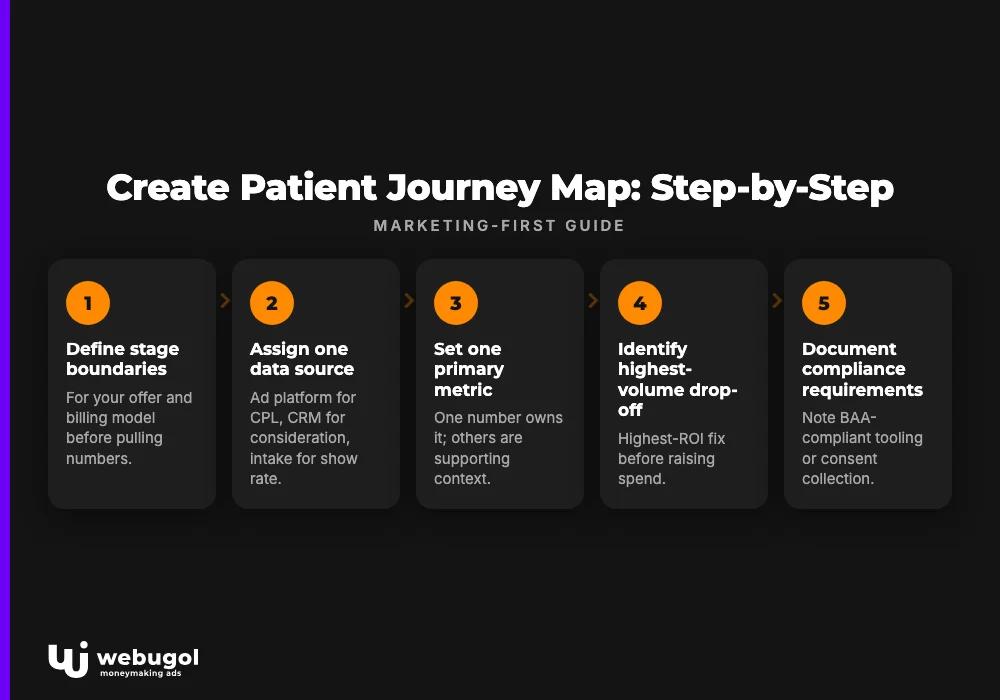
Process mapping the patient journey starts with data, not whiteboarding. Use this template structure:
- Define stage boundaries for your specific offer and billing model before pulling any numbers
- Assign one data source per stage: ad platform for CPL, CRM pipeline for consideration, intake analytics for show rate, billing for renewal
- Set one primary metric per stage: one number owns it; others are supporting context
- Identify the highest-volume drop-off stage: that is the highest-ROI fix before raising spend
- Document compliance requirements: note which touchpoints need BAA-compliant tooling or consent collection
- Schedule monthly reviews: the map is a live diagnostic, not a one-time deliverable
If you want to audit your current funnel before building the full map, the Healthcare Growth System structures that diagnostic as its first-month deliverable.
Patient Journey Mapping for Telehealth: The Digital-First Difference
Telehealth practices have no physical waiting room. Every touchpoint is a digital event with a traceable metric, which shifts the map's weight distribution: no walk-in stage, a longer pre-booking trust sequence, and an intake stage that carries more drop-off risk than any clinic front desk. Clinical credibility is established entirely through a screen, so the consideration and intake stages carry proportionally more of the funnel's work.
BAA-compliant pixels and consent-mode event tracking are not optional at digital touchpoints. Any tool that processes identifiable health information at a patient touchpoint requires a signed Business Associate Agreement before deployment. That guardrail applies to session recording tools as much as to CRMs.
What Does Patient Journey Mapping Reveal About Your Marketing Funnel?
A completed map assigns a measurable metric to each stage, so your team can isolate whether a CPA problem lives at awareness, intake, or ops without guessing. That precision is what makes healthcare conversion rate optimization actionable: you fix the stage with the highest drop-off first, not the page you most recently redesigned.
The stage with the largest drop in patient volume is the highest-ROI intervention before raising budget. Scaling spend before identifying that stage accelerates the leak.
What Tools and Software Are Used for Patient Journey Mapping?
Four tool categories cover this diagnostic work across both clinic and digital-only telehealth funnels:
- Diagramming and whiteboarding: builds the visual map collaboratively across marketing and ops, with stage-level annotations
- CRM pipeline visualization: tracks patients from lead to close, surfaces stage-level drop-off, and ties funnel stages directly to revenue
- Call tracking and session recording: captures the consideration-to-booking transition, including unanswered calls and abandoned booking flows
- Multi-touch attribution dashboards: assigns channel credit and shows which awareness sources produce patients who actually show and close
One guardrail applies across all four categories. Any software in that stack that collects or processes identifiable health information at a touchpoint requires a signed BAA before deployment. That compliance requirement narrows the shortlist faster than any feature comparison will.
Map the Revenue Leak Before You Scale
Scaling ad spend before completing a journey map is the fastest way to accelerate a problem you thought was a budget problem. The map shows whether the constraint is at awareness, intake, or renewal before another dollar goes in. Webugol owns the full revenue path from ad click to recognized revenue, so the diagnostic and the system that executes against it are built as one, not handed off between vendors.
Book a Strategy Call through the Healthcare Growth System to start with a funnel audit in week one.
FAQ
What is patient journey mapping in healthcare?
It is a structured method for documenting every touchpoint from first contact through renewal, with a specific marketing metric assigned to each stage. It functions as a revenue diagnostic, not a design exercise. The output identifies where the highest volume of qualified patients exits the funnel before converting.
How do you create a patient journey map step by step?
Define stage boundaries for your offer, then assign one data source and one primary metric per stage using your ad platform, CRM, intake analytics, and billing system. Identify the highest-volume drop-off stage, document HIPAA compliance requirements at every digital touchpoint, and schedule monthly reviews against live funnel data.
What tools are used for patient journey mapping?
The four core categories are diagramming tools for the visual map, CRM pipeline visualization for lead-to-close tracking, call tracking and session recording for the consideration-to-booking stage, and multi-touch attribution dashboards for channel-level diagnosis. Any tool that processes identifiable health information requires a signed Business Associate Agreement before deployment.
How does the journey map improve patient acquisition?
The map shows which funnel stage is driving high CPA before you raise spend. If intake drop-off is the bottleneck, optimizing ad targeting will not fix it. Directing optimization effort to the highest-friction stage produces better acquisition economics than scaling budget across the board.
What is the difference between telehealth and in-person patient journey mapping?
In-person maps include physical touchpoints like front-desk check-in, waiting, and provider handoffs that have no direct digital equivalent. Telehealth maps shift weight to the consideration and intake stages, where all trust-building is digital. Every touchpoint in a telehealth funnel requires BAA-compliant tracking tools regardless of how minor the implementation seems.