



Digital marketing for industrial companies: A practical guide
Digital marketing for industrial companies is the use of SEO, paid search, content, and email to reach technical buyers, generate qualified leads, and grow revenue in B2B markets. Manufacturers that build a consistent industrial online presence routinely outperform competitors still relying on trade shows and printed catalogs. Industrial buyers complete most of their supplier evaluation online before making any contact, which means your website and search rankings do the selling first. This guide covers the specific strategies that work for manufacturers, distributors, and industrial service providers. Rankings arrive before calls do.
What is digital marketing for industrial companies?
Digital marketing for industrial companies is a system of online channels used by manufacturers, distributors, and industrial service providers to reach engineers, procurement managers, and operations directors during their technical research phase. The goal is to appear with the right content at the right moment in the buyer's process, not simply to broadcast a brand message.
The core difference from consumer campaigns is buyer behavior. Industrial buyers evaluate multiple suppliers online, compare specifications across product lines, and often reach informal shortlists before contacting anyone. Your content library, search visibility, and website architecture handle qualification long before any sales conversation begins.
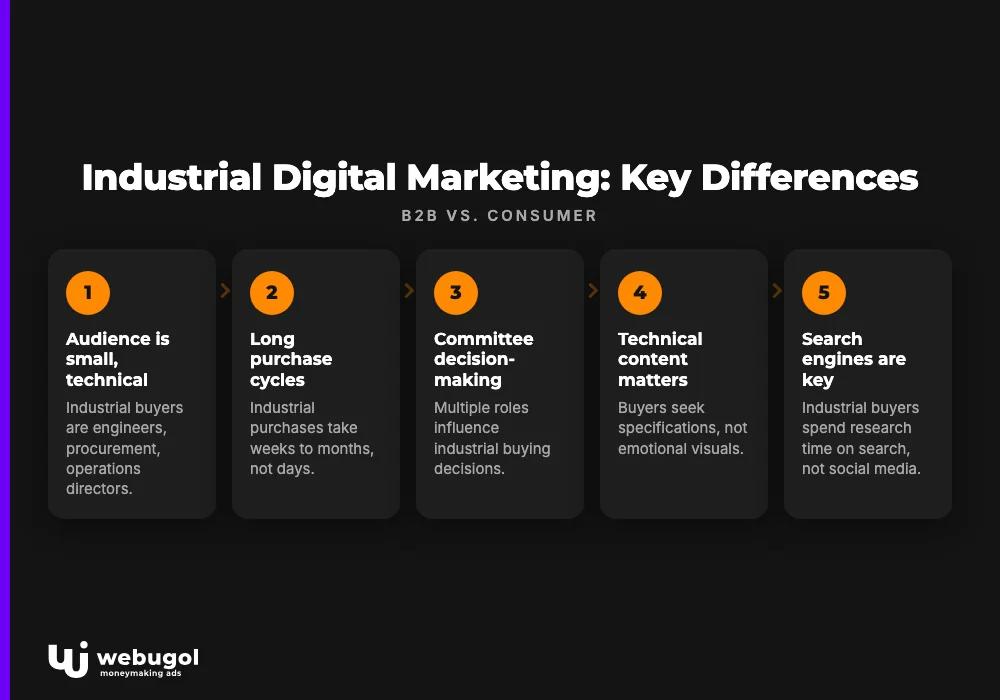
This reality shapes every decision in b2b manufacturer marketing. The audience is small and technical. Purchase cycles are long. Every channel decision carries more downstream weight than in consumer advertising.
How industrial buying differs from consumer purchasing
| Factor | Consumer marketing | Industrial B2B marketing |
|---|---|---|
| Audience size | Millions | Hundreds to thousands |
| Purchase cycle | Days to weeks | Weeks to months |
| Decision-makers | Individual | Committee: engineer, procurement, C-suite |
| Primary content type | Emotional, visual | Technical, specification-driven |
| Key channels | Social media, display | Search, email, industry content |
| Sales touchpoints | 1–3 | 5–12 or more |
Understanding where industrial buyers spend their research time is the foundation of any manufacturing marketing strategy. Most of that time is on search engines, not social media feeds.
Why do industrial companies need SEO?
Industrial companies need SEO because procurement teams and engineers use search engines to research and shortlist suppliers before making any contact. A manufacturer without strong search rankings simply does not appear in most buyers' consideration sets, regardless of product quality.
The business case is compounding value. Paid ads stop delivering the moment budgets stop. Organic rankings continue driving traffic and qualified leads for months or years after the optimization work is complete. That long-term return makes seo for manufacturers a core investment rather than an optional add-on. Competition never stops growing.
One underused application is local search. Manufacturers serving regional markets can capture high-intent buyers by optimizing for location-specific queries. A precision machining shop should rank for regional terms as well as generic product categories. Claiming and maintaining a Google Business Profile with accurate contact details, service descriptions, and client reviews supports both local rankings and buyer credibility.
Website architecture also affects industrial search performance in ways that consumer sites avoid. Product catalogs with hundreds of SKUs need logical category hierarchies, clean URLs, and internal linking that lets search engines understand the relationships between products. A well-structured catalog also helps procurement managers find specifications without calling your team for every detail. Manufacturers managing large product lines often benefit from a headless CMS platform that separates content management from website presentation, which reduces the engineering overhead of SEO updates and catalog maintenance.
For a detailed breakdown of search tactics built for manufacturing contexts, see our guide to improving search rankings for industrial sites.
How do industrial companies generate leads online?
Industrial lead generation online works through search visibility, high-value technical content, and targeted outreach that reaches decision-makers at the right stage of their evaluation. Three channels consistently deliver qualified leads in industrial markets.
Organic search captures buyers who already know what they need and are comparing suppliers. Ranking for product-specific queries brings in visitors with strong purchase intent, often at no cost per click once rankings are established.
PPC advertising fills organic gaps and accelerates results during product launches or competitive pressure. Cost-per-click in industrial categories runs higher than in consumer markets, but so does conversion intent, because the visitor pool self-selects. Every click is trackable, which makes budget optimization straightforward.
Email outreach reaches existing contacts and nurtures prospects who are not yet ready to request a quote. The key is segmentation. Grouping contacts by product category, buyer role, and evaluation stage lets you deliver content that moves people forward rather than repeating the same broadcast newsletter.
Relevance ties all three together. Industrial buyers filter out generic messaging quickly. Your industrial content marketing must address the specific technical problem the buyer is currently researching, not your company's general positioning.
What digital marketing strategies work best for manufacturers?
The strategies that consistently deliver results are SEO, technical content marketing, PPC, and targeted email. Social media plays a supporting role in most b2b manufacturer marketing programs, but it rarely drives direct pipeline at scale in industrial sectors.
Content marketing for manufacturers
Industrial content marketing builds authority by answering the technical questions buyers are already searching for. The most effective formats are technical blog posts, white papers, case studies, product demonstration videos, and specification guides.
Blogs and articles drive organic traffic when optimized for the terms engineers use during problem research. White papers convert leads when buyers need in-depth guidance to justify a purchase decision internally. Case studies close deals by presenting real project outcomes with named clients and measurable results.
The discipline that separates effective industrial content from filler is specificity. A white paper on improving welding efficiency in a specific application outperforms a generic manufacturing productivity article every time. Vague content fails to rank for technical queries and fails to convert the buyers who do find it. Specificity wins every time. For a structured approach to planning at this depth, see our overview of developing content programs for industrial manufacturers.
PPC advertising for industrial products
Pay-per-click advertising lets manufacturers appear at the top of search results for competitive terms where organic ranking takes months. Industrial PPC campaigns typically target product categories, specific applications, and competitor brand terms.
The main advantage is speed. New products and new markets get immediate visibility. The main challenge is budget discipline. Industrial CPC rates vary significantly by market competitiveness. Campaign structure, match type selection, and negative keyword lists all require ongoing management to avoid wasted spend.
Measuring PPC ROI in industrial contexts means tracking beyond clicks. Cost per lead, lead-to-quote rate, and quote-to-contract rate are the metrics manufacturing sales teams care about most. Click volume without conversion context gives an incomplete picture. Track what actually converts.
Social media in a B2B industrial marketing plan
LinkedIn is the only platform that reliably delivers B2B industrial results. It allows targeting by job title, industry, company size, and seniority, placing your content in front of procurement directors and plant managers rather than a general audience.
Other platforms generate low-engagement results in most industrial categories. The realistic role of social media in a manufacturing marketing strategy is to amplify SEO and email efforts, not replace them. Sharing technical articles on LinkedIn extends content reach. Direct pipeline from social is the exception in most industrial markets.
Email in industrial lead generation
Email lets manufacturers maintain contact with prospects across the long purchase cycles typical of B2B industrial buying. Segmented campaigns based on product category, buyer role, and evaluation stage outperform broadcast newsletters significantly.
Automation sequences triggered by content downloads, specification guide views, or quote requests let marketing teams nurture many prospects simultaneously without manual follow-up on each interaction. Scale becomes effortless. For the detailed tactics behind this channel, read our guide on targeted email campaigns for manufacturers.

How much does digital marketing for industrial businesses cost?
No single cost benchmark applies across all manufacturers. Budget depends on company size, target markets, competitive intensity, and channel mix. What industrial marketing programs consistently show is that email and PPC deliver stronger ROI than print advertising and trade exhibitions, which typically consume the largest share of traditional industrial marketing budgets.
The main spending categories for digital marketing for industrial companies are agency or in-house staffing, SEO tools and website infrastructure, paid search advertising, and content production. The allocation between these depends on whether you build in-house or work with a specialized team.
One structural advantage of digital over trade shows is that every dollar spent generates trackable data. Cost per lead, channel attribution, and conversion rates are visible within weeks, allowing continuous optimization rather than waiting until the next annual exhibition to assess results.
Measuring what matters in industrial digital marketing
Standard web analytics cover traffic and engagement but miss what drives revenue in industrial markets. The metrics that matter for pipeline and sales are:
- Marketing qualified leads (MQLs): contacts who engaged with technical content, downloaded a specification, or requested a product guide
- Sales qualified leads (SQLs): MQLs reviewed and accepted by your sales team for active outreach
- Cost per SQL: total marketing spend divided by SQLs generated in a given period
- Lead-to-quote rate: the percentage of leads that progress to a formal quote request
- Revenue influenced by digital: total contract value from deals that originated through digital channels
Platforms like HubSpot, Marketo, and Salesforce Pardot connect lead source data with sales outcomes. That connection is the only reliable way to calculate a real digital marketing ROI for industrial companies. Most teams skip this. SharpSpring and Autopilot offer comparable capabilities for smaller manufacturing teams with tighter tooling budgets.

Start building your industrial digital marketing program
Industrial buyers are already online, searching for suppliers, comparing specifications, and building shortlists without speaking to anyone. Companies that are not visible at those moments lose deals before their sales team is ever involved.
Webugol is a digital marketing agency that works with manufacturers and industrial companies to build search visibility, generate qualified leads, and convert technical buyers into long-term customers. Contact us to discuss a strategy built for your specific sector and markets.
FAQ
What is digital marketing for industrial companies?
Digital marketing for industrial companies is the use of SEO, paid search, content, and email to attract and convert B2B buyers in manufacturing and industrial sectors. It targets engineers, procurement managers, and operations directors during their technical research phase. The primary goal is generating qualified leads that turn into actual sales, not broad consumer awareness.
How do industrial companies generate leads online?
Industrial companies generate leads through organic search, PPC advertising, and segmented email campaigns aimed at technical buyers. Organic search delivers the highest-intent visitors because they are actively searching for a specific product or solution. Email nurtures prospects through the long evaluation cycles that are standard in industrial purchasing.
What digital marketing strategies work best for manufacturers?
SEO and technical content marketing deliver the strongest long-term results because they compound over time and attract buyers with high purchase intent. PPC provides faster results and suits competitive gaps in organic coverage or new product launches. LinkedIn is the only social platform that reliably generates B2B pipeline for most manufacturers.
How much does digital marketing cost for industrial businesses?
Industrial digital marketing costs vary by company size, competitive intensity, and channel mix, with no single figure applying to all manufacturers. Digital channels typically offer stronger ROI than trade shows because every spend generates trackable performance data. Most manufacturers see better returns by building SEO and content foundations before scaling paid channels.
Why do industrial companies need SEO?
Industrial companies need SEO because procurement teams and engineers use search engines to research and shortlist suppliers before making any contact. Without strong rankings for product and application queries, a manufacturer does not appear in most buyer shortlists. Organic rankings also continue driving leads long after the initial optimization investment, unlike paid advertising that stops when the budget stops.