



Alcohol treatment SEO: how rehab centers reach patients online
Alcohol treatment SEO is how rehab centers ensure people searching for help can find them at the exact moment they need it. It places treatment centers in front of high-intent searches like "alcohol rehab near me" or "help with drinking problem" and connects those searchers to credible, relevant resources. For addiction treatment providers, search visibility is not a growth metric. It is a direct line to people in crisis. Every second counts.
What SEO strategies work for addiction treatment centers?
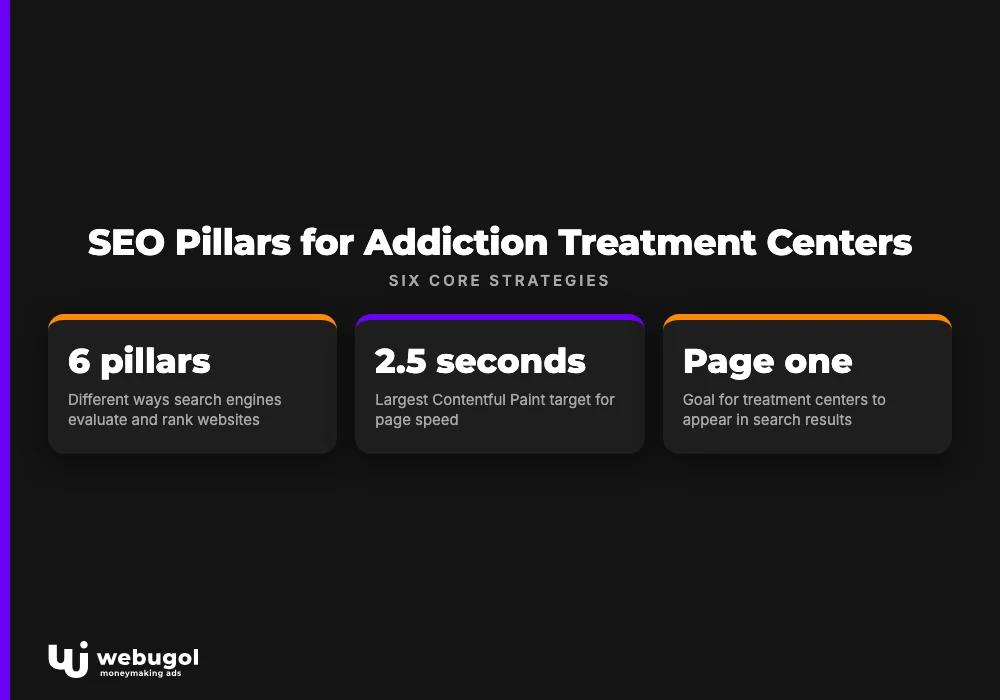
Effective rehab center SEO stacks several disciplines, each addressing a different way search engines evaluate and rank websites. Together they determine whether a treatment center appears on page one or stays invisible.
| SEO pillar | What it covers |
|---|---|
| Keyword research | Finding terms patients and families actually search |
| On-page optimization | Title tags, meta descriptions, headings, body copy |
| Technical SEO | Page speed, mobile usability, schema markup |
| Treatment center local SEO | Google Business Profile, citations, geo-targeted content |
| Content marketing | Guides, FAQs, and blog posts that answer real questions |
| Link building | Earning backlinks from healthcare and recovery sources |
No single pillar works in isolation. Strong content on a slow, uncrawled site gets no traffic. A fast site with no content ranks nowhere. Behavioral health SEO performs when all six areas reinforce each other.
Alcohol treatment SEO starts with technical and on-page foundations
Every page on a rehab center website needs a clear keyword focus in the title tag, H1, and meta description. Schema markup, specifically LocalBusiness and MedicalOrganization types, gives search engines structured signals to surface the right pages. Page speed matters unusually much here: people in crisis often search from mobile devices on cellular connections, and a slow site is a closed door. Speed saves lives here. Google's Core Web Vitals provide a practical benchmark, with Largest Contentful Paint under 2.5 seconds as the primary target.
What keywords should alcohol rehab centers target?
The answer: a mix of crisis-driven terms and longer informational phrases that match different stages of the help-seeking journey.
Keyword categories that consistently drive admissions include:
- Crisis intent: "alcohol detox near me," "emergency alcohol treatment," "help for alcohol addiction now", short, urgent searches often made from a phone in a moment of decision.
- Research phase: "how does alcohol rehab work," "what to expect at a treatment center," "alcohol rehab cost", longer queries from families gathering information before committing.
- Comparison searches: "inpatient vs outpatient alcohol treatment," "best alcohol rehab in [city]", active evaluation of specific options.
- Family and support: "how to help someone with alcohol addiction," "alcohol treatment for a family member", friends and relatives searching on a loved one's behalf.
Long-tail keywords carry lower individual search volume but higher conversion potential. Volume misleads you. "Alcohol addiction treatment center in [city] with insurance" is far more likely to generate an inquiry than the generic term "alcohol rehab." Drug rehab digital marketing campaigns that chase only high-competition head terms consistently underperform those built around a precise, intent-specific keyword architecture.
Reviewing competitor keyword coverage is also practical. Analyzing which terms drive traffic to similar regional facilities reveals gaps in your existing content. Track performance with analytics tools and adjust strategy over time.
How does local SEO help rehab centers attract more patients?
Most people seeking alcohol treatment look for facilities within a driveable distance. Treatment center local SEO ensures your center appears when those geographic searches happen, placing it in the Google local pack above standard organic results.
The foundation is a complete, accurate Google Business Profile. Consistent name, address, and phone data across your website and all directories is the single most important local ranking factor. Discrepancies suppress visibility. Check every listing. Listing your practice on directories like Yelp and Bing Places extends that geographic signal further.
Encouraging alumni to leave reviews, following applicable privacy and HIPAA guidelines, builds credibility and strengthens local pack performance. A structured local SEO approach for healthcare providers applies directly to addiction treatment facilities, including geo-specific landing pages for each location. For multi-location treatment groups, each facility needs its own optimized page with unique content, city-specific keywords, and a separate Google Business Profile. Shared or duplicated content fragments local authority and dilutes geographic relevance signals.
How to build online trust as an addiction treatment provider?
Trust is the conversion variable that separates behavioral health SEO from most other verticals. Someone choosing an alcohol treatment program is making a decision that carries weight a typical online purchase does not.
Website design as a credibility signal
A professional, uncluttered design communicates competence before a visitor reads a word. Easy navigation reduces cognitive load on people who may already be emotionally depleted. The trust elements that work are specific: staff credentials and photos, state licensing information, accreditation details, and clear program descriptions. Vague claims like "we help people recover" persuade no one. Families notice immediately. Concrete specifics do: what intake looks like, what a typical week in the program involves, what aftercare includes.
Colors, typography, and imagery should project calm and compassion rather than urgency-driven sales pressure. Healthcare website design and development that reflects clinical professionalism is a core asset for any addiction treatment provider, not a cosmetic detail.
Content quality, E-E-A-T, and search authority
Google's quality guidelines classify addiction treatment content as "Your Money or Your Life" (YMYL) material. The bar for demonstrated expertise, experience, authoritativeness, and trustworthiness is higher here than in most categories. Content written or reviewed by licensed clinicians satisfies both the algorithmic standards and the expectations of families who can recognize credible medical writing on sight.
Evergreen content covers topics that stay relevant over time: understanding alcohol use disorder, what medically supervised detox involves, how to talk to a loved one about treatment. This type of content attracts ongoing organic traffic and positions the center as a reliable resource. Recovery center marketing built on genuinely useful, clinically grounded content outperforms promotion-first copy at every stage. The same organic-first approach shapes search strategy across regulated health sectors, a topic explored in depth in our guide to healthcare and wellness search marketing.
Building backlinks and expanding alcohol rehab online visibility
A backlink from a credible healthcare publication, a recovery organization, or a local hospital system is a direct authority signal to search engines. For alcohol rehab online visibility, editorial links from addiction-focused media and established health directories carry more weight than generic directory submissions.
Practical approaches for addiction treatment marketing include:
- Guest contributions to reputable recovery or behavioral health publications.
- Referral partnerships with local hospitals, mental health clinics, and community organizations.
- Co-authored resources with licensed clinicians who have their own online presence.
Each legitimate backlink also creates a referral pathway that benefits admissions independently of its SEO impact. That compounds fast. Someone reading an article on a mental health site may click through directly and begin the inquiry process. One firm rule applies across all drug rehab digital marketing: avoid paid placements disguised as editorial content, link networks, or reciprocal schemes. Google's spam policies apply in full here, and healthcare verticals have faced the most direct enforcement through successive algorithm updates.
Work with a team that understands alcohol treatment SEO
Sustained alcohol rehab online visibility requires consistent execution across keywords, technical performance, content, and local presence. Our professional SEO services are built for regulated health sectors where both search engine standards and ethical obligations shape every decision. As a digital marketing agency with experience in addiction treatment marketing, we audit your current rankings, identify gaps, and build a plan that puts your center in front of the people who need it most. Schedule a consultation to get started.
FAQ
What is alcohol treatment SEO?
Alcohol treatment SEO is the process of optimizing a rehab center's website and online presence so it ranks for queries related to alcohol addiction and recovery. It covers keyword strategy, technical site health, local search optimization, and content development. The goal is to connect people actively searching for help with the right treatment resources.
How long does rehab center SEO take to show results?
Most treatment centers see meaningful ranking movement within three to six months of implementing a comprehensive alcohol treatment SEO strategy. Local SEO improvements, particularly a well-optimized Google Business Profile, often show results faster. Long-term authority through content and backlinks compounds over a longer timeline.
What keywords should an alcohol rehab center prioritize?
Target a mix of crisis-driven terms ("alcohol detox near me"), research-phase queries ("how does alcohol rehab work"), and location-specific phrases ("alcohol treatment center in [city]"). Long-tail, intent-specific keywords consistently outperform generic head terms for generating actual admission inquiries in drug rehab digital marketing campaigns.
How does local SEO benefit a single-location treatment center?
A well-optimized Google Business Profile and consistent local citations place a single-location center in the local pack for geographic searches, which appear above standard organic results and capture the highest-intent local traffic. Location-specific landing page content reinforces that placement. Treatment center local SEO can significantly increase qualified inquiry volume even when competing against regional chains.
Why does content quality matter so much in behavioral health SEO?
Google classifies addiction treatment content as YMYL ("Your Money or Your Life"), applying stricter quality standards for ranking than in most categories. Content written or reviewed by licensed clinicians satisfies both the algorithmic E-E-A-T requirements and the expectations of families evaluating treatment options. Thin or generic content ranks poorly and fails to convert the visitors it does attract.

