



Industrial Content Marketing: The Strategy Guide for Manufacturers
Industrial content marketing is the practice of creating and distributing technical, educational material that guides engineers, procurement managers, and plant executives through a long, committee-driven buying process. Successful content marketing for manufacturers converts product expertise into a consistent pipeline of qualified leads. Unlike generic B2B content, it speaks to buying committees at every stage of a research cycle that often spans many months, matching each stakeholder with the format and depth they need.
Whether you are mapping your first industrial content marketing plan or running an established manufacturing business where lead flow has stalled at a growth plateau, the root cause is usually the same: no repeatable system for turning technical knowledge into buyer attention. That gap is not industry-specific: it is the same structural weakness that stalls any founder or SMB owner whose website is live but not generating consistent leads.
What is content marketing for industrial companies?
Content marketing for industrial companies is a B2B content strategy built around the specific demands of technical buyers. Instead of broad brand messaging, it produces application notes, comparison guides, process explainers, and case studies that address the exact questions buyers are researching before they contact any vendor.
Three things separate it from standard B2B approaches. First, the audience has real technical depth. Engineers and procurement specialists evaluate claims precisely. A vague performance statement does not just fail to persuade. It signals that the vendor does not understand the product category.
Second, buying committees involve multiple roles. A capital equipment purchase typically involves an engineer who will use the product, a procurement specialist who controls the budget, and an executive who approves the decision. Each needs different content at different stages. A technical integration guide satisfies the engineer. A total-cost-of-ownership analysis moves the procurement decision. A summary of vendor track record provides the executive sign-off.
Third, the research phase is long. Industrial buyers conduct significantly more independent research before contacting a vendor than buyers in most other B2B categories. Your content must be present and credible throughout months of independent evaluation, well before your sales team gets a call.
How to build a content strategy for manufacturing?
A manufacturing content marketing strategy starts with three decisions: who you are targeting at each buying stage, what information each persona needs to advance, and how you will measure progress. Here is a practical framework.
Map buyer personas before you create anything. Industrial audiences segment sharply by role. Engineers care about specifications, integration compatibility, and failure modes. Procurement cares about total cost of ownership, vendor financial stability, and supply chain risk. Plant managers care about installation time and production downtime during commissioning. A B2B content strategy that treats these as one audience produces content that resonates with none of them.
Audit what your company already has. Most manufacturers hold more raw content material than they realize. Sales teams answer the same technical questions on every call. Case studies exist in email threads. Data sheets circulate as PDFs but never appear on the website. A content audit surfaces this material before you commission new production.
Build the calendar around buying triggers, not the calendar year. In industrial markets, purchasing activity concentrates around budget cycles, plant maintenance shutdowns, new product launch windows, and regulatory deadlines. A content calendar that ignores these patterns consistently publishes at the wrong moment. Tying your industrial marketing ideas to these triggers ensures content reaches buyers when they are actively evaluating solutions.
Run keyword and competitive research together. Identify the exact phrases your buyers type when researching solutions, then map competitors' organic footprints using SEO tools. Find the gaps: topics where competitor content is thin, questions they do not answer, formats they ignore. For a closer look at how search fits into a broader industrial marketing plan, how industrial companies can improve search visibility and attract qualified buyers covers the channel-level mechanics in depth.
Set success metrics before you publish. Page views and social shares tell you nothing about revenue. Define upfront which numbers connect content activity to business outcomes: qualified leads from organic search, content-influenced pipeline as a share of total revenue, and time-to-first-contact by content entry point.
Analyzing the competitive content landscape
A competitive analysis for industrial content marketing goes beyond reading competitors' websites. Use SEO tools to map their organic keyword rankings, content types, and publishing cadence. Then run a gap analysis: find topics where competitor coverage is thin, questions that go unanswered, and formats that are underdeveloped.
This analysis typically reveals that the most valuable content opportunities are not the obvious head terms. High-intent queries buyers use late in their research, specific application-level searches, often have less competition and higher conversion rates than broad category terms. A manufacturer of hydraulic components may find more traction with a detailed buyer's guide for a specific installation context than with a generic category page.
What types of content work best for industrial businesses?
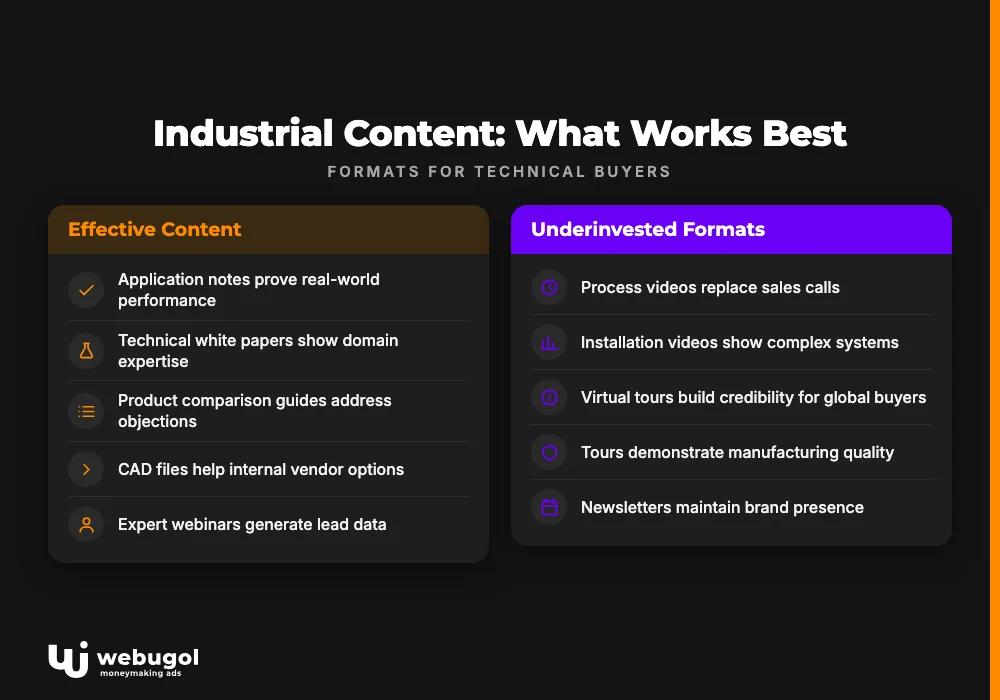
Technical buyers consume content differently from consumer audiences. They read carefully, compare across multiple sources, and return to reference material repeatedly throughout a buying cycle that spans months. The formats that convert in industrial markets directly reflect this behavior.
| Content type | Best stage | Why it works |
|---|---|---|
| Application notes and case studies | Consideration | Proves real-world performance in the buyer's specific context |
| Technical white papers | Awareness, Consideration | Demonstrates domain expertise and answers "how does this work" |
| Product comparison guides | Decision | Addresses objections before the first sales conversation |
| Process and installation videos | Awareness, Consideration | Shows complex systems faster than text and is easier to retain |
| CAD files and detailed specifications | Decision | Engineers need these to present vendor options internally |
| Expert webinars | All stages | Generates lead data and reveals active buying intent |
| Interactive product configurators | Decision | Lets buyers customize specifications before calling sales |
| Industry newsletters | All stages | Maintains brand presence during long periods between purchases |
Two formats industrial companies consistently underinvest in are video and virtual facility tours. A short video demonstrating a process or installation often replaces a thirty-minute sales call. It answers the same questions faster and in a format buyers can share internally. A virtual tour demonstrates manufacturing quality and process control to global buyers who cannot visit in person, building the kind of credibility that specification sheets cannot replicate.
Technical content creation: depth without losing decision-makers
Industrial content must be accurate. A buyer who spots a technical error will not call to discuss it. They will move to a competitor who gets the details right.
The problem is that content written exclusively for engineers loses the procurement specialist and the executive who control budget approval. The solution is layered structure. Start with a 150-200 word executive summary. Follow it with full technical depth. End with a clear action item. Each stakeholder reads to their level of need and stops.
Visuals are a functional requirement in technical content creation, not decoration. Diagrams showing how a system operates, before-and-after performance charts, and annotated product photos reduce the cognitive load of processing dense information. Industrial content marketing that relies only on prose leaves significant persuasion value unrealized.

How does content marketing generate leads for manufacturers?
Industrial content marketing generates leads through a specific sequence. Each step builds on the previous one, and skipping any step breaks the chain.
Search visibility puts you in the evaluation before sales knows the buyer exists. Most industrial buying journeys start with a specific search query. A procurement manager evaluating vendors types terms related to their application or challenge. If your technical content ranks for those queries, you are being evaluated before any sales contact occurs. This is the phase where most industrial deals are won or lost, and it happens entirely outside your sales process.
Published case studies and white papers do credibility work at scale. A documented result for a named customer in the buyer's industry accomplishes more than a sales email. It demonstrates that you have solved the specific problem before. That shifts the conversation from "convince me you can do this" to "help me understand the implementation," which is a fundamentally different and faster conversation.
Gated content converts research intent into lead data. An in-depth guide on a process challenge your buyers face regularly, available in exchange for contact information, captures buyers who are actively evaluating solutions. These leads typically convert at higher rates than paid traffic leads because the buyer has self-selected based on a genuine research need.
Email sequences sustain attention across long buying cycles. A structured email program that delivers relevant technical content keeps your brand visible without requiring sales intervention at every touchpoint. For practical guidance on building these sequences, structuring email nurture programs for industrial buyers covers segmentation, cadence, and content selection in detail.

Which channels work best for industrial content distribution?
Effective industrial marketing channels are a shorter list than most teams expect. The question is not which channels exist, but where your specific buyers spend time during a purchasing process. For most industrial segments, four channels carry the majority of the load.
Organic search is the highest-return channel over time. Technical queries in industrial markets have lower competition than consumer categories, and buyers at the decision stage use highly specific search terms. A manufacturer who publishes consistently on topics that match buyer queries builds compounding organic traffic without ongoing ad spend. The advantage grows the longer you sustain the effort.
Email marketing reaches industrial decision-makers directly. Industrial buyers check email. A segmented list organized by buyer role and product interest delivers relevant content without fighting for feed placement. A newsletter covering process improvements, application updates, or regulatory changes keeps your brand associated with useful information during the long periods between active purchases. Building that list into an effective email marketing program turns a distribution channel into an ongoing lead nurture system.
LinkedIn is the productive exception in social media. Industrial content marketing on most social platforms produces low returns. LinkedIn is different. Procurement managers, plant engineers, and operations executives use it for industry research. Articles linking back to your technical content, short videos of equipment in operation, and posts explaining process challenges all perform in this context. Treat LinkedIn as a traffic driver, not a publishing destination. Understanding how industrial companies use social media channels effectively helps you prioritize which platforms to invest in by product category and buyer role.
Industry publications accelerate trust-building. A guest article in a recognized trade journal exposes your content to audiences you have not yet earned as an owned following. The credibility transfer from the publication to your brand compresses the trust-building timeline in ways that owned media alone cannot replicate.
Paid search fills organic coverage gaps. For high-intent queries where you do not yet rank, paid search keeps you visible while content builds organic authority. Pairing paid support with organic content around the same keywords consistently outperforms either channel alone.
Measuring industrial content marketing performance
Most manufacturers track the wrong metrics. Page views and social impressions are not business outcomes. The numbers that connect content investment to revenue are:
- Qualified leads from organic search: contact form submissions and calls that originate from organic search sessions
- Content-influenced pipeline: deals in the sales pipeline that included at least one content interaction before the first sales conversation
- Time-to-first-contact by entry point: how long a new visitor from a specific content piece takes to become a known lead
- Email engagement by buyer segment: open and click rates for each persona group, which signals whether content matches that audience's actual concerns
Review these monthly. When a content type consistently drives lead volume, produce more of it. When a channel delivers traffic but no leads, investigate whether the content matches the intent of that channel's audience before increasing spend.
Stop losing the research phase to competitors
Manufacturers with deep product knowledge are sitting on a content asset that most of them never use at full capacity. Competitors who do use it consistently earn the evaluation phase of every buyer's journey before your sales team receives the first call. That gap is structural, and it compounds over time in favor of whoever built a consistent manufacturing marketing strategy first.
Webugol builds websites that grow, along with the content infrastructure that fills your pipeline. If your business has the expertise buyers need and you are not capturing organic leads from it, contact us to map where the gaps are and what closing them is worth.
FAQ
What is content marketing for industrial companies?
Content marketing for industrial companies is a B2B content strategy that uses technical, educational material to attract and guide buyers through complex, committee-driven purchasing cycles. It relies on formats like application notes, case studies, and white papers that match the research patterns of engineering and procurement audiences.
How long does it take to see results from industrial content marketing?
Most programs show measurable organic search growth within 6 to 12 months, with lead volume increasing as published content earns search rankings and backlinks over time. Email campaigns can generate leads faster, but organic search is the channel that compounds in value without proportional increases in cost.
What makes a B2B content strategy for manufacturing different from standard B2B content?
Unlike general content marketing B2B frameworks, industrial content must be technically precise and structured for buyers who evaluate claims rigorously. Engineers and procurement managers expect accurate specifications, real application data, and reference material they can return to during a long evaluation cycle. The multi-role buying committee also requires content at multiple depth levels for different stakeholders.
How much content should a manufacturing company publish?
Consistency matters more than volume. One well-researched technical guide or case study per week typically outperforms five thin posts in both search performance and buyer credibility. In industrial content marketing, depth and specificity drive results more than raw publishing frequency.
Which content formats generate the most leads for industrial companies?
Case studies and application notes consistently produce the highest-quality leads because they match the research a buyer is already conducting. A detailed case study placed in the buyer's specific application context signals that you have solved their problem before, which shortens the qualification conversation significantly.

