



Industrial social media marketing for manufacturers
Industrial social media marketing gives manufacturers a direct channel to reach engineers, procurement managers, and B2B buyers without relying on trade shows or cold outreach. The right platform mix, consistent content, and targeted paid campaigns build brand authority and generate leads throughout the long purchase cycles common in industrial sectors. That window matters. This guide covers which platforms work, how to build a strategy, and what to measure.
What social media platforms are best for industrial companies?
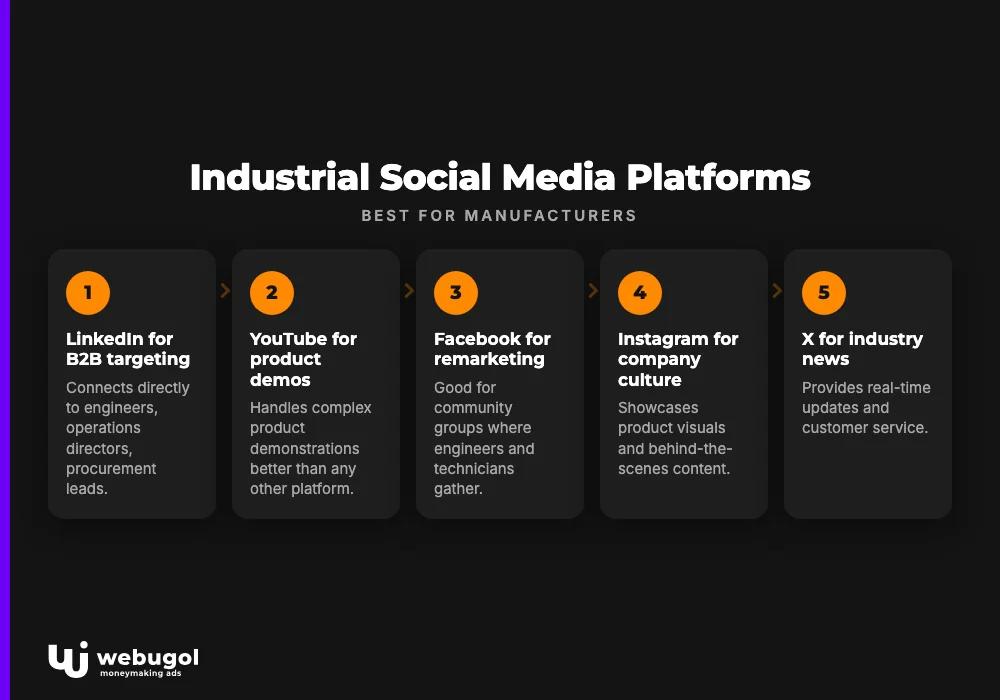
LinkedIn and YouTube are the strongest starting points. LinkedIn connects you directly to engineers, operations directors, and procurement leads who make or heavily influence purchasing decisions. YouTube handles complex product demonstrations better than any other platform. The wrong channel wastes budget.
Here is how the main platforms compare for industrial use:
| Platform | Best use case | Primary audience |
|---|---|---|
| Thought leadership, lead generation, B2B targeting | Professionals, decision-makers | |
| YouTube | Product demos, tutorials, process explainers | Technical buyers, engineers |
| Brand awareness, community, remarketing | Broad industrial and B2C mix | |
| Company culture, product visuals, behind-the-scenes | Younger buyers, general audiences | |
| X (Twitter) | Industry news, real-time updates, customer service | Industry professionals |
LinkedIn for industrial companies delivers the most precise access to B2B buyers. Its targeting filters by industry, job title, and company size, so your budget reaches decision-makers rather than passive browsers. Facebook marketing for manufacturers still earns its place for remarketing campaigns and community groups, where engineers and technicians often gather outside work hours.
Most manufacturers find that two or three platforms done consistently outperform five done poorly. Start narrow, prove the channel, then expand.
How to build a social media strategy for a manufacturing company?
A working B2B social media strategy for manufacturers starts with three defined goals: brand awareness in target verticals, qualified lead generation, and ongoing customer support. Without defined goals, every post becomes a guess.
Core steps for building the strategy:
- Define your audience. Industrial buyers are typically engineers, operations managers, or procurement specialists. Their content needs are technical and evidence-based, not lifestyle-driven.
- Set measurable goals. Follower counts are vanity metrics. Track demo requests, lead form submissions, and the pipeline generated from social channels.
- Choose two or three platforms. Spreading effort across five platforms dilutes quality. Social media management for manufacturers works best when resources are concentrated.
- Build a content calendar. Consistency matters more than volume. One strong LinkedIn post per week beats daily filler.
- Engage and respond. Reply to comments, answer technical questions, acknowledge reshares. This builds credibility with buyers and with platform algorithms.
- Review analytics monthly. Click-through rate, engagement rate, and conversion rate reveal what resonates. Adjust allocation based on data, not assumptions.
Manufacturers who want search-driven visibility alongside social should read this guide on driving organic search traffic for industrial brands, which covers how both channels reinforce each other.
What type of content performs best for industrial brands on social media?
Technical and educational content consistently outperforms promotional posts for industrial audiences. Engineers and procurement managers engage when content answers real questions, documents proven results, or demonstrates clear product capability. Promotional posts without substance get scrolled past.
High-performing formats for industrial social media marketing:
- Product demonstration videos: short clips showing equipment in operation, setup processes, and edge cases handled. YouTube and LinkedIn both distribute these effectively.
- Case studies: documented project outcomes with specific, named results. These answer the buyer's core question: has this worked for a company like mine?
- Technical articles and white papers: in-depth coverage of specifications, compliance standards, or process comparisons. These improve organic search reach alongside social visibility.
- Infographics: process flows and specification comparisons rendered visually. They earn more reshares than plain text posts on LinkedIn.
- Live webinars and Q&As: real-time events where prospects can assess your team's technical depth directly.
Each format works harder when it is part of a coordinated campaign. This guide on content campaigns for manufacturers covers how to structure them across multiple channels.
Does social media marketing work for B2B industrial businesses?
Yes. It works because B2B buyers use platforms to research and evaluate suppliers before ever making contact. By the time a buyer fills out your contact form, they have likely reviewed your content multiple times already. You are either part of that research phase or invisible during it.
The industrial sales cycle often runs six to eighteen months. Social media maintains brand visibility throughout that entire window. Consistent LinkedIn activity builds familiarity, and familiarity shortens the final decision stage. It compounds.
Industrial social media advertising accelerates this. Paid campaigns on LinkedIn let manufacturers target by job title, industry, seniority, and company size, placing technical content in front of buyers who have authority to purchase. Sponsored posts, lead generation ads, and carousel formats each address different stages of the funnel. The combination of organic presence and paid reach produces better ROI than either approach alone.
Monitoring performance in industrial social media marketing
Tracking is not optional. Without regular analytics, there is no way to distinguish what drives leads from what simply fills a feed.
Key metrics for manufacturing social campaigns:
- Click-through rate (CTR): measures whether content is relevant enough to prompt action.
- Conversion rate: tracks how many social visitors complete a defined action, such as a form fill or demo request.
- Engagement rate: shows whether content earns real reactions, comments, and reshares rather than passive impressions.
- Cost per lead (CPL): the most direct indicator of paid campaign efficiency.
Review these monthly. Identify which platform and content type drives the most qualified activity, then shift budget toward it. This is how paid ad spend optimization works: allocate to what converts, cut what does not. Performance data also reveals audience patterns, helping manufacturers refine messaging for specific buyer segments, whether that is a plant manager in automotive or a procurement officer in aerospace.
Start building your industrial social media strategy
Webugol works with industrial and manufacturing companies to design and run social media strategies that generate qualified leads, not just impressions. From platform selection and content planning through paid campaigns on Meta and LinkedIn, we handle execution so your team stays focused on what it builds.
Contact us to discuss where your current social presence has gaps and what it would take to close them.
FAQ
Does social media marketing work for B2B industrial companies?
Yes. B2B buyers in the industrial sector use LinkedIn and other platforms to evaluate suppliers and review technical content before making contact. A consistent industrial social media marketing presence keeps your brand visible during the research phase, before buyers ever reach out.
What social media platforms are best for industrial companies?
LinkedIn is the strongest platform for B2B social media strategy because it targets buyers directly by job title, industry, and company size. YouTube works well for product demonstrations, and Facebook marketing for manufacturers supports remarketing and community engagement.
How often should industrial companies post on LinkedIn?
Two to four times per week is a practical baseline for most manufacturers. Consistency matters more than frequency. Two well-researched posts per week outperforms daily low-quality content and keeps your brand present without overwhelming connections.
What content works best for industrial brands on social media?
Case studies, product demonstration videos, technical explainers, and industry news updates perform consistently well with industrial audiences. Content that answers a specific technical question or documents a proven project result earns more engagement than general promotional messaging.
How do I measure the ROI of industrial social media marketing?
Track click-through rate, conversion rate from social traffic, cost per lead on paid campaigns, and the volume of qualified pipeline attributed to social channels. Monthly reviews reveal which platforms and content types drive real business outcomes.