



Fertility clinic digital marketing: strategies that grow your patient list
Fertility clinic digital marketing covers the search, content, and paid-media tactics that help reproductive medicine practices reach patients who are actively looking for care. It is not a single channel. Each tactic, from IVF clinic SEO to email nurture sequences, handles a different stage of the patient journey. Done well, the combination moves a prospective patient from first search to booked consultation.
What digital marketing strategies work best for IVF clinics?
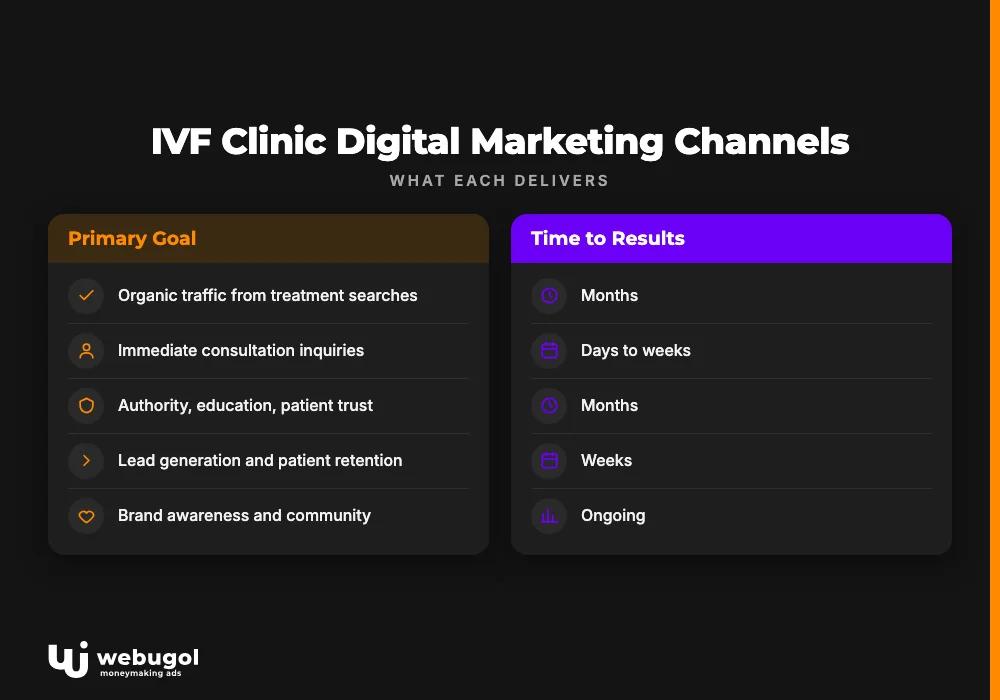
The most effective fertility marketing strategy combines organic search visibility, targeted paid campaigns, and trust-building content. No single channel handles the full patient journey. Here is a practical breakdown of core channels and what each one delivers:
| Channel | Primary goal | Typical time to results |
|---|---|---|
| IVF clinic SEO | Organic traffic from treatment searches | Months |
| Google Ads | Immediate consultation inquiries | Days to weeks |
| Healthcare content marketing | Authority, education, patient trust | Months |
| IVF lead generation and patient retention | Weeks | |
| Social media | Brand awareness and community | Ongoing |
Clinics that run these as a connected system consistently outperform those treating each channel as a separate, independent project.
How can fertility clinics attract more patients online?
Fertility clinics attract more patients online by showing up at the right moment in a patient's search. That means strong rankings for treatment-related queries, a website that converts visitors into inquiries, and active presence on the platforms where patients spend time researching options. A complete fertility clinic digital marketing plan starts with search visibility and builds outward from there.
IVF clinic SEO: getting found before the competition
Search engine optimization is the long-term foundation of patient acquisition for fertility practices. Patients in the research phase search for specific terms: procedure names, clinic locations, success rate explanations, and cost questions. Your site needs to rank for those terms, or it does not exist for those patients.
Start with keyword research to map what your audience actually types. Those terms go into page titles, headings, meta descriptions, and image alt text. Fast load times and mobile-friendly design are ranking signals, not optional refinements. Building backlinks from reputable healthcare directories and medical publications strengthens domain authority over time.
Healthcare local SEO is equally important. Most patients search within their own region. A complete, accurate Google Business Profile, consistent name-and-address data across directories, and location-specific landing pages all improve local rankings. Local visibility often determines whether a prospective patient finds your clinic or a competitor's first.
Your website as a patient conversion tool
Traffic has no value without conversions. A fertility clinic website needs fast load speeds, clear navigation, and direct calls to action for booking or inquiry. Patient testimonials, detailed treatment descriptions, and honest information about the consultation process reduce uncertainty and build the confidence a patient needs before committing.
Patients researching fertility treatment are often in emotionally difficult situations. Simple language, an intuitive layout, and a reassuring tone reduce friction at a moment when that friction carries real costs.
Is Google Ads effective for fertility clinic marketing?
Yes. In fertility clinic digital marketing, Google Ads generates results faster than any organic channel, because paid ads appear at the exact moment someone searches for treatment options. Cost-per-click in this category is significant, so execution quality determines whether campaigns are profitable.
Three factors drive paid campaign performance for reproductive medicine advertising:
Targeting precision. Campaigns built around specific demographics, search intent, and location reach people who are actively looking. Remarketing to visitors who did not convert keeps your clinic visible through a long decision process.
Ad copy and landing pages. Strong copy communicates a specific, credible advantage. Not a generic claim. The landing page must match the ad's promise exactly: an ad promoting a free consultation needs a landing page built around that offer, not a general homepage. A mismatched landing page wastes the click.
Systematic testing. Paid advertising for fertility clinics improves significantly with regular A/B testing of headlines, images, and calls to action. Weekly performance reviews identify where budget is working and where it needs redirecting.
Treating campaigns as a set-and-forget tool is the most common reason paid search underperforms for fertility practices.
Healthcare content marketing that builds patient trust
Healthcare content marketing does something paid ads cannot: it educates patients over time and positions your clinic as a credible, knowledgeable resource. That positioning matters. In reproductive medicine, patients research extensively before deciding where to seek care.
Educational blogs, videos, and guides on IVF treatment steps, egg-freezing procedures, and what affects success rates address the questions patients ask early in their research. Myth-busting content handles the misinformation patients often carry from other sources. Clear, factual writing builds authority without making claims the clinic cannot support.
Patient stories are among the most effective formats available. An honest account from a real patient builds credibility that promotional copy cannot match. Video testimonials add a human dimension that text alone cannot replicate.
Understanding how social media shapes patient decision-making in healthcare adds another content distribution layer. Instagram and Facebook allow clinics to share treatment explainers, patient milestones, and specialist content with a wider audience. Fertility-specific hashtags improve organic reach. Targeted social ads extend campaigns to specific demographics and regions.
Fertility webinars and live virtual consultations add interactivity. A specialist answering questions in real time generates qualified leads from attendees who are close to a decision and want direct access before booking.
Email marketing for IVF lead generation
Email is one of the most direct channels for staying connected with patients through a long, complex decision process. Segmentation is what separates email that converts from email that never gets opened.
A patient considering IVF for the first time needs different content than someone preparing for a second cycle. Building a segmented list starts with clear opt-in options on your website, often supported by a relevant lead magnet such as an IVF preparation guide. Automated sequences then deliver content matched to each patient's current stage.
Personalization lifts engagement. Using a subscriber's name and reflecting their stated interests makes messages feel relevant rather than generic. Tracking open rates, click-through rates, and conversions identifies what actually moves patients toward booking. A structured approach to email marketing for healthcare providers makes this channel a reliable part of your overall marketing system.
Legal and ethical standards in fertility clinic digital marketing
Fertility clinics operate under legal and ethical constraints that shape every marketing decision. These are not bureaucratic obstacles. They are the foundation of the patient relationship.
Advertising rules vary by jurisdiction but commonly restrict claims about success rates, testimonials, and comparative statements. In the US, HIPAA applies to patient data collected through digital contact forms and behavioral tracking pixels. Non-compliance is not a minor issue. It is a direct risk to clinic operations and patient trust.
Setting realistic expectations is non-negotiable. Patients approaching fertility treatment are often in vulnerable emotional states. Marketing that implies guaranteed outcomes, or that minimizes documented risks, causes direct harm and erodes long-term clinic reputation. Every channel, from Google Ads to blog content, must reflect what the clinic can actually deliver.
Transparency on success rate data, pricing where disclosed, and consultation procedures separates clinics that retain patients long-term from those that lose them after a single disappointing interaction.
Build your fertility clinic digital marketing strategy
Effective fertility clinic digital marketing requires coordinated execution across search, paid media, content, email, and social channels. Each one covers a different part of the patient journey. The gap between clinics that grow steadily and those that stagnate usually comes down to how consistently those channels are maintained and how well they connect to each other.
Webugol is a digital marketing agency that builds integrated patient acquisition strategies for healthcare practices, covering IVF clinic SEO, paid media, content marketing, and email. Contact us to discuss your clinic's current position and where targeted growth is most achievable.
FAQ
How much should a fertility clinic spend on digital marketing?
Budget varies by market size, local competition, and growth targets, with no single formula that applies across all practices. Paid search requires dedicated spend separate from SEO and content work, since the channels operate on different timelines and attribution models. The right allocation depends on your current organic visibility, how competitive local search is in your area, and how quickly the practice needs to grow.
What content should fertility clinics post on social media?
Fertility clinics perform best with content that educates and reassures: treatment explainers, IVF timeline breakdowns, myth-busting posts, and patient success stories shared with appropriate consent. Specialist-led Q&A posts and behind-the-scenes content tend to work well because they combine clinical credibility with accessibility. Consistency matters more than volume, and three substantive posts per week typically outperform daily posts that lack clear value.
What legal rules apply to fertility clinic advertising in the US?
HIPAA governs how patient data collected through digital channels, including contact forms and remarketing pixels, can be stored and used. Advertising regulations also restrict claims about success rates, before-and-after comparisons, and certain testimonial formats, so all marketing materials should receive legal review before publication. Informed consent principles extend to marketing: prospective patients must have access to realistic information about risks and outcomes, not promotional content alone.

