



Language school marketing: a practical guide to growing enrollment
Language school marketing is the combination of digital and offline strategies that brings prospective students to your school, converts inquiries into enrollments, and keeps learners returning. It spans search visibility, social media, paid advertising, and content. Schools that treat these as a connected system consistently outgrow competitors that run them as separate, disconnected efforts. Results compound over time.
What makes a good language school marketing strategy?
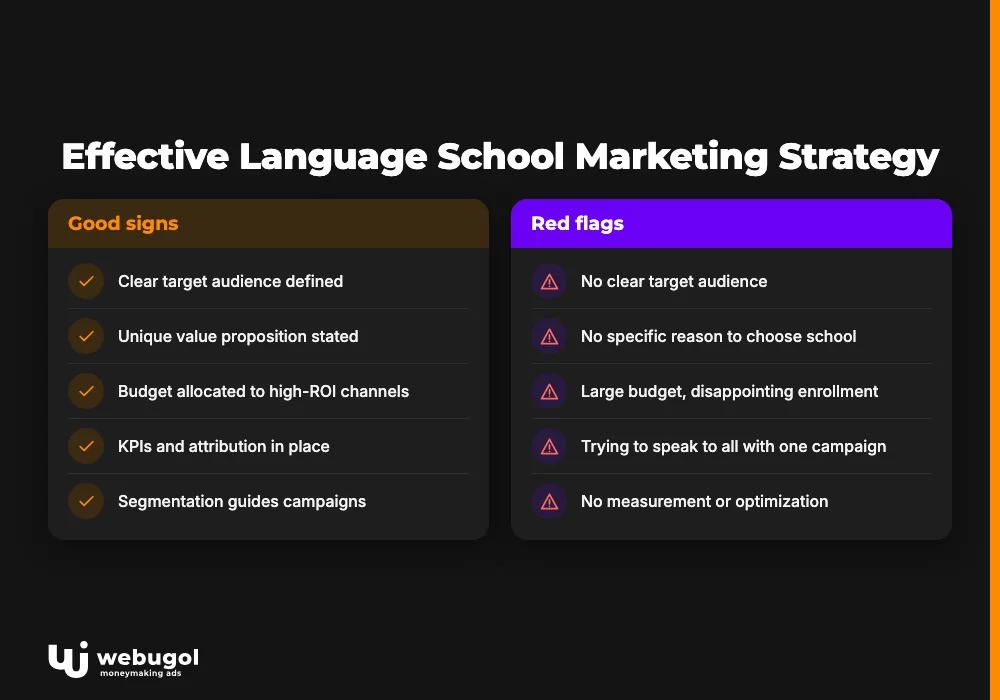
A solid strategy starts with two things: a clear picture of who you are trying to reach, and a specific reason for a student to choose your school over every alternative they find online. Without both, even a large budget produces disappointing enrollment numbers.
The four pillars below frame every effective language school marketing plan:
| Pillar | What to define | Why it matters |
|---|---|---|
| Target audience | Age, goals, location, learning motivation | Shapes every message and channel choice |
| Unique value proposition | What your school offers that competitors do not | Determines why a student picks you |
| Channel mix | SEO, social, paid, email, referrals | Allocates budget to highest-ROI touchpoints |
| Measurement | KPIs, attribution, reporting cadence | Prevents wasted spend and guides optimization |
Consider whether you are targeting young professionals seeking a career edge, exam-prep students on a deadline, or adult learners exploring a new interest. Each group responds to different messages and uses different platforms. Trying to speak to all of them with a single campaign is the most common reason school marketing underperforms. Segmentation decides enrollment wins.
How to attract more students to a language school?
The most direct path to attract students online is to show up when they search and give them a fast, credible reason to contact you. That requires both strong search visibility and a website built to convert.
Build a website that converts visitors
Your website is where most prospective students form their first real impression of your school. It must answer their core questions within seconds: which courses you offer, what they cost, how the schedule works, and what past students say about the experience.
Keep the call-to-action visible and simple. A free trial lesson or a short placement test removes the commitment barrier and lets your teaching quality make the case. Mobile users represent a significant share of education searches, so a slow or cluttered mobile experience directly costs you enrollments. Speed saves real leads.
Use language school SEO to capture intent-driven traffic
Language school SEO services connect you with students who are already looking for courses, rather than interrupting people who were not thinking about language learning. Ranking for queries like "business English class online" or "Spanish lessons near me" brings in traffic that converts at a substantially higher rate than cold social ads.
The fundamentals: keyword-optimized page titles and headings, fast load times on mobile, Google Business Profile management for local searches, and consistent citations in education directories. Schools in competitive cities also need to build local authority through reviews and backlinks from regional sources.
What digital channels work best for language schools?
For most language schools, the highest-return combination is organic search for long-term traffic, social media for awareness and community, and paid advertising for targeted lead generation when you need faster results. Running these three in coordination outperforms any single channel.
Language school social media: where to focus
Language school social media content performs well because the subject lends itself to short, shareable demonstrations of value. A thirty-second vocabulary tip on TikTok reaches more prospective students than a banner ad on most websites.
Where to allocate effort across platforms:
- Instagram and TikTok are best for short lessons, cultural content, and student success clips that spread organically.
- Facebook suits community groups, event announcements, and retargeting campaigns for warmer audiences who already visited your site.
- YouTube handles longer content well: full lesson previews, teacher introductions, and course walkthroughs that help undecided students commit.
- LinkedIn fits schools targeting professionals who need language skills for work, where career-framing of content outperforms general language tips.
Consistency matters more than frequency. Three well-crafted posts per week outperform daily filler content on every major platform algorithm. Quality wins on every platform.
Online advertising for language courses
Online advertising for language courses gives you precise control over who sees your message and when. Search ads capture students mid-decision; social ads build awareness earlier in the journey. The online advertising language courses invest in most heavily is Google Search, where student intent is clearest.
Understanding how paid search campaigns drive enrollment for language schools helps you set realistic goals before you spend. Set conversion events tied to enrollment actions, not just clicks: a trial lesson booking or a contact form submission tells you far more than a pageview. Paid advertising for language school promotion works fastest when it runs alongside SEO rather than replacing it.

How to increase language school enrollment?
Enrollment grows when you pair awareness with deliberate conversion tactics at each stage of the decision process. Awareness without conversion infrastructure wastes ad spend; conversion tactics without awareness leave no pipeline to fill. Both sides must connect.
Student enrollment strategies that consistently move numbers include:
- Free trials or placement tests reduce perceived risk and let teaching quality close the decision.
- Referral programs turn satisfied students into a low-cost acquisition channel. A discount on the next billing period in exchange for a successful referral works well for recurring course models.
- Retargeting ads re-engage visitors who browsed your course pages without signing up. These audiences already know your school, so the cost to convert them is lower than reaching cold traffic.
- Email follow-up sequences restart stalled conversations with leads who went quiet, using student success stories and time-limited offers to revive interest.
These language school promotion tactics compound over time. Each student who refers a peer lowers your effective cost-per-acquisition, making the whole system more efficient each semester.

How to market a language school: measuring results
An effective language school marketing approach adapts continuously based on data. Three metrics matter most: cost per lead by channel, lead-to-enrollment conversion rate, and student lifetime value by acquisition source. These numbers show where to invest more and where to cut.
Monthly reporting prevents small budget leaks from becoming expensive habits. Leaks grow without scrutiny. Pair the numbers with direct student feedback gathered through intake forms and surveys. Knowing that a cohort found you through a specific YouTube series or a teacher's Instagram account points to what is genuinely driving growth, not just what looks good in a dashboard. Digital marketing for schools works best when the data loop is short and the team acts on it.
Ready to build a predictable enrollment system?
Webugol is a digital marketing agency that builds growth systems for education businesses, covering SEO, paid advertising, social media, and the website infrastructure that ties them together. If your school is ready to move from sporadic campaigns to a predictable enrollment pipeline, reach out to start the conversation.
FAQ
How to market a language school?
Define your target audience and unique value proposition first, then build a presence on the channels where prospective students search and spend time, primarily Google Search, social media, and paid advertising. Combine organic SEO for long-term visibility with conversion-focused landing pages and consistent follow-up to turn interest into enrollment.
What digital channels work best for language schools?
Organic search through SEO and Google Ads captures students at the moment they are actively looking for courses. Social platforms like Instagram, TikTok, and YouTube build awareness and demonstrate teaching quality at scale. Running these channels in coordination produces better enrollment results than any single channel alone.
How to attract more students to a language school?
Start with a fast, mobile-friendly website that answers student questions clearly and makes it easy to book a trial lesson or contact the school. Layer in SEO for sustained organic traffic, paid ads for immediate reach, and a referral program to activate satisfied students as a recruitment channel.
What is the best language school promotion approach for a new school?
New schools should run Google Search ads targeting local course keywords to generate immediate visibility while building organic SEO in parallel. Offering a free trial lesson removes the enrollment barrier and generates early student testimonials that strengthen social proof on the website.
How do you measure the success of language school marketing?
Track cost per lead by channel, lead-to-enrollment conversion rate, and student lifetime value by acquisition source. These three metrics reveal which channels are generating profitable enrollments and which are draining budget without filling seats.

