



Google Ads business goals: reach buyers and scale revenue
Google Ads connects your business to buyers at the exact moment they search. Two mechanisms drive results against your google ads business goals: precise audience targeting that filters out unqualified traffic, and a measurable ROI framework that tracks revenue back to every dollar spent. Get both right, and you stop bleeding budget on impressions that never convert. For SMBs whose site cannot handle the traffic, no bid strategy fixes a slow, unoptimized landing page.
How can Google Ads help advance your business goals?
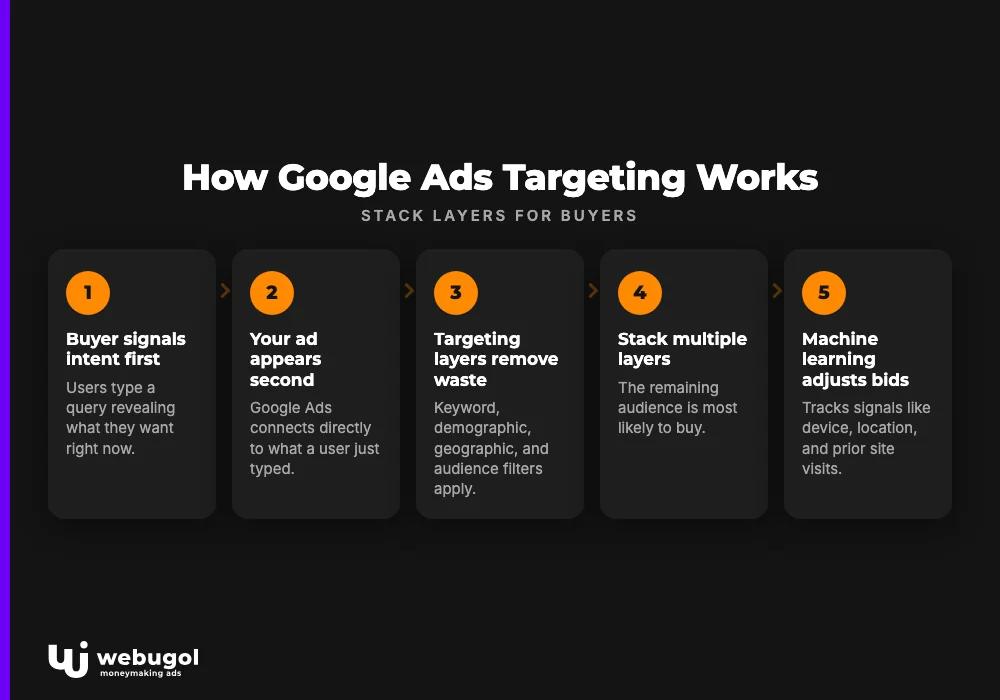
Google Ads advances your business goals by targeting buyers based on search intent rather than assumed demographics. When someone types a query, they reveal what they want right now. Capturing that signal is the core ppc advertising benefit that separates search advertising from every other paid channel.
Here is how the main google ads targeting layers work together:
| Targeting type | What it controls |
|---|---|
| Keyword | Triggers ads when users search specific terms |
| Demographic | Filters by age, gender, and household income band |
| Geographic | Limits delivery to specific cities, regions, or a defined radius |
| In-market audience | Reaches users actively researching similar products or services |
| Remarketing | Re-engages visitors who left without taking action |
Each layer removes a different category of wasted spend. A local service business that adds a geographic filter stops paying for clicks it cannot convert into booked jobs. Stack multiple layers and the remaining audience is precisely the segment most likely to buy.
How search intent advertising sharpens results
Traditional media buys impressions and hopes for relevance. Search intent advertising works in reverse. The buyer signals intent first, your ad appears second. That sequence is why Google Ads campaign performance consistently outperforms display and social formats for bottom-of-funnel offers, particularly for businesses selling services or considered purchases. Connecting the ad directly to what a user just typed removes the persuasion work that kills conversion on other channels.
Google's machine learning reinforces this by tracking signals at auction time: device type, location, time of day, and prior site visits. It adjusts bids based on the probability each impression converts rather than a flat maximum you set once and forget.
What types of Google Ads campaigns drive business growth?
Not every google ads campaign type works for every goal. Picking the wrong format wastes budget. These are the five google ads campaign types that matter most for direct business growth:
Search campaigns show text ads on the results page when someone searches a relevant term. They are the strongest format for direct-response lead generation because the user is actively looking for what you offer.
Display campaigns reach users across websites in Google's partner network. They work for brand awareness and remarketing but rarely drive direct conversion on first contact.
Shopping campaigns show product images and prices before the click, which filters for purchase intent and lifts google ads conversions for businesses selling physical products online.
Performance Max campaigns run across all Google channels simultaneously. The algorithm distributes budget toward the placements that convert, so this format suits businesses with enough conversion data to train the model.
Video campaigns on YouTube reach buyers in the consideration phase, before they reach the search bar. They work best paired with a search campaign that captures the same audience when intent firms up.
For service businesses, search and Performance Max campaigns aligned to booked jobs or submitted leads give the clearest line between ad spend and revenue. Detailed examples of this campaign architecture appear in this Google Ads guide for local service companies. Businesses in regulated sectors face additional structural constraints covered in this PPC strategy guide for regulated service markets.
How does smart bidding improve Google Ads performance?
Smart bidding unlocks the full range of ppc advertising benefits in Google Ads by adjusting what you pay per auction based on real-time signals: device type, search query, geographic location, time of day, and audience history. Manual bidding cannot process that combination fast enough to stay competitive in dynamic markets.
A smart bidding strategy works best once the campaign has accumulated meaningful conversion data. The main options:
- Target CPA: sets bids to hit a cost-per-acquisition target you define
- Target ROAS: sets bids to hit a revenue-per-spend ratio you specify
- Maximize conversions: spends the full daily budget toward the highest-converting opportunities
- Enhanced CPC: adjusts your manual bids up or down based on real-time conversion likelihood
The tradeoff is control. Handing bid decisions to the algorithm means trusting it has enough signal to optimize correctly. Without sufficient conversion history, the model defaults to broad patterns that may not reflect your specific buyers. That is why setting up accurate conversion tracking is the prerequisite, not an afterthought.
Measuring Google Ads ROI: tracking what actually matters
A campaign running without conversion tracking spends in the dark. Google Ads ROI only becomes legible when every high-value action has a tracking tag attached: purchases, form submissions, and booked calls.
Three metrics map most directly to business outcomes:
- Cost per conversion: what you pay for each lead or sale. This is the number that determines whether the campaign makes money, not click-through rate.
- Return on ad spend (ROAS): revenue divided by ad spend. This is the clearest measure of whether the account is building or destroying margin.
- Conversion rate by ad group: isolates which keyword clusters and landing pages convert and which leak spend.
Budget management follows naturally from this data. When one campaign outperforms, shifting allocation toward it is mechanical. Businesses that implement enhanced conversions tracking also recover measurement signal lost to browser privacy changes, keeping ROAS data reliable as third-party cookies phase out.
Scaling works the same way. Once a campaign proves its cost per acquisition sits below your average customer value, expanding geographic targeting or adding new keyword clusters grows volume without changing unit economics. That gap between acquisition cost and customer value is the structural foundation of a strategy that compounds over time, rather than one that plateaus.
Work with Webugol to hit your Google Ads business goals
Most Google Ads accounts lose budget through poor targeting-bidding-tracking alignment, not because the platform itself fails. When those three elements work as an integrated system rather than separate configurations, your google ads business goals translate directly into measurable revenue outcomes.
Ad spend converts at a fraction of its potential when the destination page is slow or structurally weak. Webugol builds the site that receives paid traffic and runs the campaigns that fill it, so your landing page performance and bid strategy operate from the same plan rather than against each other.
Talk to Webugol about building that combined system, and explore the Google Ads service built to close the gap between ad spend and growth.
FAQ
How can Google Ads help you achieve your business objectives?
Google Ads places your offer in front of buyers who are actively searching for what you sell, using targeting layered on keyword, location, and audience behavior. Conversion tracking connects each click to a business outcome, so you see exactly which campaigns earn margin and which do not.
What is a good ROI benchmark for Google Ads?
The right ROAS target depends on your industry, margin structure, and customer lifetime value, so a single number applies to very few businesses. The most reliable measure is tracking cost per acquisition against what a new customer is actually worth to your business over time.
How much should I budget for Google Ads?
Budget depends on your cost-per-click in your market and the number of conversions you need each month. A realistic starting point is enough daily spend to generate meaningful conversion data, since Smart Bidding strategies require sufficient volume before the model optimizes reliably.
Can Google Ads work for a local service business?
Yes. Geographic targeting restricts your ads to specific cities, regions, or a radius around your location, so you stop paying for clicks you cannot serve. Call extensions and local campaigns let you drive phone calls and in-person visits rather than just website traffic.

