



Healthcare PPC advertising: a guide for medical practices
Healthcare PPC advertising puts your clinic, hospital, or specialist practice at the top of search results the moment a patient searches for care. You pay only when someone clicks. Results appear within hours of campaign launch, making it the fastest channel for acquiring new patients. This guide covers what healthcare PPC advertising is, which strategies drive appointments, what it costs, how to choose keywords, and how to configure tracking without creating HIPAA exposure.
What is PPC advertising in healthcare?
PPC advertising in healthcare is a digital model where providers bid on patient search queries, and ads appear above organic results. The advertiser pays only on a click, not on every impression. Google Ads and Bing Ads run the dominant auction-based systems. Meta platforms operate on a parallel pay-per-click model, used primarily for awareness rather than direct appointment booking.
How the auction works
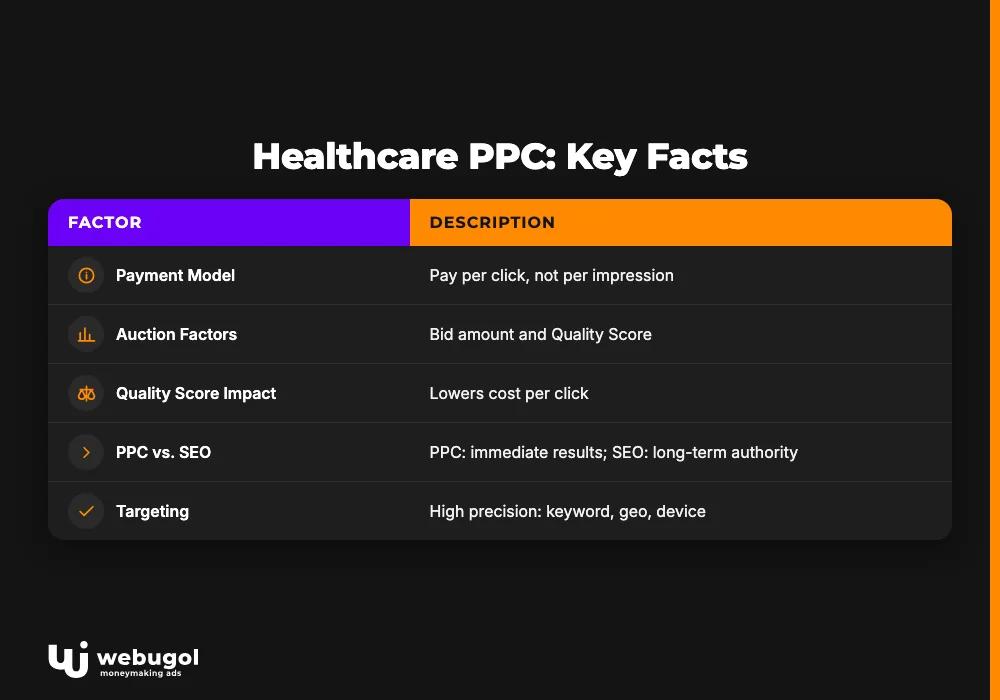
Every time a patient types "pediatric dentist near me" or "knee replacement surgeon Chicago," the platform runs an instant auction. Winning ad placement depends on two factors: bid amount and Quality Score. Google calculates Quality Score from ad relevance, expected click-through rate, and landing page experience.
Higher Quality Score lowers cost per click. A well-structured healthcare Google Ads campaign can outrank a higher-bidding competitor purely because its messaging and landing pages match patient intent more precisely. That efficiency gap is why campaign structure matters far more than raw budget size.
PPC vs. SEO: a quick comparison
| Factor | Healthcare PPC | Organic SEO |
|---|---|---|
| Time to first result | Hours after launch | Weeks to months |
| Cost model | Pay per click | Time and resource investment |
| Targeting precision | High: keyword, geo, device, time of day | Limited direct control |
| Compliance control | Ad-level, immediate changes | Content-level, slower to update |
| Long-term value | Stops when budget stops | Compounds over time |
Both channels complement each other. Healthcare PPC advertising generates immediate appointment volume. SEO builds durable authority that continues working without ongoing ad spend.
Who benefits from PPC ads for healthcare?
Most provider categories see measurable returns from paid search. The channel works best where patient decision cycles are short and geographic radius matters.
Practices that consistently benefit from healthcare digital advertising include:
- Primary care and family medicine clinics booking new patient appointments
- Urgent care centers targeting "near me" and same-day queries
- Dental and orthodontic practices running procedure-specific campaigns
- Elective specialists such as cosmetic surgeons or fertility clinics attracting high-intent procedure queries
- Mental health providers reaching patients without an established care relationship
- Telehealth platforms targeting specific geographic regions or condition-based searches
Larger hospital systems use PPC primarily for service-line and department-specific acquisition. Brand-level awareness at that scale shifts to display and programmatic channels, which carry lower CPCs for top-of-funnel exposure.
The common factor across all successful users: a defined service with measurable patient demand, a specific geographic area, and a landing page capable of converting clicks into booking requests.
Is Google Ads effective for healthcare providers?
Yes. Google Ads is the dominant platform in healthcare ppc advertising because search intent is already established when a patient types a query. Someone searching "cardiologist accepting new patients Houston" is close to a booking decision. That intent gap makes search the highest-converting channel in most medical ppc management programs.
Platform restrictions you need to know
Healthcare providers face specific restrictions. Google prohibits personalized advertising based on health conditions under its sensitive categories policy. Remarketing to users based on visits to health-related pages is blocked. Certain prescription drug and treatment categories require pre-certification before campaigns can run at all.
Understanding these limits before building campaigns prevents wasted spend, account suspensions, and compliance violations that are slow to reverse. For a structured walkthrough of compliant campaign architecture, our healthcare ad compliance guide covers setup requirements in detail.
Bing Ads and Meta as complementary channels
Bing Ads reaches a smaller audience at lower CPCs. For practices targeting patients 45 and older, adding Bing to a healthcare Google Ads strategy improves overall reach without dramatically increasing the budget. The demographic skew makes it a practical complement for practices already running Google campaigns.
Meta removed many health-related targeting options in 2023. It still works for community outreach, educational content promotion, and building local brand familiarity. Direct appointment-acquisition campaigns on Meta typically convert at lower rates than search campaigns targeting the same service area.
What keywords should a healthcare PPC campaign target?
A strong healthcare ppc advertising keyword strategy starts with three tiers: high-intent service keywords, condition and symptom keywords, and location-modified terms.
High-intent service keywords name the procedure or provider type directly. Examples: "knee replacement surgeon," "IVF clinic," "emergency dental extraction." Conversion rates are highest here. So is competition.
Condition and symptom keywords reach patients earlier in the research phase. Examples: "lower back pain treatment options," "persistent migraine specialist." These convert at lower rates but capture patients before competitors reach them in the buying cycle.
Location-modified terms add a city, neighborhood, or proximity indicator. Examples: "urgent care near me," "cardiologist in Phoenix." These drive the most geographically relevant clicks for local practices. They also tend to have lower CPCs than purely national service terms.
Negative keywords matter as much as target keywords
Healthcare PPC campaigns without a maintained negative keyword list waste significant budget on non-converting traffic. Common negatives for medical practices include:
- Job and career terms: "salary," "jobs," "how to become," "nursing school"
- Cost-research terms not tied to booking intent: "free clinic," "average cost of"
- Condition-research queries: "what causes lower back pain," "symptoms of X"
- Competitor brand names, if not running comparative campaigns
Build the negative keyword list before campaign launch. Review the search terms report monthly and add new irrelevant queries as the campaign runs. This single habit consistently ranks among the highest-ROI activities in the entire medical ppc management cycle.
For a detailed breakdown of how search advertising builds patient pipelines across practice types, the paid search strategy guide for doctors covers intent mapping in depth.
What PPC strategies work best for medical practices?
The most effective healthcare ppc advertising strategies combine tight campaign structure, conversion-optimized landing pages, and compliant tracking. Each component fails without the others.
Campaign structure and match types
Organize campaigns by service line, not keyword volume. A dental practice should run separate campaigns for implants, orthodontics, emergency care, and cosmetic procedures. This structure keeps Quality Scores high, keeps ad messaging specific to patient intent, and makes budget allocation clean and adjustable.
Use exact match and phrase match for high-intent, high-cost terms. Broad match can surface new query opportunities, but healthcare searches attract adjacent irrelevant traffic at a rate that drains budget faster than most other verticals. Check the search terms report weekly during the first two months of any new campaign.
Landing pages built for conversion
A click is not a conversion. A patient clicking a "back pain specialist" ad who lands on a generic homepage will leave within seconds. Each campaign needs a dedicated landing page that mirrors the specific ad, presents the relevant service clearly, shows location and booking options, and places a contact or appointment form above the fold.
Page load speed is as critical as content. Each additional second of load time increases the probability of a patient bouncing before the page finishes rendering. Mobile-first design is not optional: the majority of healthcare searches happen on phones.
Short forms convert better. Ask for name, phone number, and preferred appointment time. Save intake paperwork for after the booking is confirmed.
HIPAA compliance in tracking
This is where many healthcare digital advertising campaigns create hidden legal risk. Standard Google Ads conversion tracking and Google Analytics 4 transmit user behavior data to Google's servers. Under HIPAA, sending protected health information (PHI) to a third-party vendor without a signed Business Associate Agreement (BAA) is a violation. Google does not sign BAAs for its advertising products.
The practical implication: conversion events must fire on neutral confirmation pages, such as a "Your request has been received" page, not on URLs that embed condition names, diagnosis terms, or treatment types as URL path parameters. A URL like /oncology-consultation/confirmed can qualify as PHI when combined with an IP address.
Many practices work with a specialist to configure server-side tagging that strips PHI before any data leaves the organization's infrastructure. This step is often skipped because the campaigns appear to function without it, but the compliance exposure is real and enforcement cases are documented.
Ad scheduling and geographic targeting
Patient search behavior follows patterns. Urgent care queries spike on weekday mornings and weekend afternoons. Elective-procedure research is heavier on evenings and weekends. Scheduling ad delivery to concentrate budget during these high-intent windows improves cost efficiency without reducing reach where it matters.
Geographic targeting should match actual service radius. A two-location clinic does not need region-wide coverage. Tight radius targeting reduces irrelevant clicks, keeps CPC lower, and strengthens local relevance signals in the Quality Score calculation.
Ad extensions for medical practices
Four extension types deliver consistent lift for healthcare providers:
- Location extensions surface the clinic address in search results, helping patients confirm proximity before clicking
- Call extensions let patients phone the practice directly from the ad, eliminating the landing page step entirely for patients who prefer to call
- Sitelink extensions route patients to specific service pages, removing one navigation step from the conversion path
- Structured snippet extensions list accepted insurances, specialties, or appointment types directly under the ad headline
Extensions are free to add and expand ad real estate without increasing cost per click. Every healthcare Google Ads account should have all four active before scaling budget.

How much does healthcare PPC advertising cost?
Healthcare PPC advertising costs vary by specialty, geography, and competitive density in the local market. A single benchmark does not apply across the sector.
Competitive specialties such as addiction treatment, cosmetic surgery, and fertility services regularly see cost per click above $15 to $30 in major metro areas. Primary care and general dental typically run $5 to $12 per click. Urgent care sits in the middle, with significant variation depending on how many competing practices bid on the same zip codes.
The metric that actually matters for budget planning is cost per booked appointment, not cost per click. Here is why: a $20 CPC with a 15 percent landing page conversion rate produces a $133 cost per booked appointment. A $10 CPC with a 4 percent conversion rate produces a $250 cost per appointment. Landing page quality determines whether a budget goes far or burns fast.
Starting with enough monthly budget to drive at least several hundred clicks per campaign before drawing conclusions prevents premature optimization decisions based on insufficient data. Cutting a campaign after 40 clicks produces statistically meaningless results. The learning period matters.
Measuring success in medical PPC management
Key metrics to track
Four metrics define campaign health in any medical ppc management program:
- Conversion rate: booked appointments or contact form submissions divided by total clicks. Primary health indicator.
- Cost per conversion: total ad spend divided by total conversions. Reveals budget efficiency.
- Click-through rate: measures how well ad copy matches the search query. Low CTR signals a keyword-to-ad mismatch.
- Quality Score: Google's 1-to-10 rating of ad relevance, expected CTR, and landing page experience. Low scores raise costs and lower placement.
Return on ad spend connects performance to practice revenue. Multiply converted patients by average appointment or procedure revenue, then divide by total ad spend. Tracking this monthly reveals whether ppc for medical practices is generating sustainable patient acquisition or just traffic.
Conversion tracking nuances for healthcare
Healthcare providers cannot treat conversion tracking as a standard install-and-forget setup. Conversion events must fire on neutral confirmation pages. URLs that embed diagnostic terms, condition names, or treatment types as path parameters can qualify as PHI when combined with an IP address or device ID, creating HIPAA exposure through a standard tracking pixel.
"Thank you for your request" pages with generic URL paths are safe firing points. Specialty-specific URLs like /breast-cancer-screening/confirmed are not.
A/B testing in healthcare campaigns
Test one variable at a time. Headline, call-to-action text, or landing page layout. Running multiple simultaneous tests on low-traffic campaigns produces inconclusive data and extends the time to a clear decision.
A clinic that targeted "urgent care near me" and ran landing page variations saw a 35 percent increase in appointment bookings within three months, according to that practice's campaign records. The winning version placed the booking form above the fold and removed navigation links that directed patients off the conversion path.
Regulatory and trust considerations in healthcare PPC advertising
HIPAA governs data handling. FTC guidelines govern advertising claims. Both apply to every touchpoint in a medical PPC campaign.
Ads cannot promise guaranteed treatment outcomes, use before-and-after imagery in certain procedure contexts, or make claims that lack substantiation. Patient testimonials require disclosures and cannot imply that all patients achieve the same results. These rules apply to ad copy, landing pages, and any creative assets the campaign touches.
Building trust in ad copy means leading with credentials, board certifications, insurance acceptance, and clear booking mechanics, not superlatives or vague outcome language. Patients searching for healthcare are often under stress. Ads that communicate competence and ease of access convert better than ads driven by aggressive claims.
The competitive dynamic in healthcare digital advertising favors providers who stay compliant from the start. Platforms actively police healthcare ad violations. Suspended accounts can take weeks to reinstate, and that downtime has direct revenue consequences. Getting compliance right before scaling is faster than recovering from an account suspension mid-campaign.

The Webugol approach to healthcare digital advertising
Most PPC agencies treat advertising and website infrastructure as separate problems owned by separate teams. At Webugol, we integrate both from the start. A healthcare ppc advertising campaign performs better when the landing pages it drives traffic to are technically fast, built for conversion, and sit on a content architecture that compounds organic search value over time.
Our medical ppc management process covers the full acquisition funnel: HIPAA-compliant tracking audit, campaign architecture by service line, landing page build or optimization, and monthly performance reviews tied to patient acquisition cost targets. We do not hand off campaigns to a client team mid-flight. One team owns the click and what happens after it.
Practices that have run disconnected adwords for healthcare and web development through separate vendors share the same bottleneck: clicks arrive, but tracking gaps prevent accurate measurement of what actually converts. Solving that before scaling spend is where the real efficiency gains come from.
As a full-stack digital marketing agency with development capabilities, we handle both the campaign and the infrastructure behind it. No handoffs between vendors. No tracking gaps between ad click and patient booking.
For specialist practices looking for field-specific campaign guidance, see how we approach campaigns for specialist providers building out their adwords for healthcare presence.
Ready to improve your healthcare PPC advertising results?
If your campaigns generate clicks but not appointments, or if you are starting from scratch and need a compliant, structured approach to ppc for medical practices, Webugol can help. We audit current campaign performance, identify tracking and compliance gaps, and build the full acquisition funnel from search query to booked appointment.
Request a healthcare PPC audit to get a clear view of what your current setup is costing you.
FAQ
What is PPC advertising in healthcare?
Healthcare PPC advertising is a paid digital model where providers bid on patient search queries, and ads appear at the top of search results on platforms like Google and Bing. Advertisers pay only when a user clicks the ad, not per impression. It is the fastest channel for driving appointment bookings from patients actively searching for care.
How much does healthcare PPC advertising cost?
Costs vary widely by specialty and location. Competitive categories like cosmetic surgery and addiction treatment can see cost per click above $15 to $30 in large cities, while primary care and general dental typically run $5 to $12 per click. The more actionable figure is cost per booked appointment, which depends on both CPC and landing page conversion rate.
What PPC strategies work best for medical practices?
Structuring campaigns by service line, building dedicated landing pages for each ad group, and maintaining an active negative keyword list produce the most consistent results. Add HIPAA-compliant conversion tracking, ad scheduling focused on peak-intent windows, and all available ad extensions to complete the foundation.
Is Google Ads effective for healthcare providers?
Yes, particularly for services where patient intent is clear from the search query. Google Ads consistently outperforms other channels for direct appointment acquisition because patients are already in an active search mindset. Providers must comply with platform restrictions on health-sensitive audience targeting and configure tracking to avoid HIPAA exposure.
What keywords should a healthcare PPC campaign target?
Start with high-intent service keywords naming the procedure or specialist type directly, then add condition and symptom queries, and layer in location modifiers for local targeting. Build a negative keyword list before launch to exclude research queries and non-patient searches. Review the search terms report monthly to refine targeting as data accumulates.

