



Google Ads for Healthcare: Reach Patients and Stay Compliant
Google ads for healthcare connect clinics, hospitals, and individual practitioners with patients searching for medical services online. Running them requires navigating strict advertising policies and protecting patient privacy under HIPAA. Get that wrong and campaigns get paused. This guide covers every stage, from compliance to keyword selection to bidding strategy.
Why clinics and hospitals use Google Ads
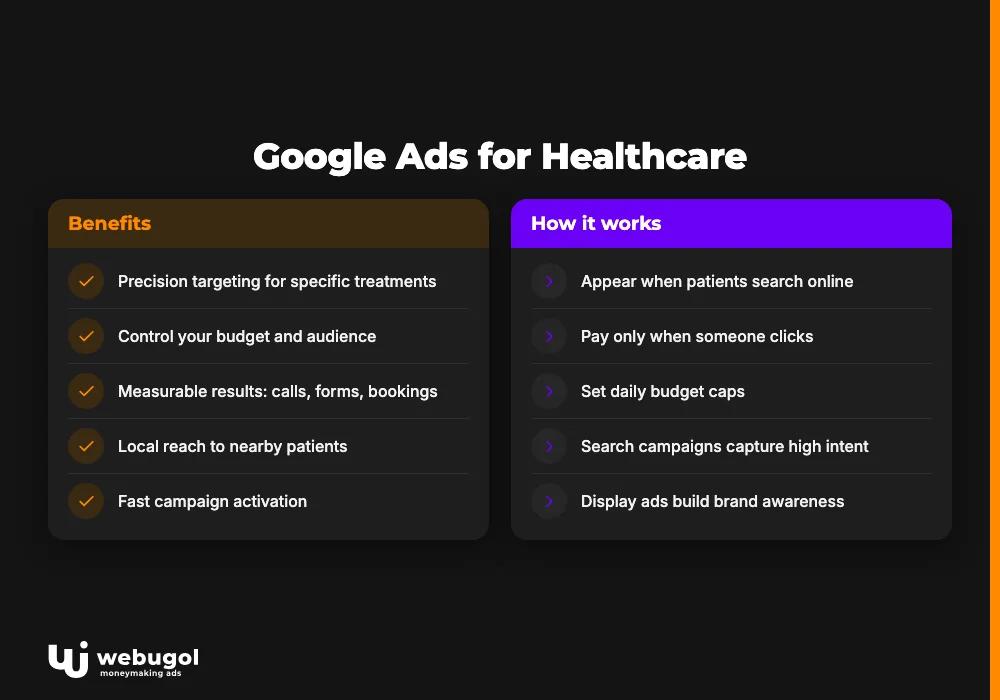
Patients increasingly search online before booking appointments. Google Ads for clinics and hospitals lets you appear exactly when that search happens. Unlike traditional marketing, the pay-per-click model means you pay only when someone clicks. You control the budget, the audience, and the geography.
Key advantages over traditional medical marketing:
| Benefit | What it means in practice |
|---|---|
| Precision targeting | Reach users searching for specific treatments or conditions |
| Cost control | Set daily budget caps; pay per click, not per impression |
| Measurable results | Track phone calls, form submissions, and appointment bookings |
| Local reach | Show ads to patients within a defined radius of your clinic |
| Fast activation | Campaigns go live in days, not months |
Search campaigns typically anchor a healthcare PPC strategy because they capture high-intent queries. Display and YouTube formats support brand awareness, but search is where appointment-ready patients are.
What are Google's policies for healthcare advertising?
Google restricts healthcare ads more than most other categories. The Healthcare and medicines policy governs prescription drugs, medical devices, telemedicine, addiction treatment, and clinical trials.
Three things every medical advertiser must understand:
- Certification is required for specific categories. Advertisers promoting prescription medications, online pharmacies, or telemedicine must apply for and receive Google certification before any ads run.
- Ad copy cannot make unverifiable claims. Phrases that guarantee outcomes or imply superlative quality trigger policy violations.
- Geographic restrictions apply. Some healthcare ad categories are permitted only in specific countries, regardless of how compliant the content is.
Check Google's policy page regularly. These rules update without advance notice. A single violation can pause an entire account.
Compliance shapes the entire structure of these campaigns. For context on how this fits into a full medical practice digital advertising plan, the policy layer matters as much as the creative.
How to set up Google Ads for a medical practice?
Google ads for healthcare start with account structure. A disorganized account wastes budget and makes optimization nearly impossible.
Step 1: Define your conversion goals. Decide whether you want phone calls, appointment form submissions, or new patient registrations. The conversion type drives every other decision.
Step 2: Build campaigns around service lines, not keywords. Create one campaign per major service: orthopedics, dermatology, urgent care. Within each campaign, create tightly themed ad groups for specific conditions or procedures.
Step 3: Write compliant, factual ad copy. Keep language verifiable. Avoid superlatives you cannot substantiate. Use your location and a clear call to action. Responsive search ads let Google test multiple headline and description combinations automatically.
Step 4: Build a dedicated landing page for each ad group. Every landing page needs a visible phone number, a short appointment form, and fast mobile load speed. A mismatch between ad promise and page content raises bounce rates and lowers Quality Score.
Step 5: Enable conversion tracking before launching. Install the Google Ads tag on your confirmation page or use call tracking to capture phone leads. Without this data, you cannot determine which keywords or ads are generating actual patients.
For tactics specific to physician practices, see our breakdown of running paid search for your medical practice.
What keywords work best for healthcare Google Ads?
High-intent keywords in google ads for healthcare fall into two groups: condition-based ("knee pain specialist near me") and service-based ("urgent care clinic open now"). Both convert well because the searcher has an immediate need.
Practical keyword selection principles:
- Long-tail keywords outperform broad terms. "Pediatric cardiologist in Chicago" attracts a ready patient. "Cardiologist" attracts researchers, students, and people with no intent to book.
- Location modifiers are essential. Most medical searches are local. Add city, neighborhood, or "near me" variations throughout your keyword list.
- Negative keywords protect your budget. Terms like "free," "jobs," "salary," and disease names without treatment intent pull irrelevant traffic. A strong negative keyword list is not optional in medical advertising.
- Competitor terms are worth testing carefully. Bidding on a competitor clinic's name is permitted but expensive. Test with a small allocation before committing real budget.
- Review and update regularly. Search behavior shifts. A term that drove appointments six months ago may now attract a different audience.

How to make Google Ads HIPAA compliant?
HIPAA compliance in google ads for healthcare is a federal legal requirement for U.S. providers, not a Google platform rule. Google's ad platform does not access or store protected health information (PHI), but how you configure tracking can create compliance exposure.
Key practices for HIPAA compliant ads:
- Do not pass PHI into tracking parameters. URL parameters that capture condition names, medication queries, or demographic identifiers tied to health status can constitute PHI transmission.
- Audit your remarketing audience rules. Google's advertising policy prohibits remarketing based on health conditions. Building an audience from users who visited your "cancer treatment" page, then targeting them with condition-specific ads, violates both Google policy and federal law.
- Confirm your analytics setup meets HIPAA standards. Standard Google Analytics configurations may not comply. Work with legal counsel to verify your tracking stack before any campaign goes live.
- Customer match lists require a Business Associate Agreement. Google does not offer a BAA, which limits how patient data can be used in audience targeting.
Medical advertising compliance requires collaboration between your marketing team and your compliance officer. Neither should build campaigns without input from the other.
What budget does a clinic need for Google Ads?
There is no universal minimum. Healthcare campaign bidding is competitive, and cost-per-click varies significantly by specialty and geography. A solo family practice in a rural market competes differently than a multi-location hospital network in a major metro.
Practical budget principles for healthcare campaigns:
- Segment by service value. Allocate more to high-margin services like elective procedures. Lower-priority informational campaigns can run on smaller daily caps.
- Run manual bidding first. Google's automated strategies need sufficient conversion history to function reliably. Collect baseline data manually before switching to automation.
- Monitor Auction Insights regularly. This report shows how often competitors appear alongside your ads. When a competitor's impression share rises sharply, bids may need adjustment.
- Review and update monthly. Adjust based on device performance, time-of-day patterns, and location-level results. Static budgets drift out of alignment in competitive healthcare markets.
Well-planned healthcare campaign bidding improves ROI and brings more qualified leads to your practice.

Monitoring and optimizing Google Ads for healthcare campaigns
These campaigns require ongoing attention. A campaign left unchanged degrades as search patterns shift and Quality Scores fluctuate.
Weekly tasks:
- Check CTR by ad group. Pause ads consistently below your account average.
- Review the Search Terms report for new negative keyword candidates.
- Monitor conversion volume and cost-per-conversion against your patient acquisition targets.
Monthly tasks:
- Test new ad copy. Change one element at a time: headline, description, or call to action.
- Review landing page performance. High bounce rates signal a mismatch between ad and page.
- Adjust bid modifiers for device, location, and time of day based on actual conversion data.
Seasonal shifts matter. Allergy season, flu season, and open enrollment periods all change search volume. Build those adjustments into your planning calendar.
For practices exploring personalized approaches within Google's policy limits, our overview of health-focused personalized advertising on Google outlines what is and isn't permitted.
Ready to grow your practice with Google Ads?
Running google ads for healthcare without a compliance framework and a clear optimization process is expensive. A healthcare PPC strategy grounded in policy knowledge and conversion data produces qualified patient leads at a predictable cost.
Contact Webugol, our digital marketing agency, to build a campaign structure that fits your practice and your patient acquisition goals.
FAQ
Do healthcare providers need special approval to run Google Ads?
Some categories require it. Prescription drug advertisers, online pharmacies, and telemedicine providers must apply for and receive Google certification before ads can run. General medical practices typically do not need pre-approval but must still follow Google's Healthcare and medicines policy.
Can Google Ads target patients by medical condition?
No. Google prohibits remarketing to audiences defined by health conditions, diseases, or medical history. You can target by search intent and geography, but you cannot build or activate audience segments tied to a patient's medical status.
How long does it take to see results from healthcare Google Ads?
Most campaigns generate initial data within the first few weeks. Reliable optimization decisions require more conversion volume to reach statistical significance. Campaigns with limited budgets take longer to accumulate enough data for meaningful conclusions.
Are Google Ads effective for hospitals and large health systems?
Yes, though google ads for hospitals typically require more complex account structures than single-practice campaigns. Hospital systems often run multiple simultaneous campaigns across service lines, geographies, and patient demographics, with centralized budget oversight and service-line-level performance reporting.
What is the biggest compliance mistake in healthcare Google Ads?
Passing protected health information into tracking URLs or building remarketing audiences from sensitive condition-related page visits. Both violate Google policy and may violate HIPAA. Audit your tracking setup before any campaign launches.