



Google ads optimization: a complete guide to higher ROI
Google ads optimization is the process of refining keywords, bids, ad copy, and landing pages so campaigns generate more conversions at a lower cost per action. Applied consistently, it turns a struggling campaign into a scalable revenue channel. This guide covers the core disciplines, from quality score improvement and ad bidding strategy to conversion tracking setup and remarketing campaign setup, with specific actions at each step.
Professional Google Ads management requires more than a strong initial launch. The platform consistently rewards advertisers who review performance regularly and adjust based on what the data shows.
What Google ads optimization covers
Seven areas determine how a paid search campaign performs. Missing even two of them typically produces inflated costs, low conversion rates, or both.
| Optimization area | What you adjust | Primary goal |
|---|---|---|
| Quality score | Ad relevance, landing page experience, expected CTR | Lower CPCs and stronger ad positions |
| Keyword strategy | Match types, search term coverage, negative keywords | Qualified, intent-matched traffic |
| Ad bidding strategy | Manual CPC, Target CPA, Target ROAS, Maximize Conversions | Cost-efficient conversions |
| Ad copy | Headlines, descriptions, ad extensions | Higher CTR and click quality |
| Conversion tracking | Goal setup, attribution model, enhanced conversions | Accurate, actionable data |
| Remarketing | Audience segmentation, bid adjustments, custom messaging | Re-engage high-intent users |
| Campaign structure | Ad groups, budgets, scheduling, geo-targeting | Budget control and efficiency |
Effective Google ads optimization treats these as a system. A campaign with tight keywords but no conversion tracking cannot improve its bidding. A campaign with excellent tracking but weak ad copy wastes the signal it collects. Each area reinforces the others.
How do I improve my Google Ads quality score?
Quality score is Google's 1-to-10 rating of how well your keyword, ad, and landing page align to a given search query. It directly affects what you pay per click.
A higher score lowers the bid required to maintain a given position compared to a competitor with a lower score on the same keyword. The three components Google measures are expected click-through rate, ad relevance, and landing page experience.
Tighten ad group structure. Each ad group should cover keywords that share the same user intent, not just a broad topic. When an ad group spans loosely related terms, no single ad stays relevant to all of them. Focused ad groups where every keyword describes essentially the same thing consistently earn higher relevance scores.
Write headlines that reflect the search query. Headlines echoing the user's specific phrase signal relevance to both the user and the algorithm. An ad group targeting "cloud accounting software for freelancers" should have a primary headline containing that phrase or a close variant. This lifts expected CTR, the most influential of the three quality score components.
Fix landing page signals. Google evaluates page speed, content relevance to the keyword, and whether the page delivers on the ad's promise. A page missing the product the user searched for will suppress quality score regardless of ad copy quality. Use Google PageSpeed Insights to identify and address mobile load-time issues.
Quality score changes appear in reporting after two to four weeks. Consistent relevance and CTR performance over time move the score more durably than any single adjustment.
How do I reduce cost per click in Google Ads?
Raising quality score is the most direct path to lower CPCs. It changes the base cost Google charges for a given position. Beyond quality score improvement, narrowing match types from broad to phrase or exact match reduces low-intent queries triggering your ads. Stricter geo-targeting removes regions with poor conversion rates. A maintained negative keyword list cuts queries that generate clicks but no outcomes.
These changes compound. Fewer irrelevant impressions lift CTR. Higher CTR improves quality score. Better quality score reduces CPC for the same ad rank. Each gain reinforces the next.
Landing page alignment and its role in costs
Landing page experience is the quality score factor most campaigns underestimate. Google checks whether the user who clicked your ad finds a page that fulfills what the ad promised.
Align the landing page headline to the ad headline. Keep the page focused on a single offer. Remove navigation that pulls users away before they complete the conversion action. These adjustments improve the landing page experience signal and lower effective CPC without changing a single bid.
Keyword strategy and negative keywords in PPC
Keywords determine who sees your ads and at what cost. Effective ppc campaign management requires three things: the right match types, a process for discovering new opportunities, and a system for blocking irrelevant traffic.
Start by identifying high-intent search terms for your campaigns using Google Keyword Planner or comparable tools. Look for terms that combine purchase intent, manageable competition, and sufficient monthly search volume. Phrase match and exact match give you more control over who triggers your ads than broad match, which is particularly important for accounts with constrained daily budgets.
Review the search terms report every week. It shows the actual queries that triggered your ads, often revealing variants and unrelated terms your original keyword list did not anticipate. This report is both a source of new keyword opportunities and a record of traffic to exclude.
What are negative keywords and why do they matter?
Negative keywords stop your ads from appearing on searches that share your words but not your intent. They are fundamental to any Google ads optimization strategy because match type expansions accumulate irrelevant triggers over time, even with narrow settings.
A business selling premium project management software, without a negative keyword list, regularly shows ads for "free project management tools," "open source PM software," and "project manager job listings." Every click drains budget. None of those users convert.
Build the list in two phases. Before launch, add obvious exclusions: "free," "cheap," "DIY," "how to," "review," and competitor names you are not deliberately targeting. After launch, mine the search terms report every two weeks and add any query that spent money without producing a conversion. Done consistently, this removes a growing percentage of wasted spend.
Use campaign-level negatives for broad, account-wide exclusions. Use ad-group-level negatives for precise filtering within specific themes. Both layers working together keep traffic relevant without cutting volume unnecessarily.
What is the best bidding strategy for Google Ads?
The right ad bidding strategy is central to Google ads optimization because it controls how your budget converts into outcomes. The best choice depends on two variables: how much conversion data your campaign has collected and what business goal you are targeting. No single strategy fits every account, but the decision criteria are clear.
Manual CPC suits new campaigns and accounts with limited historical data. It gives direct control over what you bid by keyword, device, location, and time of day. The trade-off is the time required to monitor and update bids continuously. Once conversions flow consistently, manual CPC becomes less efficient than automated alternatives.
Maximize Conversions uses Google's machine learning to allocate your daily budget toward clicks most likely to convert. It needs at least 30 to 50 conversions per month to function reliably. Below that threshold, the algorithm lacks sufficient signal and may direct spend toward high-volume, low-quality traffic.
Target CPA sets a maximum cost per acquisition and adjusts bids automatically to reach it. It is best for campaigns with consistent conversion volume and a clearly defined maximum cost per lead or sale. It requires accurate conversion tracking setup: the algorithm optimizes for the outcomes you configure, not generic clicks.
Target ROAS optimizes return on ad spend and suits e-commerce campaigns where order values vary across transactions. Feed it revenue data through your conversion tracking and it shifts budget toward queries most likely to produce high-value orders.
One consistent mistake is switching strategies or making major structural edits before the learning phase finishes. After any significant change, Google needs two to four weeks to stabilize performance. Intervening too early resets the learning cycle entirely.

Conversion tracking setup: the data foundation
Conversion tracking setup is the most important technical step in any Google ads optimization project. Without it, Smart Bidding strategies optimize for clicks rather than business outcomes. You also lose the ability to identify which keywords, ads, and campaigns generate actual revenue.
Configure a conversion action for every meaningful outcome: purchases, form submissions, phone calls, quote requests, and demo sign-ups. Assign conversion values wherever possible. If some transaction types generate substantially more revenue than others, Target ROAS needs that signal to allocate budget intelligently.
For accounts where measurement precision matters, configuring enhanced conversions in Google Ads recovers purchase data lost to browser restrictions and ad blockers. Enhanced conversions hash first-party customer data from your site and match it to confirmed Google accounts, giving the algorithm more complete attribution information.
Review your attribution model. The default last-click model assigns all credit to the final ad interaction before a conversion. This undervalues keywords that appeared earlier in the research process. Data-driven attribution distributes credit based on actual conversion path data, producing more accurate signals for Smart Bidding.
Remarketing campaign setup: re-engage warm audiences
Remarketing shows ads to people who have already visited your site, used your app, or engaged with your video content. These users have demonstrated interest. That is why they convert at higher rates and often at lower costs than cold audiences.
A remarketing campaign setup that works requires audience segmentation. A single list covering all past visitors wastes the behavioral context you have on each user. Build separate lists for product-page viewers, cart abandoners, and past purchasers. Each group represents a different intent level and warrants different bids and messaging.
Set bid adjustments based on proximity to conversion. Cart abandoners are close to buying. A 30 to 50 percent bid increase over cold traffic reflects their higher conversion likelihood. A user who read one blog post a month ago may warrant no adjustment at all.
Match the ad to the behavior. An abandoned cart user should see an ad referencing the specific product they left behind, not a generic brand message. Specificity is what makes remarketing campaigns worth their budget.
The same segmentation principles carry into specialized verticals. Google Ads optimization for home service businesses applies this audience logic to location-based, appointment-driven demand, where re-engagement timing and local radius targeting add an additional layer of precision.

Ad copy testing: find what actually persuades
Ad copy testing replaces assumptions with data. Every belief about what makes a headline effective should be measured against real campaign performance. This is how advertisers keep improving while others stagnate.
Google's Responsive Search Ads automatically rotate multiple headline and description combinations and report asset performance ratings. Check these monthly. Replace any asset rated "low" with a variant testing a different angle: a price reference, a specific outcome, a direct question, or urgency language.
For controlled ad copy testing, use Campaign Experiments to isolate one variable at a time. Test a benefit-focused headline against a feature-focused one. Test urgency language against a social proof statement. Collect at least 100 conversions per variant before drawing conclusions, otherwise results are statistical noise.
Document your tests. Copy insights from campaigns run months ago remain relevant when briefing new variants or updating existing assets. Teams that build a testing record accumulate institutional knowledge that newcomers to the account cannot quickly replicate.
How often should I optimize Google Ads campaigns?
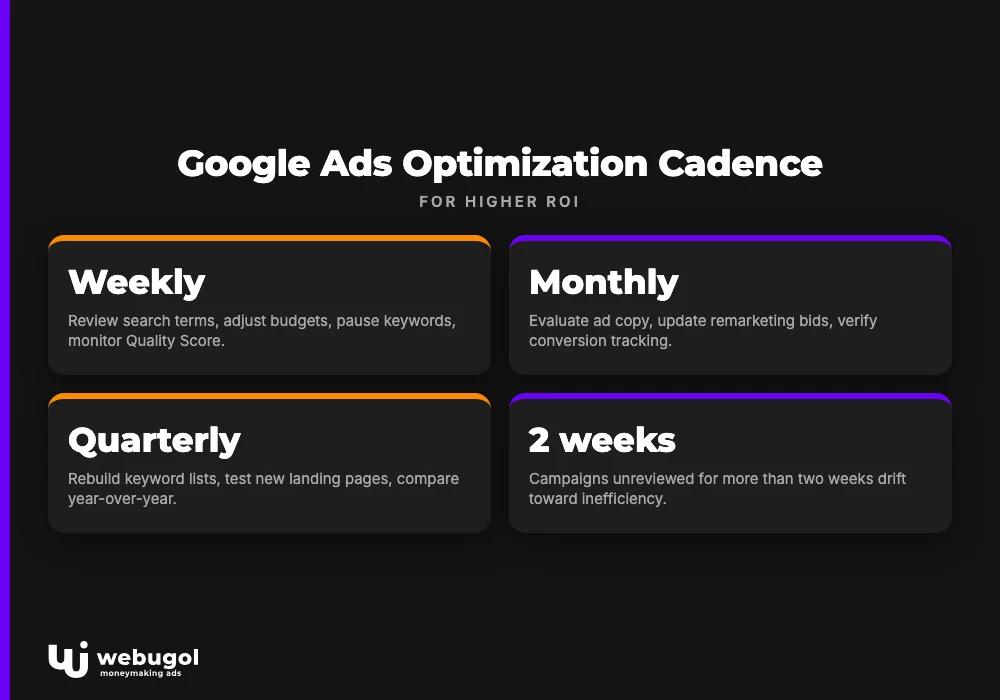
Google ads optimization requires structured, recurring attention. Weekly reviews stop small inefficiencies from becoming expensive patterns. Monthly reviews surface structural improvements that routine checks miss. Quarterly reviews align strategy to seasonal shifts and competitive changes.
Weekly tasks:
- Review the search terms report and add new negative keywords from irrelevant or non-converting queries.
- Check budget pacing and adjust daily budgets for campaigns significantly over or under their targets.
- Pause keywords that have accumulated spend with zero conversions over the past 30 days.
- Monitor quality score changes for core keywords, which can signal landing page or relevance problems early.
Monthly tasks:
- Evaluate ad copy asset performance and replace elements rated "low" with new test variations.
- Review remarketing audience performance and update bid adjustments for segments that have shifted in value.
- Verify that conversion tracking is recording accurately with no gaps or configuration errors.
- Assess whether Smart Bidding strategies have exited their learning phases and are hitting targets.
Quarterly tasks:
- Rebuild or expand keyword lists using three months of accumulated search term data.
- Test new landing page variants or campaign structures for the highest-spending campaigns.
- Compare performance against the same period in the prior year to separate seasonal patterns from underlying trends.
Campaigns left unreviewed for more than two weeks drift toward inefficiency. Budget migrates to high-volume, low-converting terms. Seasonal patterns pass unaddressed. This cadence is what separates accounts that grow from accounts that plateau.
Ready to get more from your Google Ads investment?
If your campaigns generate traffic but not the conversions your business needs, the problem usually sits in one of the areas above: quality score, bidding strategy, conversion tracking, or keyword structure. Pinpointing it requires a close look at actual account data.
The team at Webugol, a digital marketing agency focused on search and paid channels, works with businesses to audit, restructure, and scale Google Ads accounts. If you want a clear diagnosis of what is holding back your results and a concrete plan to address it, reach out and start the conversation.
FAQ
What is a good quality score in Google Ads?
A score of 7 or higher is generally strong and means your keyword, ad, and landing page are well-aligned to the search query. Scores between 4 and 6 are average and represent a genuine improvement opportunity. Scores below 4 typically indicate a relevance or landing page issue that is directly raising your cost per click.
How long does Google Ads optimization take to show results?
Most structural changes, like tightening ad groups or adding negative keywords, affect CTR and quality score within two weeks. Smart Bidding strategy changes require two to four weeks for the algorithm to exit its learning phase and stabilize performance. For new campaigns with limited conversion data, meaningful trend visibility typically takes four to six weeks.
What is the Google Ads optimization score?
The optimization score is a 0 to 100 percent rating Google assigns based on how closely your campaign follows Google's automated recommendations. A high score does not guarantee profitable performance. Review each recommendation individually before applying it, rather than accepting all suggestions to chase a higher number.
Can I run Google Ads without conversion tracking?
You can run campaigns without it, but they will optimize for clicks rather than business outcomes. Without conversion tracking setup, Smart Bidding strategies lack the data they need and default to maximizing traffic volume instead of results. You also lose the ability to identify which keywords and ads generate real business value, making meaningful google ads optimization impossible.
How do I know if my ad copy is working?
Check asset performance ratings within your Responsive Search Ads and compare CTR and conversion rate across active variants. Replace any asset marked "low" with a new version testing a different message or angle. For definitive conclusions, run Campaign Experiments with at least 100 conversions per variant before deciding which version to keep.