



Botox advertising: compliant campaigns that drive bookings
Botox advertising works when the right message reaches a qualified prospect and a connected conversion path turns that prospect into a booked consultation. The challenge is not demand. Patients are searching. The challenge is that every major platform puts strict guardrails on how injectable procedures can be promoted, and most clinics lose acquisition revenue because their ad compliance, landing pages, and post-click operations are not built as one system. This guide covers the legal framework, platform mechanics, and conversion fundamentals that turn compliant Botox advertising into a predictable appointment stream.
If you run a med spa or aesthetic clinic and you are hitting a ceiling on paid patient acquisition, the bottleneck is almost never the ad itself.
What are the legal rules for botox advertising?
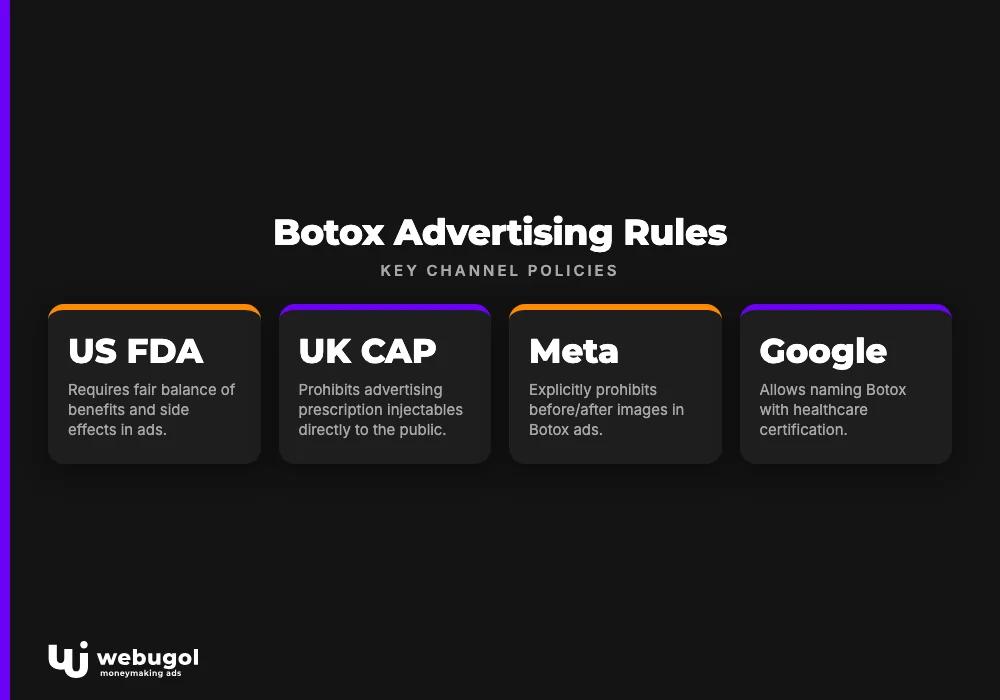
Botox is a prescription-only medicine in the United States, placing it under FDA prescription drug advertising regulations. US consumer-facing Botox advertising must not be false or misleading, must not imply uses beyond FDA-approved indications, and must provide fair balance: when a benefit is claimed, the possibility of side effects must also be communicated. Running paid ads without that balance is a regulatory violation, not just a platform policy issue.
In the United Kingdom, the ASA and CAP take a stricter position. Advertising prescription-only injectables directly to the general public is prohibited under CAP rules, so UK practitioners promote the consultation rather than the named treatment. That distinction matters if your Botox advertising reaches audiences outside the US.
Per published Meta and Google advertising policies, here is what the main paid channels allow:
| Platform | Can you name Botox in the ad? | Before/after images allowed? | Booking CTA allowed? |
|---|---|---|---|
| Google Search | Yes, with Google healthcare certification | Not excluded by default, but claims must be accurate | Yes, to a compliant landing page |
| Meta (Facebook/Instagram) | Yes | No, explicitly prohibited by Meta policy | Yes, to a booking form or lead form |
| YouTube | Yes | Not in paid placements | Yes, to a landing page |
Three rules apply across all channels. Get written consent before using any client photo or testimonial. Never guarantee outcomes. Never imply Botox is without risk. These are not optional. In the US, violations can trigger FDA enforcement actions on top of ad account restrictions.
What makes a botox ad effective?
The only metric that matters in Botox advertising is cost per booked consultation. Click-through rates and impressions are inputs, not outputs. An ad can pull strong CTR and produce zero appointments.
Creative botox ads that convert share three structural traits.
It addresses a specific concern, not a broad category. "Reduce forehead lines before your next event" holds attention longer than "anti-aging treatments available." Generic aesthetic clinic marketing lets prospects self-exit. Specific copy pre-qualifies readers before the click and reduces irrelevant traffic.
It removes friction on the next step. A strong CTA is not "learn more." It is "book a free 15-minute consultation" or "check if you are a candidate." The question behind most aesthetic searches is not "what is Botox." It is "will this work for me, and is this practice trustworthy." Your copy should answer both before asking for anything in return.
It lands on a page built for one action. Sending Botox Facebook ads or search traffic to a general services page is a structural conversion leak in aesthetic clinic marketing. The landing page should confirm the ad's claim, display practitioner credentials and real social proof, and present one CTA above the fold. That is the full chain.
Authentic images from your own clinic outperform stock. Before-and-after content builds trust, but Meta explicitly prohibits it in paid placements. Use it on the landing page and organic posts where policy allows.
The copy decisions that make it convert are structural, not stylistic. Fix the structure before optimizing the wording.
Can you advertise botox on Facebook?
Yes. Botox Facebook ads are permitted in the US within Meta's health and wellness advertising policies. Meta allows promotion of aesthetic consultations, practitioner credentials, and educational procedure content. What Meta prohibits in paid placements: before-and-after imagery, copy that implies a health condition is being treated or fixed, ads targeting users based on diagnosed conditions, and creative that applies negative body image pressure to prompt action.
Carousel ads and Instagram Reels work well for Botox promotion ideas that feature clinic environments and practitioners rather than treatment outcomes. Story formats connected to a Meta lead form reduce the number of steps between ad exposure and a captured lead.
The most consistent failure in aesthetic clinic marketing is not the ad creative. It is the tracking layer behind it. A Meta pixel installed but not configured with consent mode means every retargeting audience is built on partial data. CPL drifts upward over time. There is no reliable way to trace a booked appointment back to the campaign that drove it. Fix tracking before running Botox marketing ideas at scale. The tests you run afterward produce numbers you can act on.
Can you run Google Ads for botox?
Yes. Google permits Botox advertising in the US under its healthcare and medicines advertising policy, provided the practice meets Google's certification requirements for prescription drug-related services. Beyond certification, sensitive health content policies apply: claims must be accurate, landing pages must match ad claims, and personalized advertising targeting health-related interests requires consent-mode compliance.
Search campaigns outperform display here because patient intent is explicit. Someone searching "botox near me" or "forehead line treatment [city]" is ready to act. Display reaches audiences who have not formed that intent. Allocate budget accordingly.
Keyword strategy is where Botox advertising spend most often leaks. Broad match on "botox" generates significant volume from informational and competitor-research queries that will not convert. Phrase-match targeting on consultation-intent terms keeps CPL controlled. Responsive search ads let you test multiple compliance-approved headline and description combinations simultaneously. Run at least three headline variants covering the treatment, the result, and a trust signal such as board-certified injectors or a free consultation offer.
For a detailed breakdown of how to build compliant search campaigns for aesthetic and medical services, see Google Ads for aesthetic clinics and the healthcare paid search overview.

How much does botox advertising cost?
There is no universal CPL benchmark for Botox advertising. Cost per lead varies with market competitiveness, platform, offer clarity, and how well the post-click path performs. A clinic in a dense metro with a generic landing page and a slow follow-up response will always pay more per acquired patient than one with a tested offer and fast intake operations.
The metric to optimize is cost per booked consultation, not cost per lead. Large lead volume at low CPL means nothing if few convert to appointments. The core economic principle is straightforward: if a Botox advertising campaign costs $500 and brings in three new clients who each generate $1,500 in first-year revenue, the economics work. The tracking infrastructure to confirm that attribution is what most med spa ads are missing.
What to control on the cost side:
- Establish a limited test budget first to confirm baseline CPL and consultation booking rate before scaling spend.
- Track CPL, show rate, and close rate as separate metrics. A single "total leads" number hides where acquisition is actually breaking down.
- Increase Botox advertising spend only after closed-loop tracking from ad click to confirmed appointment is verified and working.
Creative botox ad formats that convert
Different formats address different stages of patient decision-making.
Search ads capture patients who are already ready to act. The creative job is precision and credibility. The headline should match search intent, the description should remove a barrier to the next step, and ad extensions should provide a direct booking path.
Video ads on Meta and YouTube address a core patient anxiety: not knowing what to expect. A 30-second clip of your practitioner explaining what a consultation involves, what the treatment process looks like, and what the days afterward feel like answers the questions patients are searching before they call. Educational video consistently outperforms promotional content in aesthetic clinic marketing because it reduces the primary objection before the consultation request happens.
Retargeting is where most med spa ads leave revenue on the table. A prospect who visited your Botox service page without converting has already done the research. Retargeting them with a specific, time-limited consultation offer is often the lowest cost-per-appointment Botox advertising campaign in the account. Proper consent configuration and a defined audience window are both required.
Influencer partnerships extend Botox promotion ideas beyond what paid placements allow. A local creator speaking honestly about their consultation experience provides social proof that platform policies prevent you from running as paid creative. Organic content first. Paid amplification second, within platform policy.

The conversion path most guides skip
Here is what most Botox advertising guides leave out. A compliant, well-targeted ad is necessary. It is not enough.
The revenue bottleneck in aesthetic clinic marketing is almost always post-click. Speed-to-lead is measured in minutes. A prospect who submits a consultation form at 11 AM and receives a callback at 4 PM has likely already booked with a competitor. Lead routing, response templates, and CRM intake configuration are not back-office logistics. They are performance marketing. They determine whether your spend turns into revenue or into cold leads on a spreadsheet that nobody owns.
Three questions your reporting should answer before you increase paid spend:
- What is the average time between a form submission and your first outbound contact attempt?
- What percentage of paid leads book a consultation versus go cold without contact?
- What is your show rate for paid consultations compared to organic referrals?
If your dashboard cannot answer all three, you are scaling spend into an unmeasured system. That structural gap is the most common reason ad spend in aesthetics produces diminishing returns as budgets grow. Measuring the handoff first is what separates clinics that scale from clinics that simply spend more.
For practices building a full patient acquisition path that closes the loop from paid click to confirmed appointment, this guide to paid search patient acquisition for aesthetic practices covers the operational mechanics in detail.
Stop losing revenue between the ad click and the consultation
Most aesthetic clinics running Botox advertising are not losing at the creative level. They are losing at the handoffs: between ad and landing page, between form submission and follow-up call, between booked consultation and completed appointment. Each handoff is a revenue leak. Each one compounds as spend scales.
At Webugol, we build acquisition systems for aesthetic clinics that connect every step of the path from paid click to confirmed appointment. Our process starts with a diagnostic that maps tracking gaps, funnel conversion rates, and intake response times before recommending a single budget increase. If your Botox advertising is running but you cannot trace it to booked revenue, that is the problem we address first. Book a strategy call with our team.
FAQ
Can you advertise botox on Facebook?
Yes, Botox Facebook ads are permitted in the US under Meta's health and wellness advertising policies. You can promote consultations, practitioner credentials, and educational procedure content. Before-and-after images in paid placements are explicitly prohibited by Meta policy, as are ads that target users by health condition or use negative body image pressure to drive action.
What are the legal rules for botox advertising?
In the US, Botox is FDA-regulated as a prescription drug. Consumer-facing ads must not be false or misleading, must not imply off-label uses, and must include fair balance between benefit claims and risk disclosure. Written consent is required before using client images or testimonials in any ad or marketing material. Guaranteeing results or claiming no side effects violates FDA advertising guidelines.
Can you run Google Ads for botox?
Yes, Google allows Botox advertising in the US under its healthcare and medicines policy, provided the practice meets Google's certification requirements for prescription drug-related services. Intent-based search campaigns targeting consultation queries consistently outperform display campaigns in lead quality. All landing pages must accurately reflect the claims made in the corresponding ad.
What makes a botox ad effective?
An effective Botox ad addresses a specific patient concern, reduces friction on the path to a consultation booking, and directs traffic to a landing page built around one conversion action. Cost per booked consultation is the metric that matters. Authentic clinic imagery outperforms stock photography, and educational content about the procedure outperforms purely promotional copy.
How much does botox advertising cost?
Botox advertising costs depend on market competitiveness, platform, and how well the post-click conversion path performs. There is no universal CPL benchmark. The sustainable measure is cost per acquired patient relative to that patient's long-term revenue, calculated from closed-loop tracking rather than estimated from lead volume alone.

