



Plastic surgery PPC: how to win more patients and stop wasting budget
Plastic surgery PPC places your ads directly in front of prospective patients at the moment they search for a procedure on Google. A well-built campaign generates consultation requests within 24 to 72 hours of launch. A poorly structured one burns through significant budget pursuing searches that will never produce a booked appointment. The difference between those two outcomes has almost nothing to do with the platform or the daily budget, and everything to do with whether the campaign, the landing page, and the patient intake process operate as a connected system.
Whether your cosmetic surgery practice spends $5,000 or $50,000 a month on paid advertising, the structural weaknesses that drain budget at launch are the same ones that cap growth at scale: conversion tracking that misattributes results, bids calibrated to form fills rather than actual consultations, and landing pages that fail to match the intent of the search query. At scale, the leaks simply cost more.
Why most plastic surgery PPC campaigns bleed budget before they scale
Most cosmetic surgery ad accounts are not failing because of wrong keyword selection or insufficient budgets. They fail because the ad platform, the landing page, and the patient intake process were built by different people at different times and were never connected into a single attribution chain.
The platform reports clicks and leads. The landing page captures form submissions. The front desk logs consultations. Unless those three data streams connect to one source of truth, the campaign optimizes against the wrong signal. A practice might report 60 leads in a monthly dashboard. Traced to booked consultations and completed procedures, the real number is often a fraction of that. Bids keep rising on keywords that generate form fills but no revenue. The dashboard looks productive. Patient volume stays flat.
The second failure mode is launching plastic surgeon paid advertising without a conversion baseline. Without a defined target cost-per-consultation, a known average procedure value, and a clear payback window, there is no way to judge whether a $400 CPL is efficient or unsustainable. Scale happens without evidence, and budget burns through before the underlying problem is identified.
Speed-to-lead is the third overlooked variable in plastic surgery paid advertising. A prospective patient filling out a rhinoplasty inquiry form has a narrow window of high intent. A follow-up call arriving six hours later arrives after that patient has already contacted two or three other practices. Response time is a marketing problem, not a sales department problem. It directly affects the return on every dollar spent on plastic surgery PPC, and it cannot be fixed from inside the ad account alone.
Is PPC worth it for a cosmetic surgery practice?
Yes, for practices with the right operational profile. PPC for plastic surgeons works when the average procedure value is high enough to absorb competitive CPLs, when the intake process can respond quickly to inbound inquiries, and when conversion tracking measures actual consultations booked rather than form submissions captured.
The case for paid search over organic comes down to speed and control. Cosmetic surgery Google Ads delivers patient inquiries within days of launch. SEO requires months of consistent investment before organic traffic builds to meaningful levels. For a practice entering a new market, launching a specific procedure line, or filling near-term schedule capacity, paid search offers precision and timing that organic cannot match.
The risk is equally concrete. Without proper negative keyword lists, budget flows to informational searches that will never produce appointments. Without conversion tracking, there is no data connecting spend to consultations. Without regular optimization, bids drift and underperforming ad groups collect spend that should be reallocated. Each of these failures is independent, and most established practices are dealing with more than one at a time.
A practical framing: plastic surgeon lead generation through paid search works the same way a high-touch intake role works. The channel performs only when the infrastructure behind it can handle what it generates. High ad spend against a broken intake process produces expensive, unconverted leads.
How much does PPC advertising cost for plastic surgeons?
Plastic surgery PPC sits in one of the most competitive paid search categories in healthcare. Procedure-specific keywords, rhinoplasty, body contouring, facial rejuvenation, breast procedures, carry high CPCs because the patient lifetime value is substantial and competition for those searches is intense across most US markets.
Cost per lead is the more actionable metric for planning. A click landing on an unoptimized general services page produces a significantly higher CPL than the same click arriving at a procedure-specific, mobile-optimized page with a clear offer and a direct booking form. Landing page quality consistently produces larger CPL differences than bid strategy adjustments, yet it is the lever that receives the least attention in most plastic surgery PPC accounts.
Setting a budget accurately requires three inputs: the target CPL for a consultation booking, the close rate from consultation to completed procedure, and the average revenue per procedure. If a procedure generates $8,000 in revenue and the practice closes one in four consultations, the math can support a meaningful CPL before the return goes negative. Without those inputs, any budget recommendation is a template applied without context. There is no universal CPL benchmark that holds across markets and practice types. An agency quoting guaranteed CPLs before auditing your funnel, intake process, and market competition is working from a template, not your account.
What keywords should plastic surgeons target in Google Ads?
For plastic surgeons, the highest-converting keyword categories are high-intent procedure terms combined with location or action modifiers. The biggest budget drain is broad, high-volume terms that attract informational searches with no near-term booking intent. Plastic surgery PPC performance depends on how precisely the keyword structure separates prospective patients from general researchers.
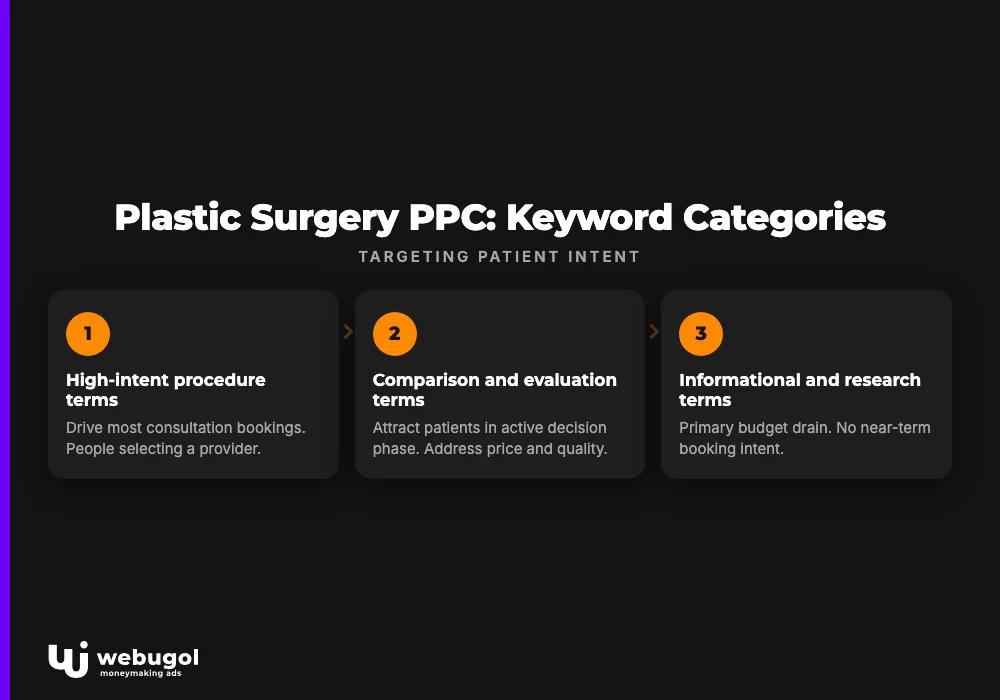
Three categories define an effective account architecture:
High-intent procedure terms drive the majority of consultation bookings. These are searches from people who have decided on a procedure and are selecting a provider: "rhinoplasty surgeon [city]," "breast augmentation consultation," "tummy tuck near me." CPCs are competitive, but these searches convert. This is where revenue comes from.
Comparison and evaluation terms attract patients in the active decision phase: "rhinoplasty cost," "best plastic surgeons in [city]," "cosmetic surgery reviews." These require dedicated landing pages that address price and quality questions directly. A visitor who searched for cost information and lands on a page that avoids the topic will leave without converting, regardless of how precise the original ad was.
Informational and research terms are the primary budget drain in unmanaged accounts. Queries like "how long does rhinoplasty recovery take" or "plastic surgery complications" represent research activity with no near-term booking intent. These belong on the negative keyword list, not in active ad groups.
A well-structured plastic surgery PPC account organized by intent:
| Keyword category | Search intent | Recommended approach |
|---|---|---|
| Core procedure + location | High commercial intent | Maximize conversions bidding |
| Procedure without location | Mixed intent | Ad copy must qualify intent |
| Cost and comparison | Research to purchase | Landing page addresses price directly |
| Branded (your practice name) | Navigational | Dedicated low-cost branded campaign |
| Informational queries | Research only | Exclude as negatives |
Negative keywords require equal discipline as the active list. Common exclusions include procedure risk and side effect queries, recovery timeline searches, medical education and career terms, and competitor brand names where defensive bidding is not the deliberate strategy. A consistent review of search term reports is one of the highest-ROI habits in medical PPC management. An unreviewed search term report in these accounts is a reliable indicator of ongoing budget waste.
How to build a plastic surgery PPC campaign that converts
Campaign structure determines where budget flows. A frequent structural error is grouping multiple procedures in a single campaign. Each major procedure needs its own campaign with dedicated ad groups, specific ad copy, and a purpose-built landing page. A patient searching for rhinoplasty lands on a rhinoplasty page. Not a general services listing.
Ad copy for cosmetic procedures requires precision. It must address the patient's specific concern without making outcome guarantees that violate Google's healthcare advertising policies. High-performing copy for plastic surgeon paid advertising typically emphasizes consultation availability, the surgeon's credentials and experience, and a specific next step. CTAs that name the action ("book a consultation," "view before and after results," "call the office") consistently outperform generic alternatives in cosmetic surgery verticals.
Responsive search ads allow testing multiple headline and description combinations within a single ad unit. The algorithm identifies which pairings perform best for each query over time. Running a static, proven ad alongside the responsive variant provides a performance baseline while the responsive ad accumulates conversion data. Neither approach alone is optimal; using both gives you control data and learning simultaneously.
Landing page quality has an outsized effect on CPL in cosmetic surgery accounts. Elements that consistently move conversion rates:
- A single, clear call to action per page: one offer, one form, one phone number
- Social proof specific to the procedure: patient testimonials, surgeon credentials, accreditation markers, procedure-specific galleries
- Fast mobile load times, since a large share of cosmetic surgery searches originate on mobile devices
- Form length calibrated to visitor intent: a shorter consultation request form for higher-funnel visitors
Remarketing re-engages visitors who left without converting. For cosmetic procedures, where the decision process can span several weeks, remarketing targets an audience that has already expressed procedure-level interest. Cost per impression is lower than cold search traffic. Conversion rates are higher because the audience is pre-qualified. Targeting procedure-page visitors with a specific consultation offer represents one of the most efficient uses of a plastic surgery PPC budget.
A/B testing one variable at a time (headline, image, CTA wording, form length) produces improvements that compound over time. Changing multiple elements simultaneously makes it impossible to identify what drove any observed change in conversion rate.
Healthcare compliance in plastic surgery paid advertising
Google's healthcare and medicines policies impose specific restrictions on cosmetic surgery advertising. Ad copy that implies guaranteed outcomes, references medical results without appropriate substantiation, or uses patient data in ways that conflict with HIPAA requirements faces rejection at the ad level or suspension at the account level.
Before launching plastic surgery PPC campaigns, both the ad copy and the landing page content need to pass a compliance review. The most common causes of medical ad disapprovals include outcome-implying language in headlines, unsubstantiated treatment claims, and landing pages that do not substantiate the representations made in the ad. Knowing what triggers medical ad rejections before a campaign launches prevents launch delays and protects all active campaigns from downstream account review. A single non-compliant ad can trigger a review that affects campaigns running correctly in the same account.
Tracking configuration is a separate compliance layer. Standard Google Ads and Analytics pixels can pass health-related signals to ad platforms inadvertently. A medical PPC tracking approach built for healthcare compliance measures campaign performance without exposing patient data. Practices running conversion tracking without a healthcare-specific data review carry a risk that may not surface until a platform audit triggers it.
Retargeting requires additional care in cosmetic surgery accounts. Audience segments built from page visits that imply a specific health condition face restrictions under Google's healthcare advertising policies. Segmenting remarketing lists by procedure category rather than inferred health status is the correct architecture for compliant cosmetic surgery paid advertising. This distinction matters during account reviews.
How long does it take PPC to generate patient leads?
Plastic surgery PPC can produce inquiries within 24 to 72 hours of launch. That speed is the core advantage over content marketing and SEO, both of which require months before traffic builds to actionable levels.
A realistic timeline for a new account breaks into three phases. Weeks 1 and 2 are the learning phase: Google's algorithm collects conversion data and calibrates bid strategies. CPL during this period is typically higher than the eventual steady state. Major campaign changes during the learning phase reset the optimization clock and delay the point where data becomes actionable.
By weeks 3 through 6, conversion patterns stabilize. CPL trends become visible. There is enough data to identify which ad groups, keywords, and landing page variants are generating consultations. Negative keyword refinement and landing page test results from this window often deliver the most significant CPL reductions. This is also the phase where speed-to-lead issues, if present, become quantifiably visible in the gap between leads recorded and consultations booked.
The scale phase, where budget can increase without a proportional CPL increase, follows after the conversion baseline is confirmed and the landing page is validated against real traffic. Scaling before that evidence exists is the most common reason practices overspend in the first 90 days of paid advertising for plastic surgeons.
How do I choose a plastic surgery PPC agency?
Choose an agency that tracks the full path from ad click to booked consultation, includes landing page optimization in the engagement, and applies a compliance review before new healthcare ad copy runs. Specialization in cosmetic surgery is useful, but accountability for post-click outcomes matters more.
An agency managing the ad platform without visibility into what happens after the click operates with an incomplete picture. When the landing page, the CRM, and the intake process belong to different vendors or internal teams, no single party can diagnose and fix conversion problems. That fragmentation explains why many practices see strong platform metrics and flat patient acquisition at the same time. The platform numbers look right. Revenue does not follow.
Questions that distinguish plastic surgery PPC agencies working strategically from those working tactically:
- How do you connect ad spend to actual consultations booked, not just form submissions?
- What can your reporting answer, and what questions does it leave structurally open?
- Is landing page testing included in the engagement, or does it require a separate project?
- What is your compliance review process before new ad copy goes live?
- How quickly do you respond when a campaign underperforms for multiple consecutive days?
Red flags: quoting guaranteed CPLs without auditing your funnel first; contracts covering only the ad platform; reporting that shows CTR and impression share without connecting to downstream revenue; no process for reviewing search term reports.
Webugol approaches plastic surgeon lead generation as a full acquisition system. Tracking infrastructure, landing page optimization, and intake process alignment are part of the engagement from the start, not optional add-ons to a platform retainer.
Book a strategy audit for your plastic surgery PPC campaigns
If your current campaigns produce clicks without producing consultations, the problem is almost always structural. A disconnected tracking setup, an unoptimized landing page, and a slow intake process erode that performance faster than any keyword or bid adjustment can recover it.
Our approach as a healthcare PPC agency starts with end-to-end attribution before scaling any campaign. We connect ad spend to consultations booked, identify where the funnel breaks, and fix the structural gaps before increasing budget. If you want to audit your current plastic surgery PPC setup or build a new program from a solid foundation, contact Webugol Agency to schedule a strategy conversation.
FAQ
How much does PPC advertising cost for plastic surgeons?
Plastic surgery PPC costs vary by procedure, geographic market, and local advertiser competition. There is no universal CPL benchmark that applies across markets. The number that matters most is cost per consultation booked, which requires tracking that connects ad spend to actual appointments, not just form submissions counted in the ad platform.
What keywords should plastic surgeons target in Google Ads?
High-intent procedure keywords, searches combining a procedure name with a location term or a booking action, drive the most direct consultation bookings. Informational queries about recovery timelines, risks, and procedures should be excluded as negatives. Managing the negative keyword list is as important as managing the active keyword list.
Is PPC worth it for a cosmetic surgery practice?
PPC for plastic surgeons produces strong returns for practices with high average procedure values, a fast intake process, and proper conversion tracking in place. Without those foundations, paid search generates form submissions that do not become patients. The channel works when the system behind it works.
How long does it take PPC to generate patient leads?
Initial leads can arrive within 24 to 72 hours of launch. The learning phase runs approximately two to four weeks, during which CPL is above the eventual steady state. Scaling efficiently requires at least 30 days of conversion data before budget increases are justified.
How do I choose a plastic surgery PPC agency?
Look for an agency that tracks the full path from ad click to booked consultation, includes landing page optimization in the engagement, and applies a compliance review before new healthcare ad copy runs. Avoid agencies quoting guaranteed CPLs without first auditing your conversion funnel and competitive landscape.

