



Google medical ads disapproval: what triggers rejection and how to fix it
Google medical ads disapproval occurs when an ad violates Google's healthcare content policies. The standard is strict. Ads that make unsupported claims, use stigmatizing language around sensitive conditions, or misrepresent credentials get blocked automatically or after manual review. Knowing exactly what triggers rejection lets you write compliant copy the first time and stop losing budget to paused campaigns.
Why do medical ads get rejected on Google?
Google's medical advertising restrictions exist to protect users from misleading health content. When a disapproval occurs, it almost always traces back to one of three root causes: an unsupported claim, prohibited language, or a missing certification required by Google's healthcare ads policy.
Unsupported claims are the most common trigger. An ad using "clinically proven," "research-backed," or "FDA-approved" requires documentation. No docs means no ad. Disapproved medical ads also signal to Google that an account needs closer scrutiny, which can slow future approvals across the entire account.
Other common rejection triggers include:
- Promising guaranteed outcomes tied to a specific medical condition
- Using stigmatizing language around mental health conditions or sexually transmitted infections
- Impersonating a licensed medical professional or institution
- Targeting vulnerable audiences with unsubstantiated treatment claims
Understanding these categories is what separates advertisers who run stable campaigns from those stuck in a repeated approval loop.
What words get Google medical ads disapproved?
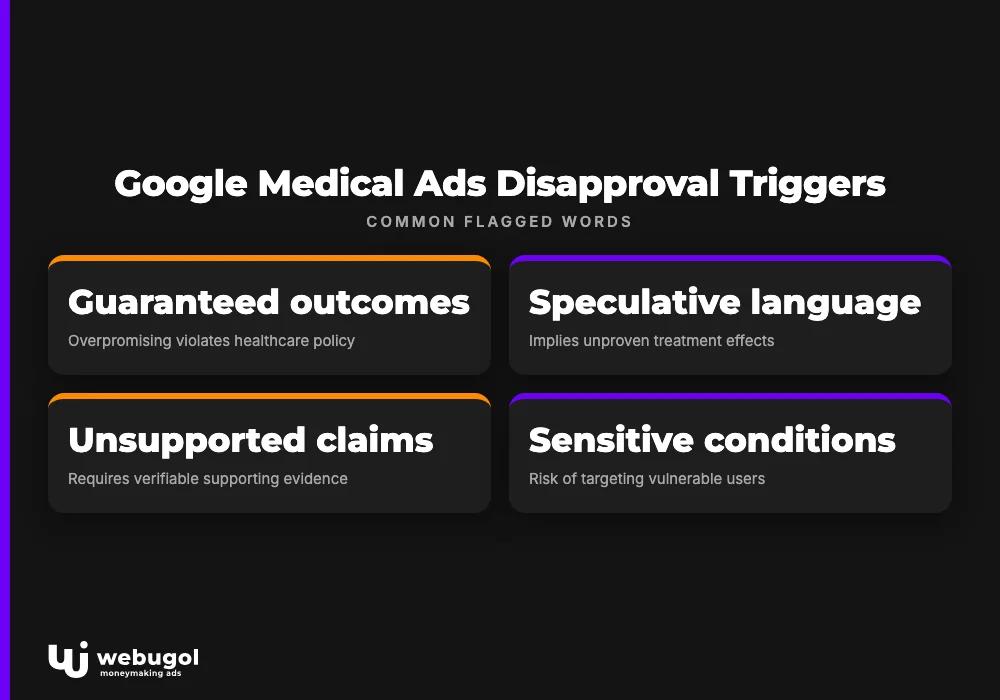
Specific language patterns reliably trip the review system. This table maps the most common categories to the phrases that cause google medical ads disapproval:
| Category | Flagged examples | Why Google blocks it |
|---|---|---|
| Guaranteed outcomes | "Cure your condition," "instant relief," "results in 30 days" | Overpromising violates healthcare policy |
| Speculative language | "Possible cure," "may treat your condition" (without citation) | Implies unproven treatment effects |
| Unsupported clinical claims | "Clinically proven," "FDA-approved" (without documentation) | Requires verifiable supporting evidence |
| Sensitive conditions | Terms around STIs, mental health, stigmatized diagnoses | Risk of targeting or stigmatizing vulnerable users |
| Rapid transformation | "Lose weight fast," "transform your body in weeks" | Prohibited under Google's weight loss advertising rules |
| Misrepresented credentials | Unverified "board-certified" or "licensed" language | Misrepresentation of practitioner credentials |
These categories account for the majority of medical ad rejected cases healthcare advertisers encounter. Identifying the specific category before editing saves time and prevents resubmitting an ad with the same problem in a different form.
What medical terms are banned in Google Ads?
Google does not publish a static banned-word list. Context drives the decision, not isolated words. "Cure" in a factual educational sentence reads differently than "cure your condition in three days." Google evaluates the full claim, not the term in isolation.
Language most commonly associated with ad disapproval includes anything that pairs a medical condition with a guaranteed outcome, rapid transformation phrasing like "overnight" or "in just days," disease claims requiring FDA regulatory oversight, and copy implying a product replaces professional medical advice.
The practical rule: if you cannot name the source behind a claim, cut it. Unsupported assertions are exactly what healthcare ads policy is designed to filter out.
What are Google Ads healthcare advertising policies?
Google ads healthcare compliance covers several distinct requirement areas. Here is what every medical advertiser needs to meet:
Certification requirements. Google requires certification for sensitive categories including addiction treatment services and, in many countries, abortion-related content. Running ads in these categories without certification causes immediate google medical ads disapproval.
Accurate ad-to-landing-page matching. What the ad promises, the landing page must deliver. A compliant ad pointing to a misleading or thin page still fails review.
Destination page requirements. Pages must include clear privacy policies and accurate business information. These are checked as part of the same ad review.
Country-specific rules. Medical advertising restrictions vary by region. What is permitted in the United States may be blocked in Germany, Australia, or the UK.
Remarketing restrictions. Advertisers cannot build remarketing audiences from visits to pages about specific health conditions or sensitive medical topics.
For a practical walkthrough of building campaigns within these boundaries, see our guide to compliant ad setup for healthcare.
How do I fix a disapproved medical ad on Google?
When your medical ad gets flagged, work through these steps in order.
Read the disapproval reason first. Google's notification names the specific policy category. Match it to the categories above to identify the exact problem before making any changes.
Edit the ad copy. Remove flagged language. Replace guaranteed outcomes with accurate descriptions. Every remaining claim should trace to a named source.
Check the landing page. Google reviews the destination alongside the ad itself. A clean ad linked to a non-compliant page still fails.
Gather and submit documentation. Claims like "FDA-approved" require certification submitted through the Google Ads policy manager before the ad goes back for review.
Appeal if the disapproval is incorrect. Google allows appeals through the policy manager. Provide clear compliance evidence; resolution usually takes a few business days.
Medical PPC compliance is not a one-time setup. Google revises its medical advertising restrictions on a rolling basis. Campaigns that cleared review last year may need updates today. Building a quarterly policy audit into your campaign calendar prevents surprise disapprovals from cutting off patient acquisition mid-month.
Ready to prevent Google medical ads disapproval?
A pattern of recurring rejections is usually a structural problem, not just a copy problem. Fixing individual ads patches the symptom. Rebuilding the account with compliance baked in solves the cause.
Webugol builds Google Ads accounts designed for healthcare compliance from day one. Our healthcare growth system covers policy-compliant campaign architecture, proactive disapproval monitoring, and ongoing optimization so your ads consistently reach the patients who need your services.
FAQ
What words get Google medical ads disapproved?
Guaranteed outcome language, unsupported clinical claims like "FDA-approved" without documentation, and stigmatizing terms around sensitive medical conditions are the most common triggers. Context determines whether a word is acceptable: the same term can appear in a compliant ad or a blocked one depending on how the claim is framed.
Why do medical ads get rejected on Google?
Medical ads are rejected for unsupported claims, prohibited language, missing advertiser certification, or non-compliant landing pages. Healthcare ads policy requires every claim to be accurate and documented, and the destination page must match what the ad promises.
How do I fix a disapproved medical ad on Google?
Read the disapproval notice to identify the specific policy violation, edit the ad copy to remove the flagged language, verify the landing page also complies, then resubmit. For certification-based rejections, submit required documentation through the Google Ads policy manager before resubmitting.
What medical terms are banned in Google Ads?
There is no static banned-word list. Google evaluates context, not individual words. Terms like "cure" or "treatment" are blocked when paired with guaranteed outcomes, unverified clinical claims, or disease-specific targeting that implies certain results.
What are Google Ads healthcare advertising policies?
Google ads healthcare compliance requires valid certifications for regulated ad categories, accurate ad-to-landing-page matching, compliant destination pages, and adherence to country-specific medical advertising restrictions. Remarketing audiences built from visits to health-related pages are also prohibited under these rules.