



What is a Magecart attack and why healthcare payment pages are a prime target
A magecart attack is an intrusion in which criminal groups inject obfuscated JavaScript into a website's checkout page to silently copy card data as customers type it. The skimmer transmits stolen records to an attacker-controlled server while the checkout completes normally, triggering no alert and leaving every conversion metric unchanged. Thousands of active skimmers operate on payment pages globally at any given moment, and healthcare is among the fastest-growing target categories because of its complex third-party script environments and the high combined value of payment and protected health data. No site type is more exposed.
For clinic owners and telehealth operators running five- and six-figure monthly ad budgets, the specific danger is this: a compromised checkout converts normally while card data exits through a channel the marketing dashboard cannot see. The acquisition team keeps optimizing spend against a signal that reads clean in every report and is corrupted at the payment level.
What is a Magecart attack?
A magecart attack is when criminal groups embed hidden code on a payment page to capture card numbers, names, and billing details in real time. The skimmer intercepts keystrokes or form submissions in the visitor's browser before data reaches the payment processor, then transmits the payload to an external domain. The transaction completes. The cardholder and site owner both receive a normal confirmation, and no alert fires.
The name originated from early attacks on Magento stores. Modern skimming campaigns target any checkout environment: custom-built portals, SaaS booking platforms, telehealth payment gateways, and scheduling widgets hosted on any CMS stack. The entry point is not the payment processor itself. Any third-party script loading on the checkout page is a potential vector.
How does a Magecart attack work?
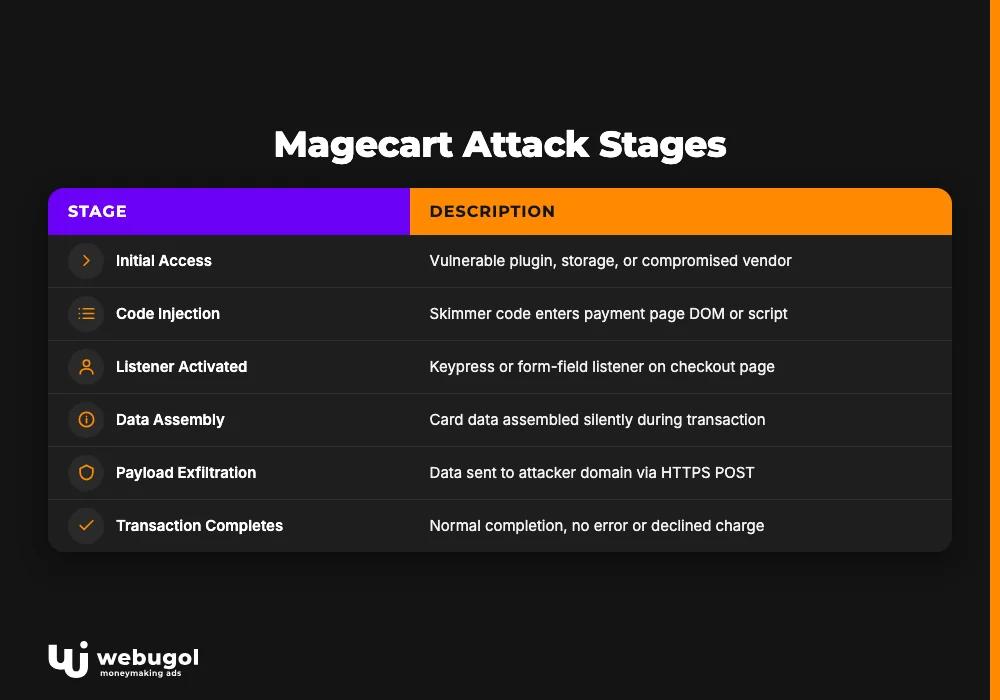
Attackers gain initial access through several routes: supply-chain compromise of a third-party JavaScript vendor, SQL injection into the site database, misconfigured cloud storage exposing source files, or a vulnerable CMS plugin with write access to the payment page. Once inside, they inject obfuscated code into the DOM. Often it hides inside a legitimate-looking script tag or attaches to an existing JavaScript file.
The code runs in the visitor's browser after the page loads. It listens for keystrokes on the checkout form, assembles card number, expiry date, and CVV, then silently POSTs the payload to an attacker-controlled domain that typically mimics a legitimate CDN or analytics service. The transaction completes. No error fires.
Magecart attack variants by entry vector and healthcare risk level
| Variant | Entry vector | Detection difficulty | Healthcare risk level |
|---|---|---|---|
| Direct DOM injection | Compromised CMS plugin or theme | Medium | High |
| Supply-chain (third-party script) | Vendor JavaScript hosted off-site | High | Very high |
| Server-side PHP injection | Database or file-system access | Low | High |
| GTM container hijack | Stolen tag manager credentials | High | Very high |
| CDN compromise | Vendor CDN origin breach | Very high | Very high |
Attack stages
- Initial access through a vulnerable plugin, misconfigured storage bucket, or compromised vendor
- Skimmer code injected into the payment page DOM or an adjacent script tag
- Keypress or form-field listener activated when the checkout page loads in the patient's browser
- Card data assembled silently during a real customer transaction
- Payload exfiltrated via HTTPS POST to an attacker-controlled domain
- Transaction completes normally with no error, declined charge, or alert
Why healthcare and telehealth checkouts are high-value targets
Telehealth and clinic payment flows combine structural complexity with high per-record data value in a way that makes them disproportionate targets. A single checkout session in a telehealth portal loads scripts from an EHR vendor, a scheduling widget, a payment gateway, a telemedicine SDK, and analytics tags. Each is a potential injection vector.
Healthcare compliance attention concentrates on HIPAA server-side data handling. Client-side JavaScript running in the patient's browser goes largely ungoverned. Attackers exploit exactly that gap.
Healthcare-specific attack surface factors:
- Four to eight third-party script tags loading on a single payment page, each sourced from a vendor CDN outside the clinic's direct control
- EHR and telehealth SDKs updated by the vendor independently, without the clinic reviewing each release
- Appointment-booking widgets that capture PHI (appointment type, condition indicator) alongside payment data in the same browser session
- Compliance audits scoped to server-side HIPAA controls, leaving client-side JavaScript unmonitored
- Low internal security operations capacity relative to the complexity of the integrated script stack
- Supply-chain exposure: one compromised plugin vendor can affect hundreds of clinics simultaneously through a shared script file
Can Magecart attacks affect telehealth and healthcare payment portals?
Yes, telehealth checkout flows are prime targets because they combine payment processing with protected health information in a single browser session and depend on multiple third-party scripts, each a potential injection vector. Patient portals, appointment-booking widgets, and telehealth payment gateways all carry this compounded exposure. This attack type does not require a weakness in the payment processor itself; it only requires access to the page that loads before the processor receives the data.

What does a Magecart attack do to your marketing data?
Here is the damage most healthcare operators do not anticipate: GA4 records checkout completions because the transaction completes. The ad platform logs conversions because the confirmation page fires. CPA looks stable. ROAS stays flat. The dashboard is green throughout the entire compromise window.
Marketing KPIs that appear normal during an active skim:
- Conversion rate: unchanged, because the checkout completes and the thank-you page fires as expected
- CPA: stable, since tracked conversions correspond to real completed transactions
- ROAS: unaffected, as the ad platform receives the same conversion signal it always did
- Checkout completions: accurately counted, since the skimmer does not interrupt the transaction flow
The first downstream signal is card fraud reports routed to the issuing bank, not to the merchant. By the time a bank notifies the clinic, weeks of attribution data are corrupted and ad spend has been continuously optimized against a poisoned signal.
Server-side event tracking adds a detection layer that client-side analytics tools structurally lack. Outbound requests to unknown domains during checkout, deviations in payload structure, and traffic anomalies inconsistent with your normal analytics stack can surface before a bank fraud notice arrives.
If your conversion data looks healthy but revenue tells a different story, a checkout and attribution review is the first diagnostic step. Request a checkout attribution audit to confirm whether your payment flow and marketing data are clean.
Notable Magecart attacks: 2022–2026
British Airways (2018, scale reference): Attackers compromised a third-party analytics script and injected a 22-line skimmer into the booking page. Around 380,000 card records were exfiltrated over 15 days. The UK Information Commissioner's Office fined the company more than $20 million. The incident is the clearest public case of how supply-chain injection multiplies the blast radius of a single vendor compromise.
Ticketmaster (2018): A compromised customer support chatbot vendor delivered the skimmer. Ticketmaster carried the injected code on its payment pages for weeks before detection. The incident demonstrated that the weakest link in a checkout's prevention posture is often not the payment processor but any third-party script loaded on the same page.
2025-2026 healthcare payment networks: Malwarebytes research published in January 2026 documented active campaigns targeting payment networks serving thousands of merchants simultaneously, with healthcare payment portals among the affected categories. Detection lag continued to grow as obfuscation techniques advanced.
Key facts across major incidents:
- Entry vector in every major case: supply-chain script, CMS plugin, or compromised analytics vendor
- Detection lag: weeks to months before card fraud reports reached site owners
- Regulatory outcome in GDPR jurisdictions: fines scaled to the number of affected records
- Healthcare compounding factor: PHI captured alongside payment data triggers a second regulatory framework

How long does a Magecart attack go undetected?
Magecart skimmers run undetected for weeks in documented incident data. Healthcare checkouts typically extend that window because fraud complaints route through the issuing bank before reaching the merchant, adding institutional latency to an already slow detection cycle.
The pattern Webugol looks for in a healthcare checkout review is this: conversion metrics show no deviation throughout the active window because the skimmer does not interrupt the transaction flow. The first internal signal is typically an unusual spike in card decline rates or a fraud notice from the payment processor, not an internal audit.
If you find a skimmer on your checkout, reconstruct the timeline by pinning down when the injected code first appeared (check the GTM version history, the CMS file-change log, and the date each vendor-hosted script last changed), when you saw the first decline spike or processor fraud notice, and when the code was removed. The span from first appearance to removal is your exposure window, and every transaction inside it belongs in scope for a PCI-DSS card-data review and, where checkout sessions also carried PHI, a HIPAA breach risk assessment.
Why skimmers stay hidden for weeks:
- No checkout disruption: every transaction completes and the customer receives a normal confirmation email
- Conversion data unchanged: GA4, Meta Pixel, and ad platform conversion tags all fire exactly as expected
- Fraud lag at bank level: cardholders report fraud to their issuing bank, not to the merchant website
- No server-side log entries: the skimmer executes in the visitor's browser and leaves no trace in server access logs
- CSP absent or not enforced: without a Content Security Policy, outbound requests to unknown domains generate no browser-level alert
How to detect a Magecart attack on your site
Detection of a magecart attack does not require a security engineering background. The checklist below covers steps a CMO or marketing director can initiate without waiting for a developer sprint.
Detection checklist (M = marketer initiates, D = developer executes):
- Open the browser network tab on your checkout page (M): look for outbound POST or GET requests to domains you do not recognize, particularly those triggered on form submission
- Audit your GTM container for unexpected tags (M): custom HTML tags with base64-encoded content or unrecognized script sources are strong compromise signals
- Inspect every third-party domain loading on the checkout page (M/D): enumerate all external requests during a test transaction and compare against your approved vendor list
- Review your CSP headers (D): an absent Content-Security-Policy means no passive tripwire is in place for unauthorized script execution
- Enable CSP violation reporting in report-only mode (D): captures violations without risking checkout disruption, creating a low-cost detection layer from day one
- Monitor card decline rate as a leading indicator (M): a step-change increase in declines without a corresponding UX change warrants immediate investigation
- Track card fraud complaint patterns (M): fraud complaints concentrated around specific transaction windows rather than scattered phishing activity indicate active skimming
Teams running a broader site review should include the checkout pages in a site-wide script and security review that surfaces unexpected injections alongside technical SEO findings.
When evaluating the best magecart attack prevention tools, look for solutions that monitor outbound script execution in real time rather than those that only scan for known vulnerabilities at deploy time. Stop magecart attack software built around runtime request monitoring catches supply-chain injection that static scanning misses entirely.

How to prevent Magecart attacks: platform and process checklist
Magecart attack prevention requires controls at both the policy and code levels. A clinic's marketing director can drive several of these without waiting for a developer sprint.
Marketing can own:
- Conduct a GTM container audit every quarter: remove inactive tags, restrict publish access, and review every custom HTML tag for unexpected script content
- Establish a payment-page script freeze policy: any new third-party tag on the checkout page requires documented approval and a security review before deployment
- Set a vendor review cadence: evaluate the security posture of every vendor whose JavaScript loads on your checkout at least annually
- Monitor card decline rate trends as a leading indicator: an unexplained spike warrants an immediate script audit before the next billing cycle
Engineering must execute:
- Implement a Content Security Policy header on payment pages: define an allowlist of script-source domains and configure a reporting endpoint for violations
- Apply Subresource Integrity (SRI) attributes to every third-party script: the browser refuses to execute any script whose hash deviates from the declared attribute, blocking supply-chain injection at execution
- Isolate payment data capture using sandboxed iframes: card fields rendered in a sandboxed iframe cannot be read by scripts running on the parent page
- Patch CMS plugins and themes on a defined schedule: most stop magecart attack security failures begin with an unpatched plugin that provided the initial access vector
GTM hygiene audit steps:
- Export the full container tag list and compare against your approved vendor registry
- Remove any custom HTML tags created more than 90 days ago without a linked support ticket
- Restrict GTM publish access to two or fewer named users and audit the list monthly
- Enforce two-factor authentication for all users with publish permission in the container
HIPAA, PCI-DSS, and Magecart: the compliance exposure
A healthcare operator who uncovers an active skimmer faces two parallel regulatory frameworks simultaneously. No competitor article in the current SERP addresses both.
PCI-DSS establishes baseline requirements for payment card security, including third-party vendor assessment. PCI compliance assessments do not, however, monitor client-side JavaScript executing in the visitor's browser in real time. The skimmer operates after the page loads, in a layer outside what standard PCI audit cycles actively cover.
HIPAA adds a second layer specific to healthcare. In a telehealth checkout session, appointment type, condition indicators, patient name, and date of service appear alongside payment data in the same browser context. All qualify as protected health information under the HIPAA Privacy Rule. A skimmer capturing that session captures PHI, triggering the HIPAA Breach Notification Rule's 60-day reporting obligation.
HIPAA breach notification triggers relevant to a Magecart event:
- The checkout session captured PHI alongside payment data: appointment type, condition, or patient name on the same page
- Access was unauthorized and data was acquired, not merely viewed without exfiltration
- 500 or more individuals in a single state were affected, triggering the requirement to notify prominent media outlets in that state within 60 days
- Business Associate Agreements do not transfer the notification obligation away from the covered entity
Does PCI-DSS compliance prevent Magecart attacks?
PCI-DSS compliance reduces your attack surface significantly but does not prevent a magecart attack. Skimmers operate in the browser after the page loads, in a client-side execution layer that standard PCI audits do not monitor in real time. A fully PCI-compliant site can carry an active skimmer for weeks without triggering a compliance finding.
Are Magecart skimmers covered under HIPAA breach notification rules?
They can trigger HIPAA notification obligations when the compromised checkout session captured PHI alongside payment data. Patient name, appointment type, or condition indicators on the same checkout page qualify as PHI, which is the standard configuration in most telehealth flows. If 500 or more individuals in a single state are affected, the covered entity must also notify prominent media outlets in that state within 60 days of discovery.
Is your healthcare checkout a silent target right now?
A compromised checkout that converts normally is the hardest failure mode to catch without a dedicated audit. The absence of alerts is the defining feature of a magecart attack, not evidence of safety. Marketing data looks clean. Ad spend keeps flowing into a funnel where card data exits through a channel the dashboard cannot see.
When Webugol takes over your acquisition system, the checkout and attribution stack review is the first thing we build, it is the Month 1 foundation everything else scales from. If your payment flow and conversion tracking have not been audited for unauthorized script activity in the past 90 days, that gap is the first risk to close before the next billing cycle runs.
FAQ
What is a Magecart attack in simple terms?
Criminals embed hidden code into a website's checkout page to copy credit card numbers as customers type them. The site works normally and no alert fires; only the pattern of card fraud in bank reports eventually reveals the compromise.
How do I know if my website has a Magecart skimmer?
Open your browser's network tab on the checkout page and look for outbound requests to domains you do not recognize, particularly on form submission. Unexpected custom HTML tags in your GTM container and an absent or unenforced Content Security Policy are reliable early signals.
How long do Magecart attacks typically go undetected?
The average undetected window spans weeks, and some incidents run for months. Skimmers do not break the checkout flow, so conversion metrics stay stable and card-fraud reports go to banks rather than site owners.
Does PCI-DSS compliance protect against Magecart?
PCI-DSS compliance lowers your attack surface but does not block Magecart. Skimmers execute in the browser after the page loads, outside the scope of what standard PCI audits actively monitor.
Can a Magecart skimmer trigger HIPAA obligations for a telehealth provider?
Yes. If the checkout session captured PHI alongside payment data, which is standard in telehealth flows, the breach likely meets the threshold for HIPAA's 60-day breach notification requirement under the Breach Notification Rule.

