



Google Ads account suspended: causes, appeal steps, and how to stop the next one
If Google Ads suspended your healthcare account overnight, campaigns still appear active in the dashboard while inbound calls and form fills drop to zero. The three most common triggers for healthcare accounts are health policy violations in ad copy, misrepresentation between ad claims and landing page content, and the harder-to-reverse circumventing systems flag. Open the Policy Manager tab inside Google Ads and read the exact policy citation before making any changes.
Why does Google Ads suspend healthcare accounts?
The suspension notice arrives because automated enforcement flagged a policy violation. The notification almost never names the specific ad or landing page that caused it. That gap between symptom and cause is where most practices lose days.
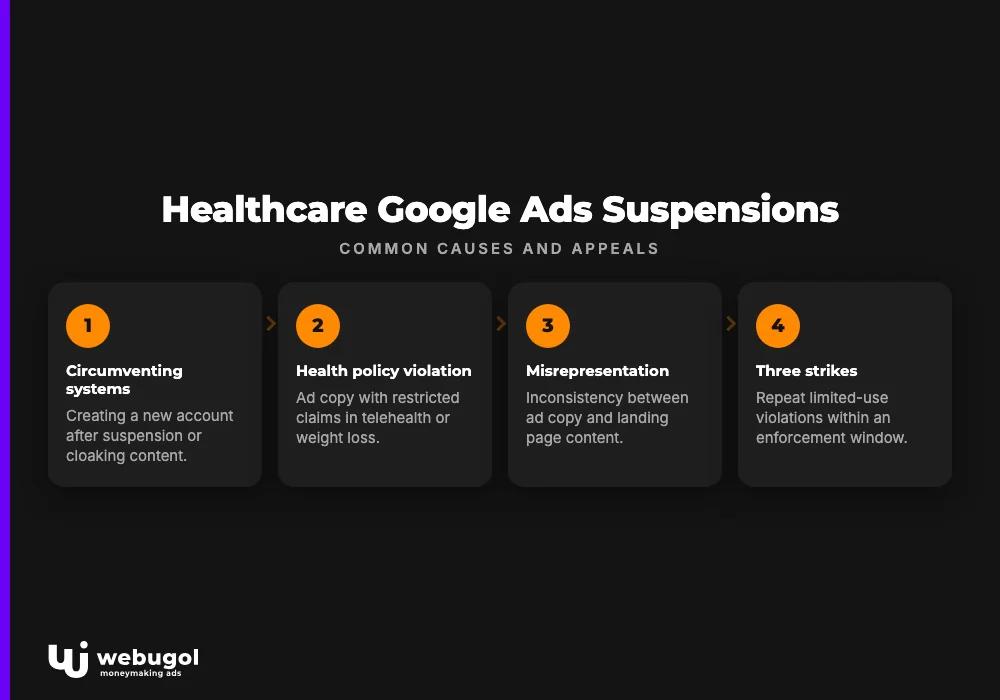
The table below maps the four suspension types most common in healthcare accounts, what drives each one, and what your appeal must address.
| Suspension type | Most common cause | What to address in your appeal |
|---|---|---|
| Circumventing systems | Creating a new account after suspension; cloaking content from reviewers | Confirm the flagged behavior stopped; provide documentation of account ownership and compliant site content |
| Health policy violation | Ad copy with restricted claims in telehealth, weight loss, TRT, or GLP-1 programs | Identify the specific claim, document the edit or removal, reference the exact policy section |
| Misrepresentation | Inconsistency between ad copy and landing page; deceptive offer framing | Show the revised landing page with screenshots; confirm copy-to-page consistency |
| Three strikes | Repeat limited-use violations within a defined enforcement window | List each violation, document the correction made, explain the monitoring process now in place |
A counterintuitive platform detail: campaigns typically still show active status in the interface after suspension. Spend halts immediately. Status indicators often lag by several minutes or longer. Checking spend and intake volume in parallel is more reliable than reading campaign status cards alone.
What does circumventing systems mean in Google Ads?
Google applies this label when an account is flagged for attempting to evade automated enforcement. Common triggers include creating a new account after a suspension or using techniques to hide prohibited content from reviewers. When you see a Google Ads account suspended for circumventing systems notification, the documentation requirements are higher than for a standard policy violation because the flag implies intent, not a copy error.
These cases follow a different escalation path. The standard appeal form handles most google ads policy violations. Circumventing systems flags often require support escalation before a reinstatement decision is issued.
What Google Ads policies do healthcare advertisers violate most?
Healthcare advertising sits under a restriction layer above standard Google Ads rules. Telehealth, weight loss, TRT, and GLP-1 verticals carry specific claim restrictions. Before-and-after language, certain condition references, and outcome guarantees trigger automatic flags. Some categories, including certified addiction treatment programs, require LegitScript certification before ads are eligible to run.
Creative that passed review at launch often fails a later automated sweep as the healthcare advertising policy expands to cover new claim types. Knowing words that trigger disapproval in medical ad copy is foundational to any account audit. This is the single most common google ads policy violation pattern for established telehealth and men's health accounts.
The failure mode nobody audits: copy drift
Generic suspension walkthroughs describe the policy. The harder question is what the incident looks like when it hits.
Ad copy written for a telehealth weight loss or men's health program before Google tightened its healthcare advertising policy often passed original review. Later automated sweeps caught the same language under a newer, broader interpretation.
Nothing changed in the ad copy. The policy expanded. The creative team approved it once and nobody reviewed it against a revised standard since.
When this happens, campaigns still show active in the dashboard. Spend stops mid-day with no platform alert. Inbound calls and form fills stop at the same moment. Without a monitoring system that flags both spend anomalies and channel-level intake drops in parallel, a practice can go hours without knowing the account is fully suspended rather than experiencing a slow day.
That is not a platform failure. It is a monitoring architecture problem. The copy-drift pattern is the highest-probability risk for any account running campaigns longer than 12 months without a systematic healthcare ads compliance review.
How to find which policy you violated
Open the suspension notification email alongside the Policy Manager tab inside your Google Ads account. The Policy Manager shows each flagged item with a specific policy reference number. That reference is what you bring into the appeal.
Three statuses matter. Under Review means enforcement is still active. Suspended means a decision has been made and the account is inactive. Final Decision means the standard appeal path is closed and escalation is required. Conflating these statuses sends you to the wrong channel and costs days.
How do I appeal a suspended Google Ads account?
The google ads appeal process has a specific order. Skipping steps is the most common reason appeals receive automatic rejections.
- Identify the exact policy violation from the Policy Manager tab.
- Fix the violation in ad copy, on the landing page, or both.
- Document the fix with screenshots dated after the change.
- Submit the appeal through the official Google Ads appeal form.
- Follow up directly with Google Ads support if no response arrives within 14 business days.
Your appeal text must answer two questions: what specifically violated the policy, and what specifically changed. Vague language such as "we reviewed our ads" produces form rejections. Specific language such as "we removed the phrase [exact phrase] from ad headline 2 in campaign [name] because it falls under [specific policy section]" creates a reviewable record.
Attach screenshots of the corrected creative and the updated landing page, including the date each change was made. Reference the exact policy section listed in the Policy Manager notification. Do not include commentary about the suspension process itself. Reviewers work from the documentation you provide, not the framing you add around it.
How long does a Google Ads suspension appeal take?
Standard appeals resolve in 3 to 5 business days. Healthcare and circumventing systems cases typically run 7 to 14 days. Silence beyond 14 days is not a final decision. Contact Google Ads support directly, reference the case ID visible in the Policy Manager tab, and request a status update through that channel rather than submitting a second appeal form.

What to do while your Google Ads account is suspended
A Google Ads account suspended event is an operational crisis for a patient acquisition system that runs on paid search. This is not a technical inconvenience.
Short-term redirection to Meta Ads is the fastest lever available, but only after a healthcare-compliant creative audit of the Meta copy first. The same policy restrictions that triggered enforcement on Google often apply to the Meta creative pool at the same time. Redirect budget without auditing and you risk suspending both channels simultaneously.
While the appeal runs, activate referral and patient reactivation programs in your CRM. Confirm your organic presence and Google Business Profile are capturing current search demand. Keep your intake team at full capacity. The continuity plan works far better when it exists before the suspension rather than being assembled in response to one.
The dual-channel risk: when Meta gets suspended too
The same compliance failure that produces a Google Ads account suspended flag often hits a Meta account at the same time. The violation lives in the creative, not in the platform. Ad copy with a restricted health claim carries that claim to every platform it runs on.
The structural exposure is running two paid acquisition channels under identical policy constraints with no third channel as a baseline. When both accounts are offline, the practice has zero paid patient acquisition. Account architecture that distributes risk across channels, combined with organic intake as a floor, reduces that exposure.
Confirm your healthcare conversion tracking setup is capturing baseline organic demand before you redirect budget, so you know what floor you are working with during the appeal window.

Prevention: how to avoid another Google Ads account suspended
The copy-drift pattern is preventable with a systematic review cadence. For established healthcare accounts:
- Review all active ad copy for healthcare ads compliance quarterly, not only at launch.
- Audit landing page claims alongside creative; Google's policy covers the full experience from click to conversion.
- Monitor the Google Ads health policy update log and flag any changes that affect active campaigns.
- Track account-level quality indicators; repeated limited approvals in the same vertical often precede a broader automated sweep.
- Assign a named owner for compliance review; copy drift happens in the gap between creative approvals and policy updates.
Compare currently active ad copy against the current policy definition, not against the definition that was in effect when the creative was first approved. That gap is where the next google ads policy violation lives. Running this check on a fixed quarterly calendar is the only reliable way to keep your account running during periods when paid acquisition drives primary patient intake.
A landing page that does not match ad copy is also a conversion problem, not only a policy problem. That is where the website build matters: when the site and the campaigns are built and reviewed together, closing the compliance gap and the conversion gap become a single task.
Stop losing revenue to preventable suspensions
When a Google Ads account suspended event forces a stop, the cost extends beyond paused spend. It includes the intake volume lost during the suspension, the time required to navigate the appeal, and the recovery window before volume returns to baseline.
What Webugol clients stop losing: intake volume during a suspension, weeks of appeal back-and-forth, and campaigns that drift out of policy because no single team owns the path from ad to booked patient. Ads run on top of a foundation we own end-to-end: the site, the tracking, and the account structure. When the landing page and campaigns are built and maintained together, healthcare ads compliance and conversion alignment become a single review, not two separate workstreams. The Healthcare Growth System starts with a copy review, policy alignment check, and site assessment before any campaign launches. For practices already running, the same diagnostic identifies exposure before it becomes a suspension.
What you stop losing is not occasional disapprovals. It is the unplanned recovery sprint after a full suspension.
FAQ
Can a permanently suspended Google Ads account be reinstated?
Most suspensions, including healthcare policy violations, are reversible once the underlying issue is corrected and a compliant appeal is submitted. Accounts flagged for circumventing systems face a higher documentation bar and may require escalation beyond the standard form before suspended account reinstatement is granted. The documentation must explicitly confirm that the flagged behavior has permanently stopped.
Should I create a new Google Ads account while mine is suspended?
No. Creating a new account while an existing one is under suspension is classified as circumventing systems and will result in a permanent ban across all accounts associated with the same billing profile, business identity, and payment method.
What is the most common reason healthcare Google Ads accounts get suspended?
Ad copy that violates Google's healthcare advertising policy is the most frequent cause, particularly in telehealth, weight loss, and men's health verticals. Creative that passed review when it was written often fails later automated sweeps as the healthcare ads compliance standard expands to cover new claim types.
How long does a Google Ads suspension appeal take?
Standard reviews resolve in 3 to 5 business days. Healthcare and circumventing systems cases typically take 7 to 14 days. If there is no response after 14 days, contact Google Ads support directly and reference the case ID visible in the Policy Manager tab.
How do I keep patient volume up while my Google Ads account is suspended?
Redirect available budget to Meta Ads after a healthcare-compliant creative review first, then activate referral and patient reactivation programs already in your CRM. Confirm your organic presence and Google Business Profile are capturing current search demand while the appeal runs.

