



Google Ads for doctors: turn search intent into booked appointments
Google Ads for doctors places your practice at the top of search results the moment a patient looks for a specialist, a procedure, or a clinic nearby. When the campaign, landing page, and intake process are aligned, the channel produces appointment-ready leads at a predictable cost. When they are not, the account reports green numbers while the front desk books nothing. The gap between those outcomes is almost never the ads.
That structural disconnect exists whether a practice is running its first campaign or spending five figures a month on adwords for doctors. Attribution gaps, weak funnel handoffs, and untested offer messaging follow the same pattern at every scale. They just cost more to ignore.
Why Google Ads for doctors convert better than most healthcare channels
Organic search takes months to show results. Social media reaches wide audiences with low intent. Google Ads for doctors captures patients in active search mode, at the moment they have already decided to seek care.
A patient typing "TRT clinic near me" or "weight loss consultation" is not browsing. They are choosing. Healthcare PPC campaigns put your practice in front of that decision before organic listings do.
| Diagnostic signal | Most likely cause |
|---|---|
| High CTR, low bookings | Landing page or intake is the bottleneck |
| Low CTR | Ad copy or keywords miss patient intent |
| Rising CPL month over month | Bid competition or quality score needs work |
| Good CPL, low show rate | Intake confirmation sequence needs attention |
Use this table before adjusting bids. Most performance problems are downstream of the campaign.
How can doctors use Google Ads to attract more patients?
Google Ads for physicians matches a practice to what patients are already searching. You define the keywords, write ads that speak to patient intent, and send clicks to a page that makes booking easy. The practice pays per click, not per impression, so spend follows demonstrated demand.
What separates campaigns that grow a practice from those that drain the budget is the path after the click. Response time matters. A patient who submitted a contact form at 8pm and received a callback the next morning at 10am already called three other providers. The ad budget paid for a lead that intake lost.
Remarketing adds a second layer. Patients who visited the practice website without booking can be served ads on other platforms, reinforcing visibility during their decision window. Keep remarketing audiences based on site behavior only. Targeting users by medical condition violates Google's healthcare advertising policy.
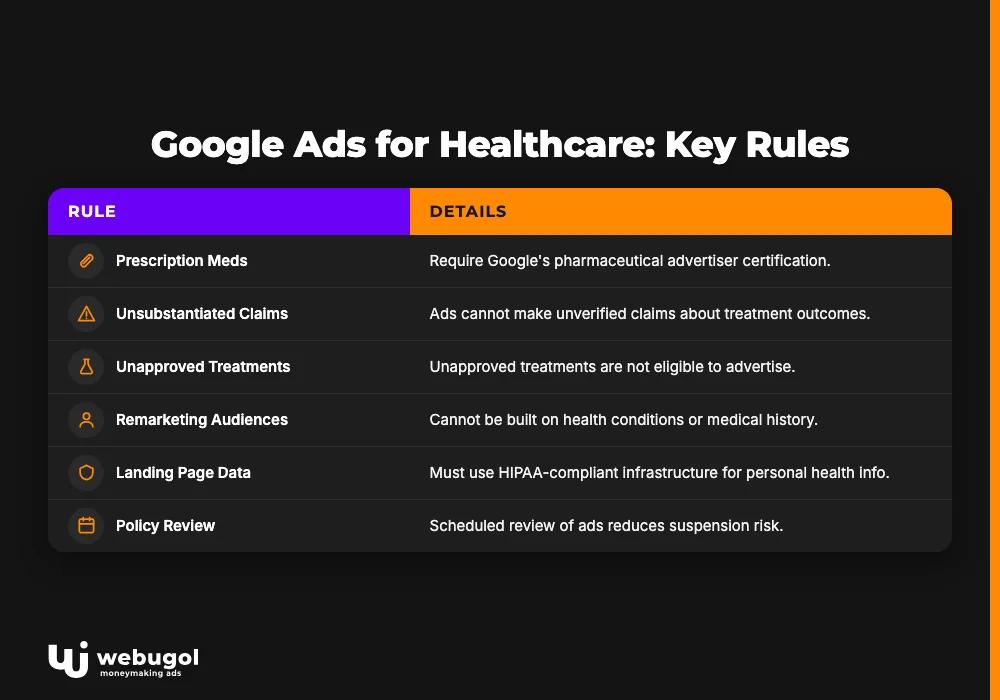
What are the Google Ads restrictions for healthcare providers?
Healthcare advertising on Google operates inside a compliance framework that applies regardless of budget size or account history. Most restrictions exist to align with HIPAA and platform safety policies.
Key rules for medical practice advertising:
- Prescription medications cannot be promoted without Google's pharmaceutical advertiser certification.
- Ads cannot make unsubstantiated claims about treatment outcomes or curative results.
- Unapproved treatments and unverified medical products are not eligible to advertise.
- Remarketing audiences cannot be built on health conditions or medical history.
- Landing pages must handle any personal health information through HIPAA-compliant infrastructure.
- Geographic restrictions apply in states or markets with local healthcare advertising laws.
- Some healthcare categories require completing Google's advertiser verification process before ads can run.
Compliance is not a launch task. Ad copy written 12 months ago may no longer meet current policy, especially in weight loss, men's health, and regenerative medicine. A scheduled review of running ads and landing pages reduces suspension risk. For the detailed platform framework, see our guide on ad policy guardrails for healthcare providers.
What types of Google Ads campaigns work best for doctors?
Search campaigns are the foundation of physician online advertising. Text ads appear when a patient actively types a procedure or specialty into Google, targeting the highest-intent traffic available. Most healthcare budgets should concentrate here first.
Display campaigns extend reach with visual ads across websites and apps. They perform best as remarketing tools, not first-touch acquisition. A patient who viewed a longevity panel page without booking can be re-served a relevant ad on another site.
Video campaigns on YouTube support patient education for high-consideration procedures. A short walkthrough of a GLP-1 program or regenerative treatment reduces objections before the consultation call.
For established practices scaling google ads for physicians, search commands the majority of budget. Display and video support the funnel. They do not replace it.

How to set up Google Ads for a medical practice?
Start with keyword lists built around booking intent. Write compliant ad copy that names the procedure and leads to a consultation. Build a landing page tied to one conversion action. Set up conversion tracking before any spend begins.
Structure determines performance. Most underperforming campaigns were not poorly managed. They were poorly built.
Build keyword lists around booking intent
Keywords drive medical practice advertising in healthcare the same way they drive any paid channel. The difference is specificity. "Doctor near me" is low-value. "GLP-1 weight loss program Houston" or "men's health clinic Chicago" connects to a patient who already knows what they want.
Build lists around procedure names, specialty terms, and geographic modifiers. Add a negative keyword list from day one to block irrelevant queries. For keyword segmentation by patient journey stage, the paid search patient funnel approach for medical practices covers architecture in detail.
Write ad copy that passes compliance review
Adwords for doctors must speak to patient intent without making claims that fail policy review. Both goals are compatible when copy is specific.
State what the practice offers. Name the service or program. Lead to a consultation booking, not a result promise. "Schedule your TRT consultation" passes review. "Reclaim your energy in 30 days" does not.
Set up conversion tracking before spending
This step is skipped more than any other. Without it, the account reports clicks and cost, not business outcomes.
Connect Google Ads to the scheduling or booking system. Track form submissions and phone calls as separate conversion actions. Where feasible, import confirmed appointments as offline conversions. Verify the configuration before launch. You cannot optimize toward outcomes you cannot see.
How Google Ads for doctors perform once tracking is verified
A verified tracking setup transforms the account from an expense into a measurement system. Every adjustment from that point has data behind it, and budget increases follow confirmed cost per acquisition rather than arbitrary targets.
How much do Google Ads cost for a medical practice?
There is no fixed number. Healthcare PPC campaigns vary significantly by specialty, geography, and bid competition in that market.
Procedures with high patient lifetime value attract more advertiser competition and higher cost per click. Weight loss programs, GLP-1 clinics, and men's health practices operate in active healthcare Google advertising markets. General primary care queries typically cost less.
Quality score, Google's combined measure of ad relevance, expected click-through rate, and landing page experience, directly affects what the practice pays per click for any keyword. A campaign with a strong landing page pays less than a weak one for the same query. Most cost management comes from structure, not bid reduction alone.

Where Google Ads campaigns lose healthcare patients
The ad platform is rarely the actual problem. The pattern in healthcare accounts is consistent: the campaign generates clicks from high-intent searches, but revenue does not materialize.
Google Ads for doctors generates the intent-matched traffic; the systems that handle patients after the click determine whether those clicks become revenue.
The diagnostic almost always finds the issue downstream.
Intake response time is the most common culprit. Response windows measured in hours eliminate most leads the campaign bought. The patient moved on.
Tracking fragmentation is the second pattern. The ad platform, GA4, and the CRM report three different conversion counts. Nobody can say which is correct. Leadership stops trusting all three. Budget decisions stall. Spend continues unchanged.
A third pattern is offer mismatch. The keyword and ad drew a patient searching for a specific program. The landing page describes a general practice. The patient did not book.
Improving doctor digital marketing ROI requires auditing the full path from search query to confirmed appointment, not just the ad creative. The click is the easiest part to fix.
Stop paying for leads your intake process loses
Your Google Ads account may already generate clicks from patients who are ready to book. The question is whether tracking, funnel, and intake capture those patients or lose them at each handoff.
Webugol's Healthcare Growth System builds the full acquisition path: tracking that reports to revenue, landing pages optimized for bookings, Google and Meta campaigns launched only after the system can measure them. Across 50+ healthcare clients, the approach has produced 3x revenue growth and a 40% reduction in customer acquisition cost.
Book a Strategy Call to see where your current campaign is losing patients.
FAQ
How can doctors use Google Ads to attract more patients?
Doctors use Google Ads to appear at the top of results when patients are actively searching for a procedure or specialist. Effective campaigns combine high-intent keywords, compliant ad copy, and a landing page with a direct booking path. Conversion tracking connects ad spend to actual appointment outcomes.
What are the Google Ads restrictions for healthcare providers?
Healthcare providers cannot advertise prescription drugs without Google's certification, make unsubstantiated treatment claims, or target users by health condition in remarketing audiences. Landing pages must handle personal health information through HIPAA-compliant systems. Categories including weight loss and men's health require additional policy review before campaigns can run.
How much do Google Ads cost for a medical practice?
Cost per click varies by specialty, location, and bid competition for those keywords. Quality score and landing page relevance directly affect what the practice pays per click. Practices typically confirm unit economics at a moderate spend level before scaling, using a confirmed CPL as the trigger for budget increases.
What types of Google Ads campaigns work best for doctors?
Search campaigns produce the most direct bookings because they target active patient intent. Display and video campaigns support remarketing and patient education but rarely drive first-touch conversions independently. Most medical practices direct the majority of ad spend to search and use display selectively for retargeting site visitors.
How to set up Google Ads for a medical practice?
Start with keyword research targeting procedure-specific and location-specific terms. Write ad copy that names the service and leads to a consultation booking, avoiding outcome claims that fail compliance review. Build a landing page that matches the ad with minimal friction to book. Set up conversion tracking before the campaign goes live.

