



CBD Email Marketing: Build Compliant Campaigns That Convert
CBD email marketing is how hemp and cannabidiol brands build a direct revenue channel that ad networks cannot restrict, suspend, or reprice. It covers list acquisition, compliance documentation, campaign strategy, and automation: the full infrastructure that converts a subscriber base into a repeatable revenue stream independent of platform policy. For CBD brands blocked from Google Ads and most paid social inventory, email is not a secondary tactic. It is the primary growth engine.
A CBD startup troubleshooting its first opt-in form faces the same structural challenge as any growing health brand stuck at a scaling plateau: the absence of a systematic owned-channel approach that compounds revenue without depending on third-party platforms.
Why CBD brands rely on email more than any other channel
Most programmatic ad networks classify cannabis and CBD as restricted categories. Google, Meta, and the majority of demand-side platforms either block CBD advertising outright or permit it only under conditions that change without warning. CBD brands cannot build the paid acquisition scale that other consumer brands take for granted.
Email sits on the other side of that restriction. The Data & Marketing Association has documented email marketing's average return at $36 for every $1 spent across industries. For CBD brands with constrained paid options, that advantage compounds.
Organic search and email are the two channels CBD brands fully own. How organic search builds lasting visibility for health and wellness brands follows the same economics: upfront investment in a system that generates returns over time, not just during active spend cycles.
What email platforms allow CBD marketing?
Most mainstream email service providers prohibit or restrict cannabis and CBD content in their acceptable-use policies. Mailchimp, Constant Contact, and ActiveCampaign have each suspended accounts promoting CBD products. The risk is real and consistently reported across cannabis marketing communities.
Platforms that accommodate hemp brand newsletter programs and CBD email campaigns:
- Alpine IQ: purpose-built for cannabis and CBD businesses; includes native segmentation, compliance tools, and loyalty program features
- Klaviyo: generally permits hemp-derived CBD; enforcement has been inconsistent and policies have changed; confirm in writing before committing
- Omnisend: allows hemp and CBD businesses subject to account review; verify that your specific product lines qualify
- Sendlane: has historically supported CBD email marketing; request written policy confirmation before migrating your list
Before committing to any platform, get their CBD policy in writing. Cannabis marketing forums surface account suspension reports regularly. Check recent user experiences before evaluating a platform based on its own sales claims alone.
What legal rules apply to CBD email marketing?
CBD marketing compliance operates across three distinct layers: federal law, state law, and platform terms of service. Each creates a different category of risk.
Federal level. The 2018 Farm Bill legalized hemp-derived CBD (under 0.3% THC) at the federal level. The FDA retained authority over marketing claims. The core prohibition is disease claims. Statements like "treats anxiety," "reduces inflammation," or "cures chronic pain" in a CBD promotional email constitute unauthorized drug claims and can trigger FDA warning letters. Every promotional email must carry the required disclaimer: "These statements have not been evaluated by the Food and Drug Administration. This product is not intended to diagnose, treat, cure, or prevent any disease."
State level. State rules on CBD sale and advertising vary significantly. Some states prohibit CBD in food products regardless of federal status. Others impose advertising restrictions or retailer licensing requirements. A cannabis email marketing strategy built for federal compliance still requires a state-by-state review when selling nationally.
CAN-SPAM. All commercial email in the US must comply with CAN-SPAM: clear sender identification, non-deceptive subject lines, a physical address, and a functioning unsubscribe mechanism. Consequences for non-compliance are amplified for CBD brands because regulators already monitor the category closely.
Age verification at signup is advisable for brands operating in states with age-gating requirements. Implementing it at the point of subscription is simpler than retrofitting it after a compliance issue surfaces.
How to build a compliant CBD email list
The list is the asset. Every campaign, automation sequence, and segmentation strategy depends on a list large enough to generate meaningful revenue and clean enough to reliably reach inboxes. Cannabis email list building done on shortcuts fails faster than almost any other marketing investment.
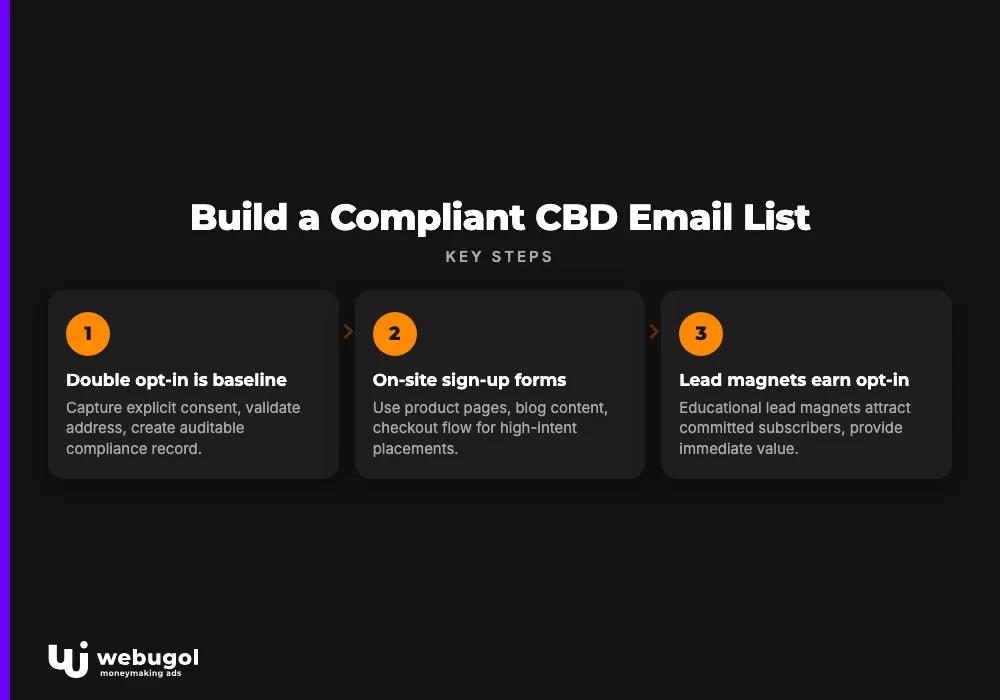
Double opt-in is the baseline. When subscribers confirm their address through a two-step process, you capture explicit consent, validate the address, and create an auditable compliance record. Single opt-in lists for CBD brands carry disproportionate risk: complaint rates run higher, and unverified consent is harder to defend when an ESP questions your acquisition practices.
On-site sign-up forms. Product pages, blog content, and the checkout flow are the highest-intent placements. Copy should specify exactly what subscribers receive and how often. "Weekly CBD education and exclusive subscriber discounts" converts better than "join our newsletter." Exit-intent pop-ups outperform immediate page-load triggers for CBD audiences.
Lead magnets that earn the opt-in. Educational lead magnets attract more committed subscribers than generic discounts. A CBD dosage guide, a "how to read a Certificate of Analysis" explainer, or a product format comparison gives new subscribers immediate value and positions the brand as a category authority.
Segmenting your cannabis email list
Sending the same campaign to every subscriber is the most common cause of declining engagement rates. Each stage of the customer journey requires different messaging, different offers, and different timing.
| Segment | Trigger | Primary goal |
|---|---|---|
| New subscribers | Sign-up, no purchase | Brand introduction, first purchase |
| First-time buyers | First order complete | Usage education, cross-sell |
| Repeat customers | 2+ orders | Loyalty recognition, bundling |
| Lapsed buyers | 90+ days, no purchase | Re-engagement, new product awareness |
| High-value customers | Spend threshold | VIP access, referral ask |
Building these segments from day one, rather than retrofitting them after the list has grown, is what separates a cannabis email marketing strategy that scales from one that plateaus.

How to write effective CBD promotional emails
CBD marketing compliance shapes every copy decision. No disease claims means CBD promotional emails win on education, product experience, and community rather than therapeutic outcome promises.
Subject lines. Keep them under 50 characters for full mobile display. Avoid spam-flagged words: "free," "urgent," excessive punctuation. Personalization increases open rates consistently. Number-driven lines ("3 ways to use CBD oil for post-workout recovery") outperform vague alternatives.
Compliance in body copy. Every promotional email needs the FDA disclaimer. Establish permissible language in a brand style guide: "may support," "some users report," and "traditionally associated with" are acceptable. "Treats," "cures," and "proven to" are not. Running every draft through the same compliance checklist is slower upfront and faster long-term than recovering from a warning letter.
Education as conversion strategy. Many CBD buyers are still early in their understanding of the category. An email explaining how CBD interacts with the endocannabinoid system, decoding a Certificate of Analysis, or comparing product formats builds brand authority. Educational emails drive the engagement rates that protect deliverability over time.
Social proof. Customer testimonials in CBD promotional emails reduce purchase anxiety without making clinical claims. Specific, concrete quotes convert better than generic praise. "I've been using the 1,500mg tincture for six months and sleep through the night for the first time in years" is permissible and persuasive. "Cured my insomnia" is not.
Design. Mobile-responsive layout is the baseline. One primary call to action per email, clearly positioned. Consistent visual identity across campaigns so subscribers recognize the email before reading the subject line. High-resolution product photography communicates quality that stock imagery cannot.
What is the ROI of CBD email marketing?
The Data & Marketing Association has documented email marketing's average return at $36 for every $1 spent across industries. For CBD brands where paid acquisition channels are restricted, email's effective ROI is higher. It is often the only scalable direct-response channel that does not carry platform dependency risk.
Automation changes the ROI equation further. A welcome series, an abandoned cart sequence, and a post-purchase flow are each built once and run continuously. Labor cost does not scale with volume. Unit economics improve with every new subscriber who enters the stack.
Core automation sequences for CBD brands
Welcome series (days 0-10). Email 1, immediately on sign-up: brand story, bestsellers, first-purchase offer. Email 2 at day 3: educational content covering CBD basics and how to read a Certificate of Analysis. Email 3 at day 7-10: social proof, reviews, and a follow-up offer for subscribers who have not yet purchased.
Abandoned cart sequence. Email 1 within 1-3 hours of abandonment: product reminder, no discount. Email 2 at 24 hours: introduce a modest offer, such as a small discount or free shipping. Email 3 at 72 hours: final reminder with scarcity language where the product warrants it.
Post-purchase sequence. Email 1 at day 2: usage guidance specific to the product purchased. Email 2 at day 14: check-in and cross-sell recommendation. Email 3 at day 30: review request.
Re-engagement. For subscribers inactive 90+ days: two emails. The first asks directly whether they want to continue receiving emails. The second pairs a win-back offer with new product highlights. Subscribers who do not respond should be removed from the active list. Keeping them damages sender reputation and suppresses deliverability for the engaged segment.
Deliverability: the foundation beneath every ROI number
Revenue projections from cbd email marketing mean nothing if emails land in spam. CBD brands face heightened deliverability scrutiny because the category is historically associated with higher complaint rates industry-wide.
Domain authentication is non-negotiable. SPF, DKIM, and DMARC records verify to inbox providers that your emails are legitimate. Missing any one of them increases spam folder placement rates. Configure all three before sending a single campaign.
List hygiene is ongoing maintenance. Remove hard bounces immediately. Suppress unsubscribes globally, not only within the sending platform. A smaller, engaged list consistently outperforms a large, unhealthy one on every metric that affects inbox placement.
In spam filter scoring, ALL CAPS subject lines, excessive punctuation, and phrases like "act now" are algorithmic inputs, not just style choices. Avoid them in every subject line and preview text.
The compliance architecture for regulated industries follows the same pattern whether the category is CBD, healthcare, or financial services. How regulated businesses structure their email compliance frameworks covers the consent-first, documentation-heavy approach that works across categories.

Tracking and improving your CBD email marketing campaigns
These metrics belong in every send report and every automation review:
- Open rate: below 20% typically signals a subject line or deliverability problem
- Click-through rate: measures content and offer relevance; low CTR with an acceptable open rate points to copy or CTA issues
- Conversion rate: purchases divided by emails delivered; the direct measure of commercial effectiveness
- Revenue per email sent: total revenue divided by volume; the clearest ROI indicator
- Unsubscribe rate: above 0.5% per campaign signals a frequency or relevance problem
- Spam complaint rate: above 0.1% is a warning sign; above 0.3% triggers ESP intervention
A/B testing generates value only when it is systematic. Test one variable per send: subject line, send time, content format, or CTA copy. Run sufficient volume before drawing conclusions. Apply learnings to both new campaigns and standing automation sequences, not just the next one-off send.
Email marketing for cannabis brands that compounds revenue over 12-24 months is not a series of good individual campaigns. It is a system: list acquisition, segmentation, automation, deliverability, and measurement working together. Building that system correctly from the start is what stops CBD brands from losing revenue to platform suspensions, deliverability collapse, and engagement decay.
Ready to build a CBD email program that compounds?
CBD email marketing generates consistent, scalable revenue only when the underlying infrastructure is right. The right platform, a compliance-documented list-building system, working segmentation, and automation that converts across the customer lifecycle each need to be in place before the returns compound. Getting one layer wrong resets months of work. A suspended ESP account, a list built without consent records, or automation firing on the wrong trigger each cuts the revenue the system should have generated.
Webugol builds websites and owned-channel growth systems for CBD and health brands. The landing pages, opt-in forms, and site conversion infrastructure that email campaigns depend on are part of the same build, developed alongside the marketing strategy that compounds subscriber growth into revenue. If your hemp or CBD brand needs a compliant, scalable email program on the right technical foundation, reach out to discuss what that looks like for your product and audience.
FAQ
What email platforms allow CBD marketing?
Alpine IQ, Klaviyo, Omnisend, and Sendlane are among the platforms most commonly used for CBD and hemp email marketing. Mainstream ESPs like Mailchimp frequently suspend accounts promoting CBD products. Always obtain written confirmation of a platform's hemp and CBD policy before migrating your list, as enforcement practices change.
How to build a compliant CBD email list?
Use double opt-in to capture verified consent and create an auditable compliance record. Place sign-up forms on product pages and at checkout. Offer an educational lead magnet, such as a dosage guide or Certificate of Analysis explainer, to attract higher-intent subscribers rather than discount-seekers.
What legal rules apply to CBD email marketing?
The FDA prohibits disease claims in CBD product marketing, and every promotional email must carry the required FDA disclaimer. CAN-SPAM requirements apply to all commercial emails sent in the US. State laws add jurisdiction-specific requirements, and age verification at signup is advisable for brands selling in states with CBD age restrictions.
How to write effective CBD promotional emails?
Focus on education, social proof, and specific product benefits rather than disease claims. Keep subject lines under 50 characters, include the FDA disclaimer in every promotional send, and center each email around a single clear call to action using compliant language like "may support" rather than prohibited clinical claims.
What is the ROI of CBD email marketing?
The Data & Marketing Association reports an average $36 return for every $1 spent on email marketing across industries. For CBD brands with restricted access to paid channels, email's effective ROI is typically higher because it functions as the primary scalable direct-response channel without platform dependency risk.

