



SEO content audit: find gaps, fix intent, and rank higher
An SEO content audit is a structured review of every published page on your website, measuring how well each piece earns organic traffic, matches search intent, and drives a business outcome. Run correctly, it identifies which pages to improve, which to consolidate, and where new content is needed to close the gaps competitors are already filling. Most content teams skip it. For a marketing director or business owner managing a blog, the audit converts a backlog of articles into a prioritized action plan with a clear decision for each URL.
What is included in an SEO content audit?
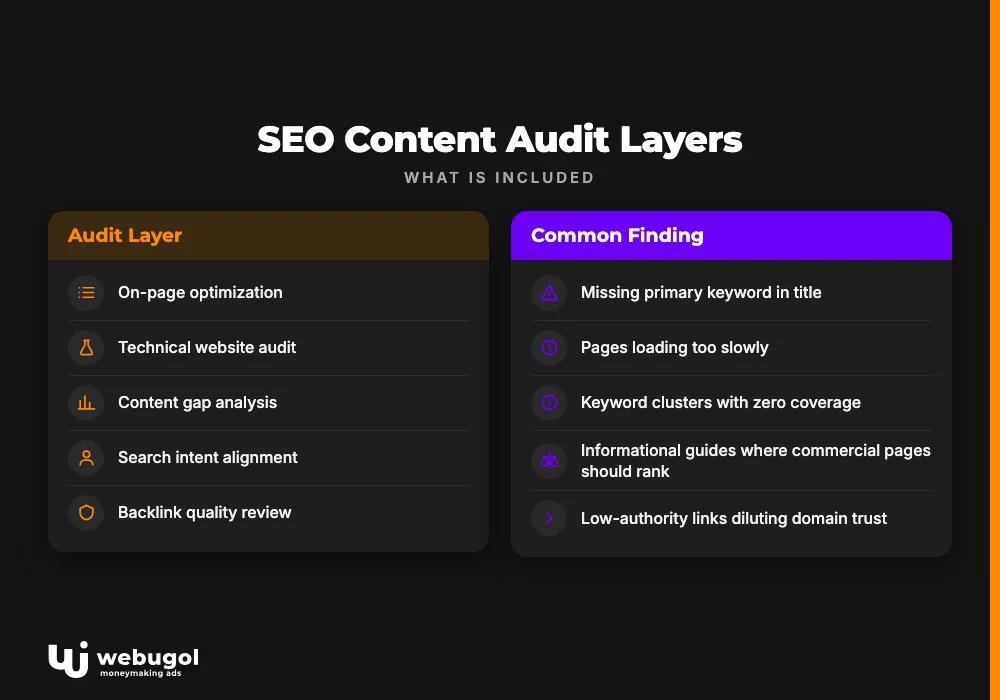
A complete SEO content audit covers five layers: on-page optimization, technical website audit, content gap analysis, search intent alignment, and backlink quality review. Each layer addresses a distinct cause of missed traffic. Skip any one of them and the audit leaves recoverable rankings untouched.
| Audit layer | What you measure | Most common finding |
|---|---|---|
| On-page optimization | Titles, heading structure, keyword density, meta descriptions | Missing primary keyword in title; duplicate or absent meta descriptions |
| Technical website audit | Core Web Vitals, crawlability, indexing errors, redirect chains | Pages loading too slowly or excluded from the index |
| Content gap analysis | Queries your audience searches with no matching page | Entire keyword clusters with zero coverage |
| Search intent alignment | Whether content format matches what the searcher expects | Informational guides where commercial comparison pages should rank |
| Backlink quality review | Authority and relevance of inbound links; toxic link patterns | Low-authority links diluting domain trust |
The order of work matters. Optimizing on-page signals on a page with a live indexing error wastes effort until the technical issue is resolved first. Filling topic gaps on a domain with a weak backlink profile produces slower results than refreshing high-impression pages that already hold partial search trust.
On-page optimization checklist
Every page in your "improve" category should clear six signals before any other change is made.
- Primary keyword in the title tag, within the first 60 characters
- Primary keyword in the H1, matching or closely echoing the title phrasing
- Primary keyword appearing naturally within the first 100 words of body copy
- Meta description between 140 and 150 characters, with the keyword near the start
- At least one H2 or H3 heading containing the keyword or a clear topical variant
- Two or more internal links pointing to the page from contextually related pages
Keyword density for the primary phrase should sit between 1.0 and 2.0 percent of total word count. Below that range, the page underuses the signal. Above it, usage becomes mechanical and the copy suffers.
Technical website audit: the health check before content strategy
Technical problems block every downstream fix. A page that loads in six seconds will not outrank one loading in under two, regardless of content depth or keyword precision. Google's Core Web Vitals thresholds now directly affect eligibility for enhanced SERP features and Top Stories placements.
Run a technical pass before optimizing a single word of copy. The three pass/fail benchmarks are Largest Contentful Paint (LCP) under 2.5 seconds, Cumulative Layout Shift (CLS) below 0.1, and First Input Delay (FID) under 100 milliseconds. Beyond Core Web Vitals, check for redirect chains (each hop adds latency and bleeds link equity), orphan pages with no internal links pointing to them, and canonical tag errors that split ranking signals across near-duplicate URLs.
For a detailed breakdown of how Core Web Vitals affect your search rankings, that guide covers the specific scoring thresholds and the technical fixes that move each metric.
Why SEO content audit findings stall at the diagnosis stage
Most content audit processes produce a spreadsheet: traffic per URL, word count, rough content scores, red-amber-green ratings. That spreadsheet is not a strategy.
Marketing directors and business owners who run an audit and see no growth in the following quarter typically hit one of three walls. The audit flags problems but gives no rule for prioritizing which to fix first, so the team attempts everything and finishes nothing. The team refreshes declining articles without changing anything substantive, often only updating the publication date, which delivers no ranking benefit. Or the audit checks keyword placement while ignoring whether the content format matches what the searcher actually expects to find.
The outcome is a busy content calendar that moves rankings by single digits. A properly scoped SEO content audit resolves this by assigning a specific decision to each URL before any optimization work begins.
An audit that actually shifts organic traffic answers three questions: which pages have the highest recovery potential from targeted improvements, what specifically needs to change on each one, and which topic clusters warrant net-new content. The process below builds each answer.
How to run an SEO content audit: step by step
Step 1: Build your content inventory
Export every published URL from your XML sitemap, or crawl the site with Screaming Frog to capture URLs the sitemap may miss. Pull 12-month impression and click data from Google Search Console for each URL. Combine both datasets in a single spreadsheet.
The combined view reveals traffic per page and whether that traffic is trending up or down over time. Trend matters more than absolute volume. A page earning 150 clicks per month and declining is a recovery candidate. A page at 30 clicks and growing may need only light reinforcement rather than a full rewrite.
Flag two categories immediately: pages with more than 200 impressions and below 2 percent CTR typically have a title or meta description that fails to compete for the click. Pages ranking between positions 8 and 20 for their primary keyword usually have a content quality or intent problem. Both categories are high-leverage because the baseline trust is already there.
Step 2: Apply the keep, improve, merge, or remove framework
Run each page through a four-category decision.
Keep: Traffic stable or growing, intent clearly matched, on-page signals complete. Review every six months.
Improve: Pages with existing impressions or rankings that have stalled or declined. These already hold partial trust with Google. A substantive rewrite, intent correction, or on-page refresh recovers rankings faster than building competing new pages from scratch on the same domain.
Merge or redirect: Thin pages, near-duplicate topics, or cases where a stronger existing page covers the same query more authoritatively. Consolidate link equity into one URL and redirect the rest. This is the most underused tactic in content audits and typically produces the fastest authority consolidation gains.
Remove: Pages indexed for 12 or more months with zero impressions. Before deleting, redirect to the closest relevant live URL to preserve any existing inbound links.
This framework prevents the most common audit failure: treating every page as an equal-priority problem. The majority of recoverable traffic concentrates in the top 15 to 20 percent of pages by current impression share.
Step 3: Run a content gap analysis
A content gap analysis identifies the queries your audience searches where you have no page to rank. These gaps set a ceiling on total organic traffic that on-page optimization alone cannot raise.
Pull competitor ranking pages in Ahrefs or SEMrush. Filter for keywords where two or more competitors rank in the top 20 and your domain does not appear in the top 50. Export and cluster by intent: informational, commercial, and transactional.
One category teams consistently miss: intent variants of existing pages. Your how-to article on a topic may rank well for informational queries but miss the commercial variants entirely ("X service," "X agency," "best X for Y"). Those variants sit at a different stage of the buyer journey. They require separate pages, not additions to the existing guide. Treating them as one URL is why many content programs plateau even after thorough on-page optimization work.
Informational gaps are the most common find and the most contested by competitors. Transactional and wholesale and B2B gaps are smaller in search volume but carry substantially higher conversion value per visit.
Step 4: Review backlink quality
Off-page authority shapes how quickly on-page improvements translate into ranking movement. A domain with a weak or toxic backlink profile lags behind competitors even when content quality is comparable.
The backlink quality review covers two dimensions. Flag links from sites with Domain Rating below 10 (using Ahrefs DR as the proxy), links from irrelevant domains with no topical connection to your industry, and any pattern of links from networks built purely to pass signals. Then identify your highest-value pages that have no external inbound links at all.
A page cannot consistently hold page-one rankings for competitive queries without some external link equity. Pages with strong on-page signals but no external links tend to hover just below page one and stall. They need a targeted outreach or digital PR component alongside content work, not more on-page revisions alone.
How does an SEO audit improve content marketing results?
An SEO audit improves content marketing results by identifying specific, actionable changes that move rankings on pages already earning impressions, and by surfacing the topic clusters competitors are capturing that you are not. Both effects build over time.
On-page improvements to keyword placement, heading structure, and meta descriptions tend to move rankings within four to eight weeks for pages already indexed and generating impressions. Intent corrections, where a how-to article is restructured as a comparison or a product page is rewritten to lead with the offer above the fold, show results in eight to twelve weeks. Gap fills targeting new keyword clusters take three to six months to build enough authority for competitive rankings.
At a content calendar level, audit findings replace assumed topics with proven demand. Rather than planning and forecasting organic search growth based on internal guesses about what might rank, the audit surfaces the specific keyword clusters competitors are already capturing. That shift from assumed to proven demand is the mechanism by which recurring audits reduce wasted content investment over time. For programs running on a quarterly cadence, each SEO content audit cycle produces sharper findings as the baseline data accumulates.
The compounding effect for a content program running quarterly audits differs materially from one running only annual reviews. Each cycle catches declining pages before they slip below position 20, where recovery requires significantly more effort and time. It also surfaces shifts in search demand as market interests evolve, so content investment tracks real audience intent rather than stale assumptions.
What tools are best for a content SEO audit?
Google Search Console is the required foundation. It reports impressions, clicks, average position, and CTR directly from Google's index, making it more accurate than third-party rank trackers for identifying individual underperformers. The Coverage report flags crawl errors, noindex issues, and mobile usability failures without requiring any additional tool.
Screaming Frog SEO Spider crawls your site and exports every on-page element at scale: title tags, meta descriptions, H1 text, word count, canonical URLs, and HTTP response codes for each URL. The free version handles up to 500 URLs; the paid license runs approximately £259 per year and removes that limit. For most content teams, it is the fastest way to run a complete on-page audit across hundreds of pages without manual spot-checking.
Ahrefs or SEMrush add keyword ranking data, competitor content gap analysis, and backlink profile reports. Both include a Content Gap feature that directly outputs the keywords competitors rank for and your domain does not. The practical choice between them tends to come down to which platform you already use for link prospecting or keyword research.
Google Analytics 4 tracks what happens after a searcher lands: engagement rate, scroll depth, and conversion actions. A page that climbs to position 4 but drives no form submissions or product page visits still has a problem. GA4 surfaces that disconnect in ways Search Console cannot.
The SEO audit tool selection guide covers how these tools compare across different audit workflows and team sizes, including the trade-offs between enterprise suites and focused point solutions.

How do you fix content gaps found during an SEO audit?
The fix depends on whether the gap is a missing page, an underdeveloped existing page, or a content format mismatch.
For gaps with no existing page on the topic, create targeted content structured to match the format of current top-ranking results. If four of the five top results for the query are listicles, a long-form narrative on the same topic will struggle against them regardless of depth or word count. Match format to what is already ranking, then compete on accuracy and specificity.
For gaps where an existing page partially covers the topic, extend that page. Add the sections addressing missing sub-queries, update internal links to surface the page in adjacent content, and submit a manual recrawl request in Google Search Console. Pages already earning impressions for a related keyword cluster typically recover faster when extended than when a competing new page is built from scratch.
For gaps caused by outdated content, replace the outdated material substantively. Update the modification date only after real changes. A refreshed timestamp with no content change provides no ranking benefit and risks triggering a freshness quality signal that flags the page for manual review.
In every case, run the search intent alignment check before publishing. A gap filled with content that does not match what searchers expect when they enter the query will not hold a ranking even if it briefly earns one.
Search intent alignment: what your SEO content audit needs to verify
Search intent classifies what a searcher expects to find: an explanation, a known site, a comparison before buying, or a transaction. Matching content format to intent is the foundation of any durable keyword optimization strategy. Mismatches create consistent friction that keyword density and backlink building cannot compensate for.
The patterns are predictable. An informational query matched to a commercial landing page sees high bounce rates because visitors want guidance, not a pitch. A commercial query matched to a step-by-step tutorial loses conversions because the visitor wanted to evaluate vendors, not learn a process.
The audit check for intent alignment: for each "improve" page, examine the top three ranking results for the primary keyword. What format are they? What does the above-the-fold section show? If your page structure differs significantly from all three, intent mismatch is the likely reason the page sits at position 10 to 18 rather than 3 to 7. The fix is structural, not cosmetic.
Navigational intent is the easiest case to resolve. If users searching your brand name plus a product or service are landing on a generic blog post, the fix is a redirect to a dedicated landing page or creating one if it does not yet exist.
Content performance tracking: closing the audit loop
Tracking is what turns a content audit from a one-time project into a compounding growth system. Without a measurement plan, there is no feedback signal on which changes worked, and the next audit cycle starts without baseline data to compare against.
Set a measurement window before making changes. Document the pre-change position, impressions, clicks, and engagement rate for each page you touch. Four-week reviews catch on-page improvements. Eight-week reviews reflect the impact of content rewrites. Twelve-week windows apply to new page creation.
When position improves but clicks do not, the meta description is failing to earn the click against adjacent results. Rewrite it to make the value clearer and more specific than what neighboring results show. When clicks improve but engagement rate drops below 50 percent, the page body is not delivering what its title and meta description promised.
Monthly check-ins against the pre-audit baseline make it practical to separate "working" from "needs adjustment" within the same quarter rather than waiting half a year for a full-cycle signal.
Technical performance compounds with content quality. A page with well-matched intent and strong content that loads slowly continues to lose ground to faster competitors, particularly on mobile where Core Web Vitals penalties accumulate across sessions. Webugol's technical and content SEO program addresses both layers together, because optimizing one in isolation consistently leaves measurable ranking potential unrealized.

How often should you audit your blog content?
Run a full SEO content audit at least once per year, with lighter quarterly reviews in between. Annual audits sweep the entire content inventory and reset category priorities across all pages. Quarterly reviews verify that pages marked "improve" are responding as expected and catch early decline signals on high-value pages before they leave the recovery range.
Triggers for an unscheduled audit: a sustained organic traffic drop lasting four or more consecutive weeks, a confirmed major Google algorithm update, a significant site migration or URL structure change, and the launch of a new product or service that requires updating existing content to reflect the current offer.
Sites with more than 200 published pages benefit from a rolling quarterly model, reviewing a rotating 25 percent of the inventory each quarter rather than attempting a full sweep four times per year. In each rolling cycle, prioritize pages currently ranked between positions 4 and 20 for their primary keyword. That range is where audit-driven improvements have the highest probability of producing measurable ranking movement within the measurement window, because the page already has proximity to page one.
Build the system, not just the spreadsheet
Running a single SEO content audit produces a snapshot. Running it on a consistent cadence, with a clear decision framework and a measurement plan, builds an organic growth system that compounds with each cycle.
Marketing teams that get the most from audits share one consistent trait. They act on findings within weeks, not quarters. Each cycle produces better baseline data for the next review. And they treat the full content stack as one interconnected system: on-page signals, technical health, intent alignment, and authority working together, not in separate workstreams. A recurring SEO content audit is the mechanism that keeps those workstreams synchronized and responsive to shifts in search demand.
That integration is where most in-house content teams hit a resource ceiling. Executing across all four audit layers simultaneously while managing a publishing schedule is a significant operational load. Understanding SEO and paid search as complementary channels helps clarify where audit-driven organic content delivers the highest return relative to paid investment, and where the two reinforce each other rather than compete for budget.
Webugol is a digital marketing agency that builds and manages the full content and technical SEO system for growth-stage businesses. If your audit has surfaced more to fix than your team has bandwidth to execute this quarter, contact us to discuss a managed engagement that moves from audit findings to measurable ranking results.
FAQ
What is included in an SEO content audit?
A full SEO content audit covers five layers: on-page optimization (titles, headings, keyword usage), technical health (crawlability, page speed, indexing errors), content gap analysis, search intent alignment, and backlink quality review. Each layer targets a different cause of lost organic traffic.
How often should you audit your blog content?
Run a full audit once per year and lighter reviews each quarter. Outside the scheduled cycle, trigger an unscheduled audit after a major algorithm update, a sustained traffic drop lasting four or more weeks, or a significant site migration.
How does an SEO audit improve content marketing results?
An audit identifies which pages have recovery potential from targeted on-page and intent changes, and which topic gaps represent unaddressed organic demand. Teams that act on findings consistently see measurable organic traffic growth within one to two quarters.
What tools are best for a content SEO audit?
Google Search Console, Screaming Frog, and either Ahrefs or SEMrush cover most audit workflows. Search Console provides direct impression and ranking data from Google; Screaming Frog exports on-page elements at scale; Ahrefs and SEMrush add competitor gap analysis and backlink profile data.
How do you fix content gaps found during an SEO audit?
For gaps with no existing page, create new content structured to match the top-ranking format for the query. For gaps where a current page partially covers the topic, extend it with the missing sections and update internal links. For outdated gap content, replace the material substantively before updating the modification date.

