



SEO for Wholesalers: Rank Higher and Win More B2B Buyers
SEO for wholesalers is the process of optimizing a wholesale website so that retailers, procurement managers, and bulk buyers find it through organic search rather than through referrals alone. Done right, it replaces dependence on existing relationships with a repeatable inbound channel that compounds over time. The buyers you want are already searching Google. Whether your site appears when they do determines how much of that demand you actually capture.
Most wholesale businesses stop growing not because of product quality or pricing, but because new buyers cannot find them online. Every lead that flows only from trade shows or cold outreach is a lead that a competitor with stronger search visibility already saw first. Wholesale SEO closes that gap by making your catalog discoverable at the exact moment a buyer is sourcing.
What is SEO for wholesalers?
SEO for wholesalers is the practice of increasing a wholesale website's visibility in organic search results for the exact terms B2B buyers use when sourcing products and suppliers. It covers keyword targeting, on-page structure, site speed, content strategy, and link authority, all calibrated to the purchase language of business customers rather than end consumers.
Wholesale SEO differs from retail SEO in one key respect. B2B buyers search with commercial specificity: "bulk frozen food supplier Texas" or "wholesale LED lighting distributor East Coast." They evaluate supplier credibility before reaching out. Your site must rank for those precise, high-intent phrases and then convert a professional buyer, not a casual shopper.
That specificity works in your favor. Wholesale search terms face less competition than mass-market consumer terms. A buyer who finds you through search has already pre-qualified themselves against your product category before your sales team speaks with them.
How do wholesalers choose the right keywords for SEO?
Wholesalers should build their keyword strategy around buyer search language, not internal product naming. Start with phrases that combine a product category with a trade signal ("bulk," "wholesale," "distributor") and, where relevant, a geographic modifier. Then layer in niche-specific terms that mirror how procurement managers actually write sourcing queries.
Keyword tiers for wholesale distributor SEO
Tier 1, Core commercial terms. High-competition, high-intent phrases tied directly to what you sell: "wholesale electronics distributor," "bulk grocery supplier," "wholesale packaging materials." These take the longest to rank but drive the most qualified traffic. They form the backbone of any wholesale distributor SEO strategy.
Tier 2, Niche vertical terms. Phrases like "seo for food wholesalers," "wholesale restaurant equipment supplier," or specific b2b wholesale search ranking terms matched to your vertical. Lower competition, faster to rank, and typically higher conversion because buyer intent is precise.
Tier 3, Informational terms. Searches like "how to find a reliable wholesale distributor" or "minimum order wholesale products" signal early-stage buyers. Content targeting these terms builds awareness before a buyer selects a supplier.
A practical starting point for wholesale website optimization is your Google Search Console queries report. Look for commercial terms where your site already appears on pages two or three. Those are the fastest leverage points.
Which wholesale website pages need SEO optimization first?
Start with category pages. Then product pages. Then the homepage.
Category pages carry the highest search volume for wholesale terms because buyers typically search by product type before narrowing to a specific SKU. These pages need keyword-optimized title tags, descriptive header tags, and enough on-page copy to signal topical relevance to both search engines and procurement buyers.
On-page SEO checklist for wholesale category and product pages
- Write title tags in the format:
[Product Category] Wholesale Distributor | [Brand Name]. - Keep meta descriptions under 145 characters with the primary keyword in the first clause.
- Use H1 for the category name and H2 for subcategory or specification sections.
- Build SEO-friendly URLs:
/wholesale-electronics/led-lightingoutperforms/cat/prod_id=123?ref=456. - Write at least 150 to 250 words of category-level copy above or below the product grid, covering what buyers receive, minimum order quantities, and sourcing advantages.
- Include bulk pricing tables and MOQ information. These are the fields B2B buyers look for before they contact anyone.
The homepage rarely ranks for specific product terms. Its job is to rank for branded queries, establish authority, and funnel buyers to the right category pages.
Technical SEO for wholesale websites
Technical SEO is the foundation of wholesale website optimization. Search engines must be able to crawl, index, and understand your site without friction. Weak technical foundations suppress rankings regardless of how well individual pages are written. Fix the foundation first. Wholesale sites often need not just optimization of the existing code but a full technical rebuild, and Webugol handles both in one package, so your rankings don't wait for a separate rebuild cycle.
Site speed and mobile performance
A slow catalog site loses buyers before they read a single product description. Google uses Core Web Vitals as a ranking signal, and B2B buyers on mobile during warehouse visits or trade shows will not wait for a sluggish page. Wholesale catalog sites often carry large product image libraries, making improving wholesale website load performance one of the highest-return technical investments you can make.
Running a technical baseline review of your site's content and indexing health before any SEO campaign is non-negotiable. It surfaces crawl errors, duplicate content from product variants, and indexing issues that quietly drain ranking potential.
HTTPS and structured data
HTTPS is a baseline ranking factor. If your wholesale site still runs on HTTP, that comes before anything else.
Structured data (schema markup) helps search engines display your products, reviews, and business information in enriched results. For wholesale distributors, adding Product, Organization, and LocalBusiness schema types can increase click-through rates from search results before a buyer even reaches your page.

Does local SEO matter for wholesale distributors?
Yes. Local SEO matters for any wholesale distributor that serves buyers in a defined geographic area. Procurement managers actively prefer regional suppliers to reduce shipping costs and lead times. "Wholesale food distributor Chicago" and "b2b beverage supplier Los Angeles" are real queries that qualified buyers submit regularly.
Optimizing your Google Business Profile with accurate categories, service area definitions, and your full product range captures this local demand. Ensure your business name, address, and phone number are consistent across all B2B directories and wholesale listing platforms. Build location-specific landing pages if you serve multiple regions.
Best wholesale SEO practices for local visibility
- Add city and region modifiers to category page titles and H1s where the match is natural and specific.
- Get listed in wholesale and B2B directories relevant to your product vertical. These generate both referral traffic and local authority signals for wholesale distributor SEO.
- Ask satisfied clients for Google reviews that mention your location and product category. Review text directly influences local search relevance.
Local SEO is not a separate strategy from SEO for wholesalers. It layers on top. The same on-page and technical fundamentals apply, with geographic targeting added to relevant pages and directory listings.
Content strategy for wholesale SEO
Content drives SEO for wholesalers in ways that page optimization alone cannot achieve. Buyers research before committing. A distributor that publishes useful content about product selection, ordering logistics, and industry specifics earns trust and search visibility at the same time.
Product pages that convert B2B buyers
Product and category pages are the most important content on a wholesale site. Go beyond a spec sheet. Write descriptions that answer the questions a procurement manager brings to a sourcing decision: minimum order quantities, lead times, packaging configurations, storage requirements, and compliance certifications. Include high-resolution images and, where applicable, demonstration video.
Short product demonstration videos embedded on category pages increase dwell time. A buyer who watches a warehouse tour or product walkthrough has already started evaluating you as a supplier before any sales conversation begins.
A detailed FAQ on each product page removes the "contact us to find out" friction that costs conversions. B2B buyers want to qualify a supplier without committing to a call.
Blog and content marketing for wholesalers
A strategic blog draws buyers at every stage of the sourcing decision. Educational content targeting informational keywords builds awareness. Commercial content targeting high-intent terms accelerates conversion.
Topics like "how to evaluate a wholesale food distributor," "what MOQ terms to negotiate," or a practical breakdown of seo for food wholesalers and how specialty distributors outrank national chains position your business as an authority. Buyers trust vendors who demonstrate subject knowledge, not just product range.
Link building for wholesale distributors
Backlinks from relevant industry sources remain a core Google ranking signal for wholesale SEO. The most practical sources for distributors are B2B and wholesale directories, manufacturer supplier pages (ask manufacturing partners to list you as an official distributor), and contributed articles in trade publications.
Avoid generic outreach campaigns targeting unrelated sites. A few relevant, high-quality backlinks from within your product vertical outweigh many off-topic placements for both rankings and referral value.

How long does SEO take to work for a wholesale business?
Most wholesale businesses see measurable organic traffic increases within three to six months of implementing foundational SEO changes, assuming no severe technical issues exist. Competitive product categories take longer. Ranking on page one for a high-volume term like "wholesale electronics distributor" realistically takes nine to eighteen months.
The timeline splits into three phases. In the first two months, technical issues are resolved, pages are optimized, and the site becomes fully crawlable. Between months three and six, targeted pages gain impressions and clicks on lower-competition terms. From month six onward, content compounds and domain authority increases, pushing rankings higher on competitive queries.
Wholesale SEO is not a campaign with a finish line. It is an owned asset that grows in value with consistent investment. A business that stops investing does not return to zero immediately, but competitors who keep investing will gradually displace it in rankings.
Measuring wholesale SEO performance
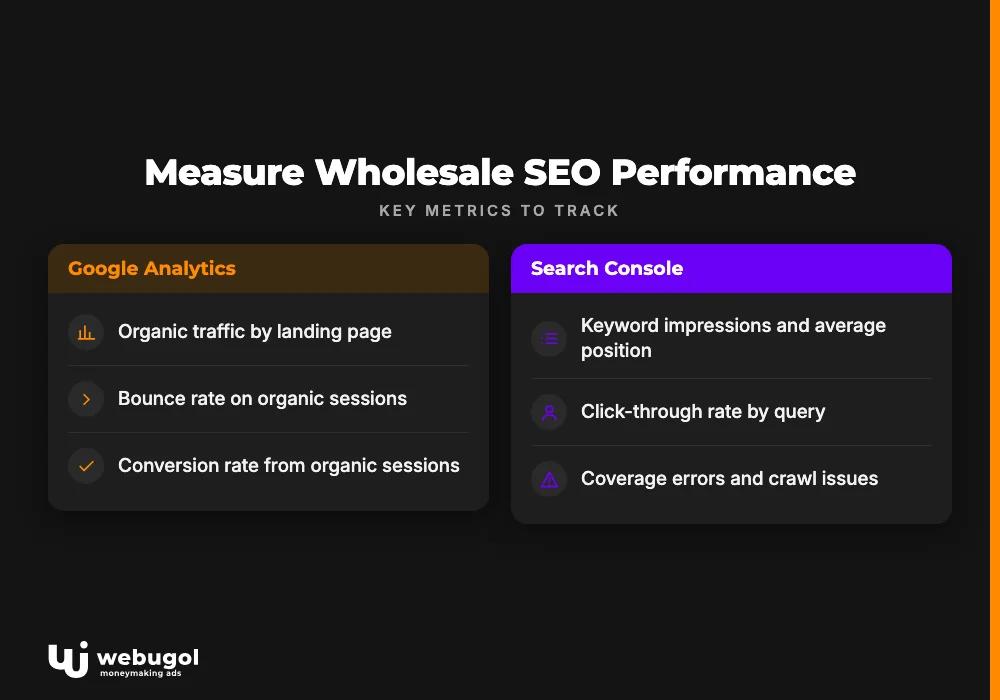
Tracking progress is what separates wholesale businesses with a compounding organic channel from those who invest and see no clear results. Two tools give you the full picture: Google Analytics and Google Search Console. Together, they show where traffic comes from, which queries drive it, and where buyers drop off before converting.
Track in Google Analytics:
- Organic traffic volume by landing page, to identify which category or product pages receive search traffic
- Bounce rate on organic sessions, since high bounce on category pages often signals a mismatch between the query and page content
- Conversion rate from organic sessions: form fills, account registrations, and quote requests
Track in Google Search Console:
- Keyword impressions and average position for core commercial terms
- Click-through rate by query, since low CTR on high-impression queries signals that title tags and meta descriptions need revision
- Coverage errors and crawl issues that prevent full indexing
Review these metrics monthly. A drop in organic impressions typically signals either an algorithm update or a technical issue. A drop in CTR points to a content or metadata problem. Both are fixable once identified.
Start generating inbound leads from organic search
A wholesale business that owns its search channel stops losing buyers to competitors who rank higher. Webugol builds the wholesale website and grows it: technical rebuild, content strategy, and link acquisition in one system that makes rankings compound rather than plateau. Contact us today to request a free growth audit: we review your site's technical foundation and the organic channel built on top of it, the way a wholesale website that grows is supposed to work.
FAQ
What is SEO for wholesalers?
SEO for wholesalers is the process of optimizing a wholesale website so that B2B buyers find it through organic search when sourcing products or suppliers. It covers keyword targeting, on-page structure, technical performance, and content strategy calibrated to business buyer search behavior rather than consumer behavior.
How do wholesalers choose the right keywords for SEO?
Wholesalers should target phrases that combine a product category with trade signals like "bulk," "wholesale," or "distributor," and add geographic modifiers where relevant. Starting with the Google Search Console queries report to identify terms already generating impressions on pages two and three provides the fastest early ranking gains.
Does local SEO matter for wholesale distributors?
Yes. Many procurement managers prefer regional suppliers to reduce shipping costs and lead times, and they search with location-specific terms accordingly. Optimizing a Google Business Profile, maintaining consistent directory listings, and building location-specific landing pages captures this demand alongside broader wholesale SEO efforts.
How long does SEO take to work for a wholesale business?
Most wholesale businesses see initial organic traffic gains within three to six months of fixing technical issues and optimizing key pages. High-competition terms take nine to eighteen months to reach page one. SEO compounds over time rather than delivering immediate results, making consistent early investment the highest-leverage approach.
Which wholesale website pages need SEO optimization first?
Category pages come first because they match the highest-volume wholesale search queries. Product pages come second. The homepage matters for branded queries but rarely ranks for specific product terms and should not be the primary SEO focus at the start of a campaign.

