



Wellness Center Marketing: A System-First Guide for Studio Owners
Wellness center marketing is the process of building a repeatable local acquisition system that connects ad spend to booked consultations, showed appointments, and recognized revenue. It is not a list of tactics. For studios at $500k or more in monthly revenue, predictable growth depends on whether the channel mix, tracking foundation, and follow-up sequence operate as one connected system managed by a single accountable team. If you run paid ads but cannot trace each booked client back to its source, this guide covers the channel structure, compliance constraints, and funnel metrics that close that gap.
Why most wellness marketing "plans" fail before they start
Most wellness center marketing advice online was written between 2011 and 2013. The format: twenty-five newsletter ideas, a social post calendar, a tip about posting consistently. Each tactic is correct inside its own narrow scope. The failure lives in the handoffs between scopes. Nobody is paid to check whether the newsletter drives consultations or whether the lead form routes to the CRM before a two-hour response window kills the show rate.
Studios that grow past that plateau have one structural advantage: a single owner of the revenue path from ad click to showed appointment. When each vendor manages a slice and no single team is accountable for bookings, spend rises, attribution breaks, and the owner becomes the integration layer. That is a structural problem. No tactic fixes it.
What metrics actually matter for a wellness center
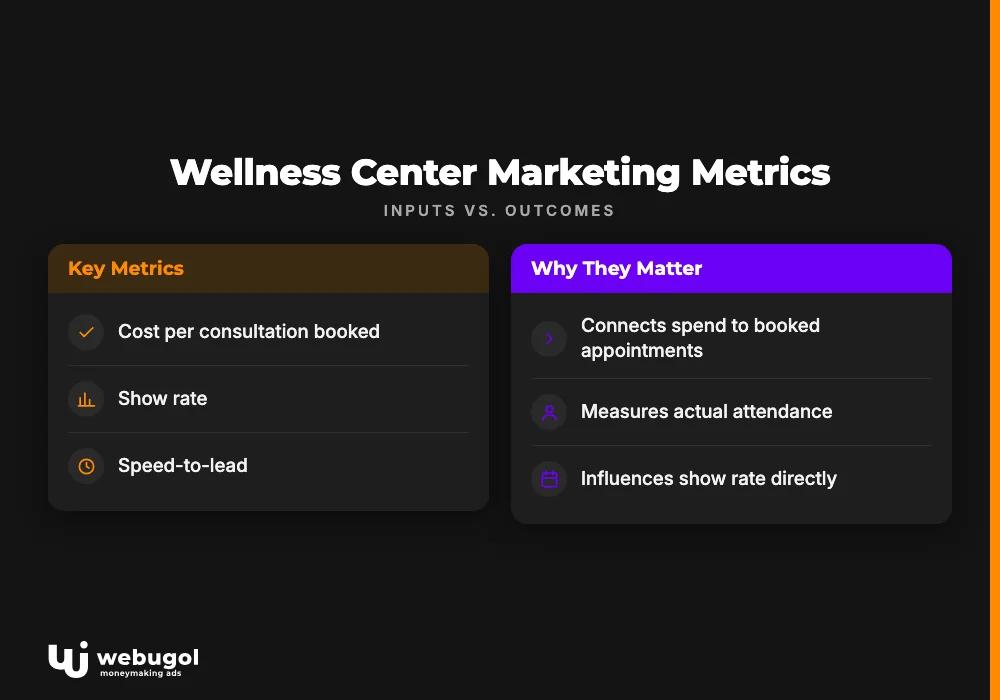
Click volume and impressions are inputs, not outcomes. The three metrics below connect marketing activity directly to showed appointments and revenue.
Cost per consultation booked, not per click
Optimizing for cost per lead at the platform level without connecting it to booking confirmations produces a familiar pattern: CPL looks healthy on the dashboard, while actual CPA in the CRM is significantly higher than planned. The fix is calculating cost per booked consultation from ad platform spend plus CRM booking data, then using that number to make budget decisions instead of platform-reported CPL.
Show rate and why it belongs to marketing
Show rate measures how many booked consultations actually attend. Most studios track this in operations. They never route the signal back to the marketing stack. Show rate is directly influenced by lead source quality, offer framing, and the nurture sequence between booking and appointment. A lead source with a persistently low show rate is a marketing problem, not a front-desk problem.
Speed-to-lead benchmarks for wellness clinics
Responding within five minutes of a lead form submission is the standard benchmark for wellness clinics. The show rate difference between a five-minute response and a 60-minute response is large enough that speed-to-lead counts as a marketing infrastructure problem: CRM routing, lead notification logic, and booking automation. This is a configuration problem, not a training problem.
| Metric | What it measures | Target range | Owned by |
|---|---|---|---|
| Cost per consultation booked | Total ad spend / confirmed bookings | Varies by service and market | Marketing |
| Show rate | Showed appointments / booked consultations | Track trend; investigate source-level drops | Marketing + Ops |
| Speed-to-lead | Time from form submission to first contact | Under 5 minutes | Marketing + CRM |
| Lead source quality | Show rate and close rate by channel | Compare channels monthly | Marketing |
How much should a wellness center spend on marketing?
Studios generating $500k or more per month typically allocate 8 to 15 percent of revenue to marketing, with monthly paid spend ranging from $10k to $100k depending on growth stage and market. Concentrating that budget in one channel is a fragility risk. A single platform policy suspension can stop new bookings entirely. Distributing across paid search, paid social, local SEO, and lifecycle channels makes each line defensible and the overall system recoverable.
How to build your wellness center marketing channel mix
No single channel fills a multi-service wellness schedule at scale. Cost per booking is shaped more by handoff quality between channels than by any single channel's optimization. For brand-level wellness strategy beyond local acquisition, see how wellness brands build long-term client engagement.
Paid search (Google Ads): compliance rules you can't skip
Google's health advertising policies restrict certain claim types and require LegitScript certification for specific wellness service categories, including some hormone and weight loss programs. A compliant campaign structure means knowing what ad copy can say (symptom-based language, consultation offers, evidence-based benefit framing) and what triggers policy rejection (unapproved treatment claims, before/after framing for certain procedures). Build compliance review into the copy approval workflow before launch, not after a suspension.
Paid social (Meta): health category restrictions and what still works
Meta's Special Ad Category restrictions and health-topic targeting limits remove standard interest and behavior targeting for many wellness services. What still converts: first-party audiences from the CRM, lookalike audiences built from existing clients, and broad interest targeting with service-specific exclusions. Creative built around consultation offers and practitioner authority performs within these constraints. Design ads for the consultation conversion, not for brand awareness.
Local SEO and Google Business Profile for wellness centers
Google Business Profile is the primary discovery surface for a local wellness center before a prospective client reaches the website. Four optimization priorities: accurate service categories (specific, not generic), consistent photo updates showing the facility and staff, active review generation with response protocols, and the Q&A section used as a conversion surface for high-intent queries. For patient-level local acquisition tactics, see what drives consistent patient volume through local search.
Email and SMS lifecycle (not just promotions)
Most studios use email and SMS as broadcast channels: a promotion, an appointment reminder, an occasional re-engagement blast. A lifecycle sequence does more. It reduces no-shows with timed pre-appointment touchpoints, drives cross-service upsells based on visit history, and generates referrals through structured post-visit asks.
GoHighLevel and HubSpot provide the orchestration layer. For the retention mechanics behind a sequence that extends client lifetime, see patient retention frameworks that reduce churn.

How do I track marketing ROI for my wellness center?
End-to-end ROI tracking requires connecting ad platform events to CRM booking data, then matching showed appointments to revenue recognized in the billing system. Four components make this work: offline conversion import (passing CRM booking confirmations back to Google and Meta), call tracking with keyword-level attribution, CRM pipeline stages mapped to funnel milestones, and attribution windows matched to the typical wellness consultation cycle rather than a default seven-day window.
Without these four pieces, the dashboard shows clicks while the bank account tells a different story. That gap is where the diagnostic always starts.
If your current setup cannot connect ad spend to consultation revenue, a tracking audit is the fastest way to find where the measurement chain breaks. [See how the Healthcare Growth System approaches end-to-end attribution from week one.](/programs/healthcare-growth-system/)
How to open a second wellness location without repeating first-launch mistakes
The second location is not a smaller copy of the first. Three structural mistakes drive most expansion failures.
First: launching on the existing ad account without campaign isolation. Spend from location one distorts optimization signals for location two, and the algorithm learns the wrong audience mix for the new market.
Second: cloning the first location's offer without validating price sensitivity and competitor density in the new market. The offer that converts in market one may not match demand in market two.
Third: treating Google Business Profile setup as a post-launch task. The listing needs to be claimed, optimized, and accumulating review signals before the first booking campaign goes live.

90-day acquisition sprint: what weeks 1-12 look like
Abstract frameworks do not fill schedules. A concrete timeline does.
- Weeks 1 to 4: Tracking foundation, offer refinement, and landing page build. This determines whether the data from weeks five onward is actionable or noise. Rushing past it is the most common reason a campaign hits early CPL targets but cannot scale.
- Weeks 5 to 8: Channel launch, first data, and early CPL signals. The goal is confirmation that the tracking holds and the offer converts. Make no major budget decisions before week eight.
- Weeks 9 to 12: Optimization against cost per booked consultation and scale decision criteria. By week twelve, enough data exists to separate early signal from noise and make a defensible budget call.
What should I look for in a wellness center marketing agency?
A wellness center marketing agency should own the full revenue path from ad click to recognized revenue, including tracking, website, CRM, and channel execution, not only ad management. Three failure patterns are most common: channel-only scope with no accountability for bookings, no compliance literacy around Google and Meta health ad policies, and reporting that shows impressions instead of showed appointments.
Five questions worth asking before signing a contract:
- Can you show how your reporting connects ad spend to consultation revenue?
- How do you handle a Google or Meta policy rejection mid-campaign?
- Who owns the tracking setup: your team or ours?
- What is your process when show rate drops unexpectedly?
- What does the engagement structure look like after the first 90 days?
If the answers stay at the channel level, the agency is offering execution within a scope, not accountability for an outcome. For the structural framing of this decision, see in-house versus agency marketing for growing health practices.

Build a wellness acquisition system that fills your schedule
Ways2Well generated $2.1M in revenue in six months. LifeRx MD increased bookings by 156 percent. Both started with the same diagnostic step: mapping exactly where the acquisition system broke down before increasing spend.
Webugol owns the full path from ad click to recognized revenue. Tracking, funnel, website, CRM, and channels run as one system by one team. No handoff failures between vendors. No attribution blind spots.
If the metrics, channel structure, and tracking approach in this guide match the gaps in your current setup, the next step is a strategy call. The Healthcare Growth System team maps where your acquisition system breaks down and what the first 30 days of addressing it look like. Book a strategy call through the Healthcare Growth System page.
FAQ
What is wellness center marketing?
Wellness center marketing is the process of attracting, booking, and retaining local clients across a multi-service studio through paid search, paid social, local SEO, and lifecycle channels working as one connected system. The goal is a measurable cost per booked consultation, not simply more website traffic.
How do I get more clients for my wellness center?
The fastest path to more clients is fixing the part of the funnel that is already leaking. Most studios lose prospective clients between the ad click and the booking, or between the booking and the showed appointment, before they ever need more ad spend. Audit speed-to-lead, show rate, and booking friction before increasing budget.
Do wellness centers need HIPAA-compliant marketing?
Wellness centers that collect any protected health information through intake forms, booking systems, or email must follow HIPAA rules for how that data is stored and transmitted. Google and Meta also enforce platform-level health advertising policies that restrict certain claim types and retargeting methods, regardless of HIPAA status.
How long does it take to see results from wellness center marketing?
With a clean tracking foundation and compliant campaigns, most studios see meaningful CPL and show rate trends within four to six weeks of launch. Scaling decisions should wait until week eight to twelve, when enough data exists to separate early signal from noise.
What is the difference between wellness center marketing and health and wellness marketing?
Wellness center marketing focuses on local acquisition for a specific studio or small network: GBP, local paid search, neighborhood demand, and booking conversion. Health and wellness marketing is a broader category that includes brand strategy, content, and retention for wellness companies of any size. This article covers the local acquisition system; broader brand and retention strategy is addressed separately.

