



Link building for healthcare: build authority that fills your schedule
Link building for healthcare means earning backlinks from authoritative medical, educational, and health-focused sources to strengthen your website's standing with search algorithms and prospective patients. For clinic owners and telehealth operators, a strong backlink profile tells Google that credentialed sources recognize your site as trustworthy, which is the foundation of every ranking gain in a regulated health niche. Unlike paid acquisition, authority compounds over time and does not stop producing results when your ad budget pauses.
Whether you are launching a new practice or running a scaled telehealth operation, the structural problem is the same: a backlink profile anchored only in low-authority directories keeps a new clinic invisible in organic search, and the identical thin authority profile keeps a $500k/month telehealth operation stuck at an organic traffic plateau while paid acquisition costs climb. The mechanics are identical. The stakes differ only in scale.
Why link building matters for healthcare websites
Backlinks are external signals that tell search algorithms your content is credible. In healthcare, Google's E-E-A-T framework, which measures Experience, Expertise, Authoritativeness, and Trustworthiness, weights these signals more heavily than in most other industries. A single editorial link from a recognized medical journal or government health resource can lift domain authority more than dozens of generic directory listings.
For clinic owners and operators, the downstream effects extend well beyond ranking position:
- Search engine rankings: Quality backlinks from relevant health sites raise your domain's authority score, lifting target pages for high-intent patient queries.
- E-E-A-T and credibility: Referral links from medical associations, universities, and established health publications signal to algorithms and prospective patients that credentialed sources vouch for your content.
- Qualified referral traffic: Visitors arriving from a specialty health directory or an editorial link already carry intent. They are researching a condition or a provider, not browsing casually.
- Local search visibility: For practices with physical locations, consistent citations in authoritative local and medical directories reinforce geographic relevance and improve visibility in the local pack.
The compounding nature of link authority is the core financial argument. A link earned today from a regional health news outlet continues sending authority and referral traffic for years at no recurring cost. Paid acquisition stops the moment spend stops. For operators modeling a 60-to-90-day payback window, organic authority building is a structural investment in acquisition resilience, not a discretionary channel tactic. That structural case is why link building for healthcare has shifted from a secondary SEO tactic to a core component of patient acquisition strategy for practices competing in high-intent search categories.
What makes a quality backlink for a healthcare website?
A quality backlink for a healthcare website comes from a source that is topically relevant, editorially earned, and carries genuine domain authority. Three factors separate high-value healthcare SEO backlinks from noise.
Topical relevance. A link from a cardiology journal to a cardiovascular practice sends a precise authority signal. A link from a general marketing directory sends almost none. The referring domain's subject matter should closely match your specialty and patient audience.
Editorial placement. Links placed because an editor chose your content as a reference carry far more algorithmic weight than those in sidebars, footers, or comment sections. Government health sites (.gov), medical schools (.edu), non-profit health organizations (.org), and recognized medical journals are the highest-authority targets in health niche link acquisition.
Domain authority relative to your own. A link from a site with a Domain Rating significantly higher than yours produces a measurable lift in your own authority score. Ahrefs and Semrush both display DR scores so you can prioritize outreach by expected impact.
Low-quality signals to avoid: private blog network links, link exchanges with unrelated industries, and paid link schemes that violate Google's guidelines. These risk algorithmic or manual penalties that can take months to recover from.
One practical implication for compliance-sensitive verticals: content used in link-building outreach, whether a guest article or a shared clinical guide, must carry accurate, verifiable claims. Any copy published under a physician's name or attached to a licensed practice carries the same HIPAA and clinical accuracy obligations as your main website.
How does link building improve healthcare SEO?
Link building improves healthcare SEO by raising your site's domain authority score, which lifts rankings across all target keywords, not only the pages that receive links directly. It also strengthens the topical authority signals that Google's health content evaluation systems weigh when assessing E-E-A-T compliance.
The mechanism works in three stages. First, each quality backlink increases your domain's overall authority, making every page slightly easier to rank. Second, links from topically relevant health sources reinforce subject-matter credibility at the domain level. Third, referral traffic from contextually placed links tends to carry higher intent and lower bounce rates, both of which are positive engagement signals for search algorithms.
One operational implication for telehealth and multi-location practices: backlinks for medical websites compound. A link earned this month from a health news outlet continues sending authority and referral traffic for years. For operators optimizing a combined acquisition portfolio, that asymmetry matters when modeling how to reduce long-term CPA while maintaining consistent patient volume.
How to build links for medical sites?
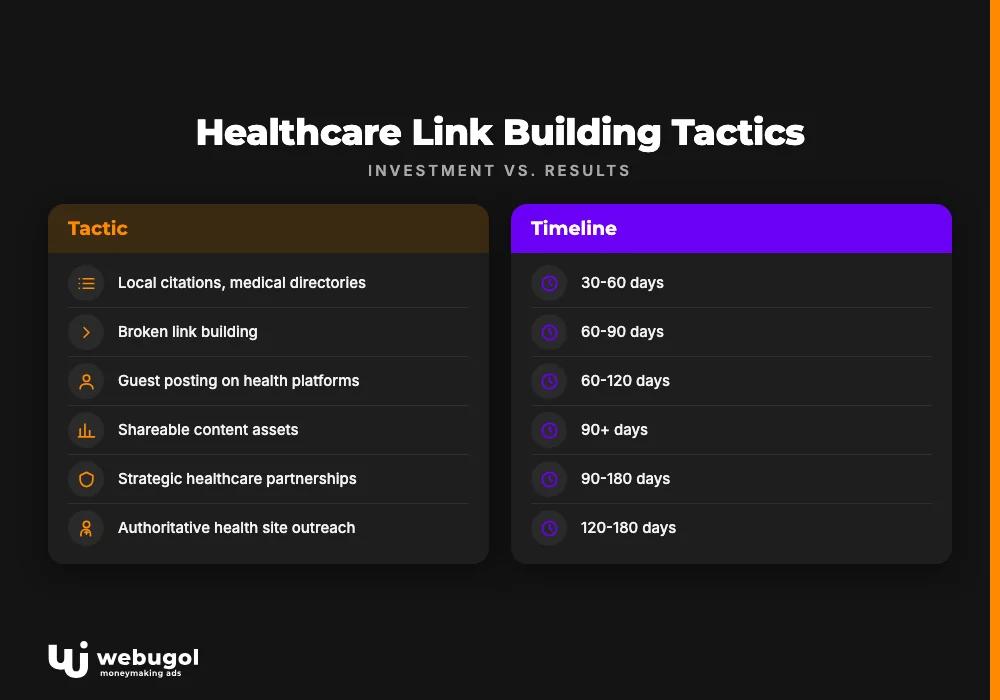
The tactics below vary by resource investment and results timeline. Effective programs layer multiple approaches simultaneously rather than cycling through them one at a time. This layered structure is what makes link building for healthcare more effective than any single tactic pursued in isolation.
| Tactic | Primary benefit | Timeline to results |
|---|---|---|
| Local citations and medical directories | Local pack rankings, NAP consistency | 30 to 60 days |
| Broken link building | Editorial links from authoritative sites | 60 to 90 days |
| Guest posting on health platforms | Authority + referral traffic | 60 to 120 days |
| Shareable content assets | Passive long-term link acquisition | 90+ days |
| Strategic healthcare partnerships | High-relevance editorial links | 90 to 180 days |
| Authoritative health site outreach | Highest-authority links (.gov, .edu, journals) | 120 to 180 days |
Earn links from authoritative health sources
Getting a link from a government health site, a major hospital network, or a peer-reviewed journal is the highest-leverage move in medical link building. One such link can produce domain authority gains that dozens of directory submissions cannot match.
Where to target: government health agencies (.gov), medical schools and research universities (.edu), national specialty associations, and established medical journals. Creating original research, detailed clinical guides, or data-backed summaries that these organizations would cite is the most reliable path. Building relationships with health journalists at major publications is slower, but the editorial links that result hold long-term authority value and are far harder for competitors to replicate.
Guest posting on health and wellness platforms
A guest article on a reputable health or wellness publication earns a backlink and reaches an audience already interested in health topics. For a dermatology practice, an article on evidence-based skincare for a wellness magazine targets exactly the right prospective patient profile. For a telehealth operator, a contributed piece on access-to-care for a patient advocacy publication builds authority in a high-trust editorial context.
To find guest posting opportunities, search for terms like "health blog write for us" or "wellness guest post." Vet the site's domain rating and audience relevance before committing. Author bio links are standard; in-content links are more valuable when the editorial context supports them naturally.
Build strategic healthcare partnerships
Partnerships with medical associations, research institutions, universities running clinical studies, and local health-focused businesses generate a stream of high-relevance backlinks at domain authority levels that cold outreach campaigns rarely reach.
For healthcare link building services focused on partnership development, the key criterion is mutual value. A clinic that produces an educational resource used by a regional health network has grounds for a genuine editorial link. The relationship anchors the link, not a transaction.
Leverage local citations and directories
For practices with physical locations, local citation building is the fastest-return layer of link building for healthcare. Consistent name, address, and phone number (NAP) data across directories helps search engines confirm your location and specialty, improving local pack visibility directly.
Priority directories: Google Business Profile, Yelp, Healthgrades, and Vitals, plus your state or specialty association directories. Your Google Business Profile is both a citation source and a local discovery channel on its own. Treating it as a core component of your healthcare SEO backlinks strategy compounds the overall local authority signal. A full walkthrough of local search optimization for healthcare practices covers this in detail.
Create shareable content assets
Infographics, original surveys, and comprehensive clinical guides earn backlinks passively because other publishers choose to reference them. These assets require upfront investment but continue accumulating links long after publication.
Strong content formats for medical link building: visual explainers of treatment processes, synthesized evidence-based guideline summaries that practitioners cite, and data-driven reports on access or care utilization drawn from publicly available sources. A well-produced reference piece functions as a link acquisition vehicle for years.
Building content that earns editorial links requires clinical accuracy and an editorial standard that health publishers trust. That is why many growing practices pair their link-building program with a dedicated clinical content production strategy for patient-facing SEO from the start.
Use the broken link building technique
Broken link building means identifying dead links on authoritative health sites and offering your own relevant content as a replacement. You give the site owner a reason to act, and you earn a contextual backlink in exchange.
Process: identify high-authority health sites in your niche, use a tool like Ahrefs to scan for broken external links, match those broken links to content you can offer as a replacement, and contact the site owner with a specific, polite proposal. Outreach success rates are higher than cold link requests because you are solving an existing problem for the site owner, not asking for a favor.

What are the best link building strategies for healthcare websites?
The best link building strategies for healthcare websites combine local citation building for immediate local SEO gains, editorial outreach for long-term domain authority, and content asset creation for passive link acquisition. No single tactic dominates. Effective programs layer all three because each addresses a different tier of the authority-building problem.
A practical prioritization for clinic owners and telehealth operators:
Foundation tier. Claim and fully optimize all local and specialty directory listings. Healthgrades, Vitals, Google Business Profile, and your state or specialty association directories are the baseline. Fast, defensible, and directly tied to how patients search for providers in your area.
Authority tier. Build relationships with health publications, medical associations, and academic institutions for editorial links. This tier is slower, but the links carry the highest E-E-A-T weight. For competitive specialty terms, this is what separates practices with real domain authority from those that plateau despite consistent content production.
Content tier. Create assets other sites want to cite. Condition guides, data visualizations, and evidence-based clinical summaries attract backlinks passively. Each asset is an ongoing link acquisition vehicle with no per-unit outreach cost after launch.
Tactical tier. Apply broken link building, competitor backlink analysis, and strategic guest posting to fill gaps and accelerate authority growth on specific target pages.
For operators running integrated acquisition programs: the backlink profile feeds organic authority, which reduces the load on paid acquisition. A clinic earning consistent editorial links from health publications can sustain patient volume at a lower combined acquisition cost. Not by eliminating paid search, but by shifting the channel mix over time.
Healthcare link building by niche
Medical website authority requirements differ by specialty and business model. The right approach to link building for healthcare shifts meaningfully across practice types.
Medical practices (dental, dermatology, primary care). Local SEO drives the majority of patient acquisition for physical locations. Build citations in local and specialty directories, earn links from local health news outlets and community organizations, and treat your Google Business Profile as a core element of your backlink strategy. Most new patient searches start with a local intent query.
Telehealth and remote-care operators. Geographic diversity in linking matters less; topical authority matters more. Target national health publications, specialty clinical organizations, and telehealth-focused trade publications. Domain-level authority drives rankings for condition-specific and service-specific queries that pull regional and national traffic.
Health and wellness content sites. Depth and citation-worthiness are central. Comprehensive, expert-authored guides that larger media outlets reference generate the highest-value healthcare SEO backlinks. Pitching health journalists through editorial platforms amplifies passive reach.
Weight loss, GLP-1, and regenerative medicine practices. These verticals carry additional compliance sensitivity. Platform restrictions on health claims under Google and Meta health policies affect which content can be published without triggering editorial rejection. Link-building in these niches requires clinically accurate content at every tier of the program, with claims matched to published clinical evidence. Backlinks for medical websites in regulated specialties must link to pages that themselves meet compliance standards.

Common mistakes in link building for healthcare
Paying for links. Buying links directly violates Google's guidelines. Algorithmic and manual penalties can collapse organic traffic for months. The short-term ranking lift from paid links is not worth the downside exposure, particularly for regulated health content where trust signals matter doubly.
Using private blog networks (PBNs). PBNs are networks of sites built only to distribute links. They carry significant penalty risk, provide no real referral traffic, and offer no editorial credibility. Avoid them regardless of how the seller frames the configuration.
Prioritizing volume over relevance. A hundred low-authority directory links move domain rating less than three editorial links from recognized health publications. Track referring domain quality, not the total link count.
Ignoring content quality. Backlinks point to pages. A link pointing to thin or inaccurate content adds minimal authority because the page cannot satisfy editorial judgment or convert the referral traffic it receives. Build the destination content before the outreach campaign.
Skipping local citations for physical practices. Clinics that focus only on broad domain authority tactics and neglect local citations miss the highest-converting traffic segment: patients searching for a provider near them.
Underestimating compliance requirements. Content used in link-building, such as guest articles and shared clinical resources, must carry accurate, HIPAA-compatible information. Any content published under a physician's name carries the same approval obligations as any patient-facing communication.
How long does healthcare link building take to show results?
Healthcare link building typically shows first measurable results in 90 to 180 days. Meaningful keyword ranking improvements on competitive terms take six to twelve months of sustained effort. The timeline depends on your starting domain authority, niche competitiveness, and the quality of links acquired.
The pattern most practices observe: the first 30 to 60 days produce quick wins from directory optimization and initial outreach responses. By weeks six through twelve, domain rating begins moving and referral traffic from newly earned links becomes visible in your analytics. Ranking improvements for competitive terms follow at the three-to-six-month mark and compound from there.
One calculation error that stalls programs: stopping activity at month two or three because rankings have not moved yet. Domain authority accumulates cumulatively. A program paused at month three loses the compounding effect that drives ranking shifts at month six. For operators accustomed to paid acquisition feedback cycles of a few days, link building requires a different benchmark entirely.
The correct benchmark is not this month's CPA. It is what share of your patient acquisition comes from organic search at 12 months versus today, and what that shift is worth at your patient lifetime value.
Ready to build backlinks that actually bring in patients?
Growing organic authority in healthcare requires a coordinated program: link acquisition, technical SEO, authoritative content, and accurate tracking all working as a single system. Sustainable link building for healthcare means building the editorial relationships and content credibility that authority sources choose to cite repeatedly, not just once. Most clinic owners and telehealth operators manage these as separate workstreams with separate vendors. The failures accumulate in the gaps between those vendors.
Webugol, a digital marketing agency built for healthcare growth, owns the full revenue path from domain authority strategy through to patient acquisition tracking, so your link-building program is never optimized in isolation from the funnel it is supposed to feed. If your backlink program is producing links but not patients, the gap is almost never in the links themselves. It is in how authority building connects to the rest of your acquisition system.
Book a Strategy Call through our Healthcare Growth System to get a diagnostic on where your organic authority and patient acquisition are misaligned.
FAQ
How do you build links for medical websites?
Start with a full audit of your existing backlink profile using Ahrefs or Semrush, then identify gaps in directory coverage, topical authority, and local citations. Earn editorial links by producing clinically accurate content that authoritative health publishers would cite, and apply broken link building to replace dead links on relevant health sites with your own resources.
What are the best link building strategies for healthcare websites?
The most effective combination is local citation building for immediate local SEO gains, editorial outreach to health publications and medical associations for long-term domain authority, and shareable content asset creation for passive link acquisition. Broken link building and targeted guest posting supplement these core tactics.
What makes a quality backlink for a healthcare website?
A quality healthcare SEO backlink is topically relevant, editorially placed, and sourced from a high-authority domain relative to your own. Links from government health sites (.gov), medical schools (.edu), and recognized specialty organizations carry the highest E-E-A-T weight. Links from unrelated industries, paid schemes, or PBNs carry minimal value and risk algorithmic penalties.
How does link building improve healthcare SEO?
Link building raises your site's domain authority score, which lifts rankings across all target keywords, not only the pages receiving links directly. It also strengthens the E-E-A-T signals that Google weights heavily for health content, and drives qualified referral traffic from sources that prospective patients already trust.
How long does healthcare link building take to show results?
Most healthcare sites see first measurable changes in domain authority within 90 days and meaningful keyword ranking improvements between months three and six. Full authority gains on competitive terms take six to twelve months. Stopping the program before the six-month mark loses the compounding effect that drives ranking shifts at the mid-term horizon.

