



Healthcare Google Business Profile optimization: the complete clinic guide
For most patients, finding a new provider starts with a Google search. An optimized healthcare Google Business Profile is typically the first thing they encounter, and it determines whether they call your clinic or a competitor's. Get it right and Google's local pack delivers high-intent patients at no cost per click. Get it wrong and every paid acquisition channel compensates by paying more to overcome the trust gap your profile creates.
That structural gap affects every stage of practice growth. A new clinic needs GBP visibility to be found at all. A clinic already spending $20k or more a month on paid media needs a clean, active profile to protect the conversion value of every click it buys. Healthcare SEO for medical practice is not a one-time setup task; it is an ongoing signal you either send consistently or fail to send at all.
How do healthcare providers optimize their Google Business Profile?
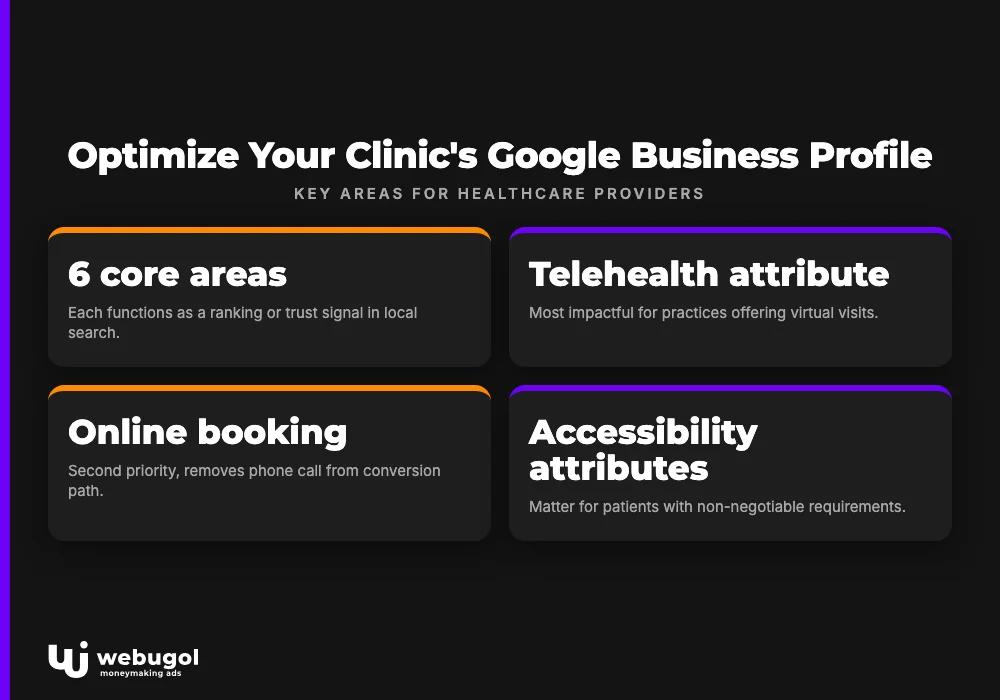
Optimization covers six core areas, each functioning as a ranking or trust signal in medical practice local search.
NAP consistency. Your Name, Address, and Phone Number must match exactly across your GBP, website, and every directory where your practice appears. Inconsistencies weaken local ranking signals.
Category selection. Pick the most specific primary category for your specialty. Add secondary categories for every additional service you offer.
Business description. Write a clear summary of your practice: your values, the patient experience you deliver, and what distinguishes your approach. Include your specialty and location terms naturally.
Attributes. Toggle on every applicable feature, including wheelchair access, online booking, and telemedicine availability. Patients use these filters when comparing options.
Photos and videos. Show your team and facility. A virtual tour video helps prospective patients orient themselves before their first visit.
Google Posts. Short updates that keep your listing active and give patients reading your profile a clear next step.
What GBP attributes matter most for medical practices?
For GBP for clinics, telehealth availability is the most impactful attribute for practices offering virtual visits. It surfaces your listing in searches specifically filtered for remote care. Online booking is the second priority because it removes the phone call from the conversion path. Accessibility attributes matter for the subset of patients for whom they are a non-negotiable requirement.
| GBP element | Why it matters for medical practices |
|---|---|
| Telehealth attribute | Captures virtual-visit searches directly |
| Online booking link | Converts profile views without requiring a call |
| Accessibility attributes | Filters in patients with specific requirements |
| NAP consistency | Validates local ranking signals across directories |
| Photo recency | Signals an active, trustworthy practice |
| Review response rate | Affects both ranking and patient confidence |
How do HIPAA rules affect requesting Google reviews from patients?
HIPAA governs the content of your review requests, not whether you can ask. The rule is direct: no protected health information in the message. You cannot reference a patient's visit, condition, or treatment. What you can send is a brief, non-incentivized message by email or text after an appointment, inviting them to share their experience.
Keep the message generic. "We hope your visit went well, and we'd appreciate a review on Google" contains no protected information and meets both HIPAA and Google's policies. Do not route patients through a pre-screening step that sends only satisfied patients to Google and directs others elsewhere. That practice violates Google's review policies regardless of HIPAA compliance.
Best practices for managing Google reviews for doctors:
- Send review requests within 24 hours of a completed appointment.
- Use email or SMS with a direct link to your profile's review form.
- Respond to every review within 24 to 48 hours.
- Thank patients for positive feedback in a brief, personal response.
- Address negative reviews professionally and move resolution to a private channel.
- Never offer discounts, gifts, or any incentive for leaving a review.
Review volume and recency are confirmed signals in Google's local ranking algorithm. A consistent, compliant flow of honest patient feedback is one of the highest-leverage activities in GBP local SEO for medical practices.
How often should a clinic update its Google Business Profile?
A healthcare Google Business Profile requires both routine and reactive updates.
Routine cadence: post at least once a week. Consistent Google Posts signal to the algorithm that your practice is active and current. Each post should include a high-quality image and a clear next step for the patient.
Reactive updates: any change to hours, phone number, address, provider roster, or service availability should go into the profile the same day it happens. Patients who find incorrect information in a doctor Google listing lose trust before they ever contact you. Use Google's "special hours" feature for holidays and temporary closures rather than leaving default hours in place.
A practical maintenance routine: check the profile weekly for reviews needing a response and run a full information audit monthly. Stale profiles lose patients you never know you lost.
Does GBP optimization increase patient acquisition?
Yes. Profile optimization is the organic layer of local SEO for medical practice growth, and GBP Insights gives you the data to measure exactly where it is and is not working.
The insights panel shows how patients found your profile: through direct searches by practice name, or through discovery searches by category or keyword. It shows where they viewed your listing, either in Search or Maps, and what actions they took, including website clicks, calls placed, and direction requests.
Use this data to prioritize improvements. High direction requests mean local proximity is a strong driver. Low website clicks relative to profile views suggest the description or posts are not giving patients sufficient reason to continue. Track these numbers monthly alongside actual appointment volume.
Your GBP and practice website design need to work together. After seeing your profile, patients typically visit your site before calling. The landing page your listing links to should load fast, work on mobile, use HTTPS, and offer a clear booking path. Optimizing healthcare website content for local search ties that handoff together and keeps the conversion path intact.
As AI assistants and voice search expand, GBP data increasingly feeds those recommendation surfaces. When someone asks a smart device to find a nearby dermatologist, the answer draws on well-structured, complete profile data. A profile built correctly today positions your practice for that discovery channel as it grows.
Off-page authority factors that reinforce your GBP local SEO position compound the gains a well-maintained profile delivers on its own.
Build a patient acquisition system beyond the profile
A fully optimized healthcare Google Business Profile closes the organic trust gap and captures local patients at no cost per click. For clinics running paid acquisition, it protects the value of that spend by ensuring the organic layer holds its weight.
What comes next is connecting GBP traffic to measurable revenue: tracking that confirms whether a profile view became a booked appointment, and a funnel that converts the patients who find you into ones who show up and return.
Webugol builds acquisition systems for US healthcare providers, from telehealth platforms to specialty clinics, covering tracking, funnel, website, and paid channels as one integrated system rather than a set of disconnected vendors. Contact our healthcare team to identify where your current patient acquisition path has gaps and what it is costing you.
FAQ
How do I verify my healthcare practice on Google Business Profile?
Google verifies most practices by mailing a postcard with a PIN to the listed address, which typically takes five to seven business days. Some practices qualify for phone, email, or video verification. Check which options appear in your GBP dashboard after claiming the listing.
Can a multi-location clinic create one GBP listing for all locations?
Each physical location requires its own separate GBP listing. A clinic network should create one verified listing per address. Creating multiple listings for a single location violates Google's policies and can result in suspension across all associated profiles.
What happens if a patient leaves a false or defamatory review?
Flag the review through the GBP dashboard using the "Report a problem" option if it violates Google's content policies, for example by containing fabricated information or a conflict of interest. Respond professionally to the review publicly while the report is under review, since other patients will see how the practice handles disputes.
How do HIPAA-compliant review requests differ from standard ones?
The message cannot reference anything specific to the patient's appointment, condition, or treatment. A compliant request is generic: it thanks the patient for choosing the practice and provides a direct link to leave a review on Google. Any implication of awareness of their health situation crosses the HIPAA boundary.
Do Google review ratings directly affect local search ranking?
Review signals, including rating, volume, and recency, are confirmed components of Google's local ranking algorithm. A practice with more reviews and a higher average rating than nearby competitors generally holds a stronger local pack position, though NAP consistency and profile completeness carry similar weight.

