



Plastic surgery web design: what actually converts visitors into patients
A well-built plastic surgery web design does one job above all else: it turns a stranger's curiosity into a booked consultation. The best cosmetic surgery websites load fast, establish trust in the first seconds, guide patients to a clear next step, and hold up under search engine scrutiny from day one. If yours is not doing all four, you are leaving consultations on the table. That is a fixable problem.
That is as true for a solo surgeon launching a first practice as it is for an established aesthetic group managing hundreds of thousands in monthly revenue. The structural gap is the same: a website that generates traffic but loses patients somewhere between the first click and the front desk. The design decisions you make at build time determine where those losses occur.
What makes a good plastic surgery website?
A good plastic surgery website combines trust signals, clean surgeon website design, and an unbroken path from landing to booking. Patients arrive with questions and leave with an appointment when the site answers those questions quickly, proves your credentials visually, and removes friction at every step.
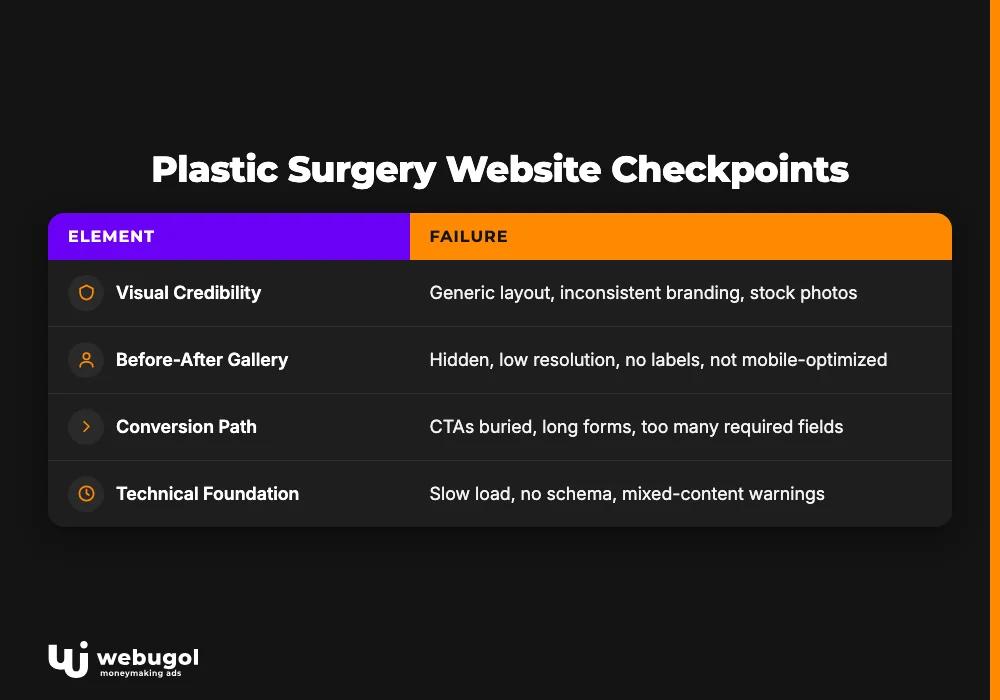
The table below maps the four non-negotiable elements to what failure looks like in practice.
| Element | What "good" looks like | Common failure |
|---|---|---|
| Visual credibility | Professional photography, consistent branding, real patient cases | Generic layout that could belong to any medical practice |
| Before-and-after gallery | Organized by procedure, labeled with recovery context, mobile-optimized | Hidden behind a login, low resolution, no labels |
| Conversion path | Clear CTAs on every page, short contact form above the fold | Contact buried in footer, too many required fields |
| Technical foundation | Sub-2-second load time, structured data, HTTPS everywhere | Slow server, no schema markup, mixed-content warnings |
Each row is a checkpoint. If your site fails one, that segment of visitors exits without converting.
What features should a cosmetic surgeon website have?
The gap between a cosmetic surgery website that ranks and one that converts comes down to specific features the design either includes or omits entirely. These plastic surgeon website tips address each gap in turn. The difference is measurable.
Before-and-after gallery design
Before-and-after galleries are the single most important content block on any plastic surgery website. They answer one core patient question: can this surgeon produce results like what I am looking for?
Good before after gallery design organizes cases by procedure type, shows realistic outcomes at different recovery stages, and loads fast on mobile. Poor gallery execution undermines trust. The surgical quality in the photos matters, but so does the way they are presented.
Labeling matters as much as image quality. Each case should note the procedure, the recovery timeframe shown, and when possible the patient's starting point. This gives prospective patients a realistic frame of reference before they call.
Trust signals and credentials
A plastic surgery website needs to convert a stranger into someone willing to call your office. That requires layered proof. Board certification and hospital affiliations belong on the homepage and the surgeon bio, not buried in an "About" page three clicks deep.
Patient reviews from verified platforms should appear near booking prompts. Any press coverage, awards, or media appearances belong in a visual strip that loads fast and scans in seconds.
Privacy statements and security indicators matter here too. A patient submitting a contact form is sharing sensitive personal information. If the site does not signal that it handles that data with care, a meaningful share of visitors will abandon the form before submitting.
Search visibility built from the start
Healthcare website UX and SEO are not separate disciplines in plastic surgery. A site that looks beautiful but lacks structured metadata, a logical URL hierarchy, and local search signals will not rank for the procedures you offer. That is not a later problem. Integrating search engine optimization for plastic surgery practices at the design stage, rather than adding it after launch, removes the need for disruptive rebuilds and makes every new content page work harder from the first day it goes live.
Why is mobile design important for plastic surgeons?
Most prospective plastic surgery patients first encounter your practice on a mobile screen. They search during commutes, in waiting rooms, in the quiet moments of an evening. A site that is slow or awkward on a phone loses that first encounter before you have a chance to demonstrate your skill. Gone, within seconds.
Mobile performance affects more than user experience. Google uses mobile performance as a primary ranking signal, which means a poorly optimized cosmetic surgery website is competing at a disadvantage in search results, well before a patient ever sees your work.
Responsive plastic surgery web design goes further than fitting content to a small screen. Touch targets need to be large enough to tap accurately. The before-and-after gallery must display at full quality without horizontal scrolling.
Contact forms should be short, with auto-fill enabled for phone and email fields. Each element is a point where friction is either removed or introduced.
Speed is the variable with the clearest cost. Slow pages drive visitors away on mobile, and in high-ticket aesthetic medicine where each consultation has real revenue attached, those exits are not just metrics. They are missed appointments.

How to improve plastic surgery website conversions?
Conversion improvement is a diagnostic problem before it is a design problem. These plastic surgeon website tips for conversion improvement start with session data, not design opinions. You need to know where patients exit before you can fix the right thing.
Session recording tools show where visitors stop scrolling, what they click, and where they abandon forms. Most practices find that the problem is not the homepage design. The exit usually happens further down the funnel.
The culprits are specific: a gallery that opens in a lightbox the patient cannot close on mobile, a form with nine required fields, or a "Learn more" button that leads to the surgeon's education page rather than a clear next step.
Specific actions that consistently move the needle:
- Move the primary CTA above the fold on every procedure page, not just the homepage.
- Reduce contact form fields to name, phone number, email address, and procedure interest. Each additional required field decreases submission rates measurably.
- Add a click-to-call button that stays visible on mobile, since a significant share of plastic surgery inquiries still happen by phone.
- Use page-specific conversion goals, not a single sitewide metric, so you can see which procedures drive the most consultation requests.
- Build your keyword targeting for high-intent plastic surgery searches so organic traffic data connects directly to consultation bookings.
The underlying principle: every element of a plastic surgery web design should move visitors toward a booked consultation. That includes photo galleries, service pages, and blog posts. Each should close with a specific prompt, not a generic "contact us."
For practices that already generate traffic but convert poorly, the structure of the patient flow through the site matters as much as visual design. A detailed look at structural web design principles for patient acquisition covers the patterns that matter most for established practices.
How much does a plastic surgery website cost?
Plastic surgery website costs vary widely depending on scope, and no honest medical web design agency can quote without understanding your patient acquisition goals first. What is worth knowing is the relationship between cost and what you are actually buying.
A template-based cosmetic surgery website built on a generic platform costs less up front. It typically requires a paid developer for every change, lacks the technical SEO infrastructure that custom builds include from the start, and limits how the site performs as your content and procedure offering grows. You pay less at launch and more over time.
Custom plastic surgery web design built on a performance-first foundation, with integrated SEO, structured conversion tracking, and a content management system your team can actually use, costs more at launch. The return shows up in lower cost-per-consultation over time, because the site works as an asset rather than a placeholder.
Before requesting quotes, clarify what you are comparing. Ask each vendor: what does the technical SEO setup include, how is conversion tracking implemented, what happens to page speed after the first content update, and who owns the codebase if you switch providers. The answers separate a marketing asset from a marketing expense.
Ready to get a plastic surgery web design that converts?
A well-built plastic surgery web design is a patient acquisition asset. It works around the clock, qualifies patients before they call, and builds the trust your surgeons need to close consultations from the very first point of contact.
Webugol builds conversion-led websites for plastic surgery and aesthetic medicine practices, with tracking and SEO integrated from the foundation up.
If your website generates traffic but loses patients somewhere between click and consultation, the Healthcare Growth System starts with a full diagnostic of where those losses are occurring. Book a strategy call to find out what is costing you consultations right now.
FAQ
What makes a good plastic surgery website?
A good plastic surgery website establishes trust quickly through board certification signals, real patient reviews, and a well-organized before-and-after gallery. It loads fast on mobile, routes visitors to a clear consultation booking path, and ranks for the procedures you offer through built-in search engine optimization.
What features should a cosmetic surgeon website have?
A cosmetic surgeon website needs professional before-and-after galleries organized by procedure, prominent trust signals including credentials and reviews, and a short contact form with click-to-call for mobile visitors. Fast load times and local SEO setup complete the foundation, tying your site to the geographic area you serve.
How to improve plastic surgery website conversions?
Start by identifying where visitors exit with session recording tools, then reduce form fields, move your primary CTA above the fold on every procedure page, and add click-to-call for mobile visitors. Each procedure page should close with a specific consultation prompt rather than a generic contact link.
Why is mobile design important for plastic surgeons?
Most plastic surgery searches begin on a mobile device, so a slow or hard-to-navigate site loses those visitors before they see your work. Google also ranks mobile performance as a core signal, meaning poor mobile experience reduces your search visibility and your reach at the same time.
How much does a plastic surgery website cost?
Plastic surgery website costs range from low-cost template builds to full custom design, and the gap in outcome over time is significant. The more important question is what tracking, SEO, and conversion infrastructure is included, since those determine your cost-per-consultation long after launch day.

