



Healthcare SEO keywords: full guide for medical practices
Healthcare SEO keywords are the specific search terms patients type when looking for medical care, symptoms, or providers near them. Choosing the right ones determines whether your practice appears on page one or stays buried in results no one reaches. This guide covers medical keyword research, how SEO for medical practices differs from general search optimization, and how healthcare organizations can measure whether their content strategy is driving real patient inquiries.
Healthcare SEO keywords: the four categories that matter
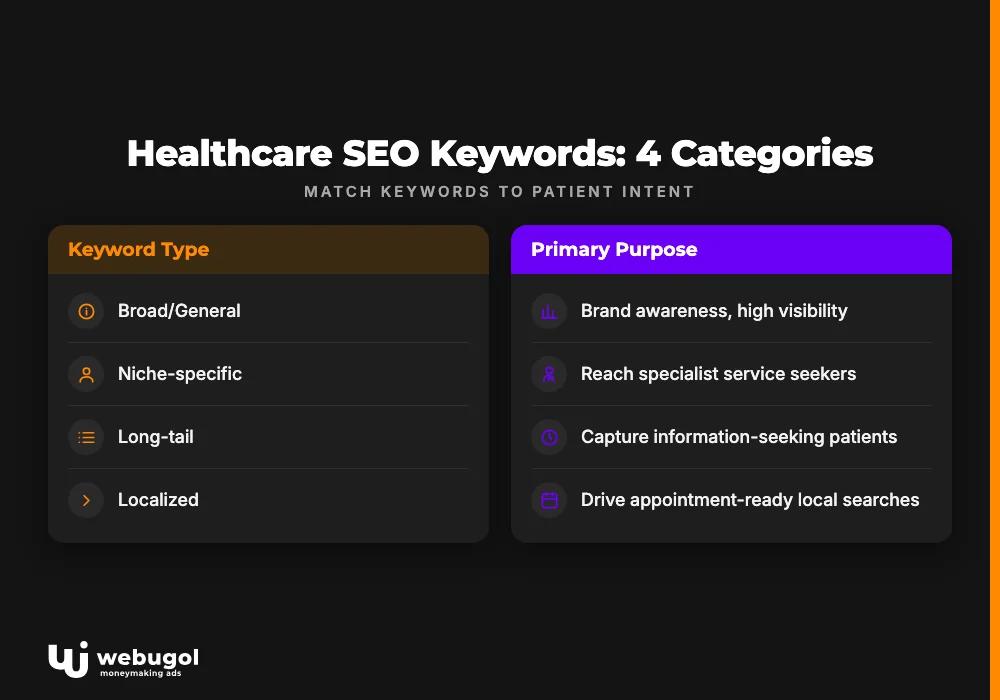
Not every keyword does the same job. Before building any strategy, you need to understand what each type does and when to use it.
| Keyword category | Examples | Primary purpose |
|---|---|---|
| Broad/general | "healthcare services," "medical care," "health insurance" | Brand awareness, high-volume visibility |
| Niche-specific | "pediatric neurology," "laser eye surgery," "cardiac rehabilitation" | Reaching patients seeking specialist services |
| Long-tail | "symptoms of type 2 diabetes," "treatment for chronic back pain" | Capturing information-seeking patients |
| Localized | "pediatrician in New York," "urgent care hours near me" | Driving appointment-ready local searches |
Broad terms generate the most search volume. They also face the most competition. Long-tail and localized terms attract smaller audiences but convert at far higher rates because the searcher's intent is specific. A well-built healthcare content strategy targets all four categories, with the weight placed toward terms your actual patients search rather than terms your competitors target most heavily.
The right mix shifts depending on practice type. A job posting site needs entirely different healthcare SEO keywords than a specialty clinic, prioritizing terms like "healthcare job openings," "nursing jobs in Los Angeles," or "pharmacist positions in Boston" rather than condition-based or service queries.
What are the best SEO keywords for healthcare websites?
The best healthcare SEO keywords close the gap between how clinicians describe conditions and how patients describe them. A patient types "knee pain walking upstairs." Not "patellofemoral pain syndrome." That gap is where medical keyword research begins.
General terms like "healthcare services," "health insurance," and "local clinics" are worth including but rarely win competitive rankings without substantial domain authority behind them. The more reliable wins come from three directions:
- Condition-specific long-tail phrases: "symptoms of type 2 diabetes," "treatment for chronic back pain," "how to manage high blood pressure at home"
- Service plus location combinations: "pediatrician in New York," "best cardiovascular surgeon in Chicago," "dermatologist accepting new patients in Austin"
- Appointment-intent phrases: "urgent care open Saturday," "same-day appointment family doctor," "walk-in clinic near me"
Niche-specific terms like "pediatric neurology" or "laser eye surgery" let specialty practices like medical marijuana dispensaries reach the patients seeking those exact services. A hospital digital marketing team will prioritize different terms than a solo urgent care clinic, and both will look nothing like a healthcare job posting site.
There is no universal list. The right healthcare SEO keyword set reflects your specific services, your geography, and the type of patient intent you want to capture at each stage of their search.
How is SEO different for healthcare providers?
Healthcare content falls into Google's "Your Money or Your Life" (YMYL) category, which subjects it to stricter quality evaluation than lifestyle or entertainment content. Thin content, unsupported claims, and anonymous authorship do not simply rank poorly in healthcare. They actively damage the trust signals that affect the entire domain's performance. That damage accumulates.
Four factors separate SEO for medical practices from general website optimization:
E-E-A-T carries more weight. Google's Quality Rater Guidelines apply extra scrutiny to medical expertise, authoritativeness, and trustworthiness. Content reviewed or authored by licensed practitioners consistently outranks anonymous content in healthcare search results. Named authors with verifiable credentials are a ranking factor in medical website optimization, not an optional extra.
Accuracy constrains what you can say. You cannot claim a treatment cures a condition without clinical backing. Guaranteed outcomes, unverifiable statistics, and absolute language fail Google's quality guidelines and create legal exposure for the practice.
HIPAA shapes content boundaries. Privacy regulations restrict the use of patient data in marketing content, which limits certain types of social proof that other industries rely on freely.
Local intent dominates patient search behavior. Most patients search for care within a specific geography. Healthcare local search is not an optional layer. A patient in Dallas searching "cardiologist" expects local results, not a national hospital network's generic landing page. Missing local intent means missing the majority of appointment-driving queries.
Understanding these differences is what makes medical website optimization a distinct skill, not a simple application of standard SEO principles.
How do you find low-competition healthcare keywords?
Low-competition healthcare SEO keywords sit at the intersection of specific patient language, local intent, and services your competitors have not fully optimized content around yet. The process has four practical steps.
Step 1: Translate clinical language into patient language. Start with the words your patients use during consultations and in online reviews. These informal phrases often have lower competition than the medical terminology competitors optimize for. "Back pain from sitting all day" reaches a different audience than "lumbar disc herniation," with less competition and the same underlying patient need.
Step 2: Filter by intent. Informational keywords like "what is hypertension" attract researchers. Transactional keywords like "hypertension specialist near me" attract patients ready to book an appointment. Weight your keyword list toward transactional and local intent for patient acquisition.
Step 3: Add geographic modifiers. Local modifiers shrink the competitive field significantly. "Dermatologist" competes globally. "Dermatologist accepting new patients in Portland" competes locally, with near-perfect intent alignment for your actual service area. This logic is the foundation of effective healthcare local search strategy.
Step 4: Mine your existing rankings. Google Search Console shows which queries bring traffic to your site at positions 5 through 20. Those mid-ranking terms are your fastest improvement opportunities. They already have relevance signals from Google. Targeted content and on-page optimization can move them into the top three.
Supporting keywords that build topical authority alongside your primary phrase include SEO for medical practices, medical website optimization, hospital digital marketing, healthcare content strategy, medical keyword research, and local search optimization for medical providers. Weaving these into your content architecture reinforces search engines' understanding of your site's subject matter expertise.

What role does HIPAA play in healthcare content SEO?
HIPAA does not regulate SEO tactics directly, but it constrains what healthcare content can say. That constraint shapes the entire content strategy.
Patient testimonials require written authorization. Many healthcare marketers avoid patient-specific stories entirely because obtaining proper authorization is operationally complex. This removes a trust-building tool that other industries use freely. The practical alternative is condition-focused content that speaks to patient experience in general terms without referencing identifiable individuals.
Analytics and tracking scripts raise HIPAA concerns when they capture health-related data from authenticated sessions or intake forms. For healthcare local search campaigns, this restricts certain remarketing and behavioral targeting methods that work without issue in other industries.
The SEO implication is direct. Healthcare providers must build content credibility through authorship and clinical accuracy rather than social proof alone. Named authors with verified credentials, cited clinical sources, and transparent editorial standards compensate for what HIPAA prevents. This constraint also aligns with what Google's quality guidelines reward: expert, source-backed content rather than testimonial-driven claims.
HIPAA-safe content focuses on conditions, treatments, general patient education, and clinical expertise. That is exactly what performs well in healthcare SEO, which means the regulatory constraint and the ranking requirement point in the same direction.
Placing healthcare SEO keywords where they work
Knowing which healthcare SEO keywords to target matters less than placing them correctly. Medical website optimization depends on placement, density, and context working together across every page element.
Title and H1 should contain the primary keyword near the start. This signals relevance to search engines and to users scanning results pages before they click.
First paragraph must use the primary keyword and give a direct answer to the query. Search engines and AI-powered answer features often extract opening paragraphs as featured content. This is where AEO and SEO overlap most directly.
Subheadings carry supporting keywords naturally. One to two H2 headings containing terms like "medical keyword research" or "local search visibility for clinics" establishes topical breadth without forcing keyword density into body prose.
Body text is where density is earned. A primary keyword density of 1.0 to 2.0 percent means the exact phrase appears roughly every 50 to 100 words on average, never forced. Read every sentence aloud. If the phrase sounds inserted rather than written, rewrite the sentence.
Meta descriptions need the primary keyword within the first 120 characters. Mobile search results truncate beyond that point. A meta that buries the keyword at character 130 loses visibility precisely where most patients now search.
URL slugs should reflect the page's primary topic clearly and concisely. Short, keyword-descriptive slugs outperform long URLs with dates and stop words in most cases.
The practical discipline: write for the patient first, then audit for keyword placement. Drafting in natural language and verifying keyword presence afterward consistently produces content that satisfies both Google's quality signals and the patient's actual need for clear, accurate information.
For practices looking to build a full organic presence across multiple service areas, reviewing the SEO approach for expanding medical practices outlines the structural decisions that determine long-term visibility.

How do healthcare companies measure SEO success?
Healthcare SEO success cannot be measured by rankings alone. Rankings are an input metric. Patient inquiries and appointment requests are output metrics. A complete measurement framework tracks both, and connects them.
The key performance indicators for healthcare organizations include:
- Organic sessions: total traffic from search engines, segmented by landing page and keyword group
- Keyword positions: tracked weekly for primary and supporting healthcare SEO keywords
- Conversion events: appointment requests, phone calls, and contact form submissions attributed to organic search
- Impressions and click-through rates: pulled from Google Search Console for target queries
- Local pack appearances: how often the practice shows up in map results for local searches
One important distinction for hospital digital marketing: branded search growth and non-branded search growth tell different stories. Branded growth reflects reputation and offline marketing. Non-branded growth reflects actual SEO performance. A strategy that moves only branded metrics is not improving discoverability for patients who do not already know the practice by name.
A customized analytics dashboard connecting keyword ranking data to patient inquiry volume gives healthcare teams actionable insight rather than vanity metrics. The goal is to see whether ranking improvements for specific healthcare SEO keywords correspond to actual increases in appointment requests from those keyword segments.
Webugol offers exactly this type of tracking through its healthcare growth system, connecting keyword performance to patient inquiry volume so practices can make informed decisions about where to focus their content development efforts.
Reputation management and healthcare local search
Online reputation directly influences healthcare local search rankings. Google considers the volume, recency, and average rating of reviews when determining which practices appear in local map results.
Review management is therefore a measurable part of SEO for medical practices, not a separate marketing function. Practices with consistent positive reviews, timely responses to all feedback, and a steady flow of new submissions rank better in local results than practices with static or outdated review profiles. The difference is measurable and significant.
Responding to reviews, including critical ones, signals to search algorithms that the practice is active and engaged. This is one of the few areas where direct patient interaction has a direct, traceable effect on search visibility. For healthcare local search specifically, response rate and response timeliness are factors in how local ranking algorithms evaluate a practice's relevance.
Platforms like Google Business Profile and healthcare-specific review sites like Healthgrades and Zocdoc contribute to this picture. A consistent presence across these platforms, with accurate information and actively managed reviews, supports the broader medical website optimization effort.
For practices looking to strengthen their local visibility, local search profile management for healthcare providers addresses the practical steps that connect directly to this aspect of healthcare SEO performance.
Work with a team that specializes in healthcare SEO
If your practice's search visibility does not match your clinical reputation, keyword strategy is usually where the gap starts. Webugol focuses on healthcare SEO, medical keyword research, and building content strategies that connect practices with the patients actively searching for their services. Reach out to get a review of your current keyword coverage and identify where the clearest opportunities are.
FAQ
What are the best SEO keywords for healthcare websites?
The most effective healthcare SEO keywords combine service-specific terms with local modifiers and condition-based long-tail phrases. Examples include "pediatrician accepting new patients in [city]," "symptoms of type 2 diabetes," and "urgent care open Saturday near me." The right set depends on your specialty, geography, and the stage of patient intent you are targeting.
How is SEO different for healthcare providers?
Healthcare SEO operates under stricter quality standards because medical content falls into Google's YMYL category. Providers must demonstrate clinical expertise through named authors and cited sources, avoid unverifiable claims, and prioritize healthcare local search because most patients search for care within a specific geography.
How do you find low-competition healthcare keywords?
Match patient language to clinical services, filter by local and transactional intent, and check Google Search Console for queries where your site ranks between positions 5 and 20. Those mid-ranking terms are the fastest improvement opportunities because they already have relevance signals from Google that targeted content can push higher.
What role does HIPAA play in healthcare content SEO?
HIPAA restricts patient-identifying content in marketing materials, which limits testimonials and specific case studies unless written authorization is obtained. Healthcare providers compensate by building trust through named expert authors, cited clinical sources, and general patient education content rather than relying on identifiable social proof.
How do healthcare companies measure SEO success?
Effective measurement tracks organic session volume, keyword ranking positions, local pack appearances, and conversion events like appointment requests and phone calls attributed to search traffic. Separating branded from non-branded organic growth clarifies whether SEO improvements are generating genuinely new patient discovery or simply reflecting existing offline reputation.