



Chiropractic marketing tools to attract more patients
Chiropractic marketing tools are the digital platforms, software, and strategies that help clinics become visible online, attract new patients, and keep current ones returning. The essential stack includes a professional website, local SEO software, social media scheduling, email marketing, and reputation management. Used together, these tools let a practice compete in local search, build patient trust before a first visit, and cut the administrative overhead that drains clinic staff. Without them, strong clinical care stays invisible.
What digital marketing tools do chiropractors need?
Every chiropractic practice needs five tool categories for effective digital marketing for chiropractors: a mobile-optimized website, local search optimization, social media scheduling, email marketing, and reputation tracking. These categories cover the complete patient journey, from first search query to return appointment. The table below maps each category to the platforms most commonly used in chiropractic practices today.
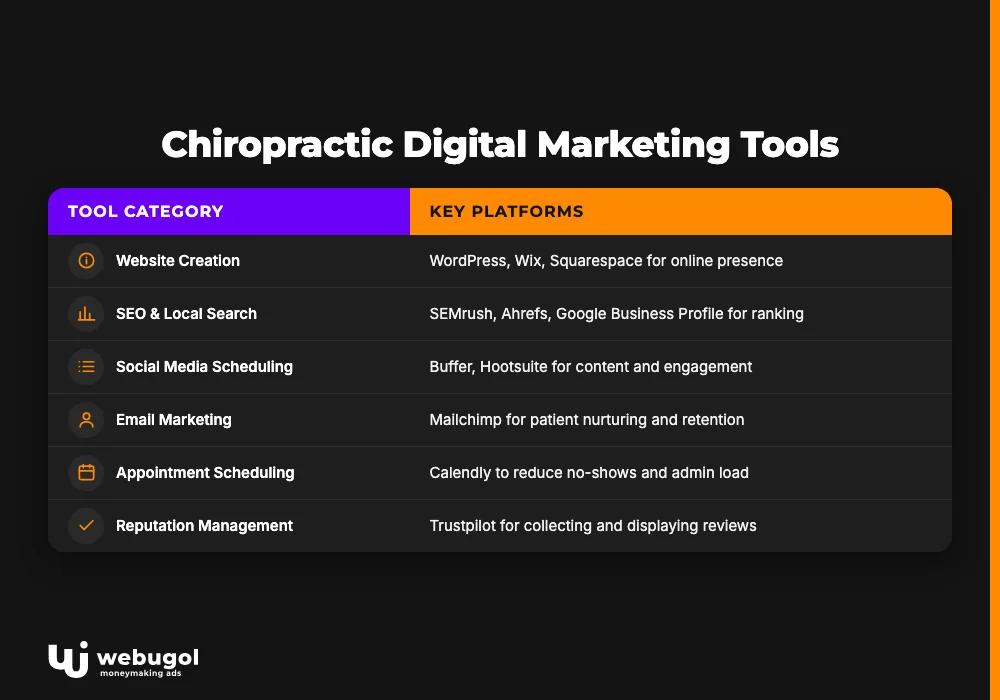
| Category | Primary function | Common platforms |
|---|---|---|
| Website creation | Online presence and appointment booking | WordPress, Wix, Squarespace |
| SEO and local search | Rank in "chiropractor near me" searches | SEMrush, Ahrefs, Google Business Profile |
| Social media scheduling | Content planning and engagement tracking | Buffer, Hootsuite |
| Email marketing | Patient nurturing and retention | Mailchimp |
| Appointment scheduling | Reduce no-shows and administrative load | Calendly |
| Reputation management | Collect and display patient reviews | Trustpilot |
Not every practice needs all six categories immediately. Start with a professional website and a fully optimized Google Business Profile. Layer in the remaining chiropractor marketing tools as patient volume and budget grow. Running six platforms simultaneously with a small team typically means running all of them ineffectively, which undermines the entire investment.
The most effective chiropractic marketing tools programs begin with a gap analysis: identify which specific step in your patient acquisition process is losing people, then select the tool that closes that particular gap. Adding subscriptions before diagnosing the actual problem is one of the most common and most expensive mistakes in clinic marketing.
How to market a chiropractic practice online?
Marketing a chiropractic practice online starts with local search visibility and a credible website, then extends into content and social channels. Local search drives the highest-intent traffic. Those patients are already looking for care, often within the next few hours.
Build a professional website. Platforms like WordPress and Squarespace let clinics create fast, mobile-responsive sites without a development team. Every chiropractic site needs clear service descriptions, a booking option visible above the fold, and an easy-to-find contact page. A slow or disorganized site loses visitors before they read a single word about your clinical approach.
Claim and optimize your Google Business Profile. This free listing places your clinic in local map results when patients search nearby. Fill every available field: hours, services, photos, accepted insurance, and the Q&A section. Respond to all reviews, positive and negative. A consistently maintained profile is one of the highest-return activities in chiropractic digital marketing because the only real cost is staff time.
Use SEO tools to close visibility gaps. SEMrush and Ahrefs identify the specific terms your target patients search, which competitor pages rank for those terms, and where your site falls short technically. Location-specific service pages, structured data markup, and consistent name-address-phone listings across directories form the foundation. For a detailed walkthrough of the local search signals that move clinic listings up in map packs, the guide on how healthcare practices rank in competitive local markets covers the full process.
Build local directory citations. Accurate, consistent listings on Google, Yelp, Healthgrades, and other relevant directories reinforce your local search signals. This is unglamorous foundational work. It compounds steadily over time.
Publish content that answers real patient questions. Blog posts and FAQ pages on topics like "what to expect from a chiropractic adjustment" or "how many sessions does sciatica typically require" attract organic traffic and give social accounts material worth sharing. Useful content pages keep driving traffic for years. Paid ads stop the moment the budget runs out.
What is the best marketing strategy for chiropractors?
The best strategy connects local SEO, reputation management, and social media into a system where each channel reinforces the others. A list of tools is not a strategy. A connected, measurable system is.
The patient acquisition path looks like this: a patient searches "chiropractor near me" on their phone. Your Google Business Profile appears in the map results. They click through to your website. They read your Trustpilot reviews. They schedule through Calendly. You follow up with a Mailchimp email sequence. Every link in that chain must hold, or patients exit at that point.
Chiro marketing tools are only effective when they all point toward the same outcome: converting search intent into booked appointments. The right chiropractic marketing tools connect these stages so that patient information flows consistently from one channel to the next. Smaller practices should track which specific channels drive new bookings and stop spending on anything not contributing measurably.
Marketing solutions for chiropractors should match the clinic's actual size, patient demographics, and local competitive environment, not the most impressive vendor demo. A rural single-provider clinic and a multi-location metro practice need completely different configurations, even though they share the same core tool categories. Chiropractic digital marketing works when the configuration fits the practice, not when it mimics a competitor's approach.
Track results monthly. Patient acquisition source, cost per new patient, and appointment-to-return rates are the three numbers that reveal whether a marketing program is producing or just running.
How to get more chiropractic patients online?
Effective digital marketing for chiropractors requires three operational priorities: rank well in local searches, convert the visitors who find you, and retain the patients you already have. Most practices over-invest in the first and underinvest in the third. That imbalance is where significant growth gets left behind.
Ranking means a complete Google Business Profile, consistent local directory citations, and location-specific keywords across your website pages. Organic search builds over time. Paid ads stop when the budget does. For practices weighing where to invest first, the long-term case for building organic search before paid channels is strong, and the overview of how search engines compound growth for health and wellness businesses explains the trajectory in practical terms.
Converting means removing friction between a visitor's decision to book and their actually completing a booking. A visible phone number, an online scheduling option, and trust signals such as credentials and patient reviews near the booking form all reduce drop-off. Speed and clarity matter more here than visual design. A prospective patient who cannot find your contact information within ten seconds will close the tab and book elsewhere.
Retaining is where most practices leave significant revenue unclaimed. Email campaigns, appointment reminder sequences, and seasonal wellness content keep current patients engaged and prompt return visits. Mailchimp and similar tools automate most of this work once the initial sequences are built. A systematic email approach for retaining healthcare patients provides a practical starting framework for building sequences that run without ongoing manual effort.
Which social media platforms work best for chiropractors?
Facebook and Instagram are the strongest starting points for most chiropractic practices. Facebook reaches older demographics more likely to seek care for chronic pain, sports injuries, or recovery from accidents. Instagram suits practices that can produce consistent visual content around posture correction, movement, and wellness lifestyle.
YouTube is worth the investment if you commit to regular educational video content: what a chiropractic adjustment involves, common causes of back pain, at-home stretches for neck and shoulder tension. Building an audience there takes time and sustained production effort. TikTok can reach younger demographics but delivers inconsistent returns for most local health practices with limited content budgets.
The practical question is not which platform is theoretically best. It is which platform your specific patient base uses most, and which one your team can maintain on a consistent schedule. Posting sporadically on four platforms is measurably less effective than one well-run channel updated weekly. Chiropractic marketing tools for social management, like Buffer and Hootsuite, support advance scheduling and engagement tracking, which makes consistency achievable even for small clinic teams. For a data-informed look at how patients use social platforms to evaluate and choose healthcare providers, the breakdown of how patients engage with healthcare providers across social channels covers the platform-specific patterns worth reviewing before committing your time and resources.
How to evaluate chiropractic marketing tools before you buy
Most tool guides tell you what exists. Few explain how to choose between options for your specific practice. Four criteria help any clinic make sharper decisions before spending budget on platforms that may not fit.
Market size and competitive density. A solo practitioner in a smaller regional town has genuinely different needs than a six-provider clinic in a major metropolitan area. Smaller markets benefit from less paid ad spend and more community-aligned content. Larger markets require stronger local SEO investment and, in competitive specialties, paid search to break into the top results against practices that have been building their digital presence for years.
Your current patient acquisition cost. Know what you currently spend per new patient across all active channels. If you have no baseline, build one before adding tools. SEO and email carry higher time costs upfront but lower cost per acquisition over a multi-year horizon. Paid ads produce volume quickly and stop producing when the budget stops. Neither approach is inherently better; the right choice depends on your timeline and operational capacity.
Your review volume. Online patient reviews are the modern form of the word-of-mouth referrals that historically drove chiropractic growth. If your practice has fewer than twenty Google reviews, reputation management should take priority over most other tool investments. New patients read reviews before they visit your website, not after. Trustpilot and Google's native review request tools both support systematic collection.
Your team's real capacity. Every tool requires someone to manage it. A platform that no one has time to update consumes budget without generating any return. Social scheduling tools like Hootsuite reduce the management burden but do not eliminate it. Be realistic about available weekly hours before adding a new subscription to the stack.
Chiropractor marketing tools that work well for an established clinic with dedicated marketing staff often overwhelm a two-person practice that is still setting up its first website. Match the tool selection to your current growth stage. Start with the fundamentals. Add layers when the existing ones are producing measurable, consistent results.
Ready to take your chiropractic practice further?
If you want a structured approach to chiropractic digital marketing built around your clinic's size, patient demographics, and local competitive environment, the Webugol healthcare growth system maps the full acquisition and retention cycle and identifies which chiropractic marketing tools to prioritize at your current stage of growth. Start a direct conversation about your specific market at Webugol.com.
FAQ
What are the most important chiropractic marketing tools for a brand-new practice?
For a new practice, the three highest-priority tools are a professional website, a fully optimized Google Business Profile, and a consistent process for collecting patient reviews. These three establish the local visibility and trust signals that drive initial bookings without requiring a significant advertising budget.
How long does it take for chiropractic marketing tools to produce results?
Local SEO and reputation management typically produce measurable ranking improvements within three to six months of consistent work. Paid search and social advertising can drive appointment requests within days but require ongoing budget to sustain that volume. Email retention sequences generally show measurable reactivation results within the first one to two months once they are live.
Do chiropractors need a marketing agency to use these tools effectively?
Many tools, including Google Business Profile and Mailchimp's entry tier, are built for self-management by small clinic teams. A marketing agency adds practical value when in-house expertise or capacity is limited, when local competition is particularly strong, or when a practice wants to grow faster than organic effort alone can deliver within a reasonable timeframe.
How does chiropractic digital marketing differ from general healthcare marketing?
Chiropractic practices depend more heavily on local search and patient reviews than most healthcare categories because patients typically choose a chiropractor based on geographic proximity and the experiences of others in their community. This makes local SEO and reputation management proportionally more important for a chiropractic clinic than for a national telehealth brand, where broad awareness campaigns carry greater weight.