



Medical aesthetics marketing: a practical guide for clinics
Medical aesthetics marketing is the organized set of strategies clinics use to attract patients, build professional credibility, and generate reliable appointment volume. It covers local search, paid advertising, social content, and patient communication campaigns. Done well, it creates compounding demand. Done poorly, you compete on price with every med spa in your market.
How do you market a medical aesthetics clinic?
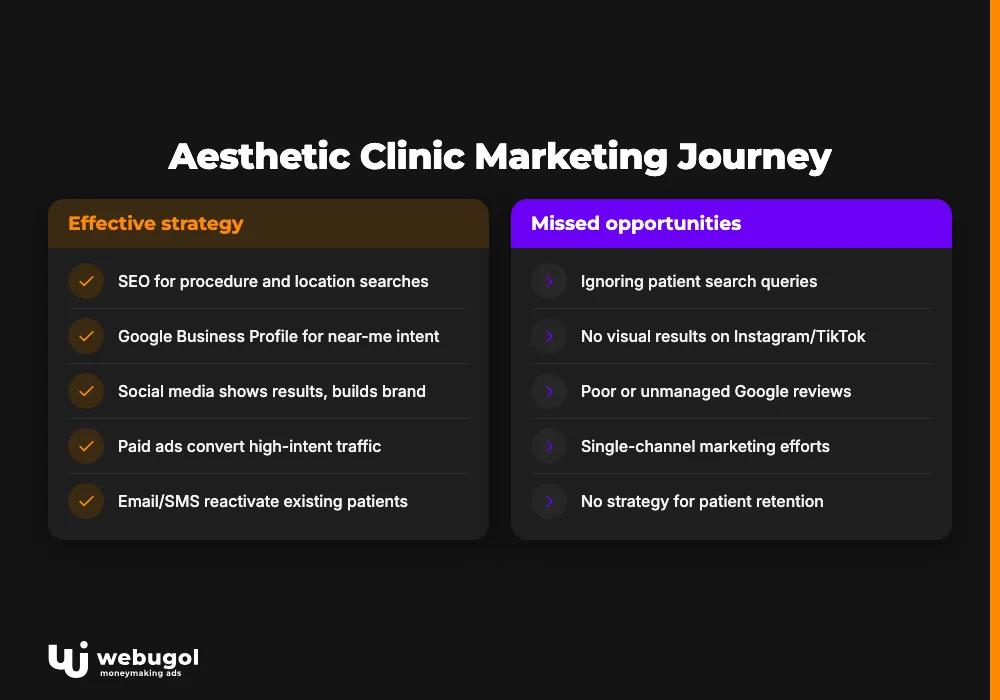
Marketing a medical aesthetics clinic effectively means matching your strategy to how patients actually research these decisions. Most prospective patients start with a search query, move to Instagram or TikTok to evaluate results visually, and then check Google reviews before booking. A strategy that covers all three stages outperforms any single-channel effort.
The table below maps the core elements of aesthetic clinic digital marketing to each stage of the patient journey:
| Channel | Patient journey stage | Primary goal |
|---|---|---|
| Cosmetic clinic SEO | Awareness / discovery | Rank for procedure and location searches |
| Google Business Profile | Consideration | Capture near-me intent and manage reviews |
| Social media content | Consideration / trust | Show results, build brand personality |
| Paid search and social ads | Decision | Convert high-intent traffic |
| Email and SMS sequences | Retention | Reactivate and rebook existing patients |
| Influencer partnerships | Awareness | Reach new demographics |
Each channel reinforces the others. A patient who finds your clinic through search, sees your before-and-after reels on Instagram, and reads a strong set of Google reviews is far more likely to book than one who encounters a standalone ad with no supporting credibility.
What digital channels work best for aesthetic clinics?
Local search, social media, and email consistently deliver the strongest returns for aesthetic practices. They address different stages of the patient journey and compound in value when run together rather than in isolation.
Local search and cosmetic clinic SEO. Most aesthetic procedure searches include a location modifier. Ranking for "botox clinic near me" or "laser hair removal [city]" requires an optimized Google Business Profile, consistent local citations, and service pages built around local search intent. Organic search builds authority that paid ads cannot replicate: the traffic it delivers grows without a per-click cost attached to every visit.
Healthcare social media marketing. Instagram and TikTok are the primary discovery platforms for aesthetic services. Patients use them to evaluate results, assess the provider's personality, and gauge clinic culture before making contact. The formats that generate the most direct inquiries are before-and-after posts, short educational clips about specific procedures, and candid team content. What drives patient decisions across social platforms varies by age group, so your content mix should reflect the demographics you are actually targeting.
Email for patient retention. Email reaches the patients you already have, and treatment cycles for procedures like Botox and fillers are predictable enough to support well-timed reactivation sequences. Building email programs that drive aesthetic patient rebooking is one of the highest-ROI moves available to a clinic with an existing patient base, because the cost per rebooking falls as your list and automation mature.
Medspa online advertising. Paid search captures patients actively searching for specific treatments. Paid social on Meta and TikTok targets by age, income, and interest. Running both creates a broad-to-narrow funnel: social for awareness, search for conversion intent.
What content works for medical aesthetics on social media?
Medical spa content strategy on social platforms rests on three types: results, education, and personality.
Results content means before-and-after photos and short procedure walkthroughs. This is the format that converts. Prospective patients use it to set outcome expectations and compare providers before they ever make contact, which is why it consistently drives the highest inquiry volume for botox clinic promotion, filler services, and laser treatments.
Educational content addresses the questions patients type into search engines and ask at consultations: recovery timelines, candidacy criteria, procedure comparisons, follow-up requirements. Answer these questions clearly and you build clinical authority. That authority also feeds cosmetic clinic SEO directly, because well-structured educational posts align with the exact search queries patients use to find procedures near them.
Personality content covers team introductions, clinic walkthroughs, and candid behind-the-scenes clips. It reduces the anxiety many patients carry before a first aesthetic appointment. More practically, it builds the trust that makes premium pricing defensible against lower-cost competitors in the same market.
Virtual consultations, now enabled by AI and augmented reality tools, are gaining traction as a supplementary aesthetic practice lead generation layer. A free virtual assessment lowers the barrier to first contact and converts social engagement into booked appointments more efficiently than a contact form alone.
How to attract new clients to a medical spa?
Attracting new aesthetic patients at scale requires removing friction at every step between awareness and a booked appointment. The most reliable tactics are:
- Online reviews. A clinic with a strong volume of recent Google reviews consistently wins local searches over a competitor with fewer, even if that competitor's services are equal. Asking every satisfied patient for a review immediately after their visit is the simplest available high-return tactic.
- Influencer partnerships. Collaborating with local or niche beauty influencers whose values align with your clinic's positioning drives awareness more efficiently than broad ad buys. Alignment matters more than raw follower count.
- Cross-industry partnerships. Alliances with hair salons, fitness studios, and wellness spas reach overlapping demographics without direct ad spend. A co-promotion or shared gift card arrangement generates warm referrals at marginal cost.
- Marketing automation. Chatbots answer common questions around the clock and capture contact details from patients who are not ready to call. Automated appointment reminders reduce no-shows. Follow-up sequences drive rebooking. These tools compound in value as your patient database grows.

How much should a medical aesthetics clinic spend on marketing?
There is no fixed number. The right budget depends on clinic size, market competition, and growth stage. A practice entering a dense urban market needs to invest more aggressively than an established clinic with strong reviews and referral volume already in place.
Channel allocation matters more than the total figure. Cosmetic clinic SEO and content creation build durable value because the traffic they generate does not stop when the budget does. Paid search and social advertising produce faster volume but require continuous spend to sustain results. Running both in parallel gives your medical aesthetics marketing program resilience that neither channel delivers alone.
Measuring return by channel makes reallocation rational. If paid acquisition costs significantly more per lead than organic search, the next budget decision is straightforward. Most clinics underinvest in measurement and cannot make that call confidently, which leads to wasted spend at scale.
Ethics and compliance in aesthetic marketing
Speed is always tempting. Launching a campaign before patient consent processes are documented, or publishing images without written authorization, creates regulatory risk that outweighs any short-term gain. The FTC requires that testimonials and before-and-after images represent typical results, or include clear disclosures when they do not.
Responsible medical aesthetics marketing does not overstate outcomes. It distinguishes between treatments backed by strong clinical evidence and those with limited support. This discipline protects patients. Over time, it also differentiates your practice from providers who prioritize conversion over accuracy, and it keeps your marketing credible as regulators and ad platforms continue tightening oversight of healthcare-adjacent claims.
Build a medical aesthetics marketing system that lasts
Sustainable growth in medical aesthetics marketing comes from consistency across every patient-facing touchpoint: search visibility, social content, paid campaigns, and the post-visit communication that drives loyalty. If you want to identify where your current approach is losing ground, our healthcare growth system covers the full digital stack for aesthetic clinics. Webugol partners with practices at every growth stage to build integrated programs that produce measurable patient volume.
FAQ
What makes medical aesthetics marketing different from general healthcare marketing?
Aesthetic services are elective, so patient decisions are driven by desire and trust rather than urgency or medical necessity. Visual proof of results, the personal brand of the provider, and peer recommendations carry far more weight than in symptom-driven healthcare categories, which fundamentally changes which channels and content types work best.
How long does cosmetic clinic SEO take to show results?
Local SEO for aesthetic clinics typically shows measurable ranking movement within three to six months, with compounding growth over the following 12 months. Paid advertising generates leads faster but at a higher ongoing cost per patient.
Should a medical spa invest in influencer partnerships?
Influencer partnerships work well when the influencer's audience matches your target demographic and their aesthetic values align with your clinic's positioning. A smaller, engaged local audience typically converts better than a large national following with weaker demographic fit.
What is the most overlooked tactic in aesthetic practice lead generation?
Most clinics focus on acquiring new patients while underinvesting in retaining existing ones. Reactivating patients who have not returned after a predictable treatment window consistently delivers a better return on investment than equivalent spend on new-patient acquisition channels.