



Medical marijuana SEO: a practical strategy guide for dispensaries
Medical marijuana SEO is the practice of optimizing a dispensary's website and online presence so patients find it through organic search results. Because Google, Meta, and most ad networks prohibit or heavily restrict paid cannabis advertising, organic search is the primary patient acquisition channel for most dispensaries. A complete medical marijuana SEO strategy covers local optimization, keyword targeting, content, technical performance, and regulatory compliance, all working together. Done correctly, it builds compounding patient traffic that paid advertising in this space cannot deliver.
Why organic search is the primary growth channel for dispensaries
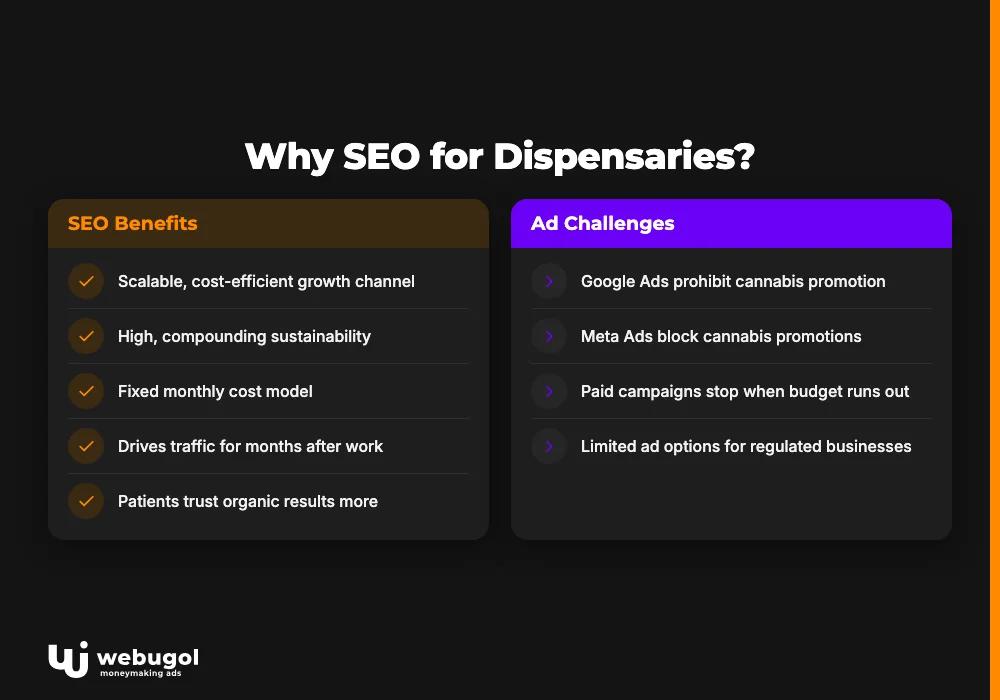
Cannabis businesses face advertising restrictions that most other industries do not. Google Ads prohibits the promotion of cannabis products in the vast majority of markets. Meta's ad policies block cannabis promotions across most U.S. states, even where medical use is legal under state law. That reality makes marijuana search engine optimization one of the few scalable, cost-efficient growth channels available.
| Channel | Available to dispensaries? | Sustainability | Cost model |
|---|---|---|---|
| Google Ads | No, in most markets | N/A | Per click |
| Meta Ads | No, in most U.S. states | N/A | Per impression |
| Cannabis SEO | Yes | High, compounding | Fixed monthly |
| Weedmaps / Leafly | Yes | Moderate | Subscription |
| Email and SMS | Yes, with compliance | High | Per send |
The math is straightforward. A paid campaign stops sending traffic the moment the budget runs out. An organic ranking built through consistent medical marijuana SEO keeps driving visitors for months after the optimization work is complete. For regulated businesses operating with limited ad options, that compounding return is the core argument for investing in organic search.
There is also a trust dimension. Research into healthcare search behavior consistently shows patients trust organic results more than paid placements. A dispensary that ranks organically for local queries signals to prospective patients that it is an established, credible resource in its market, not just a business that bought its way into view.
What legal restrictions apply to cannabis digital marketing?
Federal law classifies cannabis as a Schedule I controlled substance under the Controlled Substances Act. That classification is the root of nearly every restriction cannabis businesses face online. Full stop.
Platform-level restrictions emerge directly from that federal status. Google, Meta, Apple Search Ads, and most programmatic ad networks restrict cannabis advertising because they operate across state lines and carry federal liability exposure. The restrictions do not reflect a judgment about local state law; they reflect the federal risk these platforms bear as national operators.
State rules add a second layer. California's Bureau of Cannabis Control requires dispensary advertising to include specific disclosures and prohibits targeting audiences that may include minors. Colorado, Illinois, and other states with established medical cannabis markets impose similar requirements. Any content strategy, including organic blog content, should be reviewed against the specific state regulations where the dispensary operates before publication.
Website content falls under these restrictions too. Publishing unverified health claims about cannabis products can attract regulatory scrutiny. Content should be accurate, source claims where verifiable, and avoid absolute therapeutic promises that state law does not permit. This compliance layer is one reason medical marijuana SEO requires a specialist approach rather than a general-purpose digital marketing agency.
Can dispensaries run Google Ads for cannabis products?
No. Google's advertising policies explicitly prohibit promoting recreational drugs and, in most markets, cannabis products even where state law permits medical use. Google permits ads for certain hemp-derived CBD products in specific U.S. states when advertisers meet certification requirements, but that exception does not cover THC-containing dispensary products.
Some dispensaries attempt workarounds by advertising general wellness content or directing traffic to landing pages that avoid direct product references. That approach carries real risk. Google's policy enforcement can suspend an account entirely, and reinstatement is a slow process with no guaranteed outcome.
The practical answer is to direct those resources toward cannabis search engine marketing through organic channels. A dispensary that ranks on page one for "medical dispensary [city]" through marijuana website visibility tactics gains reliable, recurring traffic without the platform suspension risk that ad workarounds create.
Google Business Profile placements operate under somewhat different policies and may offer limited paid visibility in some markets. This area shifts frequently. Dispensaries should verify current GBP advertising rules directly with Google before testing any paid placement through that surface.
What SEO tactics work for cannabis websites?
The core tactics mirror what works for any local health business: technical site health, on-page optimization, authoritative content, and strategic link acquisition. What differs is the compliance layer and the platform restrictions that determine which of those tactics carries the most weight in this specific category.
Building a keyword map for marijuana website visibility
Cannabis keyword research requires mapping search volume against patient intent. Someone searching "medical dispensary near me" wants directions today. Someone searching "does cannabis help with nerve pain" is in research mode, weeks from a decision. The keywords a dispensary targets should reflect those distinct intentions, because each intent requires a different content format.
Three tiers structure an effective keyword map:
- Local and brand terms capture patients already searching for the dispensary by name or specific location and are ready to visit.
- Condition and treatment queries reach patients exploring cannabis as a medical option before they have chosen a provider.
- Product and strain terms capture patients near the point of purchase who know what they want.
Supporting terms like "cannabis search engine marketing," "dispensary SEO strategy," and location-modified phrases broaden the site's keyword footprint throughout the content without diluting the core optimization. For a structured approach to building this kind of cannabis and medical keyword architecture, our cannabis and healthcare keyword research guide covers the full process.
Technical SEO for cannabis sites
Technical performance is often where cannabis sites lose rankings earned through content and link work. Common problems include slow mobile load times, duplicate content from menu syndication, and crawl budget wasted on faceted search URLs generated by inventory filtering tools.
Mobile speed matters more in local search than many operators realize. Google's published Core Web Vitals guidelines set 2.5 seconds as the "good" threshold for Largest Contentful Paint (LCP). Sites that miss that threshold rank below competitors who hit it, all else being equal.
Menu syndication is a structural problem specific to cannabis. Many dispensary platforms pull live inventory data from third-party providers like Dutchie or Jane. When that menu content appears as near-identical across dozens of dispensary sites on the same platform, it dilutes each site's individual authority. Canonical tags and, where possible, a menu solution that generates unique content per domain both address this problem directly.
Schema markup using LocalBusiness and MedicalBusiness structured data types helps search engines understand the site's entity and geographic service area. It is not a direct ranking signal, but it improves how the listing appears in search results and supports entity recognition across Google's Knowledge Graph.
Content strategy and medical marijuana SEO
Content is the primary lever for ranking on condition-related and educational queries, which represent a large share of medical cannabis search volume. A dispensary that publishes well-researched articles addressing specific patient questions can rank for queries that no directory listing or product menu page will reach.
Quality wins over volume. One 1,500-word article that answers a specific patient question accurately, with verifiable sources and genuine depth, will consistently outperform ten thin posts written to inflate keyword counts. Google's helpful content guidance, updated through 2025, explicitly targets thin, search-engine-first writing.
The challenge in medical marijuana SEO content is a narrow channel: language patients actually use, grounded in accurate information, and free of unverified therapeutic claims. That combination is where a substantive content strategy earns its ranking advantage over competitors publishing generic wellness copy.

How does local SEO help dispensaries attract more patients?
Cannabis local SEO directly connects a dispensary to patients in its physical vicinity. For brick-and-mortar locations, it is the single highest-leverage component of any dispensary SEO strategy. It delivers measurable patient traffic from searches with clear geographic intent, where the user is actively looking for somewhere to go.
Optimizing your Google Business Profile
A fully completed Google Business Profile (GBP) is the foundation of local search visibility. Dispensaries should claim and verify their profile, then complete every available field: business category, description, hours, photos, services, and attributes.
Category selection matters. Using "Cannabis dispensary" or "Medical cannabis dispensary" as the primary category correctly tells Google what the business is. Secondary categories can widen the query footprint, but the primary must be accurate.
According to Google's published GBP performance data, profiles with more recent, high-quality photos receive more direction requests and calls. A practical target is 10 or more photos updated at least quarterly. Our step-by-step guide on setting up and maintaining a healthcare location profile covers the full optimization checklist.
Reviews are a confirmed local ranking factor. Volume and recency both figure into the local ranking algorithm, which means a dispensary with many recent reviews at a moderate average rating typically outranks a competitor with very few reviews at a higher average. The most reliable way to build review velocity is a consistent post-visit request: a text after the appointment, an email the following day, or a prompt at point of sale.
NAP consistency and cannabis directories
Name, address, and phone number (NAP) consistency across the web tells search engines that a business is legitimate and its information is reliable. For dispensaries, that means identical information on the GBP, the website, Weedmaps, Leafly, Yelp, and every other directory where the business is listed.
Weedmaps and Leafly operate as vertical directories with their own search ranking systems and carry link authority that passes value to a dispensary's main domain. A dispensary that builds strong profiles on both platforms while maintaining a well-optimized standalone site builds marijuana website visibility across multiple search surfaces at once.
Cannabis local SEO also means acquiring backlinks from local sources: city business associations, regional journalism covering the cannabis industry, and local health publications. These links carry geographic relevance signals that national directory links alone do not transmit.
Location-specific content pages
A dispensary in Chicago and one in Aurora, Illinois, need distinct pages, not the same template with the city name substituted. City-level and neighborhood-level landing pages built with genuine local content rank for location-modified queries that a single homepage cannot cover.
Effective location pages are specific. They address conditions commonly treated by patients in that area, list products available at that location, provide directions from recognizable landmarks, and describe services unique to that site. Thin pages duplicated from templates are a liability in the current search environment. Substantive ones rank and convert.
How do you market a medical marijuana business online?
Cannabis search engine marketing is broader than organic SEO alone. A complete approach layers organic search with compliant social media, email, and directory presence, each reinforcing the others.
Social media for cannabis businesses
Social platforms permit educational cannabis content in most markets, even when paid advertising is restricted. Dispensaries can publish posts about strain education, patient questions, regulatory updates, and community events. The goal is building an audience that follows the account because the content is genuinely useful.
Influencer collaborations work in this category but require scrutiny before any agreement is signed. A partnership with an influencer whose audience skews under 21 creates regulatory exposure in most states. Audience demographic data should be reviewed before any collaboration begins. Our guide on creating effective social media ads covers compliant approaches in detail.
Email and SMS marketing
Both channels are regulated for cannabis businesses at the federal level under CAN-SPAM and TCPA, with state rules potentially adding further requirements around promotional cannabis content. Explicit opt-in with documented consent is not optional. It is the entry requirement for either channel.
Within those constraints, email and SMS deliver some of the highest returns available to dispensaries. A list of opted-in patients is a direct communication channel that no search algorithm can remove. Done well, it supports patient retention alongside the patient acquisition work that medical marijuana SEO handles month over month.
Competitor keyword gap analysis
Understanding which queries competing dispensaries rank for helps allocate content effort efficiently. If three competitors all rank for "indica strains [city]" but none ranks for "cannabis for fibromyalgia [city]," that gap is a content opportunity with relatively low competition.
Competitor backlink analysis surfaces which local sources link to competing sites and identifies regional publications worth pursuing. Most mainstream SEO tools support this analysis. Cannabis-specific platforms like Weedmaps require manual audit because they do not expose link data in standard crawlers.

Measuring what your dispensary SEO strategy actually delivers
Tracking the right metrics separates cannabis search engine marketing that grows a business from activity that generates reports but not revenue.
Organic sessions from local search matters most for a brick-and-mortar location. Total organic session counts can rise while local traffic stays flat if new rankings are coming from non-local queries. Segment geographic data before drawing any conclusions from the overall trend line.
Keyword rank by category shows whether the content strategy is working. Rankings for local terms, condition-related queries, and product terms move independently of each other. Track them in separate groups. Movement in each group reflects the health of a different part of the strategy.
GBP engagement metrics including direction requests, calls, and website clicks from the profile measure local search performance directly. Keyword rank data alone does not capture this. A dispensary could hold a strong ranking and still underperform on GBP engagement if the profile is incomplete or the photos are poor.
Conversion rate from organic traffic is the ultimate indicator. Ranking and traffic are inputs, not outcomes. A dispensary that converts 50 new patient inquiries from 500 monthly organic sessions outperforms one that converts 15 from 2,000 sessions. Traffic quality matters more than traffic volume.
Review all of these monthly and adjust based on data. Medical marijuana SEO is iterative: test, measure, refine, repeat. The organic growth framework behind this approach applies broadly to health businesses, as covered in our guide on growing a medical practice through organic search.
What to look for in a medical marijuana SEO partner
Most cannabis SEO guides skip this question entirely. It matters. Choosing the wrong agency costs time, budget, and the ranking ground that compounds over months.
Cannabis-specific experience is necessary, not optional. A generalist agency may not recognize when a content framing crosses a state regulatory line, or understand why Weedmaps citations carry different weight than Yelp citations for a dispensary's domain authority. Ask for cannabis industry case studies specifically, not just healthcare or retail e-commerce examples. The niche has real compliance nuances that only experience teaches.
Transparency on realistic timelines. Any agency promising first-page rankings within 30 days is making a promise it cannot keep. Organic rankings in competitive local cannabis markets typically take three to six months to move significantly. A credible partner walks through which metrics they track, why those metrics reflect actual business performance, and what a realistic improvement timeline looks like for the specific market and starting position.
A documented content compliance review process. Before publication, every piece of content should be reviewed against the advertising regulations of the state where the dispensary operates. Ask any prospective partner how that review works and who conducts it. If there is no clear answer, that is a meaningful red flag. Cannabis content published without compliance review can create regulatory exposure that goes well beyond SEO.
Reporting that connects to business outcomes. Monthly reporting should include GBP engagement metrics, local keyword rank movement, organic session trends segmented by geography, and keyword category performance. Ask to see a sample report before signing any agreement. A report that shows only total traffic and ranking positions without geographic segmentation is unlikely to surface the local performance data a dispensary actually needs.
Choosing the right cannabis search engine marketing partner is one of the most consequential decisions in a dispensary's digital strategy. The cost of a wrong hire extends beyond the agency fee; it includes the organic ground lost while the relationship produces nothing.
Ready to grow your dispensary through organic search
Medical marijuana SEO is a long-term investment with compounding returns for dispensaries that approach it systematically. Dispensaries that build local authority, produce accurate patient-focused content, and maintain solid technical site health consistently outperform competitors who treat SEO as a one-time project.
The Webugol team works with health businesses in specialized, compliance-sensitive environments where generalist approaches fall short. If your dispensary is ready to build organic visibility that converts patient searches into appointments, contact us to start with a full audit of your site and local presence.
FAQ
What is medical marijuana SEO and why does it matter for dispensaries?
Medical marijuana SEO is the process of optimizing a dispensary's website and local presence to rank in organic search results for the queries patients use to find cannabis services. It matters because most paid advertising channels are closed to cannabis businesses, making organic search one of the only scalable patient acquisition sources available at scale. A strong local ranking directly connects a dispensary to nearby patients who are ready to visit.
How long does it take to see results from cannabis SEO?
Most dispensaries begin to see meaningful keyword movement within three to six months of starting a structured SEO program. Competitive local markets with many established dispensaries may take six to twelve months before organic traffic increases significantly. The timeline depends on the site's current authority, the competitiveness of the local market, and the consistency of the optimization work over time.
What makes medical marijuana SEO different from standard local SEO?
The core technical and content principles are the same, but cannabis SEO requires an additional compliance layer that standard local SEO does not. Content must avoid unverified health claims, advertising restrictions shape which channels are viable, and directory strategy must include cannabis-specific platforms like Weedmaps and Leafly alongside general business directories.
Can a dispensary rank on Google without running ads?
Yes. Many of the highest-traffic dispensary sites in major markets rank through organic search without any paid Google presence. Organic rankings built through consistent medical marijuana SEO work are more durable than paid placements and are not subject to the policy suspensions that regularly affect cannabis ad accounts.
What does a complete dispensary SEO strategy typically include?
A complete dispensary SEO strategy typically includes Google Business Profile optimization, keyword research mapped to patient intent, technical site audits and fixes, local citation building across cannabis and general directories, content targeting condition and location queries, and monthly performance reporting. Each component reinforces the others, and the strongest results come from running all of them in parallel rather than sequentially.