



Google Ads for medical practices: a complete 2026 guide
Google Ads for medical practices places your clinic at the top of search results when patients look for your services. You pay only when someone clicks, you set the daily budget, and you can pause campaigns at any time. This guide covers how healthcare paid search works, what the channel costs, which keywords drive bookings, and how to configure campaigns that meet Google's advertising requirements for healthcare providers.
Why healthcare PPC works differently than most channels
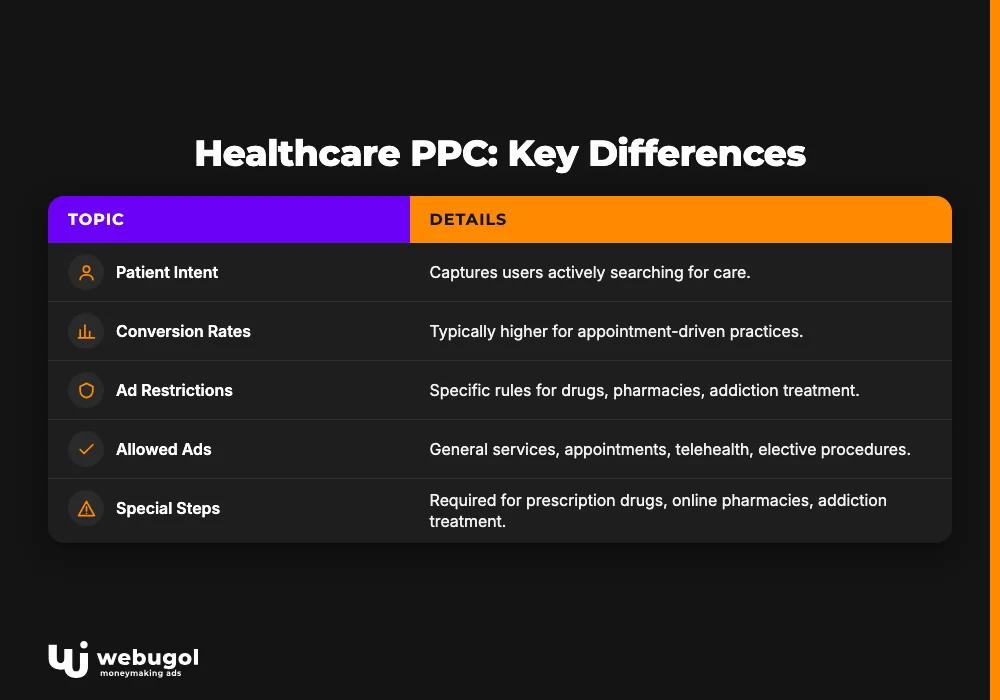
Patients searching "urgent care near me" or "cardiologist accepting new patients" have already decided they need care. That intent is rare. Most advertising interrupts people who weren't looking. Medical clinic paid search captures patients in the act of searching, which is why conversion rates typically outpace display or social advertising for appointment-driven practices.
PPC for healthcare providers puts your clinic at the top of results for high-intent queries, ahead of organic listings and map results. Every competitor visible there is a reason to be there too.
Healthcare paid search also operates under a different rule set than most industries. Google restricts prescription drug advertising to certified pharmaceutical manufacturers in approved markets and requires LegitScript certification for online pharmacies and addiction treatment services in certain countries. These restrictions do not apply to general clinical services, appointment booking, or specialist marketing.
Google Ads for doctors and medical practices can legitimately cover:
- General practitioner and specialist appointment booking
- Telehealth and virtual visit promotion
- Urgent care and walk-in clinic availability
- Elective procedures such as cosmetic dermatology or vision correction
- Dental, orthodontic, and specialty dental services
- Pediatric, obstetric, and family medicine practices
- Physical therapy, chiropractic, and allied health services
What requires extra steps or special certification:
- Prescription drug advertising to consumers
- Online pharmacy fulfillment services
- Addiction treatment services in certain markets (LegitScript certification required)
- Clinical trial recruitment for specific conditions
Knowing where these lines fall matters before building a campaign. A practice advertising general appointments and specialist referrals has no restrictions to navigate beyond standard ad copy compliance. A practice promoting a program that touches prescription medications needs to review each ad group against Google's Healthcare and Medicines advertising policy before launch.
Can doctors advertise on Google Ads?
Yes. Physicians, specialists, dental practices, vision centers, physical therapists, and most healthcare providers can run Google Ads campaigns for clinical services and appointment booking. No special certification is required for general medical practice advertising.
Google's restrictions target specific categories, not the healthcare sector broadly. Prescription drug promotion, unauthorized pharmacy services, and certain clinical products require additional certification or are prohibited outright. General outpatient clinical services and specialist care fall outside these restrictions entirely.
Before launch, review your planned keywords and ad copy for terms that trigger Google's clinical content review system. Words associated with prescription medications or restricted service categories can cause ad disapprovals even when the underlying practice is fully compliant. A brief copy audit before launch prevents delays on your go-live date.
How much do Google Ads cost for a medical practice?
Google Ads for medical practices uses a pay-per-click (PPC) model. You pay when someone clicks your ad, not when your ad appears. There is no minimum spend requirement. Google caps your daily charges at the budget you set, so you will never pay more than you planned.
Cost per click varies by specialty, location, and keyword competition. Healthcare keywords carry higher costs per click than many consumer categories because practices compete for patients with strong long-term value. A patient who books an annual physical often begins a multi-year relationship; advertisers in this space bid accordingly.
To manage spend effectively from launch:
- Set daily budget caps aligned with your monthly patient acquisition targets
- Use phrase match or exact match keyword types rather than broad match to reduce irrelevant clicks
- Build a negative keyword list before launch to exclude irrelevant searches such as job listings, research studies, and free clinic lookups
- Review search term reports every week and add non-converting queries to your negative list
- Configure conversion tracking before launch so you measure bookings, not just clicks
The PPC model is accountable in a way most other channels are not. Every click is logged, every booking can be traced to a keyword, and budgets adjust in real time.
What keywords should a medical practice use in Google Ads?
The strongest keywords for healthcare paid search fall into two categories: service-specific terms and geography-modified phrases.
Service-specific keywords describe what you do:
- "family doctor accepting new patients"
- "same-day urgent care appointment"
- "sports medicine specialist"
- "pediatrician for children with asthma"
Geography-modified keywords add location context:
- "cardiologist in [city name]"
- "walk-in clinic near me"
- "orthopedic surgeon [neighborhood]"
- "dermatologist [zip code] accepting insurance"
Long-tail phrases convert better than broad terms. "Allergy specialist for children in [city]" matches high-intent searches with lower advertiser competition, which reduces cost per click. Google's Keyword Planner tool shows estimated monthly search volumes and competition levels for any phrase before you spend a dollar.
Negative keywords matter as much as target keywords. Healthcare searches surface many irrelevant queries: "free clinic," "medical jobs," "nursing salary," "medical school," "research study." Build an initial negative list from obvious mismatches, then expand it from your search term report each week during the first 60 days.
Keyword match types for healthcare PPC management
Match type controls which searches trigger your ads. Broad match shows your ad for any query Google considers related, including searches you would never bid on directly. Phrase match requires your keyword phrase to appear in the search in order, allowing words before or after.
For medical practices new to paid search, phrase match is the practical starting point. A phrase match keyword for "urgent care [city]" shows your ad for "urgent care open Saturday [city]" but not for "urgent care nurse salary [city]." This balance provides coverage without budget waste. Add exact match for your highest-converting, most-searched terms after 30 to 45 days of campaign history, once you have enough data to identify them.

How do I set up Google Ads for a healthcare provider?
The initial campaign build takes roughly one hour. Getting campaigns profitable requires weeks of data and ongoing adjustments. Plan for both.
Define goals and configure conversion tracking
Before writing a single headline, configure conversion tracking. Decide what counts as a conversion: a phone call, a completed appointment form, a booking confirmation page. Google Ads can track all three with the right setup in place.
HIPAA compliance affects how tracking works for medical practices. Standard Google Tag Manager setups can accidentally pass protected health information (PHI) to Google's servers through form field data. Work with a Google Ads specialist who understands healthcare requirements to capture conversion events without transmitting diagnostic or personal health data. This step is frequently skipped and creates real compliance exposure. Configure it before launch, not after.
Structure campaigns by service line
Separate campaigns for each major service line give precise control over budget allocation and ad relevance. A family medicine practice might run campaigns for general wellness, pediatric care, chronic disease management, and telehealth. Each campaign contains ad groups organized around closely related keyword clusters.
This structure keeps Quality Scores high. Google scores each keyword on expected click-through rate, ad relevance, and landing page experience. Scores run from 1 to 10; higher scores reduce cost per click and improve ad placement. Ad groups that mix unrelated keywords, copy, and landing pages drag scores down and raise your effective cost.
Write ad copy that meets Google's healthcare advertising standards
Medical practice advertising on Google must not make unsubstantiated health claims or promise specific clinical outcomes. "Board-certified orthopedic surgeon accepting patients in [city]" is compliant. "Best knee surgery results guaranteed" is not.
Effective headlines for healthcare providers include specialty, location, and a practical detail: same-day availability, new patients accepted, specific insurance plans listed. Ad extensions extend your reach without additional cost. Call extensions display your phone number directly in the search result. Location extensions show your address. Sitelink extensions link to specific service pages.
Review copy against Google's restricted terms before uploading. Catching a policy issue in draft takes minutes; resolving a post-launch disapproval takes longer and delays patient acquisition. The right bidding strategy affects how often your ads appear. Start with manual cost-per-click bidding until you record 30 to 50 conversions, then consider Target CPA to let Google's system optimize placement.
Build dedicated landing pages for each ad group
Ads should never send patients to a homepage. Each ad group needs a page that matches the specific promise in that ad. An ad for "same-day appointments" should land on a page with that phrase above the fold, a visible booking form, and your specialty and location stated clearly.
Landing page quality directly affects Quality Score and whether visitors book. Per guidance in optimizing healthcare landing pages, page load speed on mobile affects both ad position and conversion rate. Test load time before launch. Include trust signals: credentials, accepted insurance plans, and patient reviews reduce the friction that pushes people away before they book.
Apply geotargeting and audience layers
Most practices serve a defined geographic radius. Set location targeting to your service area and exclude zones outside your boundaries. Adjust bids by location after you have enough conversion data. If patients from one part of your metro book at twice the average rate, bid higher there.
Audience layering adds behavioral context to location targeting without restricting who sees your ads. In-market segments for healthcare can direct more of your budget toward users Google has identified as actively researching medical providers.
Monitoring your Google Ads for medical practices campaigns
Weekly check-ins matter most in the first 60 days. Four metrics drive most optimization decisions.
Click-through rate (CTR) measures how often patients click after seeing your ad. Low CTR on a term with many impressions means the headline does not match what patients searched for. Rewrite the headline to mirror search intent more closely, or test a different ad format.
Conversion rate tracks how many clicks result in calls or bookings. High CTR with low conversion usually points to a landing page issue: too many form fields, missing insurance information, or slow load time on mobile.
Search terms report is the most actionable weekly task in any google ads for doctors campaign. It shows the exact queries that triggered your ads. Add irrelevant queries to your negative keyword list. This single practice reduces wasted spend faster than almost any other adjustment in healthcare paid search.
Cost per conversion connects campaign metrics to business outcomes. A cost per new patient booking that seems high in isolation may be entirely reasonable when measured against the revenue that patient relationship generates over time.
Google Ads produces results immediately. Organic visibility takes longer but keeps working when ad spend pauses. Building long-term search authority through SEO compounds over months while paid search handles near-term demand. For practices using social platforms as well, coordinating paid search with paid social campaigns gives patients multiple points of contact across their decision journey.
To see how paid search fits within a broader patient acquisition strategy, our healthcare growth system details how each channel connects for practices across specialties.

Ready to run Google Ads for your medical practice?
Google Ads for medical practices is one of the few channels where you reach patients the moment they search for your specialty. The technical setup is manageable. Configuring HIPAA-compliant conversion tracking, building a keyword structure that avoids wasted spend, and writing copy that passes Google's healthcare review all require specific expertise. Our team at Webugol works with medical providers to build and manage campaigns that comply with Google's advertising requirements and deliver measurable patient bookings. Contact us to review your current setup or start a new campaign.
FAQ
How much do Google Ads cost for a medical practice?
Google Ads uses a pay-per-click model with no minimum spend requirement. You set a daily budget and pay only when someone clicks your ad. Healthcare keywords tend to cost more per click than many consumer categories because practices compete for patients with high long-term value, but your total spend is always capped by your daily budget.
Can doctors advertise on Google Ads?
Yes. Physicians, specialists, dental practices, and most healthcare providers can advertise clinical services and appointment booking without special certification. Restrictions apply specifically to prescription drug advertising and online pharmacy services, not to general outpatient or specialist care.
What keywords should a medical practice use in Google Ads?
Service-specific and geography-modified phrases perform best, such as "pediatrician accepting new patients in [city]" or "same-day urgent care near me." Long-tail phrases convert at higher rates than broad terms because they match high-intent searches, and they typically cost less per click due to lower advertiser competition.
How do I set up Google Ads for a healthcare provider?
Create a Google Ads account, define your conversions (phone calls or form submissions), structure campaigns by service line, write compliant ad copy, build dedicated landing pages for each ad group, and apply geotargeting to your service area. Configure HIPAA-compliant conversion tracking before launching so you can measure which keywords produce actual bookings.
What is healthcare PPC management?
Healthcare PPC management covers the ongoing work of running paid search campaigns for medical practices: keyword selection, bid adjustments, ad copy testing, negative keyword expansion, HIPAA-compliant conversion tracking, and compliance review. Most practices see stronger results working with a specialist who understands both paid search mechanics and healthcare advertising requirements.