



Google Ads bidding strategy: how to choose the right one
A Google Ads bidding strategy determines how Google spends your budget at each auction. The right choice depends on your campaign goal, your account's conversion history, and whether your conversion tracking is configured correctly. Choose the wrong one and your budget drains without meaningful results. This guide covers every major option and the practical criteria for choosing between them.
What is smart bidding in Google Ads?
Smart bidding is Google's term for automated bid strategies that use machine learning to optimize for conversions or conversion value at the moment of each individual auction. Instead of applying a flat rule, smart bidding reads dozens of signals simultaneously, including device, location, time of day, and the specific search query, and calculates a unique bid for that impression.
Four strategies fall under smart bidding: Target CPA, Target ROAS, Maximize Conversions, and Maximize Conversion Value. All four require accurate conversion tracking. Without it, the algorithm optimizes toward whatever it can measure, which may have no connection to your actual business outcomes.
Smart bidding performs best on accounts with enough conversion history to train the model. New accounts with thin conversion data often experience an extended learning period and inconsistent early results.
How to choose a Google Ads bid strategy?
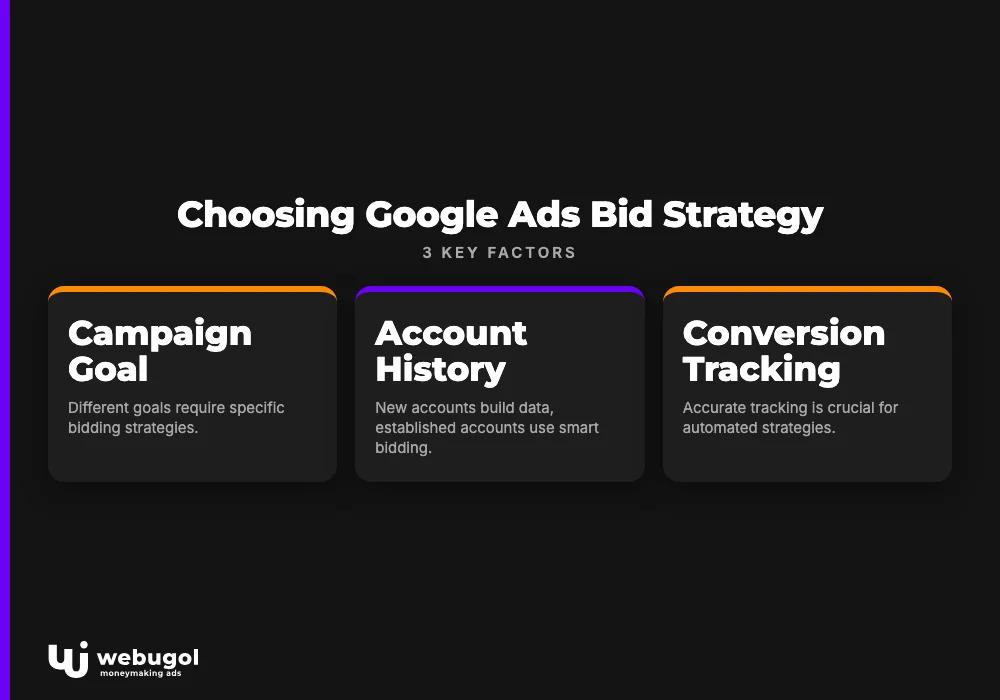
Most resources describe each bidding option in isolation. The decision logic connecting those options is where advertisers actually get stuck. Three factors determine which Google Ads bidding strategy fits your account right now.
Your campaign goal
- Website traffic only: Manual CPC or Maximize Clicks.
- Conversions at a controlled cost: Target CPA or Enhanced CPC.
- Maximum total conversion revenue: Target ROAS or Maximize Conversion Value.
- Brand visibility and awareness: Target Impression Share, CPM, or vCPM.
Your account history
- New account with no conversion data: start with Manual CPC or Maximize Conversions to build a data foundation.
- Established account with consistent conversions: smart bidding strategies become reliable and typically outperform manual control.
Conversion tracking quality
- Misconfigured conversion events cause any automated strategy to optimize in the wrong direction. Confirm tracking accuracy before switching to automation.
Building this three-part picture before touching campaign settings is what separates accounts that compound results from ones that cycle through strategies without progress. Aligning campaigns with broader business goals is the natural starting point, since different objectives point to different bidding approaches from the outset. The keyword layer that feeds your bidding decisions, covered in detail in this post on matching keywords to your campaign bids, shapes how your budget gets distributed once a strategy is active.
Manual CPC bidding: full control, slower iteration
Manual CPC bidding lets you set a maximum cost-per-click for each keyword or ad group. You decide exactly what each click is worth and can raise, lower, or pause individual bids based on what the data shows.
The trade-off is time. In an account with many campaigns and ad groups, maintaining manual CPC bidding across every keyword is a significant ongoing commitment. One practical detail: when configuring manual CPC, confirm that "Optimized CPC" is not enabled. If it is, Google adjusts your bids automatically regardless of your intent.
Manual CPC bidding fits best when:
- Your account is new and has no conversion history for automation to learn from.
- You already know your average CPC from prior campaigns and want to hold spend within a predictable range.
- Your daily budget is too small to give an automated strategy room to run through its learning period.
The core advantage of this approach is visibility. You can see exactly which keywords generate clicks, compare their costs, and redirect budget toward the ones that convert. That feedback loop is valuable in the early stages even if the plan is to move to automation once the account has data.
How does target CPA bidding work?
Target CPA bidding is a smart bidding strategy where you set the amount you are willing to pay for one conversion, and Google automatically adjusts your bids to hit that cost across your campaigns. CPA stands for cost per acquisition.
When target CPA Google Ads is active, Google raises bids in auctions where a conversion looks likely and pulls back where it does not. Over enough auctions, the average cost per conversion trends toward your target. Individual conversions will vary in cost, but the average stabilizes across the campaign.
Using this Google Ads bidding strategy effectively requires three things:
- Enough conversion history for Google to model likely outcomes in new auctions.
- A realistic CPA target based on historical data, not a figure set without reference to past performance.
- Accurate conversion tracking, because the algorithm optimizes toward whatever conversion events you have configured.
Setting a target CPA on a new account without sufficient data typically stalls performance. The recommended path is to start with Maximize Conversions, build a conversion history, and then transition to Target CPA once the account has a reliable baseline to work from.
Target ROAS bidding: when revenue per conversion varies
Target ROAS bidding tells Google to adjust bids so that your total conversion value reaches a set multiple of what you spend. In Google Ads, ROAS is expressed as a percentage: a 400% target means four dollars in conversion value for every dollar in ad spend.
Target ROAS bidding suits accounts where different conversions carry different values, such as an e-commerce store with products across a wide price range. The strategy allocates more budget toward high-value transactions and less toward lower-value ones.
Like Target CPA, this strategy requires a mature account with properly assigned conversion values. The practical approach is to check your current average ROAS, set an initial target close to that figure, and raise it gradually once the campaign shows it can hit the goal consistently. Starting with a target well above historical ROAS will restrict auction participation and reduce conversion volume.
Maximize conversions bidding: volume first, efficiency later
Maximize conversions bidding is a fully automated strategy that uses your daily budget to generate as many conversions as possible, without a cost-per-conversion cap. It may spend your full budget even when individual conversions are expensive.
Two situations favor this approach: launching a new campaign where you need conversion data to enable smarter strategies later, or running a campaign where volume matters more than cost efficiency. After a few days of delivery, the actual cost per conversion gives you the baseline needed to set a realistic Target CPA target if you want to introduce tighter control.

Maximize conversion value: optimizing for total revenue
Maximize Conversion Value works similarly to maximize conversions bidding but optimizes for the highest combined conversion value within your daily budget, rather than the highest number of individual conversions.
This strategy applies to accounts that track conversions with distinct assigned values and where total revenue matters more than transaction count. An account selling offerings across a range of price points benefits from letting the algorithm prioritize higher-value conversions rather than treating every conversion as equivalent.
Enhanced CPC: a bridge for accounts in transition
Enhanced CPC (eCPC) starts from your manually set bids and lets Google's algorithm adjust them upward or downward based on predicted conversion probability. You keep your base bids; the system applies limited automated adjustments on top.
eCPC suits accounts that are not yet ready for full smart bidding but want some algorithmic input. It requires conversion tracking but functions with less historical data than Target CPA or Target ROAS. For accounts on the edge of qualifying for full smart bidding, eCPC is a practical intermediate step.
Google Ads bidding strategy for awareness: CPM, vCPM, and impression share
When visibility is the goal rather than immediate conversions, three options apply.
CPM bidding Google Ads is available on the Display Network and YouTube. You set a fixed price per 1,000 impressions, and Google delivers your ads within that cost structure. Because CPM bidding is not tied to clicks or conversions, it is purpose-built for campaigns focused on brand reach.
vCPM bidding (viewable CPM) operates the same way but counts an impression only when the ad is actually visible on screen. Per Google Ads policy, a display ad must remain on screen for at least one second to count as a viewable impression. For YouTube ads, the threshold is two seconds. vCPM gives you a more accurate measure of real exposure than standard CPM.
Target Impression Share is a smart bidding strategy for Search campaigns that automatically adjusts bids to show your ads at a target rate across search results. It works well for branded terms where maintaining consistent presence above competitors is the priority. Budget and quality score still affect actual impression share, and impressions alone do not produce conversions.
CPV bidding: paying for video engagement
CPV (cost per view) bidding applies exclusively to video campaigns. You pay when a viewer watches at least 30 seconds of your ad, or interacts with it by clicking a call to action, an overlay, a banner, or a card. If your video is shorter than 30 seconds, a view is counted when the ad plays to completion.
You set a maximum bid per view or interaction. For first-time CPV campaigns, starting with a conservative bid and adjusting based on delivery results is the standard approach. If the ad is not appearing at expected frequency, raising the bid is the first adjustment to make. Quality score and ad position affect actual cost per view, so improving ad relevance can reduce costs over time without requiring a higher bid.

What is the best Google Ads bidding strategy for small budgets?
For small budgets, Manual CPC or Maximize Clicks gives you the most predictable cost control. Both options cap spending directly, so Google cannot exceed your set limits while chasing conversions. Smart bidding strategies like Target CPA need enough conversions to learn from; on a small budget they may never exit the learning period and will underdeliver.
Once the account has logged steady conversion data and you understand your average cost per result, shifting to Maximize Conversions with a clear daily budget limit is a practical next step. That transition makes sense after several weeks of consistent conversion volume, regardless of how long the account has been active.
When should I use manual vs automatic bidding in Google Ads?
Use manual bidding when your account is new, your daily budget is small, or your conversion tracking has not been validated. Manual CPC bidding gives you direct control and clear visibility during the period when you are still building the data foundation your campaigns need.
Switch to automatic bidding once your account has a reliable conversion history and your tracking accuracy is confirmed. At that point, smart bidding Google Ads strategies can process far more auction signals simultaneously than any manual process. For a structured method to identify when you have hit that threshold and what to do next, see this guide on improving campaign performance over time.
Ready to get your bidding strategy right?
The Google Ads bidding strategy you choose shapes every dollar your campaigns spend. The team at Webugol works with advertisers to audit existing setups, fix conversion tracking, and align bidding with real business goals. Reach out through our Google Ads management services to find out where your campaigns have room to improve.
FAQ
What is manual CPC bidding in Google Ads?
Manual CPC bidding lets you set a maximum cost-per-click for each keyword or ad group, giving you direct control over how much each click costs. It works best for new accounts or advertisers with limited budgets who need predictable spend. Google will not exceed the maximum you set, though actual costs are typically lower.
Can I switch bid strategies mid-campaign?
You can change your bid strategy at any time inside campaign settings. Switching to a smart bidding strategy resets the learning period, during which performance may fluctuate. Give any new strategy at least two to four weeks before drawing conclusions about results.
What is the difference between Target CPA and Target ROAS?
Target CPA optimizes for a set cost per conversion and works best when all conversions have roughly equal value to your business. Target ROAS optimizes for total revenue relative to spend and is better suited to accounts where different conversions have different values, such as products at varying price points.
How many conversions do I need before switching to smart bidding?
Google recommends at least 30 to 50 conversions per month as a baseline before switching to Target CPA, with Target ROAS typically requiring more data than that. Starting with Maximize Conversions builds the conversion history that smarter strategies need to function reliably.
What is CPM bidding used for in Google Ads?
CPM bidding is used for Display Network and YouTube campaigns focused on brand reach rather than direct conversions. You pay per 1,000 impressions, regardless of clicks or conversions. It is the right choice when visibility across a broad audience is the primary campaign goal.