



SEO writing checklist: how to write articles that rank
An SEO writing checklist is a step-by-step process covering keyword research, content structure, on-page elements, and a final publish review. Following it consistently is what separates SEO-friendly content that earns organic rankings from blog posts that get little search traffic. This guide covers each checkpoint and explains what it does for your search visibility.
What should be included in an SEO writing checklist?
A complete SEO writing checklist has six core areas. The table below maps each area to the specific tasks that need to be done before an article goes live.
| Checklist area | Key tasks |
|---|---|
| Keyword research | Identify a primary keyword and supporting terms using Google Keyword Planner or SEMrush |
| Content structure | Write an H1 with the primary keyword; plan H2/H3 headings logically before drafting |
| On-page elements | Optimize the title tag (60 chars max), meta description (145 chars max), URL slug, and image alt text |
| Internal linking | Add 2 to 3 links to relevant pages on your site with descriptive anchor text |
| Readability | Keep paragraphs to 2 to 4 sentences; vary sentence length; cut filler |
| Post-publish | Submit the URL to Google Search Console; confirm indexing within 48 hours |
Running through this on-page SEO checklist before publishing reduces the chance of missing an element that quietly costs you rankings. Each area builds on the previous one: solid keyword research informs the content structure, the structure shapes the on-page elements, and the readability review catches anything that slipped through.
How do you write an SEO-friendly article?
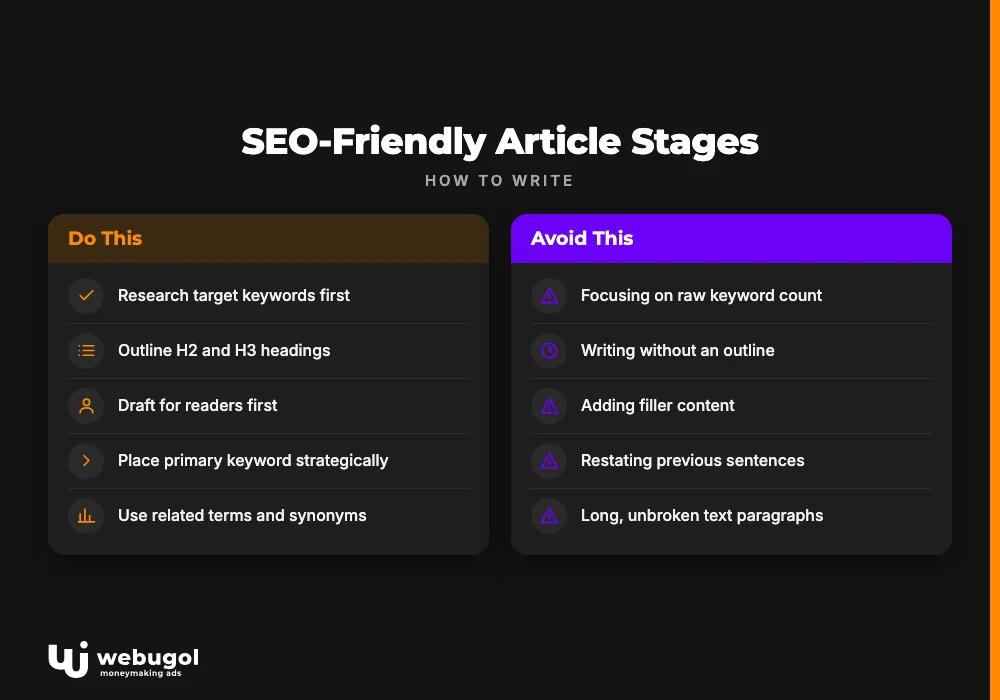
Writing an SEO-friendly article means producing content that satisfies what readers are searching for while giving search engines enough structured signal to rank it correctly. The process has four stages: research, outlining, drafting, and publishing.
Research your target keywords first
Use a keyword research tool such as Google Keyword Planner or SEMrush to find your primary keyword and a cluster of related phrases. Raw keyword count is not the goal. Search engines reward semantic richness: content that uses related terms, synonyms, and contextual phrases alongside the primary keyword signals that you have genuinely covered the topic.
Place the primary keyword in the title tag, H1, opening paragraph, one to two subheadings, and naturally throughout the body. An SEO audit of your existing content is a practical starting point because it reveals which topics your site already ranks for and where the real gaps are.
Outline before you write
A short outline maps your H2 and H3 headings before you write a single sentence of body copy. This prevents filler and ensures every section earns its place. Note where internal links, images, and lists belong before you start drafting. Breaking long text into paragraphs of two to four sentences helps both readers and crawlers process the article faster.
Draft for readers first
Article writing for SEO should produce content people genuinely want to read. Write for the audience. Use plain language, vary your sentence length, and make every sentence add information. Cut any sentence that only restates what the previous one said.
Add external links to credible sources when citing strong claims. Internal links help distribute page authority across your site and keep readers moving through related content.
Publish with all on-page elements in place
Before publishing, check each item on this list:
- Title tag contains the primary keyword within the first 60 characters.
- Meta description leads with the primary keyword and stays within 145 characters.
- URL slug is short and includes the primary keyword.
- At least one image has a descriptive alt tag that includes the primary keyword.
- H1 matches or closely mirrors the title tag.
- Two to three internal links use unique, descriptive anchor text.
- At least one external link points to a credible primary source.
- The draft has been reviewed for grammar and readability.
These SEO content tips cover the on-page elements with the most direct effect on how search engines interpret and rank a page.
How many keywords should an SEO article contain?
Keyword count matters less than distribution and natural use. For a 1,000 to 1,500-word article, the primary keyword should appear roughly five to eight times, placing it at about 1.0 to 2.0% of total word count. Supporting keywords each need two to four appearances. If inserting a phrase makes a sentence read awkwardly, rework the sentence rather than forcing the phrase in.
Search intent matters more than keyword count. When someone types a question into a search engine, they want a direct answer. An article that repeats a phrase many times but never addresses the question will not outrank a well-structured piece that answers it in the opening paragraph.
Does blog post length affect search rankings?
Blog post length is not a ranking signal on its own. Length correlates with rankings because a more complete article naturally becomes longer, not because search engines reward word count. If you can fully cover a topic in 800 words, write 800 words. Padding an article to hit an arbitrary target adds filler that hurts the reader experience and signals low-quality content.
A practical content optimization guide: match length to what the topic requires. Broad topics like a complete on-page SEO checklist typically need 1,200 to 2,000 words. Narrow, specific questions can often be answered in 600 to 900 words.
What makes content rank on Google?
Google's ranking systems reward content that matches the search query, covers the topic thoroughly, and gives readers a reason to stay on the page. Three signals matter most: relevance (does the content match the query?), quality (is the information accurate and well-sourced?), and user behavior (do readers engage or leave quickly?).
Relevance comes from keyword research and matching search intent. Quality comes from accurate information and citing every strong claim with a named source. User behavior improves when the page loads quickly, the text is easy to scan, and the content delivers on what the headline promised.
A slow-loading page drives readers away before they read a single word. Running a page speed audit is a fast way to catch technical issues that affect both user experience and search visibility.
Publishing consistently also keeps your site active in Google's index. Most sites benefit from publishing at least two articles per month. If your content plan includes organic and paid channels, understanding how search ads and SEO work together helps you allocate budget and effort more efficiently.
Get help with your SEO content
Working through an SEO writing checklist on every article takes consistent time and specialized knowledge. Webugol's content team manages the full process: keyword research, semantic clustering, drafting, on-page optimization, and publish review. Clients from across the world have reported real increases in web traffic after working with the team. Visit Webugol.com to see what we do, or contact us to discuss a content plan for your site.
FAQ
What is an SEO writing checklist?
An SEO writing checklist is a list of tasks completed before and after publishing an article, covering keyword placement, title and meta description optimization, internal linking, image alt text, and readability. Working through it on every post reduces the chance of missing an element that affects rankings.
Does keyword density still matter for SEO?
Keyword density remains a useful guide: aim for 1.0 to 2.0% for a primary keyword in a typical blog post. Higher density does not improve rankings and can signal keyword stuffing. The priority is natural placement across the title, headings, opening paragraph, and body.
How often should I publish new articles for SEO?
Most sites benefit from publishing at least two articles per month. Consistent publishing keeps your site active in Google's crawl queue and steadily expands your keyword coverage. Irregular bursts of content followed by long gaps are less effective than a steady schedule.
Do internal links help SEO?
Internal links help search engines discover and index your pages, distribute authority across them, and guide readers to related content. Each article should include at least two to three internal links with descriptive anchor text that matches the topic of the linked page.
What is the difference between on-page SEO and content SEO?
On-page SEO covers technical elements on a single page: title tag, meta description, URL slug, headings, and image alt text. Content SEO refers to the words and structure of the article itself: topic coverage, keyword use, readability, and answer quality. A complete blog post SEO guide addresses both together.