



Google Ads best practices to improve campaign performance in 2026
Applying consistent google ads best practices is the most reliable path to lower wasted spend, higher click-through rates, and better return on ad spend without inflating your budget. The core areas are responsive search ads, smart bidding strategies, keyword selection, audience targeting, and regular campaign reviews. Each area reinforces the others, which is why isolated tactics rarely produce the gains that a coordinated approach across all of them does.
What are the best practices for Google Ads in 2026?
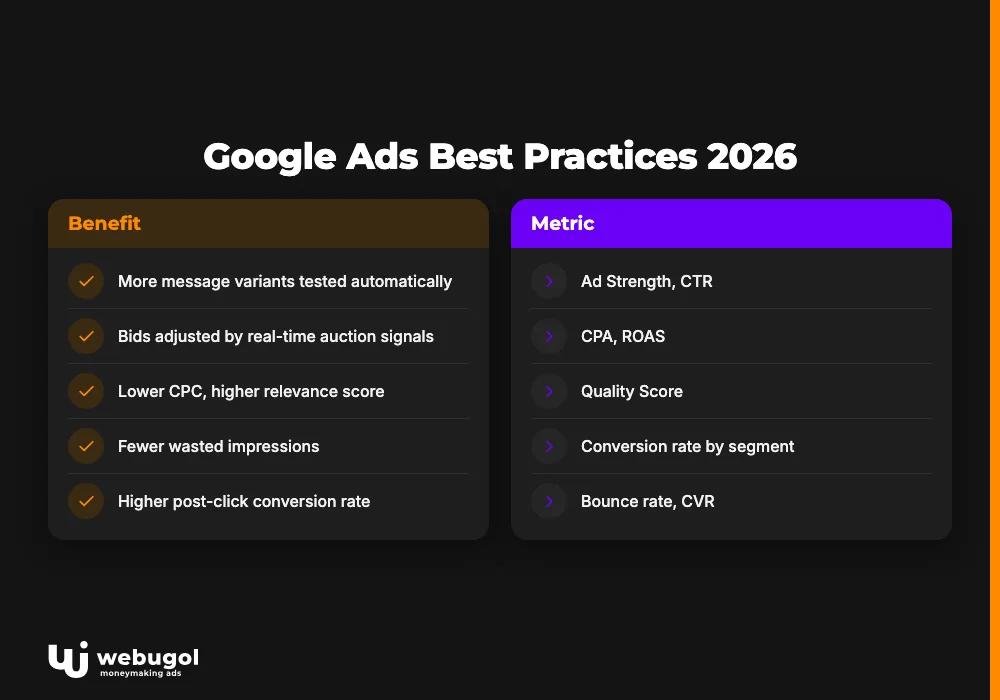
Google ads best practices in 2026 center on automation, audience signals, and continuous testing. Here is a structured overview of the key areas and what each one affects:
| Practice | Primary benefit | Metric to track |
|---|---|---|
| Responsive search ads | More message variants tested automatically | Ad Strength, CTR |
| Smart bidding strategies | Bids adjusted by real-time auction signals | CPA, ROAS |
| High-quality keywords | Lower CPC, higher relevance score | Quality Score |
| Google ads audience targeting | Fewer wasted impressions | Conversion rate by segment |
| Remarketing google ads | Re-engage users already familiar with your brand | Return visit rate |
| Ad assets | More ad space on the search results page | CTR lift |
| Landing page alignment | Higher post-click conversion rate | Bounce rate, CVR |
This hierarchy reflects how most google ads campaign management professionals structure an account audit: start with what you control inside the ad system, then layer in audience signals, then optimize the experience after the click.
What is a responsive search ad and how does it work?
A responsive search ad (RSA) lets you upload up to 15 headlines and 4 descriptions, and Google's machine learning tests combinations across real auctions to find which pairings drive the best results for each search query.
Instead of committing to a single static ad, you give the algorithm a pool of messaging options. For each auction, it selects the headline and description combination most likely to earn a click, based on the user's search term, device, time of day, and behavioral context. According to Google, RSAs can increase click-through rates by up to 15% compared to standard expanded text ads.
Responsive search ads tips to improve Ad Strength
Pin a headline only when the message must appear in a fixed position, such as a brand name or a legally required disclaimer. For all other headlines, leave them unpinned so Google has full flexibility to identify the best-performing combinations. Write at least one headline that uses the primary keyword and craft the remaining ones around distinct value propositions: price, speed, social proof, and urgency each deserve their own headline.
Check Ad Strength regularly. Google rates each RSA as Poor, Good, or Excellent based on headline diversity, keyword inclusion, and character utilization. An Excellent rating does not guarantee better performance on its own, but it confirms you have given the algorithm enough material to work with.
How does smart bidding work in Google Ads?
Smart bidding is a subset of Google's automated bid strategies that uses machine learning to set bids at the individual impression level. Rather than applying a fixed manual bid to an entire keyword, the system evaluates real-time signals for every auction and adjusts accordingly.
The main smart bidding strategies available are:
- Maximize Conversions spends your full budget to generate as many conversions as possible without targeting a specific cost per conversion.
- Maximize Conversion Value prioritizes higher-revenue conversions when you have assigned different monetary values to different actions.
- Target CPA keeps your average cost per conversion at or below a target you specify.
- Target ROAS adjusts bids to hit a return-on-ad-spend target you define.
The system draws on signals that manual bidding cannot access: browser type, operating system, device, time of day, location, audience list membership, and the semantic meaning of the search query. This is why smart bidding strategies outperform manual CPC once an account has accumulated sufficient conversion data.
Maximize Clicks is a separate automated option that optimizes for traffic volume, not conversions. Use it only during a new campaign launch when conversion history is too thin for conversion-based strategies. Once you have sufficient data, switching to a conversion-focused smart bidding strategy consistently helps improve google ads performance at the campaign level.
Focus on keywords that match buyer intent
Keyword quality affects every downstream metric: Quality Score, Ad Rank, cost per click, and conversion rate. Long-tail, specific keywords attract users who are closer to a purchase decision and typically cost less per click than broad head terms.
Start research with Google Ads Keyword Planner, which provides search volume, competition level, and bid range estimates. Supplement with tools like SEMrush or Ahrefs to surface gaps competitors are bidding on. For a detailed walkthrough of the research process, the guide on building a targeted keyword list for paid search campaigns covers each step from initial brainstorming to match type selection.
Negative keywords deserve as much attention as positive ones. Review the Search Terms report weekly to find queries triggering your ads that do not match your target intent, and add them as negatives. This is one of the most consistent google ads optimization tips because it directly protects budget from irrelevant clicks without requiring any bid changes.
Match type selection shapes how the algorithm finds traffic. Broad match paired with smart bidding gives the algorithm maximum query coverage to discover new converting terms. Phrase and exact match provide tighter control and suit campaigns where audience intent is already well understood.

How do I optimize a Google Ads campaign?
The most direct answer: review three core metrics first, click-through rate, conversion rate, and cost per conversion. Each one points to a different problem. A low CTR usually signals an ad copy or audience mismatch. A low conversion rate often points to a landing page problem. Rising cost per conversion suggests bidding inefficiency or increased competition.
Campaign optimization in practice is an ongoing process built around a consistent review schedule:
- Weekly: review the Search Terms report, add negative keywords, and check budget pacing against monthly targets.
- Bi-weekly: analyze performance by device, time of day, and location; adjust bid modifiers or audience bid adjustments where the data is clear.
- Monthly: evaluate keyword performance, pause underperforming keywords, test new ad copy variants, and compare conversion totals against campaign targets.
A/B testing is central to reliable google ads campaign management. Test one variable at a time: one headline versus another, one CTA versus another, or one landing page layout versus another. Running multiple variables simultaneously makes it impossible to attribute the result to any single change. Allow each test to accumulate enough clicks for statistical significance before drawing conclusions.
For a structured, repeatable approach to diagnosing underperforming campaigns, the step-by-step account review process covers the full workflow from identifying what broke to implementing fixes systematically. "False clicks" from irrelevant queries inflate cost while depressing the true conversion rate. Consistent Search Terms reviews and tight match types are the primary defense.
What targeting options are available in Google Ads?
Google ads audience targeting gives advertisers several ways to define who sees an ad beyond the keywords they search.
The main targeting options in Google Ads are:
- In-market audiences reach users Google has identified as actively researching a specific product or service category based on recent search and browsing behavior.
- Affinity audiences target users with demonstrated long-term interest in a topic.
- Custom segments let you build audiences by entering competitor URLs, app categories, or keyword themes that describe your ideal customer.
- Customer match lets you upload a first-party customer list to target or exclude existing customers.
- Similar segments target users whose online behavior resembles your existing customer or remarketing lists.
- Demographic targeting lets you filter by age, gender, parental status, and household income bracket.
The most productive use is layering. Apply a new audience in Observation mode first so the algorithm can gather performance data without restricting ad delivery. Once a clear conversion lift is visible in that segment, switch to Targeting mode to focus spend on it.
Remarketing google ads: re-engage users with existing brand context
Remarketing displays ads specifically to users who have already visited your website or interacted with your app. Because these users carry prior brand context, their conversion rates are typically higher than cold traffic.
Segment remarketing lists by behavior rather than by a broad "visited site" rule. A user who viewed a product page without purchasing is a different prospect than one who reached checkout and abandoned. Tailoring the creative to match where the user dropped off in the funnel increases relevance and conversion likelihood. Pairing remarketing google ads with layered audience targeting produces precise segments that reflect the actual purchase journey rather than broad behavioral buckets.
For businesses also running email campaigns, the insights in how paid and email channels complement each other for conversion are relevant here: audience signals from email behavior can sharpen the definition of your remarketing lists.

Use ad assets to earn more space in search results
Ad assets (formerly called extensions) attach additional information to your ads and increase the physical space they occupy in search results. More space means more visibility, and ads with assets consistently achieve higher CTRs than ads without them.
The core assets to activate on every campaign are:
- Sitelink assets direct users to specific pages on your site, such as a contact form, a product category, or a pricing page.
- Callout assets highlight short benefit phrases of up to 25 characters. Google recommends no more than three callouts per ad to avoid visual clutter.
- Structured snippet assets list specific features or products in your offering. Use the right category header and avoid generic phrases like "great quality" that do not differentiate you from other advertisers.
- Call assets add a phone number so users can contact you directly from the search result.
Write asset text around your actual differentiators. Specificity outperforms generic language in every asset type, and assets that closely match what the user searched for contribute positively to Quality Score. Using ad assets well is one of the google ads best practices that requires the least ongoing management time relative to the CTR impact it delivers.
Align landing pages with your ads
Every click your campaign pays for is an implicit question: does this page deliver what the ad promised? When the landing page and the ad tell different stories, bounce rates rise and conversions fall.
A well-aligned landing page mirrors the headline and offer from the ad that sent the visitor there. If the ad promotes a free consultation, the page should lead with that offer above the fold. Remove navigation elements that pull attention away from conversion, keep copy concise and intent-matched, and make the call-to-action impossible to miss. For businesses choosing between a homepage, a dedicated landing page, and a targeted product page, understanding the differences between each page type helps determine which format fits each campaign goal.
Run A/B tests on high-traffic pages regularly. Headline, CTA button text, form length, and hero image are the highest-impact variables. Use Google Ads' landing page experience data alongside your analytics platform to find which pages underperform and trace the cause.
Start putting these google ads best practices to work
Running campaigns without a structured approach turns ad budget into an experiment with no clear feedback loop. The google ads best practices in this guide, covering RSA setup, smart bidding, keyword discipline, audience targeting, regular optimization cycles, and landing page alignment, are most effective when treated as a system rather than a checklist.
The team at Webugol works with businesses to audit existing accounts, identify the highest-impact changes, and implement them with measurable targets in place. If your campaigns are underperforming or you want an outside read on where spend is being lost, the Google Ads management service is the right starting point. Reach out to discuss what your campaigns need.
FAQ
What are the best practices for Google Ads in 2026?
The core google ads best practices are using responsive search ads with diverse headlines, applying smart bidding strategies once sufficient conversion data is in place, layering audience targeting on keyword campaigns, and running weekly Search Terms reviews to remove irrelevant traffic. These practices compound when applied together rather than in isolation.
How does smart bidding work in Google Ads?
Smart bidding uses machine learning to set bids at the individual auction level using real-time signals: device, location, time of day, audience list membership, and query semantics. It replaces manual per-keyword bids and optimizes toward the goal you choose, such as Target CPA or Maximize Conversions. Smart bidding strategies perform best when the account has accumulated meaningful conversion history for the algorithm to learn from.
What is a responsive search ad and how does it work?
A responsive search ad lets you upload up to 15 headlines and 4 descriptions, and Google's algorithm selects the best combination for each specific search query in real time. The system learns which pairings drive clicks and shows them more frequently over time. According to Google, RSAs can increase CTR by up to 15% compared to static expanded text ads.
What targeting options are available in Google Ads?
Google Ads audience targeting includes in-market audiences, affinity audiences, custom segments, customer match lists, similar segments, and demographic filters such as age, gender, and household income. Start new audiences in Observation mode to collect performance data without restricting delivery, then switch to Targeting mode once a high-converting segment is confirmed.
How do I reduce wasted spend in Google Ads?
Review the Search Terms report weekly and add non-converting queries as negative keywords. Use tighter match types for campaigns where audience intent is already well understood, and track Search Impression Share to distinguish whether low results stem from budget limits or Quality Score problems.