



Social Media Advertising: A Practical Guide to Paid Social Campaigns
Social media advertising is a paid marketing method that puts targeted messages in front of specific audiences on platforms like Facebook, Instagram, and Snapchat. Unlike organic posts, paid social campaigns reach users based on their demographics, interests, and behaviors, bypassing the algorithm entirely. Done right, social media advertising drives measurable results across brand awareness, website traffic, and direct conversions. This guide walks through every stage of building paid social campaigns that perform.
What makes a social media ad effective?
An effective social media ad connects a clear goal with the right audience and creative that earns attention. When all three elements work together, the ad moves people toward a specific action. When one is off, the others cannot compensate.
Set goals before building creative
Every campaign starts with a stated objective. Before writing copy or selecting images, decide what success looks like: website visits, lead form submissions, product purchases, or video views. The goal shapes which campaign type to run, which ad format to use, and which metrics to track.
Ad tracking links set up before launch capture performance data while the campaign runs. That data lets you adjust elements mid-campaign rather than waiting until after it ends.
Match the message to the buyer's journey
A first-time visitor and someone who browsed your product page last week need different messages. Awareness-stage ads introduce the brand and communicate value broadly. Consideration-stage ads highlight specific benefits or social proof. Conversion-stage ads are direct: they tell a warm audience what to do next.
Mapping each ad to a stage makes every creative decision more focused. This alignment is what turns it from a broadcast activity into a targeted, efficient system.
Which platform is best for social media advertising?
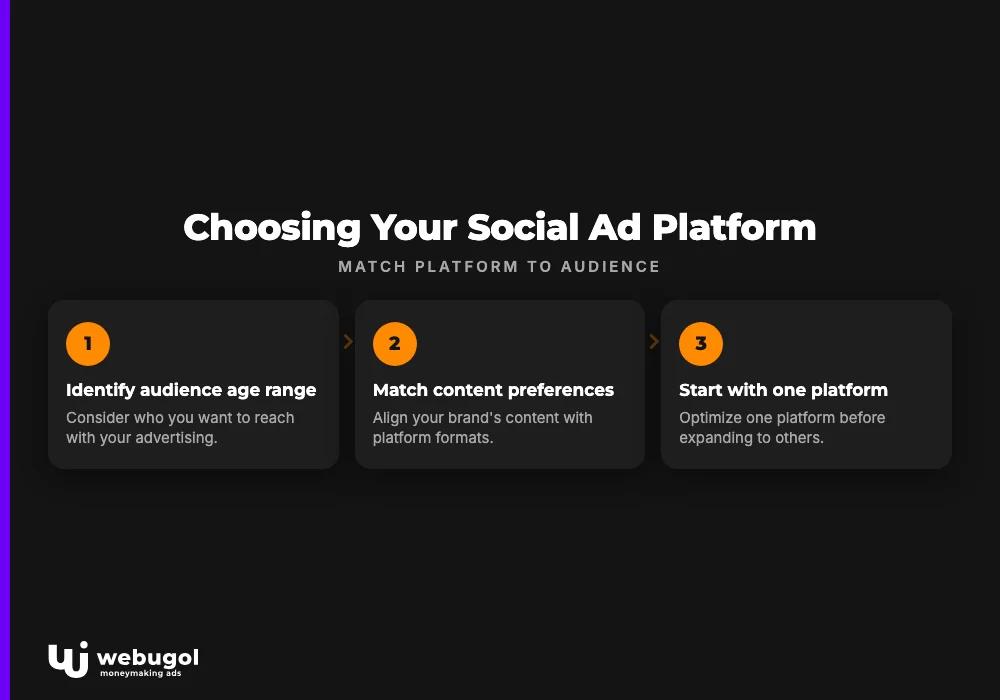
The right platform for social media advertising depends on your audience's age, the content formats your brand produces well, and where your target customers already spend time.
Here is a quick comparison of three commonly used platforms:
| Platform | Audience skew | Key ad formats | Works best for |
|---|---|---|---|
| Broader, skews older | Image, video, carousel, lead gen | Reach, retargeting, lead generation | |
| Younger, visually engaged | Photo, video, Stories, Reels, Shopping | Brand identity, e-commerce | |
| Snapchat | Younger users | Snap Ads, Story Ads, AR Lenses | Youth-focused brands, short video |
Facebook works well for reaching older demographics, given its scale and wide range of ad formats. Instagram and Snapchat attract younger audiences who engage more with visual content, which changes how creative needs to be designed and how short copy needs to be.
The practical decision: identify your audience's age range and content preferences, then match them to the right platform. A business selling athletic wear to young people interested in sports gets more traction on Instagram than on Facebook. Start with one platform, optimize it, then expand. Splitting a limited budget across three platforms at launch means none of them generate enough data to make informed decisions.
Audience targeting ads: reaching the right people
Social platforms collect detailed behavioral data from their users: pages they follow, posts they engage with, products they browse, and purchases they complete. Social media advertising uses this data through targeting options that go well beyond age and location.
Start with the basics: age, gender, location, and interest categories. These filters form the foundation of any campaign. A business selling eco-friendly products can add interest targeting to reach users who have demonstrated an interest in sustainability rather than just everyone in a broad age bracket.
Retargeting is where audience targeting ads often deliver the highest returns. These campaigns re-engage users who already know your brand: people who visited your website, watched a previous video ad, or engaged with a prior post. A well-timed retargeting ad moves them from consideration to action without needing to re-introduce the brand.
For businesses in specialized industries, the targeting logic does not change but the audience definition gets more precise. See how audience-specific paid social campaigns work in the healthcare sector for a practical example of applying these principles in a regulated field.
How do you write copy for social media ads?
Effective social ad copy is short, specific, and focused on what the reader gains. The most common mistake in social media advertising is writing about the brand instead of addressing the audience's problem directly.
Lead with value, not the brand name
Feeds move fast. The first line of copy has to stop the scroll. Lead with the outcome your audience wants or a problem they recognize. Generic openers lose readers before they reach the offer.
Keep the message tight and direct
Mobile feeds leave little room for long paragraphs. Write the main message in one or two sentences, then follow with a specific call to action. An ad that tries to communicate multiple ideas dilutes all of them.
A practical checklist for social ad copy:
- Use one clear idea per ad rather than competing messages that confuse the reader.
- Write in active voice so the copy feels direct and intentional.
- Choose a specific CTA rather than a vague prompt like "Learn more."
- Make the copy and the visual reinforce the same message so both elements point in the same direction.
- Avoid jargon the target audience would not immediately recognize.
Test copy variations systematically
Write two to three versions of the headline and body copy, then run them simultaneously. Test one variable at a time: headline in one round, CTA in the next. Systematic testing is central to any meta ads strategy: run variants, read the data, optimize, repeat. Reliable findings about what your audience responds to come from structured testing, not generic best practices.

Facebook ad creative: visuals and video that earn attention
Strong facebook ad creative does two things at once: it matches your brand's visual identity and it breaks the default scroll behavior of a busy feed. These goals can conflict, which is why creative testing matters more than intuition.
Build separate creative for each placement
Every platform has different display requirements. An image that looks clean on desktop can appear cropped or blurry in a mobile Story. Build separate creative assets for feed, Stories, and Reels, since each placement has a different aspect ratio, text placement area, and viewer context.
Images that include people tend to outperform product-only shots because faces draw attention more quickly. High-contrast compositions and bright colors help ads stand out in a crowded feed where everything competes for the same attention.
Video paired with matching audio
Video carries a narrative that a static image cannot. When choosing music or sound for a video ad, match the energy and tone to the message. A high-energy product needs different audio than a trust-building service ad. Mismatched audio and visuals reduce engagement because the dissonance registers even without viewers consciously noticing it.
Build every video so it makes sense without sound first. Many users watch social video on mute. Add subtitles or on-screen text so the core message lands even during silent autoplay.
Match the call to action to the campaign stage
The call to action closes the loop between the ad and the next step the audience should take. Awareness campaigns use softer prompts. Conversion campaigns use direct language: "Buy now" or "Get a quote." A CTA that does not match the campaign stage creates friction rather than removing it.
Optimize for mobile before launch
Most users access social platforms on their phones. Mobile optimization is a baseline requirement for any social media advertising campaign, not an optional refinement.
Keep copy short. Mobile screens give you less space, and mobile users have shorter attention windows than desktop users. Write the essential message, then cut further.
Use responsive ad formats. Ads built with responsive design or HTML5 banners automatically adjust to the viewer's device, whether a smartphone, tablet, or desktop. This eliminates the most common mobile display errors without requiring separate creative for every device size.
Optimize the landing page too. An ad optimized for mobile should send users to a page that continues the same conversation. A landing page that loads slowly, requires pinch-zooming, or buries the key action below the fold loses conversions that the campaign worked to earn.

How do you measure social media advertising performance?
Tracking ad performance metrics is how you separate campaigns that produce results from campaigns that only look impressive in a dashboard. Set up conversion tracking before any campaign goes live.
Core ad performance metrics
Conversion tracking records how many users click an ad and complete a target action: a purchase, a form submission, or a newsletter signup. This is the most direct measure of whether the campaign is meeting its objective.
Additional ad performance metrics to monitor during any campaign:
- Click-through rate (CTR): the percentage of impressions that resulted in a click. A low CTR typically signals a creative or targeting problem.
- Cost per click (CPC): what you pay for each click. It is useful for comparing ad sets within the same campaign.
- Cost per conversion: the total cost to produce one desired action. This number determines whether the campaign is profitable.
- Video completion rate: for video ads, the percentage who watch to the end. A low rate usually indicates a problem in the first few seconds.
- Frequency: how many times the same user has seen your ad. High frequency paired with low conversions signals audience fatigue; rotate creative before adding more budget.
Turn data into ad campaign optimization decisions
Platform dashboards like Facebook Ads Manager break down performance by audience segment, ad placement, and creative. Use this data to identify which combinations drive results, then shift budget toward those combinations and away from underperformers.
Testing different creative formats and targeting options is how marketers build campaigns that improve over time rather than plateauing. Review performance data on a weekly cycle. Decisions made with two weeks of data are more reliable than decisions made after three days.
How much should a business spend on social media ads?
No single budget figure applies to every business or every objective. What matters more than the number itself is how you allocate your budget and what you learn from the data it generates.
Start small and scale what works. Run a limited test across two or three ad sets, identify which combination of audience, creative, and copy produces the lowest cost per conversion, then increase spend on that combination specifically. Scaling an unoptimized campaign burns money faster than a small test budget ever could.
Match spend to the campaign objective. Awareness campaigns need broad reach and more impressions, which requires higher spend. Retargeting campaigns target a smaller, warmer audience, so the budget can be lower while the conversion rate tends to be higher.
Watch frequency alongside spend. As the budget increases, the same users see your ads more often. When frequency climbs high without a corresponding increase in conversions, rotating the creative before adding more budget is the right call.
For a detailed breakdown of how to allocate spend across campaign types, our Facebook ad campaign budget breakdown covers the specifics.
Start running social media advertising that converts
Social media advertising produces consistent, trackable results when strategy, creative, audience, and data all connect. The team at Webugol works with businesses at every stage, from setting campaign objectives through creative production and ongoing optimization. Explore what is possible through our Meta advertising services and reach out to discuss your campaigns.
FAQ
What is the difference between social media advertising and social media marketing?
Social media marketing covers organic activity: posting content, engaging with followers, and building an audience without paying for reach. Social media advertising refers specifically to paid placements where you set a budget, define a target audience, and pay the platform to deliver your message to people who would not otherwise see it.
Which social media platform is best for advertising?
Results depend on your product, audience, and how well your creative fits the platform's format. Facebook offers broad reach and varied ad formats, while Instagram and Snapchat reach younger, visual audiences more effectively. The best platform is the one where your specific target audience already spends time.
How long should a social media ad campaign run before you evaluate it?
Most campaigns need one to two weeks of data before drawing reliable conclusions, because early performance fluctuates as the platform's algorithm calibrates to the audience. Evaluate creative and targeting decisions after enough conversions have accumulated to be statistically meaningful, not after two or three days.
What element of a social media ad matters most?
Audience targeting matters more than any individual creative element. A strong ad shown to the wrong people will not convert. Getting the audience right, then testing creative variations, produces better outcomes than perfecting creative for a poorly defined audience.
How do I know if my social media advertising is working?
Track conversions and cost per conversion from the first day. If conversions are occurring at a cost below what a new customer is worth to your business, the campaign is working. If conversion costs are too high, check targeting first, then creative, then the landing page.