



Weight loss Facebook ads: complete budget optimization guide
Weight loss Facebook ads deliver measurable returns when budget, targeting, and creative align with where the buyer is in the decision process. Set goals before you set bids. Track the right KPIs from day one, and let performance data guide every reallocation. For health and wellness advertisers, Meta's strict content policies belong in the campaign structure before the first ad goes live. Compliance is not a late-stage patch; it is the foundation.
What sets weight loss Facebook ads apart from other categories
The weight loss market on Facebook is simultaneously competitive and policy-heavy. Dozens of programs, supplements, and clinics target overlapping audiences, which drives ad costs up. Meta also applies stricter review to health and body-related claims than to most other categories. These two pressures make facebook ads budget optimization in this niche a fundamentally different exercise than running ads in less regulated markets.
Before setting any spend, map your campaign goals to the right objective and primary KPI:
| Goal | Campaign objective | Primary KPI |
|---|---|---|
| Brand awareness | Awareness / Reach | CPM |
| Website traffic | Traffic | CTR, CPC |
| Lead generation | Leads | Cost per lead (CPL) |
| Program sign-ups | Conversions | Conversion rate, ROAS |
| Retargeting warm visitors | Conversions | Cost per acquisition (CPA) |
Matching the objective to the funnel stage is the first discipline. A reach campaign judged by conversion rate will always look like it failed. A conversion campaign optimized against cold traffic will always be overpriced. The table above prevents both mistakes from the start.
How much should I spend on Facebook ads for weight loss?
There is no universal figure. Budget depends on program price, market competitiveness, and how much conversion data already exists. Start small, validate cost per lead, and scale from there.
A practical allocation framework: assign the largest share to conversion campaigns targeting warm audiences, a moderate share to lead generation, and a smaller portion to top-of-funnel awareness.
Skipping awareness entirely on a new product typically raises CPL over time. Retargeting an audience with zero prior brand exposure costs more than retargeting one that has already watched a video or visited your site.
KPIs drive budget decisions. CTR below 1% on cold audiences signals a creative problem. High CTR with low conversion rate points to a landing page mismatch. High CPL relative to program value means the audience, the offer, or both need adjustment.
Set daily budget caps at the ad set level, not only at the campaign level. This prevents one audience from consuming the full budget before others collect enough data. The facebook ads roi tips that hold up across campaigns are mostly structural: build controls in from the start, not after money is already gone.
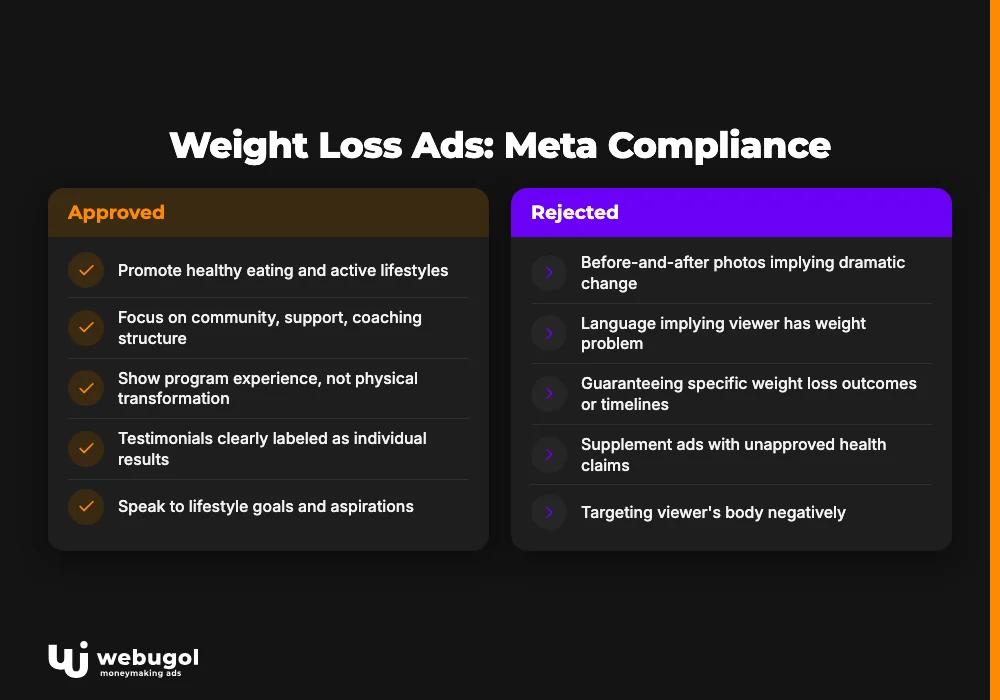
What are Facebook's restrictions on weight loss advertising?
Facebook ad compliance health requirements for weight loss are among the strictest Meta enforces. Understanding them before writing copy prevents account flags, rejected ads, and the budget waste that comes from slow review queues on accounts with prior violations.
What Meta will not approve:
- Before-and-after photos that imply dramatic physical transformation do not pass review
- Language implying the viewer has a weight problem ("struggling with your weight?") violates the personal attributes policy
- Ads guaranteeing specific weight loss outcomes or timelines will be rejected
- Supplement ads with unapproved health claims fail the health product review
- Creative that targets the viewer's body or health status in a negative frame gets flagged consistently
What Meta permits:
- Ads promoting healthy eating habits and active lifestyles pass review reliably
- Program ads focused on community, support, and coaching structure get approved when they avoid outcome promises
- Creative that shows the program experience rather than a physical transformation is approvable
- Testimonials clearly labeled as individual results are generally acceptable under current policy
The distinction is framing. Meta's personal attributes policy prohibits ads that assume something negative about the viewer's body. Copy that speaks to lifestyle goals and aspirations, rather than problems the viewer allegedly has, passes review far more reliably.
Build a compliance checklist and run every ad through it before submission. This reduces review cycle times and keeps the account in good standing, which matters more as campaign scale increases. Accounts with repeated rejections face slower review on future submissions.
For a broader overview of how Facebook handles health-related advertising across service categories, Facebook advertising for healthcare brands covers the policy mechanics that apply across the health and wellness space.
How to target the right audience for weight loss ads on Facebook?
Precise weight loss target audience selection separates cost-efficient weight loss facebook ads from expensive ones. Age, gender, and location are the starting layer. The real targeting advantage comes from layering in behavioral and interest signals that indicate active engagement with health and fitness content.
Audience segments that perform well in this category:
- Interest-based targeting reaches users who actively engage with fitness apps, nutrition content, meal planning tools, or wellness communities on Facebook and Instagram
- Behavioral targeting focuses on users who have recently interacted with diet or health-related content across the platform
- Lookalike audiences built from your current customer list or highest-intent website visitors typically outperform broad interest targeting; a 1% lookalike is usually the strongest starting point once source data is sufficient
- Custom audiences include past website visitors, video viewers, and lead form openers who have not yet converted, forming the retargeting pool
People aged 25 to 50 show higher engagement and conversion rates for weight loss programs. This age range generally has greater readiness to invest in health services, making it the most productive starting range before expanding.
Avoid broad targeting on limited budgets. Meta's delivery algorithm needs a focused audience pool to identify patterns. A tight, well-matched audience consistently outperforms a wide one at the same budget level, particularly in the first four to six weeks of a campaign.
For health brands managing multiple content types and audience segments, social media marketing for medical practices provides a structured content and targeting framework that applies directly to weight loss and wellness programs where medical credibility matters.

Which ad formats work best for weight loss businesses?
Ad format selection determines how much story you can tell within Meta's compliance boundaries. Each format suits different funnel stages and objectives.
Single image ads
Single image ads keep the message focused and the review path clean. One image, one benefit claim, one call to action. That constraint helps in a compliance-heavy category because there is less room to drift toward language or imagery Meta rejects. Use lifestyle and activity imagery rather than transformation comparisons. Short, benefit-focused copy outperforms long explanatory text in static ad units.
Carousel ads
Carousel ads let you walk a prospect through multiple program advantages in a single unit. Each card covers a separate angle: coaching structure, meal approach, community, or support system. Users scroll at their own pace, which extends time spent with the ad. This format works particularly well for lead generation campaigns where the program has several distinct features that need space to register individually.
Video ads
Video generates higher engagement than static images across most Facebook and Instagram audience segments. Short videos outperform long ones for cold audiences. The first three seconds stop the scroll. A 30-second clip featuring a program coach explaining one specific benefit typically outperforms a polished brand video in early-stage tests. Keep captions on; most video on Facebook plays without sound.
Video also lets meta ads for health brands demonstrate credibility without making explicit outcome claims. Tone, setting, and the presence of a real person communicate trust faster than any text element. In a category where audiences have seen too many overclaimed weight loss ads, understated credibility becomes a genuine differentiator.
Retargeting weight loss campaigns: connecting with warm audiences
Retargeting weight loss campaigns consistently outperform cold-traffic campaigns on conversion rate and cost per acquisition. The person who already visited your site or watched your video is a fundamentally different prospect from someone encountering your brand for the first time. They need different creative, different offers, and different messaging.
Facebook Pixel makes this possible. Install it on your website, configure the relevant conversion events, and it tracks every meaningful action: page views, form opens, purchases, and video engagement. Those actions become the foundation for custom audiences that Meta can reach at a fraction of cold-prospecting costs.
A retargeting sequence worth testing:
- Video viewers (25 to 75% watched): serve them a testimonial or a detailed program overview that continues the conversation they already started
- Website visitors who did not complete a lead form: offer a lower-friction entry point such as a free consultation, a free assessment, or a short downloadable guide
- Lead form openers who did not submit: simplify the offer and add a specific incentive or a clear deadline to reduce friction further
- Past purchasers: present a longer program, an upgrade tier, or a complementary service that adds value to their current progress
Each segment needs different creative. Showing the same ad to a cold prospect and to someone who spent three minutes on your pricing page wastes the retargeting advantage entirely. The warm-audience ad should speak to where the person actually is. They know you. Something stopped them. Address that gap directly.
Pixel data also unlocks conversion-level optimization. Instead of optimizing for link clicks, Meta's delivery system can optimize for specific events: a form submission, a booking, or a purchase. That shift typically cuts CPL meaningfully once campaigns have accumulated enough conversion volume, generally 50 events per ad set over seven days.

How to improve ROI on weight loss Facebook campaigns?
ROI improvement on weight loss facebook ads is iterative. No single fix exists. The process is: test a variable, read the data, reallocate, repeat.
Four levers that consistently move ROI:
Creative testing. Run two to three ad variations per audience with different headlines, opening images, or calls to action. Allocate equal budget for five to seven days, then cut the underperformer and scale the winner. Never increase budget on creative you have not tested against an alternative.
Audience segmentation. Identify which audience segments produce the lowest CPL and move more budget to them. Cut segments that generate clicks but no conversions. They produce dashboard activity without business value and feed the algorithm misleading signal about who your best buyers are.
Landing page alignment. High CTR combined with low conversion rate signals a mismatch between ad promise and landing page delivery. Audit the first thing visitors see after clicking. Any gap between what the headline offered and what the page delivers leaks budget. For adjustments that directly affect click-through rates, improving Facebook ad CTR covers the specific changes that move that metric.
Budget pacing. Avoid large daily budget changes on campaigns in the learning phase. Meta's algorithm responds to sudden shifts by resetting the learning phase, which raises CPL for several days. Change budgets by no more than 20% per day during the learning phase.
ROAS is the summary metric. It does not diagnose problems. Track CTR, CPC, conversion rate, and CPL separately. When ROAS drops, those component metrics identify where the break occurred and which lever to pull.
Test one variable at a time. Changing headline and image simultaneously makes it impossible to attribute the result to a specific change. That discipline in test structure prevents weeks of inconclusive data.
Health and wellness brands running paid social also benefit from keeping their operational tooling current. For the workflow side of keeping campaigns effective as Meta's tools and policies evolve, managing social media tools for health marketing covers the platform decisions that matter most for ongoing campaign health.
Aligning budget allocation with funnel stage
Most underperforming weight loss campaigns share one structural problem: all spend flows to conversion campaigns targeting cold audiences. This skips the relationship-building phase that makes conversion campaigns cheaper over time.
Top of funnel: awareness
Run video views or reach campaigns to build a warm custom audience at low CPM. Direct returns look small here. The real return comes later, when retargeting those viewers costs significantly less than reaching a cold audience with the same conversion intent.
Middle of funnel: consideration
Traffic and lead generation campaigns convert warm awareness into identifiable leads. Offers at this stage work best when they require minimal commitment: a free guide, a discovery call, or a free trial of one program element. The goal is not immediate revenue. It is moving someone from "I've heard of you" to "I trust you enough to share my contact information."
Bottom of funnel: conversion
Conversion campaigns targeting prior website visitors and lead form openers close the sale. These audiences are smaller but far more valuable per impression. Budget here generates the highest ROAS, but only when the upper funnel has been consistently building the pool that feeds it.
The facebook ads budget optimization principle underlying this framework: do not start at the bottom with a new product or brand. Build the audience first, then convert it. Running conversion campaigns on a cold audience is often the most expensive way to discover that the brand has no recognition in its target market.
Run weight loss Facebook ads that deliver real results
Running weight loss Facebook ads profitably requires more than a compliant offer. It takes disciplined budget allocation across funnel stages, a tested audience structure, Pixel-enabled retargeting, and consistent creative testing driven by real performance data.
Webugol builds Facebook and Instagram campaigns for health and wellness brands operating within Meta's content policies while delivering measurable results on CPL and ROAS. Our paid social advertising services cover compliance setup, audience architecture, and ongoing optimization.
If your current campaigns are not hitting targets, the fix is usually structural. Contact us to audit your campaign setup and identify where budget is going without returning value.
FAQ
How much should I spend on Facebook ads for weight loss?
There is no universal minimum, but results require data, and data requires spend. Budget enough at the ad set level to generate 5 to 10 conversion events per week, the threshold Meta's algorithm needs to exit the learning phase. Validate cost per lead at a low daily spend before scaling.
How to target the right audience for weight loss ads on Facebook?
Start with interest-based targeting layered over the 25 to 50 age range, which shows stronger engagement and conversion rates in this category. Add behavioral signals, then build 1% lookalike audiences from your best existing contacts. Keep retargeting audiences separate from cold prospecting, as they have different CPLs and need different creative.
What are Facebook's restrictions on weight loss advertising?
Meta prohibits before-and-after transformation imagery, language implying the viewer has a weight problem, guaranteed outcome claims, and unapproved supplement health claims. Focus copy on lifestyle goals, program benefits, community, and coaching support. Outcome language framed as individual experience with a clear disclaimer is generally approvable under current policy.
Which ad formats work best for weight loss businesses?
Video generates the highest engagement on cold audiences when the hook lands in the first three seconds. Carousel ads work well for lead generation where the program has multiple distinct advantages. Single image ads perform best in retargeting, where the viewer already knows the brand and needs one clear, uncluttered next step.
How to improve ROI on weight loss Facebook campaigns?
Test one creative variable at a time, let winners run five to seven days before scaling, and audit the match between ad headline and landing page. Move budget toward audience segments with the lowest CPL, avoid large mid-campaign budget changes, and switch from click optimization to conversion optimization once campaigns have 50 or more conversion events per ad set.

