



Healthcare social media marketing: the complete guide for medical practices
Healthcare social media marketing is the practice of using platforms like Facebook, Instagram, LinkedIn, and YouTube to attract patients, build provider credibility, and share health education at scale. Practices that execute it well fill appointment books, deepen patient loyalty, and become recognized community health resources. This guide covers the platforms, content types, compliance requirements, and patient engagement strategies that produce real results for medical teams.
Is social media marketing effective for healthcare?
Yes. An active, compliant social media presence consistently drives higher patient acquisition and stronger retention compared to practices with no social strategy.
Patients no longer rely on referrals alone. They watch provider video content, read posts, and review profiles before booking. A practice that shows up consistently with accurate, useful content earns trust before the first appointment is scheduled. That trust converts a curious follower into a new patient.
Effectiveness depends on strategy, not activity volume. Posting without purpose generates noise. Publishing patient education, answering real questions, and featuring the people behind the practice builds a real audience that refers, returns, and grows.
Healthcare social media marketing also compounds over time. A post about managing seasonal allergies reaches a patient months before they need an allergist. A video explaining what to expect from a knee replacement starts working on a patient's anxiety long before they call to book. Every educational post, every patient story, and every public Q&A response adds to a searchable record of the practice's expertise. That record continues working long after each individual post goes live.
The return on investment is best understood through the patient journey rather than a short-term funnel. Social content builds the awareness and trust that make a patient choose your practice when a health need arises - often weeks or months after first contact. Practices ready to build on this can start with a structured growth system for healthcare practices that coordinates social, search, and paid channels for compounding results.
What social media platforms are best for doctors?
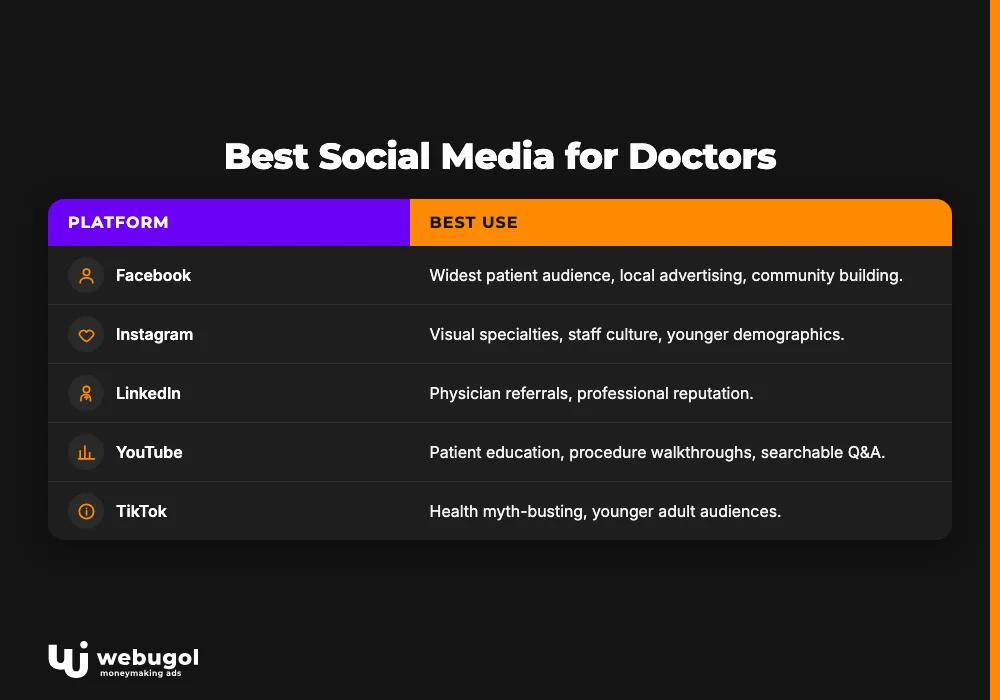
Facebook reaches the widest patient audience for most medical specialties. Instagram works best for visual fields like dermatology and dentistry. LinkedIn connects providers with referring physicians and professional networks. YouTube builds long-term organic reach through searchable educational video.
Here is a quick-reference breakdown:
| Platform | Primary use | Best content format |
|---|---|---|
| Patient acquisition, local advertising, community building | Posts, video, paid ads | |
| Visual specialties, staff culture, younger demographics | Reels, Stories, carousels | |
| Physician referrals, hospital brands, professional reputation | Articles, thought leadership | |
| YouTube | Patient education, procedure walkthroughs, searchable Q&A | Long-form and mid-length video |
| TikTok | Health myth-busting, younger adult audiences | Short-form video |
Platform choice should match patient demographics. A geriatric practice generates stronger returns on Facebook than TikTok. A sports medicine clinic targeting active adults in their 30s will likely outperform on Instagram Reels. Pick one or two platforms, execute them well, and expand only when those channels run consistently.
Doctor Facebook marketing earns particular attention because of its advertising depth. Facebook lets practices target users by ZIP code, age range, health interest category, and life event - specificity that most traditional media channels cannot approach. How Facebook advertising reaches healthcare patients breaks down this targeting for practices weighing the channel investment.
How should medical practices use social media?
Medical practices should use social media to educate patients, answer common health questions, promote specific services, and maintain a responsive digital presence - all within HIPAA boundaries at every step.
A practical framework to follow:
Define one goal per platform. Facebook drives appointment bookings and community engagement. Instagram builds brand identity and introduces the team. LinkedIn generates professional referrals. Dividing effort evenly across every platform produces mediocre content everywhere.
Build a monthly content calendar. Consistency outperforms volume. Three well-planned posts per week outperform seven rushed ones. A calendar locks in health awareness month themes, seasonal condition alerts, and FAQ series so no one scrambles for ideas at the last minute.
Respond to every comment and direct message. The patient communication tips that reliably move the needle return to this single habit. A comment left unanswered is a missed connection. A direct message answered within the hour signals exactly the attentiveness patients want from their provider.
Follow a 70/30 content split. Seventy percent of posts should educate, inform, or connect with the audience. Thirty percent can promote services or drive appointment bookings. Audiences disengage from feeds that feel like continuous advertising.
Track what actually converts. Reach and likes are indicators, not results. Appointment bookings are results. Track which post types drive website clicks and booking completions, and adjust the content mix each quarter based on what the data shows.
Practices that pair a structured strategy with a dedicated social media management service can maintain a consistent posting rhythm even during the busiest clinic weeks without putting the burden on clinical staff.
What content should doctors post on social media?
Doctors should post educational health content, patient success stories with consent, staff spotlights, answers to frequently asked medical questions, and health awareness content tied to annual observances.
Effective content categories for healthcare social media marketing:
- Patient education posts: Break down a diagnosis, treatment option, or prevention strategy in plain, accessible language. A cardiologist explaining cholesterol levels in three clear steps earns more saves and shares than a promotional post about office hours ever will.
- Staff spotlights: Introduce the people patients will meet before their first visit. A short video featuring a nurse, medical assistant, or front-desk coordinator reduces first-visit anxiety and gives the practice a recognizable human face.
- Before-and-after content: Generates strong engagement for dermatology, plastic surgery, dentistry, and orthopedics, always with explicit written patient consent obtained before anything is published.
- Health observance posts: February is American Heart Month. May is Mental Health Awareness Month. October is Breast Cancer Awareness Month. A content calendar tied to these observances positions the practice as an active community health resource year-round.
- FAQ video series: Record short answers to the questions patients ask every day in the exam room. If patients ask it in person, they are searching for it online.
- Live Q&A sessions: Facebook and Instagram Live allow providers to answer patient questions in real time, building authority quickly and generating content that can be repurposed into posts, clips, and written material.
Medical content marketing performs best when it addresses what patients are already searching for. The questions your front desk fields every Monday morning are your content calendar waiting to be written.
Content repurposing extends the value of every piece you create. A live Q&A session becomes video content, which becomes short clips for Instagram Reels, which becomes transcribed text for a blog post, which becomes a FAQ entry for the website. One well-planned live session can fuel two to three weeks of content across multiple platforms. Practices that think this way get far more output from the same time investment.
For guidance on implementing the right content platforms and workflows for medical teams, the right scheduling and management tools remove daily friction and keep the posting calendar running without constant hands-on attention.
Patient engagement strategies that actually move the needle
Patient engagement on social media is not measured in likes. It is measured in trust built over weeks and months - the kind that makes patients think of your practice first when they need care.
The most consistent patient engagement strategies in healthcare focus on three actions: respond, educate, and celebrate. Respond to every comment within 24 hours. Educate through content that solves a real problem rather than just broadcasting services. Celebrate patient milestones - recovery progress, wellness achievements, annual checkups - with explicit written consent every time.
Health challenges create community. A practice might run a "10,000 steps daily" challenge during Heart Health Month. Patients tag the practice, share progress, and invite family members to join. The practice gains organic reach without paid spend. Patients gain accountability and a sense of connection to their provider between visits.
Incentives and recognition sustain momentum. Acknowledging patient progress publicly, with consent, creates visible proof that real health outcomes are being achieved. Whether recognizing someone who completed a weight-management program or a recovery milestone from surgery, these public celebrations reinforce that the practice is invested in patient outcomes, not just appointment volume.
Testimonials carry outsized weight in healthcare decisions. A prospective patient reading a detailed account of how a practice supported someone through a difficult recovery is reading the most persuasive content that practice can produce. Collect stories systematically, share them with written consent, and write them with specific detail. Vague praise is far less convincing than a concrete patient experience with named outcomes.
Specialist collaborations multiply credibility. A primary care practice that co-creates content with an affiliated dietitian or physical therapist reaches multiple patient concerns simultaneously and appears in more feeds. These partnerships expand the audience while reinforcing a commitment to whole-person care.
Practices that treat social media as a conversation grow their audience. Those that treat it as a broadcast channel eventually lose it.

HIPAA social media compliance: what your team must know
HIPAA social media compliance is non-negotiable. A single violation can result in federal fines, reputational damage, and immediate loss of patient trust, with no simple path back to where the practice stood before.
The core rule: never post patient information without explicit written consent. That includes names, photos, diagnoses, procedure details, and any information that could allow someone in the patient's community to identify them. Even an apparently harmless post - "Great to see one of our longtime patients hit a major milestone this week" - can constitute a HIPAA violation if the patient is recognizable to people who know them.
Your team must follow these requirements:
- Obtain written, HIPAA-compliant consent before using any patient image, quote, or story in social media content. A generic photo release is not sufficient for social media purposes.
- Never respond to patient health questions in public comment threads. Acknowledge the comment and direct the person to call the office or send a private message for any clinical discussion.
- Do not confirm or deny that a specific individual is a patient of the practice in any public-facing forum.
- Establish and maintain a written social media policy for all staff. Include it in onboarding documentation and review it at least once per year.
- Monitor tagged posts and comments regularly. If a patient tags the practice in a health-related post, a staff response with condition-specific information in a public thread creates compliance exposure that can trigger an investigation.
Healthcare digital marketing partners with HIPAA experience build compliance into every content brief, approval step, and posting workflow from the start. If your current marketing partner does not raise compliance questions proactively, that gap is worth examining carefully.
Practices that pair HIPAA-safe social strategies with strong local search visibility compound their patient acquisition results. Connecting social media presence with specialized local search for healthcare providers ensures that patients who discover the practice on social can also find it easily through organic search.
Medical content marketing: education that builds authority
Medical content marketing works because it meets patients at the moment they are already searching for answers. When a practice consistently publishes accurate, accessible health content, it builds authority that converts to appointment bookings - often months after the original post goes live.
Video outperforms static content across nearly every healthcare context. A two-minute walkthrough of what to expect during a colonoscopy reduces patient anxiety and appointment cancellations more effectively than a printed brochure. A dermatologist demonstrating a skincare routine builds rapport before the patient ever calls to book.
Short-form articles and carousel posts travel well on Facebook and Instagram. Condition education, medication explainers, and seasonal health alerts get shared between family members. They drive page follows that grow the audience organically over months without additional paid spend.
Infographics present complex clinical information in a scannable, shareable format. A well-designed graphic on early warning signs of high blood pressure can generate sustained organic reach long after its publish date, resurfacing each time a follower shares it with someone who needs it.
LinkedIn articles and podcast appearances position specialists as thought leaders for professional and referring audiences. This matters most for surgical specialties, rare-condition practices, and any provider who benefits from physician-to-physician referrals.
Accuracy is the foundation that medical content marketing stands on. An error in a health education post travels as fast as a correct one. Clinical staff should review every educational post before publication - not as a formality, but as a genuine quality check that protects patients and the practice.
Collaborating with affiliated specialists builds credibility and reach simultaneously. A practice that records a conversation with an affiliated cardiologist or physical therapist demonstrates depth, a commitment to whole-patient care, and expertise across a broader range of health concerns than any single provider can cover alone.
How often should a medical practice post on social media?
Most medical practices should post three to five times per week on their primary platform. Frequency matters far less than consistency. A practice posting three times every week without fail builds more audience momentum than one posting daily for two weeks and then going quiet for a month.
Social media algorithms reward sustained activity. When an account goes silent, patients stop expecting content from it - and when posting resumes, the algorithm has already deprioritized the page.
Posting frequency by platform: Facebook performs best at three to five posts per week. Instagram benefits from four to six per week when Stories are counted alongside feed posts. LinkedIn stays active at two to three posts per week. YouTube needs only one to two videos per month if each video is thorough and keyword-optimized for search.
Timing matters as much as frequency. Facebook Insights and Instagram Analytics show exactly when your specific audience is online. For most medical practices, early weekday mornings from 7 to 9 AM and early evenings from 5 to 7 PM see the strongest engagement rates. Use your own platform analytics, not general benchmarks, to confirm this for your specific patient base.
Batch content creation solves the daily friction problem. Setting aside two to three hours at the start of each month to plan and schedule the full month's content is far more sustainable than daily content decisions. A scheduling tool keeps the calendar running consistently, even during the busiest clinic weeks.

Doctor Facebook marketing: reaching patients in your community
Doctor Facebook marketing combines organic content with targeted paid advertising for maximum local reach. Organic posts build trust and keep the page credible. Paid campaigns put specific services in front of specific audiences with precision that most traditional media channels cannot replicate.
Facebook's advertising platform lets practices target by ZIP code, age range, health interest category, and life event. A weight-loss clinic can reach adults within 10 miles who have expressed interest in nutrition programs. A pediatric practice can target new and expectant parents. An orthopedic surgeon can reach users who have recently searched for joint pain management or sports injury recovery options.
The most effective healthcare Facebook campaigns drive traffic to a specific landing page, not the homepage, for a specific service. A campaign promoting annual physicals should link directly to a physicals booking page. A campaign for a new sleep medicine service should land on a page that explains the service and offers an immediate appointment option - not a general contact form.
The most overlooked element in doctor Facebook marketing is the page itself. Before any paid campaign goes live, the practice Facebook page should have a complete profile, recent organic posts, and active reviews. Facebook's algorithm uses page quality signals to determine ad relevance scores. A well-maintained organic page makes paid campaigns perform better at a lower cost per click.
Retargeting is one of the most underused tools in healthcare social media marketing. Website visitors who browsed without booking can see follow-up ads on Facebook that keep the practice visible during the patient's decision window. For elective or specialist care, that window can stretch days or even weeks.
Organic and paid Facebook strategies work best together. Organic content warms the audience and builds the credibility that paid campaigns rely on to convert. Running paid campaigns without a credible organic presence behind them consistently underperforms compared to an integrated approach.
Grow your practice with healthcare social media marketing
Healthcare social media marketing rewards practices that show up consistently, educate genuinely, and engage like the care providers they are. The practices pulling ahead on social post with clear purpose, stay HIPAA-compliant, and treat every comment and message as a patient interaction worth taking seriously.
Webugol builds and executes healthcare digital marketing strategies for medical practices ready to grow - from content planning and HIPAA-compliant posting workflows to Facebook advertising campaigns that drive real appointment bookings. Whether your practice needs a complete social media overhaul or targeted support with a specific platform, the team designs a plan around your actual growth goals.
FAQ
How should a medical practice handle negative comments on social media?
Respond professionally, without disclosing any patient information. Acknowledge the concern, invite the person to contact the practice directly by phone or private message, and move all clinical discussion offline. Never engage in a public dispute over a health-related complaint.
What is the biggest HIPAA risk in healthcare social media marketing?
Responding to patient health questions in public comment threads is the most common violation path. A well-intentioned public response that confirms someone is a patient or references their health condition in an open forum can trigger a HIPAA investigation.
Can doctors post before-and-after photos on social media?
Yes, with written HIPAA-compliant patient consent that specifically names social media as an intended use. A generic photo release is not sufficient. The consent form must authorize the specific content type and the channels where it will appear.
What metrics should a medical practice track on social media?
Track reach, engagement rate, follower growth, and appointment conversions - specifically how many social media visitors actually book. Vanity metrics like total likes matter far less than whether the social media program generates new patients for the practice.
How long does healthcare social media marketing take to show results?
Engagement growth typically becomes measurable within 60 to 90 days of consistent posting. Organic patient acquisition takes 3 to 6 months to develop. Paid Facebook campaigns can generate appointment bookings within the first two to four weeks of launching.