



Healthcare marketing agency: why your medical practice needs one
A healthcare marketing agency builds patient pipelines for medical practices through SEO, paid advertising, content, and reputation management. Unlike a general firm, it understands HIPAA constraints and the compliance requirements specific to health communication. Medical practices gain a structured patient acquisition strategy rather than scattered promotional efforts. The result is measurable growth in appointments and stronger patient retention.
What does a healthcare marketing agency do?
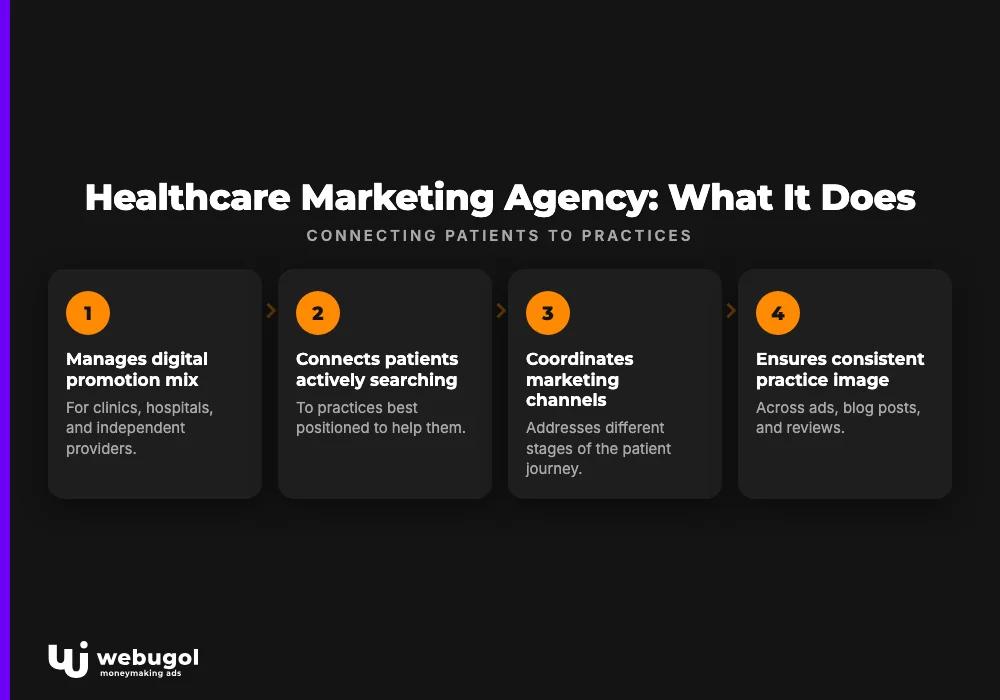
A healthcare marketing agency manages the full digital promotion mix for clinics, hospitals, and independent providers. Its core function is connecting patients who are actively searching to the practices best positioned to help them.
| Service | Primary goal |
|---|---|
| Medical SEO services | Rank for condition- and location-based searches |
| Google Ads / PPC | Capture high-intent patients immediately |
| Social media advertising | Build awareness and reach retargeting audiences |
| Content marketing | Establish clinical authority and answer patient questions |
| Reputation management | Grow and protect online review profiles |
| Email campaigns | Retain existing patients and reduce churn |
| Local SEO and Google Business Profile | Dominate map-pack results for "near me" searches |
Each channel addresses a different stage of the patient journey. A medical marketing company coordinates them so the patient who clicks an ad, reads a blog post, and checks reviews before booking encounters a consistent, credible practice at every step.
How to attract more patients to a medical practice?
Local search optimization, educational content, and proactive reputation management form the core of any effective patient acquisition strategy.
Local SEO comes first. When someone searches "urgent care near me" or "dermatologist in [city]," Google's map pack appears above organic results. Optimizing a Google Business Profile with accurate hours, services, and responded-to reviews improves those rankings. Health clinic marketing that skips local search hands the most motivated searchers directly to competitors.
Educational content is the second layer. A blog post on "what to expect during a first cardiology visit" ranks for informational queries and guides readers toward booking. Each published piece compounds over time. A paid ad stops delivering the moment billing stops. A well-written article keeps working for months.
Reputation management rounds out the strategy. An agency trained in doctor marketing services knows how to systematically invite satisfied patients to leave reviews and how to handle negative feedback without violating patient privacy rules.
What is the best marketing strategy for a medical practice?
The highest-performing strategies build on a solid technical foundation before layering paid and content channels on top.
For most practices, that sequence looks like this:
- Fix technical performance first. A slow, mobile-unfriendly site loses patients before they book. Speed and mobile usability are non-negotiable starting points.
- Claim local search territory. Medical SEO services focused on local intent attract patients with booking intent already in place.
- Run paid ads for immediate traction. Google Ads campaigns reach patients ready to book now, bridging the gap while organic rankings build.
- Publish educational content consistently. Blog posts, FAQ pages, and video explainers build clinical authority and support E-E-A-T signals that Google weights heavily for health content.
- Nurture through email. Retaining existing patients through structured email programs costs less than acquiring new patients from scratch.
The agency runs all five tracks simultaneously. Internal staff rarely has the bandwidth or the specialized expertise to manage that workload effectively.
Why should doctors hire a marketing firm?
Time is the obvious answer. A physician running a practice has no spare capacity to track keyword rankings, monitor ad performance, respond to reviews, and publish content each week. In-house marketing costs more than it appears once staff time, tool subscriptions, and training are factored in.
Specialization matters just as much. Health clinic marketing carries requirements that general firms often miss: HIPAA compliance in retargeting audiences, restrictions on patient testimonial usage, and the E-E-A-T standards Google applies to medical content. The agency builds those guardrails into every campaign from the start. A general firm can breach compliance without recognizing it.
The third advantage is accountability. A qualified medical marketing company connects marketing spend to actual appointment bookings, not just clicks or impressions. You see which channel drove the patient, what it cost to acquire them, and what shifted that cost over time. That data makes the next budget cycle more precise, not just larger.

Choosing the right healthcare marketing agency: five criteria
Most practices evaluate agencies on sales presentations rather than results. Here is what actually predicts outcomes.
Healthcare-specific experience. Ask for examples from practices similar to yours. A firm that built patient pipelines for orthopedic clinics applies fundamentally different methods than one that markets software products.
Compliance fluency. The agency should explain, without prompting, how it handles HIPAA in digital ad targeting. A blank response is a clear warning.
Transparent reporting tied to business outcomes. Every campaign should connect to appointments booked, calls generated, and cost per new patient. Reports that stop at website sessions are insufficient.
Proven local search capability. Most patient decisions are local. Verify the agency has documented results in building local patient visibility for healthcare practices, not just general SEO projects.
Content written to medical standards. Google's E-E-A-T framework requires demonstrated expertise in health content. Thin articles written by generalists are a ranking liability, not an asset.
Medical SEO services: what specialization actually requires
These services differ from standard SEO in two ways: the stakes and the standards.
Google applies stricter quality criteria to health content under its E-E-A-T framework. A page ranking for "chest pain symptoms" carries real-world consequences if the information is wrong. Quality raters scrutinize medical content more heavily than content in most other categories.
For a practice, that means SEO cannot be generic. Keywords must reflect actual patient search behavior. On-page content needs physician review or cited clinical sources. Author credentials matter. Schema markup for medical providers helps search engines parse and display practice information correctly.
Organic search also builds something paid ads cannot replicate. Organic search builds durable authority for health and wellness businesses month after month. A suspended ad budget ends traffic instantly. A well-optimized practice page keeps compounding.

Ready to grow your patient base?
If your schedule has gaps, your Google profile has unanswered reviews, or your website traffic has stalled, those are solvable problems. This starts with mapping the specific gaps in your patient acquisition strategy and building the campaigns to close them.
Webugol's Healthcare Growth System is built around these exact outcomes. Contact us to discuss how it applies to your practice.
FAQ
What does a healthcare marketing agency do?
A healthcare marketing agency provides medical SEO services, paid advertising, content creation, reputation management, and local SEO for clinics and medical practices. It coordinates those channels so patients encounter consistent, credible messaging at every step before booking. The agency handles compliance constraints specific to health advertising throughout every campaign.
How much does medical practice marketing cost?
Costs vary by market size, competition level, and the number of channels in the strategy. Most agencies structure fees as a monthly retainer covering a defined set of deliverables, which allows continuous optimization rather than one-off project work.
How do I attract more patients to my medical practice?
Local SEO is typically the fastest lever, since patients searching "doctor near me" carry high booking intent. Combine a well-managed Google Business Profile with targeted paid ads for immediate results while content marketing builds organic traffic over time.
What makes a healthcare marketing agency different from a general firm?
HIPAA compliance in ad targeting, E-E-A-T requirements for health content, and the high-trust nature of medical decisions all require specialized knowledge that general agencies rarely have. It drives new patient appointments while keeping campaigns legally and ethically compliant.
Why should doctors hire a marketing firm instead of handling it in-house?
Doctor marketing services require dedicated staff, ongoing tool subscriptions, and expertise that takes years to develop. An agency brings a trained team, tested systems, and cross-client data that most single practices cannot replicate independently.