



Healthcare Local SEO: Why Medical Practices Need a Specialized Agency
Healthcare local SEO is the practice of optimizing a medical provider's online presence so it ranks in location-based search results when nearby patients are actively searching for care. A specialized agency manages Google Business Profile upkeep, HIPAA-compliant content, and local keyword targeting at the same time. General agencies rarely understand these overlapping constraints. That gap is why practices that partner with healthcare-specific SEO firms consistently outperform those relying on broad-market digital marketing agencies. The data proves it.
What does a healthcare local SEO agency do?
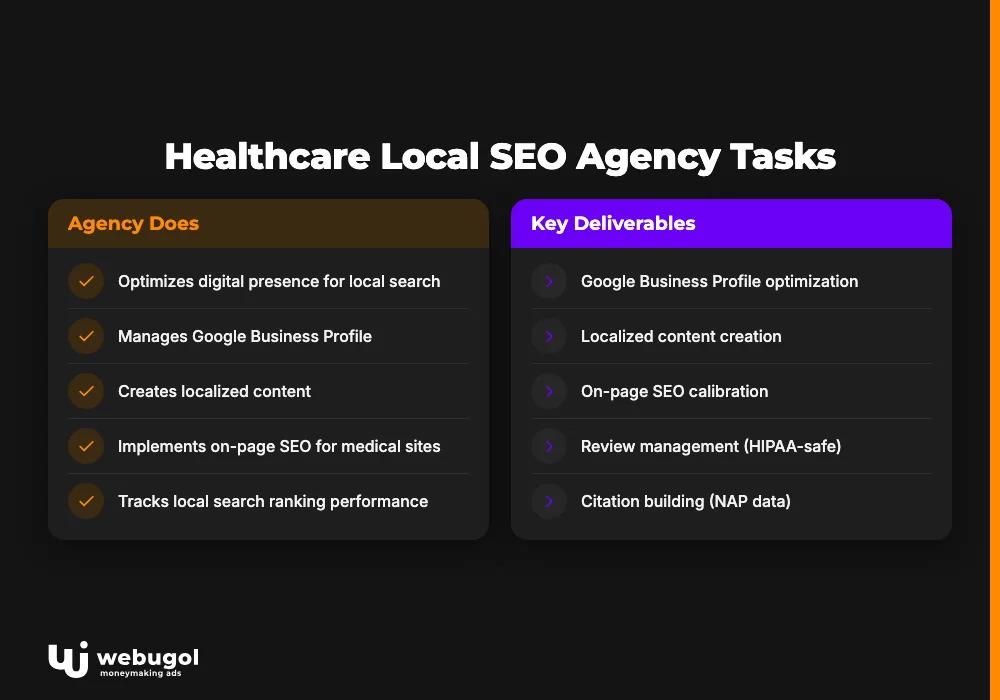
A healthcare local SEO agency optimizes a medical practice's digital presence to rank in local search results, Google Maps, and AI-generated overviews for location-specific health queries. The work spans technical optimization, content creation, Google Business Profile management, and review strategy, all of which must account for compliance requirements that do not apply in most other industries.
Core deliverables typically include:
- Google Business Profile optimization keeps categories, service areas, hours, and photos current, pushing the listing into the local map pack
- Localized content targets condition-specific and location-based queries through blog posts, FAQs, and landing pages designed for the practice's service area
- On-page SEO calibrates title tags, meta descriptions, heading structure, and schema markup specifically for medical practice websites
- Review management builds systems for collecting and responding to patient reviews within HIPAA-safe guidelines
- Citation building maintains consistent NAP (name, address, phone) data across directories such as Healthgrades, Zocdoc, and Vitals
- Local link acquisition pursues relationships with community organizations, local media, and medical associations to build domain authority signals
The agency also tracks doctor local search ranking performance across target zip codes and refines strategy as search patterns change. That ongoing monitoring is what distinguishes a sustained program like this from a one-time website project.
How does local SEO help medical practices attract patients?
Local SEO helps medical practices attract patients by placing them in front of high-intent local searchers at the exact moment someone is looking for care. The conversion path is short. A visible listing with recent positive reviews leads directly to a phone call or a booking.
Most patients begin their search for a provider online, then filter by proximity and trust signals before deciding where to go. Search drives that decision.
A patient types "urgent care near me" or "family doctor accepting new patients in [city]," scans the local pack, reads two or three reviews, and calls the practice that looks most credible. It shapes every step of that sequence.
A fully optimized healthcare Google Business Profile with current hours, clear service descriptions, and a steady stream of recent patient feedback wins that call more reliably than an incomplete or outdated listing. The Business Profile is often the first impression a practice makes. In healthcare, first impressions carry outsized weight.
Patient volume follows directly from visibility. Local SEO for doctors increases a practice's presence exactly when search intent is highest, which is when someone is actively seeking care. This is fundamentally different from brand advertising, which reaches people who may never need the service. Local SEO for clinics captures demand that already exists in the market rather than trying to create it.
For practices competing in dense metro areas, medical practice SEO is not optional. A rival clinic ranking in the top three local results captures a disproportionate share of new patients regardless of actual quality differences between practices. Visibility creates the opportunity for everything that follows.
Why do healthcare providers need specialized SEO?
Healthcare providers need specialized SEO because the regulatory environment, patient trust dynamics, and content authority requirements in medicine are fundamentally different from those in any other industry. A generalist approach consistently produces compliance risk, underperforming content, or both.
The HIPAA compliance challenge
Any content strategy or review-response system at a medical practice must comply with HIPAA. This means an agency cannot use patient data for case studies without explicit written authorization, cannot confirm patient-provider relationships in public review responses, and must advise practices on which forms of testimonial content are legally permissible. A standard digital marketing agency often does not know these rules exist, and many discover them only after a complaint has been filed. That risk is real.
HIPAA violations carry significant financial penalties. That reality makes compliance fluency a non-negotiable requirement for any medical SEO services provider operating in this space. This work also intersects with Google's health-specific content policies, which restrict how medical claims are worded in meta descriptions and landing pages. A specialist accounts for these restrictions from the first draft. A generalist frequently produces content that either violates guidelines or hedges so heavily it communicates nothing useful to the patient reading it.
Patient trust is not consumer trust
A patient choosing a specialist is not making the same kind of decision as a customer choosing a product. The risk is physical, potentially irreversible, and emotionally significant. Search behavior reflects this: healthcare queries tend to be longer, more specific, and frequently include trust markers such as "board-certified," "accepts [insurance plan]," and "near [neighborhood name]."
Effective local SEO for doctors accounts for these patterns in both keyword selection and content architecture. Review dynamics also work differently in healthcare. Patients weigh review volume, recency, and the tone of provider responses far more carefully than most consumers do. A single dismissive public response to a negative review can suppress new patient conversion more decisively than losing ground on a target keyword. Reputation management within this discipline must treat every review interaction as a trust event.

What is the difference between healthcare SEO and general SEO?
Healthcare SEO optimizes for visibility, compliance, and trust at the same time. General SEO focuses primarily on visibility and traffic volume. Those goals sometimes conflict, and resolving that tension requires domain knowledge that most generalist agencies have not developed.
The keyword landscape shows the gap most clearly. A general SEO strategy might target "knee pain treatment" as a broad, high-volume phrase. A healthcare specialist breaks that into intent-specific variants: "knee pain specialist [city]," "orthopedic surgeon near me," and "ACL surgery recovery time." Each variant serves a different patient at a different stage of care-seeking. Local SEO for clinics requires this level of segmentation to convert traffic into booked appointments rather than pageviews.
Geographic targeting also works differently for healthcare than for retail or e-commerce. A consumer brand can rank across a broad region with a single optimized domain. A medical practice typically needs location-specific landing pages for each clinic branch or service area, each with unique content, local schema markup, and city-level citations. Healthcare Google Business Profile management adds another layer: multi-location practices need individual profiles maintained at the clinic level, not the brand level, or the whole system underperforms.
Content authority in medicine is held to a higher standard than in almost any other content category. Google's Search Quality Rater Guidelines classify health content as YMYL (Your Money or Your Life), requiring demonstrated expertise, authoritativeness, and trustworthiness. Medical content needs credentialed authors, clinically accurate information, and references to established sources. A generalist writing health tips without physician review produces content that actively works against a practice's authority score. Quality cannot be faked.
For context on how organic search and social channels work together in a complete patient acquisition approach, see the complete social media content guide for medical practices.

How to choose a local SEO company for healthcare?
Choose a healthcare local SEO company by evaluating its compliance knowledge, healthcare-specific case studies, keyword methodology, local reporting structure, and timeline transparency. The wrong agency creates compliance exposure, wastes budget, and leaves rankings lower than when it started. Here is what to examine before committing.
Demonstrated healthcare experience. Ask for case studies from medical or dental clients specifically. Review websites the agency has built, verify those sites rank in local packs today, and read the content for clinical accuracy. Vague metrics like "we increased a healthcare client's traffic by X%" are not sufficient. Specific markets, named specialties, and verifiable position improvements indicate real expertise in medical practice SEO.
Compliance awareness. Ask directly how the agency handles review responses and whether the team understands HIPAA's rules on public patient data. A specialist answers immediately and correctly. A generalist asks for clarification, or worse, gives a confident wrong answer. In a regulated industry, the latter creates more liability than an honest admission of ignorance.
Keyword strategy process. A credible agency explains exactly how it identifies target queries for your specialty and geographic market. Generic promises about "ranking doctors in Google" are not a strategy. Ask for a sample keyword map for your practice area before signing a contract.
Local-specific reporting. Doctor local search ranking reports should show keyword-level position changes, Google Business Profile engagement metrics (calls, direction requests, website clicks), and new patient inquiry attribution where trackable. Reports showing only aggregate organic traffic are not designed for medical practices and will not tell you what is actually driving appointments.
Honest timelines. Healthcare local SEO in competitive markets typically requires four to six months before substantial ranking movement becomes visible. Any agency guaranteeing top-three placements within thirty days is promising an outcome that no SEO provider can reliably deliver. Run from those promises.
Webugol's healthcare growth system integrates healthcare local SEO, reputation management, and HIPAA-aware content strategy into a single patient acquisition framework built specifically for clinics and independent practices.
Start building your practice's local search presence
Healthcare local SEO targets patients who are actively searching for exactly what your practice offers. That makes it one of the highest-return digital investments available to medical providers when it is executed with the right expertise. Doing it correctly requires compliance knowledge, trust-signal architecture, and local search mechanics that generalist agencies consistently lack. Webugol partners with medical practices and clinics across the US to build local search visibility that translates into appointment bookings. Contact us to discuss a healthcare local SEO strategy designed for your specialty and market.
FAQ
How long does healthcare local SEO take to produce results?
Most medical practices see measurable ranking improvements within four to six months of consistent optimization. Google Business Profile engagement metrics, including calls and direction requests, often improve sooner, within six to eight weeks, because profile completeness feeds directly into local pack ranking signals. That speed surprises most.
What is healthcare Google Business Profile optimization?
Healthcare Google Business Profile optimization ensures a medical practice's listing is complete, accurate, and keyword-relevant so it appears in the local map pack when patients search for nearby care. It covers primary and secondary category selection, services listing, clinical photos, and review management within HIPAA guidelines.
Does local SEO for clinics require a separate strategy per location?
Yes. Each clinic location needs its own Google Business Profile, a location-specific landing page with unique content, and an independent citation profile across relevant healthcare directories. Treating multiple locations as a single entity prevents each location from ranking competitively in its own service area.
Can a general SEO agency handle medical practice SEO effectively?
General SEO agencies lack the healthcare-specific knowledge to navigate HIPAA compliance, YMYL content standards, and the trust signals that drive patient conversion. They can generate traffic, but that traffic frequently does not convert to appointments because the content does not match what patients in medical search contexts expect.
How does healthcare local SEO compare to paid search for doctors?
Local SEO builds durable organic visibility that continues generating patient inquiries without ongoing ad spend, while paid search delivers immediate placement that stops when the budget runs out. High-performing medical practices typically use both: paid search for immediate capacity needs and healthcare local SEO for sustainable long-term patient acquisition.