



Medical device marketing agency: strategy, compliance, and growth
Such an agency handles the full commercial lifecycle for regulated health technology companies, from pre-clearance positioning to FDA-compliant demand generation. Unlike a general marketing firm, it reviews every claim and channel against regulatory requirements before anything publishes. Compliance is not a final gate. It is built into the workflow from day one, which is why specialized agencies consistently deliver faster market entry and lower enforcement risk than in-house teams working without this expertise.
What does a medical device marketing agency do?
It manages every market-facing activity across the product lifecycle, from brand building during clinical trials through post-launch optimization. These agencies handle what generalist firms cannot: validating claims against cleared indications, packaging clinical evidence for sales teams, and designing healthcare B2B marketing campaigns built for the long, multi-stakeholder buying cycles typical of hospital procurement.
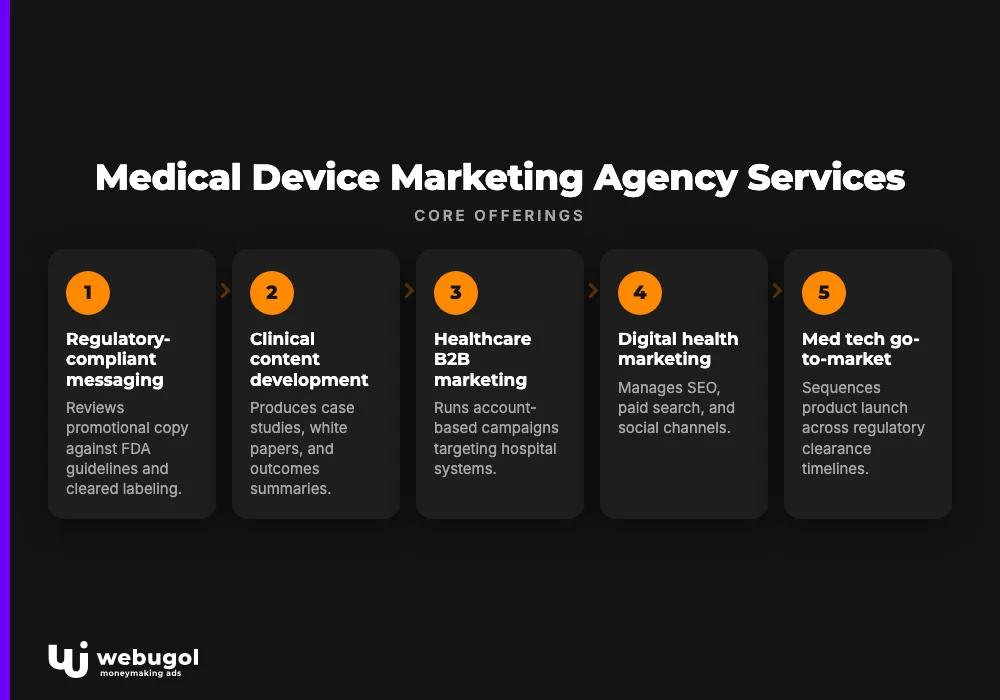
Core services a specialized agency typically delivers:
- Regulatory-compliant messaging: Reviewing all promotional copy against FDA advertising guidelines and cleared labeling before publication.
- Clinical content development: Producing case studies, white papers, and outcomes summaries that support physician evaluation committees.
- Healthcare B2B marketing: Running account-based campaigns targeting hospital systems, group purchasing organizations, and regional distributors.
- Digital health marketing: Managing SEO, paid search, and social channels with ad copy that passes FDA compliance review.
- Competitive positioning: Defining differentiation and pricing narrative based on clinical outcomes data from trials or registries.
- Med tech go-to-market coordination: Sequencing product launch across regulatory clearance timelines, distributor onboarding, and sales enablement programs.
How is medical device marketing different from regular marketing?
Medical device marketing operates under legal constraints that consumer goods marketing does not face. That single difference reshapes every channel, every message, and every campaign decision. This is not a minor operational detail.
A standard agency can make bold performance claims without clinical verification. A medical device marketing agency cannot. Every efficacy statement must align with cleared indications for use. Claims that extend beyond what regulators approved expose manufacturers to FDA warning letters, consent decrees, and in serious cases, product seizure.
The sales cycle is also structurally different. Hospital capital purchases involve clinical evaluation committees, value analysis teams, and contracting departments. The decision chain spans many stakeholders across multiple organizational layers. Effective healthcare marketing strategy for this environment requires nurture content tailored to each decision-maker, a very different discipline from a consumer brand's short purchase funnel.
Finally, the evidence standard differs. Clinicians dismiss brand-only messaging. A credible healthcare marketing strategy pairs peer-reviewed citations, registry summaries, and real-world outcomes data with commercial content, without misrepresenting the underlying science. General agencies rarely have the medical writing or compliance review capacity to do this work well.
How do you market a medical device in the US?
Effective US device marketing starts before clearance arrives. Smart manufacturers engage a medical device marketing agency during clinical validation to build positioning and evidence infrastructure in parallel with the regulatory submission. That parallel work means market activation can happen on clearance day, not months after.
A proven med tech go-to-market sequence runs in four phases.
Phase 1: Positioning and evidence. Define the clinical problem, map the decision-maker ecosystem, and build the competitive narrative. This work feeds both the FDA submission language and the commercial messaging architecture at the same time.
Phase 2: Pre-launch content. Produce clinical assets, including white papers, KOL testimonials, and outcomes summaries, that sales reps and distributors will use during device evaluations. Establishing organic search visibility before launch and building email sequences during this phase means the brand has search presence and warm audience lists on clearance day.
Phase 3: Market activation. On clearance, execute across channels simultaneously: targeted outreach to priority health systems, trade media announcements, paid search against relevant procedural codes, and distributor enablement training. Competitors monitor 510(k) clearance databases. Speed at activation matters.
Phase 4: Post-launch optimization. Integrate real-world performance data into updated content assets. Adjust channel investment based on which buyer segments convert. A structured healthcare growth system sustains commercial momentum well past the initial launch window.
What are FDA requirements for medical device advertising?
FDA advertising compliance means every promotional claim must be truthful, non-misleading, and consistent with the device's cleared labeling. The FDA's Division of Industry and Consumer Education (DICE) reviews promotional materials upon complaint or audit. Warning letters are public record. Hospital procurement teams search them before awarding contracts.
Core FDA advertising compliance rules that a medical device marketing agency must build into its workflow:
- Cleared indications only: Promotional materials cannot promote a device for uses beyond its cleared or approved indications for use, regardless of anecdotal clinical reports or physician testimonials.
- Fair balance required: Any promotion citing benefits must disclose relevant risks with equivalent prominence in the same material.
- No unsupported superiority claims: Comparative advantage claims require head-to-head clinical evidence reflected in the cleared labeling.
- Digital channels are fully in scope: FDA guidance on interactive and digital media confirms that paid social posts, sponsored search ads, and influencer content fall under the same rules as print advertising.
Compliance review must sit inside the content production process, not at the end of it. Catching a non-compliant claim after a campaign launches costs far more than catching it during copy review.
For manufacturers operating across regions, the complexity multiplies. Obtaining FDA clearance for the US market, CE marking for Europe, and other regional accreditations each introduces distinct promotional requirements. An experienced agency with international clients maintains working knowledge of these frameworks so promotional tactics stay compliant across every active market.

Using clinical evidence as a marketing asset
Procurement committees and clinicians buy on evidence, not brand narratives. Case studies documenting patient outcomes, white papers summarizing multi-site registry data, and peer-reviewed citations embedded in sales decks each shift the conversation from claims to proof. That shift accelerates evaluation committee decisions.
A focused health tech brand strategy treats the clinical record as the primary marketing material. It aligns what the device has demonstrated in controlled settings with the story told at every buyer touchpoint, across every channel.
Social media has become a genuine clinical marketing channel. Healthcare social media strategies for clinician audiences on LinkedIn and educational content on YouTube build brand familiarity with decision-makers before a sales rep makes first contact. An agency running these channels applies the same FDA compliance lens to every post, just as it applies it to a journal advertisement or sales aid.
Data analytics and AI tools have expanded what agencies can observe and act on. Monitoring market trends, tracking competitor positioning, and analyzing buyer behavior patterns all feed into better campaign decisions. This analytical layer is part of what separates specialized agencies from generalist firms that lack the medical context to interpret what the data actually means.
When a dedicated medical device marketing agency makes financial sense
Building an in-house team with the right mix of regulatory, clinical, and digital competencies is slow and expensive. Finding a compliance-trained content strategist, a medical writer, a paid media specialist, and a market access analyst takes months of recruiting and onboarding, with significant fixed overhead even during slow commercial periods.
A specialized partner delivers that full capability stack from the first engagement, with models that scale to commercial stage. A startup preparing for a first 510(k) launch needs different support than an established manufacturer expanding into new procedural categories or entering a new regional market. Flexible engagement structures allow device companies to allocate resources where they matter most without maintaining full-time headcount for functions that are intensive at launch and lighter afterward.
The financial case is direct. Market entry speed is revenue. Each quarter of delayed commercialization represents market share going to competitors who moved faster.

Build a compliant medical device marketing strategy
Webugol builds digital marketing programs for health technology companies, combining FDA-compliant content, healthcare B2B demand generation, and technical SEO into programs that generate qualified pipeline. Whether you are launching a new device, entering the US market, or scaling an existing commercial operation, the Webugol team can identify where the biggest leverage points are in your med tech go-to-market approach. Contact us to start with a commercial diagnostic.
FAQ
What does a medical device marketing agency do?
Such an agency develops and executes regulatory-compliant marketing programs for manufacturers of regulated health technology products. Core services include FDA-compliant content creation, clinical evidence packaging, healthcare B2B demand generation, and full go-to-market coordination. These agencies bridge the gap between regulatory clearance and commercial adoption.
How is medical device marketing different from consumer marketing?
Medical device marketing operates under FDA advertising compliance requirements that prohibit off-label claims and mandate fair balance between benefits and risks. Buying cycles in hospital systems involve multi-stakeholder decision committees and extend well past typical consumer purchase timelines. Content must meet clinical evidence standards rather than relying on brand messaging alone.
What are the FDA requirements for medical device advertising?
FDA requirements state that all promotional materials must be truthful, non-misleading, and consistent with the device's cleared indications for use. Comparative claims require clinical evidence reflected in cleared labeling, and digital content including paid social media is subject to the same rules as traditional advertising. Warning letters from the FDA are publicly accessible and can damage hospital account relationships.
How do I choose the right medical device marketing agency?
Look for an agency with FDA compliance review built into its content workflow, verified experience in your device category, and case studies showing commercial outcomes at a comparable company stage. Ask specifically how the agency handles claim validation and whether medical writing capacity is in-house or outsourced.